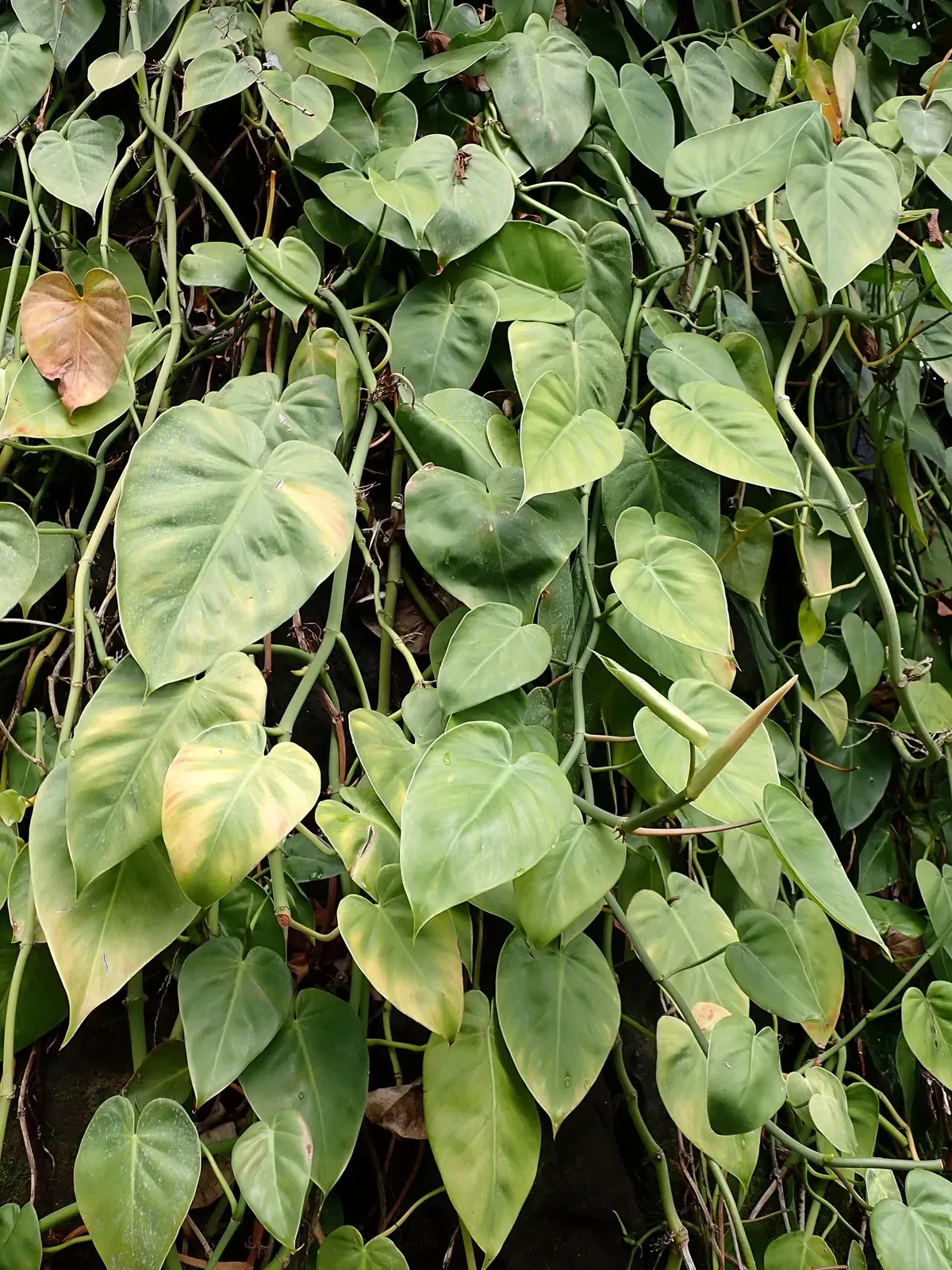
| ☀️ Light | Bright indirect light |
|---|---|
| 💧 Water | Moderate (lightly moist) |
| 🪴 Soil | Airy, well-draining indoor potting mix |
| 🌡️ Temp | 15°C – 29°C |
| 🐾 Safety | Cats: toxic · Dogs: toxic (ASPCA Animal Poison Control) |
| 📏 Mature size | 4.0 m |
Where It Grows & Climate Tolerance
Pet & Companion Animal Toxicity (Heartleaf Philodendron)
The classic heart-leaf trailing vine. Easy, forgiving and happy in lower light than most houseplants, but toxic to pets.
Care instructions
Care Guide & Maintenance Routine
Medium to bright indirect light; tolerates low light but gets leggy. Water when the top 3 to 5 cm of mix is dry, much less often in winter. Keep above 15°C and off cold glass. Feed half strength monthly April to September. Toxic to cats, dogs and horses.
Light & Sunlight
Medium to bright indirect light. Survives long periods in low light (NC State) but grows leggy. East or south window in winter; grow light 12 to 14 h a day, 30 to 60 cm above leaves (UMN Extension). Shade from hot summer sun through glass.
Watering Schedule
Water when the top 3 to 5 cm of mix feels dry, then until it drains; empty the saucer. No fixed schedule: often every few days in summer, two weeks or more in a cool winter room. Slow down in winter (NC State, RHS).
Potting Mix & Drainage
Airy, well-draining indoor potting mix
Temperature & Humidity
RHS gives a 15°C winter minimum for P. hederaceum var. hederaceum. The 29°C upper figure is an editorial comfort guide, not a limit. Keep off frosty windowsills, away from exterior doors and heat registers. Indoors all year in Canada (hardy only in USDA zones 11 to 12, NC State).
Heartleaf philodendron is the plant most Canadians picture when they hear the word philodendron. It is the trailing vine with soft green, heart-shaped leaves that hangs off bookshelves in offices, dorm rooms and grandma's kitchen. It copes with less light than most houseplants, it roots from a single cutting in a glass of water, and it forgives the odd missed watering. It does have limits, though, and a Canadian winter tests every one of them: short days, cold glass and dry furnace air. This page covers what to buy, how to grow it month by month, and how to fix the usual problems.

Heartleaf philodendron at a glance
| What you need to know | Short answer |
|---|---|
| Botanical name | Philodendron hederaceum, arum family (Araceae) |
| Also sold as | Heart philodendron, sweetheart plant, parlour ivy, cordatum; older labels say Philodendron scandens or Philodendron oxycardium |
| Growth habit | Trailing or climbing vine; clings with aerial roots if given support |
| Light | Medium to bright indirect light is best; tolerates low light but gets leggy |
| Water | When the top few centimetres of mix are dry; much less often in winter |
| Warmth | Keep above about 15°C in winter; away from cold glass and doors |
| Difficulty | Beginner |
| Pets | Toxic to cats, dogs and horses (ASPCA) |
| In Canada | Indoors all year; a shaded summer holiday outside is optional |
Identification, naming and varieties
How to recognise it
Look for thin, smooth leaves shaped like a heart, with a long pointed tip and a deep notch where the stalk joins. New leaves can open with a bronze tint and turn green as they harden. Stems are thin and bendy, and each node has a small brown aerial root that grabs onto a pole, a wall or the edge of a pot.
The best tell is how a new leaf appears. NC State Extension notes that heartleaf philodendron has obvious stipules on new growth. These are thin sheaths that wrap the new leaf, then dry to a papery brown strip that falls off. The leaf stalk is round, not grooved. Pothos, its usual look-alike, has a groove running along the top of each leaf stalk and no papery sheath.

Heart philodendron, heartleaf philo and Philodendron scandens: one plant, many names
Garden centres use a lot of names for this plant. "Heart philodendron", "heartleaf philo", "sweetheart plant" and "parlour ivy" all mean the same vine. ASPCA also lists it as "cordatum", an old trade name.
The botanical name accepted by Kew is Philodendron hederaceum. "Hederaceum" means ivy-like, a nod to how it climbs and trails like English ivy. Kew's checklist splits the species into two varieties:
- Philodendron hederaceum var. hederaceum. Old names Philodendron scandens and Philodendron micans are synonyms of this variety. RHS lists it as the ivy-leaved philodendron.
- Philodendron hederaceum var. oxycardium. The old name Philodendron oxycardium belongs here.
So if your plant tag says Philodendron scandens, you have the right plant with an older name. Many growers believe the plain green heartleaf sold in shops is mostly var. oxycardium. That is likely, but we have not found a botanical source that settles it, so treat a shop label as a guide rather than proof.
Varieties you will see in Canadian shops
NC State Extension lists several named forms. All of them need the same care as the green plant, with a little more light for the coloured ones.
- 'Brasil': green leaves with a lime to yellow stripe down the centre. See our Philodendron Brasil profile.
- 'Lemon Lime': bright yellow to chartreuse leaves all over.
- 'Rio': silver and cream centre with dark green edges.
- 'Silver Stripe': cream to light green with a silver stripe.
- 'Cream Splash': light green and cream centre, dark green border.
- 'Gabby': light green and cream leaves that can turn almost fully cream.
The velvet-leaved form sold as micans is the same species too. It has its own page: Philodendron micans (velvet-leaf philodendron).

Buying a heartleaf philodendron in Canada
Heartleaf philodendron is one of the cheapest houseplants on the shelf at hardware stores, grocery stores and garden centres. That makes it easy to buy a tired one. A few checks help:
- Lift the pot. A heavy pot with soggy mix in a cool shop can mean the roots have been sitting wet. Tip it out gently if the shop allows and look for white or tan roots, not brown mush.
- Look at the gaps between leaves. Short gaps mean it was grown in good light. Long bare stretches mean it has been stretching for light and will need a trim.
- Turn leaves over and check the stem joints. Cottony white tufts are mealybugs. Fine webbing and speckled leaves point to spider mites. Brown bumps that scrape off are scale.
- Count the stems. A full pot usually has several rooted cuttings planted together. One long stem in a big pot will look thin for a long time.
Buying between November and March is fine, but protect the plant on the way home. Even a short walk through sub-zero air can damage the leaves. Ask for a paper sleeve or a bag, and warm the car first. When you get home, keep the new plant away from your other plants for two or three weeks and check it for pests before it joins the group.
Light in a Canadian home
NC State Extension says this vine can survive long periods in very low light, and that it prefers medium light. Survive is the key word. In a dim corner it will stay alive, but it grows slowly, the leaves get smaller and the gaps between them get longer.
Here is how window direction usually works out across Canada:
- North window: fine in summer. From November to February it is often too dim, so move the plant to a brighter room or add a grow light.
- East window: a good spot all year. Gentle morning sun does no harm.
- West window: good, but in July the late afternoon sun through glass can scorch leaves. Set it back a little or use a sheer curtain.
- South window: the best winter spot. In summer, keep it a metre or so back from the glass or behind a sheer.
From late October to early March, the sun sits low and days are short, especially in the Prairies and the North. Moving the plant closer to the window for those months helps a lot. Just keep leaves from touching the cold glass.
Using a grow light in winter
A basic LED grow light is the easiest fix for a leggy winter vine. The University of Minnesota Extension suggests 12 to 14 hours of light a day for foliage houseplants, with the light 30 to 60 cm (12 to 24 inches) above the leaves. Put the light on a cheap timer so you do not have to remember it. A plain white "full spectrum" LED works well and looks better in a living room than a purple one.
Soil mix, pots and repotting
Heartleaf philodendron wants a mix that holds some moisture but drains fast and lets air reach the roots. A plain bag of indoor potting mix is a fine start. To make it airier, mix:
- 2 parts good indoor potting mix (peat- or coir-based)
- 1 part perlite
- 1 part small orchid bark
This is our starting recipe, not a lab formula. If your home is very dry in winter and the pot dries out in two or three days, use less bark. If it stays wet for more than a week or two, add more perlite.
Pick a pot with a drainage hole. A decorative pot without a hole is fine as an outer cover, as long as you lift the plant out to water and let it drain. Plastic holds water longer, which suits a bright warm room. Terracotta dries faster, which suits a cool or dim room where the mix stays wet.
Repot in spring, from April to June, when roots circle the bottom or poke out of the hole. Go up only one pot size, about 2 to 5 cm wider. A pot that is too big holds wet mix the roots cannot reach, and that is how root rot starts in winter.
Watering by season
There is no fixed watering day for this plant. A pot by a sunny south window in June can dry out in a few days. The same pot in a cool north room in January may stay damp for two weeks or more. So check the mix, not the calendar.
Push a finger into the mix up to the second knuckle, about 3 to 5 cm. If it feels dry at that depth, water slowly until water runs out of the hole. Empty the saucer after 15 minutes. If it still feels damp, wait and check again in a few days. Lifting the pot also helps: a dry pot feels much lighter.
Spring and summer
Growth speeds up from about April as days get longer. The plant drinks more, especially in warm rooms or on a balcony. Check every few days in hot spells.
Autumn
From September, growth slows. Once the furnace comes on, the top of the mix can feel dry while the bottom is still wet. Check deeper before you water.
Winter
From November to February the plant uses very little water. NC State Extension advises slowing down on watering in winter, and RHS says to water less at low temperatures. Overwatering in winter is the most common way people lose this plant in Canada. If the leaves look a bit limp but the mix is wet, do not water. Check the roots instead.
Use room-temperature water. Ice-cold tap water in January can shock roots. If your tap water is very hard and leaves a white crust on the pot, flush the pot with plenty of water a few times a year, in the sink, and let it drain fully.
Humidity and temperature
NC State Extension says heartleaf philodendron tolerates dry air, though it prefers medium humidity. That is good news in Canada, where heated homes can get very dry in January. You do not need a humidity tent. Still, brown, crispy edges and spider mites both show up more in dry air, so a little help is worth it:
- Group it with other plants.
- Run a room humidifier during the heating season.
- Keep it away from heat registers, baseboard heaters and wood stoves.
Misting wets the leaves for a few minutes and does little for the air. If you like to mist, do it in the morning so leaves dry by night.
For warmth, RHS advises a minimum winter temperature of 15°C for Philodendron hederaceum var. hederaceum. Most Canadian homes sit well above that, but window ledges, sunrooms, entryways and basements can drop lower on cold nights. Cold drafts from a door that opens to the street are worse than a steady cool room. Keep the plant a few steps away from exterior doors in winter.
Fertilizer
Feed only while the plant is actively growing, roughly from April to September. A balanced liquid houseplant fertilizer at half the label strength once a month is plenty. Water the plant first, then feed, so the roots do not get a strong dose on dry mix.
Stop feeding by October. A plant that is barely growing in winter cannot use the food, and the salts build up in the mix, which can burn root tips and cause brown leaf edges. If you keep it under a grow light and it keeps putting out new leaves all winter, a light feed every second month is fine.
Pale leaves are not always hunger. In winter, they are more often a sign of low light or wet roots. Fix those first.
Pruning and training
This vine responds well to a trim. RHS says no routine pruning is needed, but most indoor plants look better with one. Pinching off a stem tip makes most vines branch. The US plant patent for 'Brasil', a form of this same species, notes that pinching enhances branching.
- Cut just above a node, the bump where a leaf meets the stem. A new shoot usually grows from that node.
- Trim long, bare stems in spring. You can root every piece you cut off.
- Remove yellow leaves at the base of the stalk with clean scissors.
- Wear gloves. The sap can irritate skin (NC State Extension, RHS).
Want it to climb? Give it a moss pole, a slab of wood or a trellis, and tie stems loosely with soft plant ties until the aerial roots grab on. Climbing stems often grow bigger leaves than hanging ones.

Propagation
Heartleaf philodendron is one of the easiest plants to propagate. RHS lists stem-tip and leaf-bud cuttings, and layering. Spring and summer give the fastest results in Canada, because the light is better. Winter cuttings work too, but they are slower.
Cuttings in water
- Cut a stem piece with two to four leaves and at least one node, ideally one with a small aerial root.
- Remove the leaf closest to the cut end, so the node sits in water without a leaf rotting below the surface.
- Stand it in a glass of room-temperature water in bright indirect light.
- Change the water every few days. Roots usually appear within a few weeks.
- Pot it up when the roots are a few centimetres long. Keep the new pot a little moister than normal for the first couple of weeks.
Cuttings straight into mix, and layering
You can also push the node of a cutting straight into damp mix. For an even easier method, lay a long stem across the top of a second pot of mix and pin the node down with a bent paper clip. Once it roots, cut it free. Several cuttings planted in one pot make a fuller plant much faster than one.
Our upcoming philodendron propagation guide covers more methods step by step.
Why is my heartleaf philodendron losing colour?
The plain green plant has no variegation to lose, but it can lose its rich green. Here is what pale, yellow or faded leaves usually mean:
- Pale, small leaves on long bare stems: not enough light. This is the most common winter problem. Move it closer to a window or add a grow light.
- Bleached or washed-out patches on the sunny side: too much direct sun through glass, usually in summer. Move it back from the window.
- One or two old yellow leaves near the base: normal ageing. Remove them.
- Many yellow leaves at once with wet mix: overwatering or root rot. See the troubleshooter below.
- Light green leaves all over in spring and summer, with dry mix and no feeding for a year: it may need fertilizer.
If you grow a variegated form like 'Brasil', and new stems come out plain green, that is reversion. RHS advises cutting reverted shoots back to a part with variegated leaves. The Brasil page explains how.
Problem troubleshooter
| What you see | Likely cause | What to do first |
|---|---|---|
| Long gaps between small leaves | Low light, often in winter | Move closer to a bright window or add a grow light. Trim and root the leggy tips in spring. |
| Several yellow leaves, mix still wet | Too much water, poor drainage or a pot that is too big | Let the mix dry more. Check the hole is clear. If the mix smells sour, check roots. |
| Limp leaves, mix wet, mushy brown roots | Root rot | Cut off rotten roots, repot in fresh mix in a clean smaller pot, and root healthy stem tips as a backup. |
| Limp, curling leaves, mix bone dry | Thirst | Water slowly until it drains. If the mix has shrunk from the pot edge, soak the pot in a sink for 20 minutes. |
| Brown, crispy leaf edges | Dry air, heat register, salt build-up from fertilizer | Move from heat, raise humidity, stop feeding in winter and flush the pot. |
| Black or dark brown patches after a cold night | Cold damage from glass or a draft | Move away from the window or door. Cut off badly damaged leaves. |
| Fine webbing, tiny speckles on leaves | Spider mites, common in dry winter air | Rinse the plant in the shower. Repeat weekly and use an insecticidal soap labelled for houseplants if needed. |
| White cottony tufts in leaf joints | Mealybugs | Isolate the plant. Dab tufts with a cotton swab dipped in rubbing alcohol and treat with a houseplant-labelled product. |
| Brown bumps on stems and leaf undersides | Scale insects | Scrape off by hand, then follow up with a labelled product. |
| Soft brown spots with yellow rings | Leaf spot, often from wet leaves | Water the mix, not the leaves. Remove spotted leaves. |
NC State Extension lists aphids, spider mites, mealybugs and scale as the pests to watch, plus leaf spots and root rot in wet soil. When you use any pest product, choose one labelled for indoor plants in Canada and follow the label exactly. You can also check symptoms on our plant problems page.
Month-by-month care calendar for Canada
Dates shift by region. Spring arrives earlier in Vancouver and Victoria than in Winnipeg or Edmonton. Watch your plant and your thermostat as much as the calendar.
| Month | What to do |
|---|---|
| January | Lowest light of the year. Keep near the brightest window, off cold glass. Water rarely. No feeding. Check leaf undersides for spider mites. |
| February | Days lengthen. Keep the grow light on its timer. Wipe dust off leaves so they catch more light. |
| March | New leaves may appear. Water a little more as the mix dries faster. Plan any repotting. |
| April | Start feeding at half strength. Repot if roots fill the pot. Trim leggy winter stems and root the cuttings. |
| May | Strong growth. Turn the pot a quarter turn every week or two for even growth. |
| June | If you move it outside, wait until nights stay above about 15°C. Choose full shade, never direct sun. |
| July | Check moisture more often in hot weather. Pull back from west or south glass if leaves look bleached. |
| August | Last good month for cuttings and repotting. Feed monthly. |
| September | Bring outdoor plants inside before nights drop near 15°C. Rinse and check for pests first. Feed one last time. |
| October | Stop feeding. Furnace season starts; check the mix deeper before watering. Move closer to the light. |
| November | Water much less. Add a grow light if growth stalls. Keep away from heat registers. |
| December | Watch drafts near doors during holiday visits. Keep it off cold windowsills on the coldest nights. |
Safety for pets, children and skin
Heartleaf philodendron is not pet safe. ASPCA lists Philodendron hederaceum as toxic to dogs, cats and horses. The plant contains insoluble calcium oxalate crystals. Chewing a leaf can cause mouth pain and swelling, heavy drooling, vomiting and trouble swallowing. NC State Extension also lists it as a problem for children and notes it can cause contact dermatitis. RHS lists the plant as harmful if eaten and a skin and eye irritant.
- Hang it high or put it on a shelf that cats cannot reach. Trailing stems are very tempting to cats.
- Pick up dropped leaves.
- Wear gloves when pruning and wash your hands after. Keep sap away from your eyes.
- If a pet chews it, call your vet. The ASPCA Animal Poison Control line is (888) 426-4435 (a fee may apply). If a child eats part of the plant, call your provincial poison centre.
Looking for something safer? See our list of pet-safe plants for Canadian homes.
Common mistakes
- Watering on a fixed day all winter. The mix stays wet for much longer in January.
- Leaving it in a north window from November to February and wondering why it looks stringy.
- Using a huge pot "so it has room to grow". Extra wet mix leads to root rot.
- Letting leaves press against frosty glass.
- Feeding all year round.
- Putting it outside in May before nights warm up, or in direct sun.
- Trimming without gloves and then touching your eyes.
- Treating pests with an unlabelled home remedy. Use a product labelled for houseplants.
Watch: vining philodendron care
This video covers the heartleaf group, including Brasil, Lemon Lime and micans. The presenter waters on a rough weekly rhythm in summer; in a Canadian winter, follow the finger test above instead.
Related plants and guides
- Philodendron types and care for Canadian homes, our main philodendron guide
- Philodendron Brasil, the striped form of this vine
- Philodendron micans, the velvet-leaf form
- Pink Princess philodendron
- Philodendron Birkin
- Hoya carnosa, another easy trailing plant
- Heartleaf vs Brasil vs micans
- Philodendron vs pothos
- Philodendron winter care in Canada
Sources
- NC State Extension Plant Toolbox: Philodendron hederaceum (identification, light, pests, cultivars, toxicity). Accessed 10 Nov 2026.
- RHS: Philodendron hederaceum var. hederaceum (synonyms, 15°C winter minimum, propagation, harm). Accessed 10 Nov 2026.
- Kew Plants of the World Online: P. hederaceum var. hederaceum and var. oxycardium. Accessed 10 Nov 2026.
- ASPCA: Heartleaf Philodendron (toxic to dogs, cats and horses). Accessed 10 Nov 2026.
- University of Minnesota Extension: Lighting for indoor plants (12 to 14 hours, 30 to 60 cm). Accessed 10 Nov 2026.
- RHS: Reversion (cutting out green shoots on variegated plants). Accessed 10 Nov 2026.
- US Plant Patent PP12,956 ('Brasil') (pinching enhances branching). Accessed 10 Nov 2026.
Seasonal rhythm
Seasonal Calendar
A month-by-month calendar for Heartleaf Philodendron in Canada is coming soon. See the light, water and temperature notes above.
Diagnostics
Common Problems & Troubleshooting
Long gaps between small leaves: low light, add light and trim. Yellow leaves with wet mix: overwatering, let it dry and check drainage. Brown crispy edges: dry air, heat or fertilizer salts. Webbing: spider mites, rinse and treat.
Pests & seasonal watch: Watch for aphids, spider mites, mealybugs and scale; leaf spot and root rot in wet soil (NC State). Rinse plants, isolate, and use products labelled for indoor plants in Canada, following the label.
- Leggy — Long weak stems with big gaps between small leaves, leaning to the window.
- Fading variegation — Variegated leaves come in greener, or whole shoots turn fully green.
Care encyclopedia · 8 guides
Guides & Articles for Heartleaf Philodendron
Philodendron Plants: Types, Care and Varieties for Canadian Homes
Which philodendron suits your Canadian home? Compare vining, variegated and self-heading types, pink philodendrons, winter care basics and pet safety, with links to every profile.
Read guide →Philodendron vs Pothos: How to Tell Them Apart
Heartleaf philodendron and pothos look alike. Check leaf shape, leaf stalks, new leaves and aerial roots to tell them apart, then see how their care differs.
Read guide →Heartleaf vs Brasil vs Micans: How to Tell These Philodendrons Apart
Heartleaf, Brasil and micans are all forms of one species. Here is how to tell them apart by leaf colour and texture, and what that means for care in a Canadian home.
Read guide →How to Propagate Philodendron: Cuttings, Division and Air Layering
Step-by-step philodendron propagation for Canadian homes: where to cut, rooting in water or mix, division for bushy types, air layering and timing.
Read guide →Philodendron Winter Care in Canada: Light, Water and Heat
How to keep philodendrons healthy through a Canadian winter: light, grow lamps, watering less, humidity, cold windows, heat registers and pests.
Read guide →Pothos Yellow Leaves in Winter: Water, Light or Cold Window?
A yellow pothos leaf in winter is usually about water, light or cold. These checks show which one, and what to change before more leaves go.
Read guide →Top 10 "Air-Purifying" Plants for Canadian Apartments: What They Can and Can't Do
The famous 1989 NASA plant study doesn't translate to real homes: a 2019 review found you'd need 10 to 1,000 plants per square metre to match normal ventilation. Here is what plants can do, what really cleans apartment air, and 10 easy NASA-list plants.
Read guide →15 Low-Light Houseplants for Dim Canadian Winters
A cast-iron plant, a Chinese evergreen or a parlor palm is a realistic start in a dim Canadian winter room. Here are 15 plants with live Canada profiles, plus an honest note on a few that only pretend to like the dark.
Read guide →Q&A
Frequently Asked Questions
Is Philodendron scandens the same as heartleaf philodendron?
Yes. Philodendron scandens is an older name. Kew's checklist and RHS treat it as a synonym of Philodendron hederaceum var. hederaceum, the heartleaf philodendron. Labels may also say Philodendron oxycardium, which belongs to the other variety, var. oxycardium. All of these are sold as heartleaf philodendron and need the same care.
Is heart philodendron the same plant as heartleaf philodendron?
Yes. Heart philodendron, heartleaf philo, sweetheart plant, parlour ivy and cordatum are all common names for Philodendron hederaceum. Garden centres use different names, but the plant and its care are the same. Coloured forms such as 'Brasil' and 'Lemon Lime' are cultivars of this same species.
Why is my heartleaf philodendron leggy in winter?
Low light is the usual cause. From November to February, Canadian days are short and the sun is low, so the vine stretches and grows small leaves with long gaps. Move it to a brighter south or east window, or add a grow light for 12 to 14 hours a day, then trim and root the long stems in spring.
How often should I water heartleaf philodendron in Canada?
There is no fixed schedule. Water when the top 3 to 5 cm of mix feel dry, then water until it drains and empty the saucer. In summer that can be every few days. In a cool, dim room in winter it may be two weeks or more. Checking the mix prevents winter root rot.
Is heartleaf philodendron toxic to cats and dogs?
Yes. ASPCA lists Philodendron hederaceum as toxic to dogs, cats and horses. It contains insoluble calcium oxalate crystals that cause mouth pain, drooling, vomiting and trouble swallowing if chewed. Keep it out of reach, and call your vet or the ASPCA Animal Poison Control line if a pet eats some.
How do I tell heartleaf philodendron from pothos?
Look at new growth and leaf stalks. NC State Extension notes heartleaf philodendron has thin sheaths, called stipules, around new leaves that dry to brown papery strips, and its leaf stalks are round. Pothos has a groove along the top of each leaf stalk, no papery sheath, and usually thicker, waxier leaves.
Can heartleaf philodendron grow in low light?
Yes, it survives low light better than most houseplants, as NC State Extension notes. It will not thrive there, though. Growth slows, leaves shrink and stems get leggy. For a healthy, full plant, give it medium to bright indirect light, especially in a Canadian winter, or use a grow light.
Can I put my heartleaf philodendron outside in a Canadian summer?
Yes, if you wait until nights stay above about 15°C, which RHS gives as the winter minimum for this plant. Choose full shade, because direct sun burns indoor leaves. Bring it in early in September, rinse it and check for pests before it goes back near your other plants.
Why are my heartleaf philodendron leaves turning yellow?
One or two old yellow leaves near the base are normal. Many yellow leaves at once, with wet mix, usually mean too much water or poor drainage, especially in winter. Let the mix dry more, check the drainage hole and look for mushy roots. Pale leaves on long stems point to low light.
How do I propagate heartleaf philodendron?
Cut a stem piece with two to four leaves and at least one node. Remove the lowest leaf and stand the stem in water or push it into damp mix, in bright indirect light. RHS lists stem-tip cuttings and layering. Roots usually show within a few weeks in spring or summer; winter cuttings are slower.
Should I fertilize heartleaf philodendron in winter?
No, not in most Canadian homes. Feed a balanced liquid fertilizer at half strength once a month from about April to September, then stop in October. A slow-growing winter plant cannot use the food, and salt build-up can brown leaf edges. Under a grow light with steady new growth, a light feed is fine.
What temperature does heartleaf philodendron need?
RHS advises a minimum winter temperature of 15°C. Normal room temperature suits it well. In Canada, the risks are cold windowsills on January nights, drafty entry doors and unheated sunrooms. Keep leaves off frosty glass and away from heat registers, which blow hot, dry air.
Similar Botanical Matches
Grower field notes
Reader Field Notes in Canada
Share how this plant performs in your local Canada climate.