
| ☀️ Light | Bright indirect light |
|---|---|
| 💧 Water | Moderate (lightly moist) |
| 🪴 Soil | Loam-based or well-draining indoor potting mix |
| 🌡️ Temp | 15°C – 29°C |
| 🐾 Safety | Cats: toxic · Dogs: toxic |
| 📏 Mature size | 2.5 m |
Where It Grows & Climate Tolerance
Pet & Companion Animal Toxicity (Philodendron Brasil)
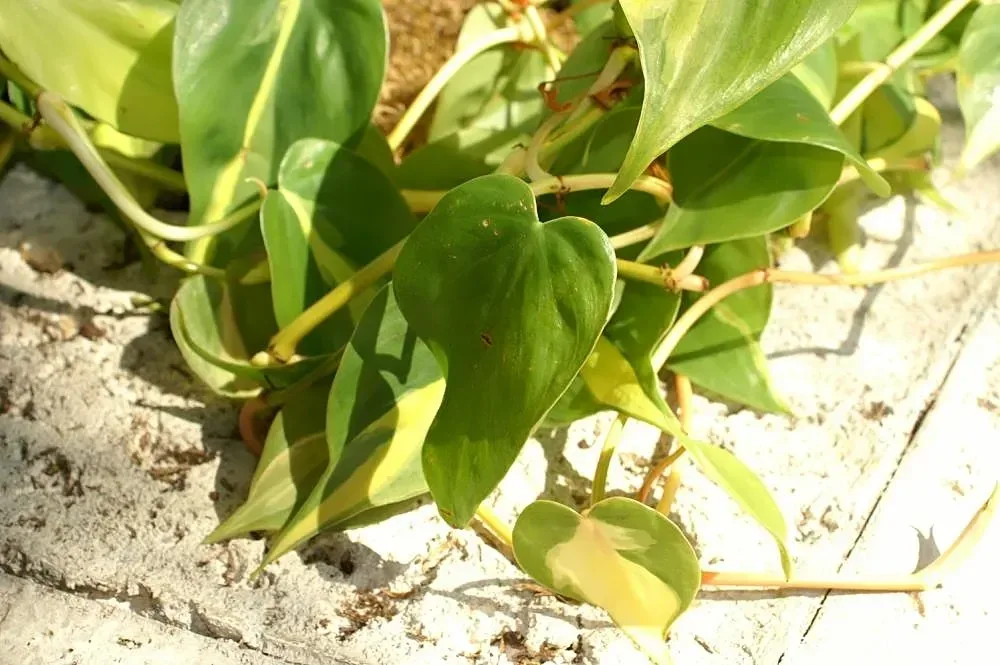
A heartleaf philodendron with a lime-yellow stripe through each leaf. Just as easy as the green plant; cut out any stem that turns plain green.
Care instructions
Care Guide & Maintenance Routine
Bright filtered light, shaded from hot sun. Water when the top few centimetres of mix are dry, sparingly in winter. Keep above 15°C. Feed monthly April to September. Prune reverted green stems. Not pet safe.
Light & Sunlight
Bright filtered light with shade from hot sun (RHS). East window all year, south window in winter. The 'Brasil' patent notes low light enhanced variegation in trials, but very dim winter light gives leggy growth; use a grow light 12 to 14 h, 30 to 60 cm above (UMN Extension).
Watering Schedule
Water moderately in growth and sparingly at other times (RHS). Check the mix: water when the top few centimetres are dry, then let it drain. Hanging baskets dry faster. No fixed schedule.
Potting Mix & Drainage
Loam-based or well-draining indoor potting mix
Temperature & Humidity
RHS rates 'Brasil' H1A (keep above 15°C). Upper figure is an editorial comfort guide. Off cold windowsills in winter; outdoors only in shade once nights stay above about 15°C.
Philodendron Brasil is the heartleaf vine with a splash of lime and yellow through the middle of each leaf. Think of a plain green heartleaf philodendron that someone painted a bright stripe on, and you have it. It grows just as easily as the green plant, trails beautifully from a shelf or hanging basket, and brightens a grey Canadian winter. You may also see it sold as Brazilian philodendron, philo Brasil or Philodendron scandens 'Brasil'. They are all the same plant. This page explains how to tell it apart from look-alikes, how to keep its stripe, and how to care for it through every Canadian season.

Philodendron Brasil at a glance
| What you need to know | Short answer |
|---|---|
| Name | Philodendron hederaceum 'Brasil'; arum family (Araceae) |
| Also sold as | Brazilian philodendron, philo Brasil, Philodendron scandens 'Brasil' |
| What it is | A natural sport (mutation) of the heartleaf philodendron, found in Brazil in 1991 |
| Habit | Trailing or climbing vine, ideal for shelves and hanging baskets |
| Light | Bright, filtered light with shade from hot sun (RHS) |
| Water | Moderately in growth, sparingly in winter (RHS); check the mix first |
| Warmth | Keep above 15°C (RHS H1A) |
| Difficulty | Beginner |
| Pets | Not pet safe (RHS; ASPCA lists the species as toxic) |
Identification, naming and varieties
How to recognise a Brasil
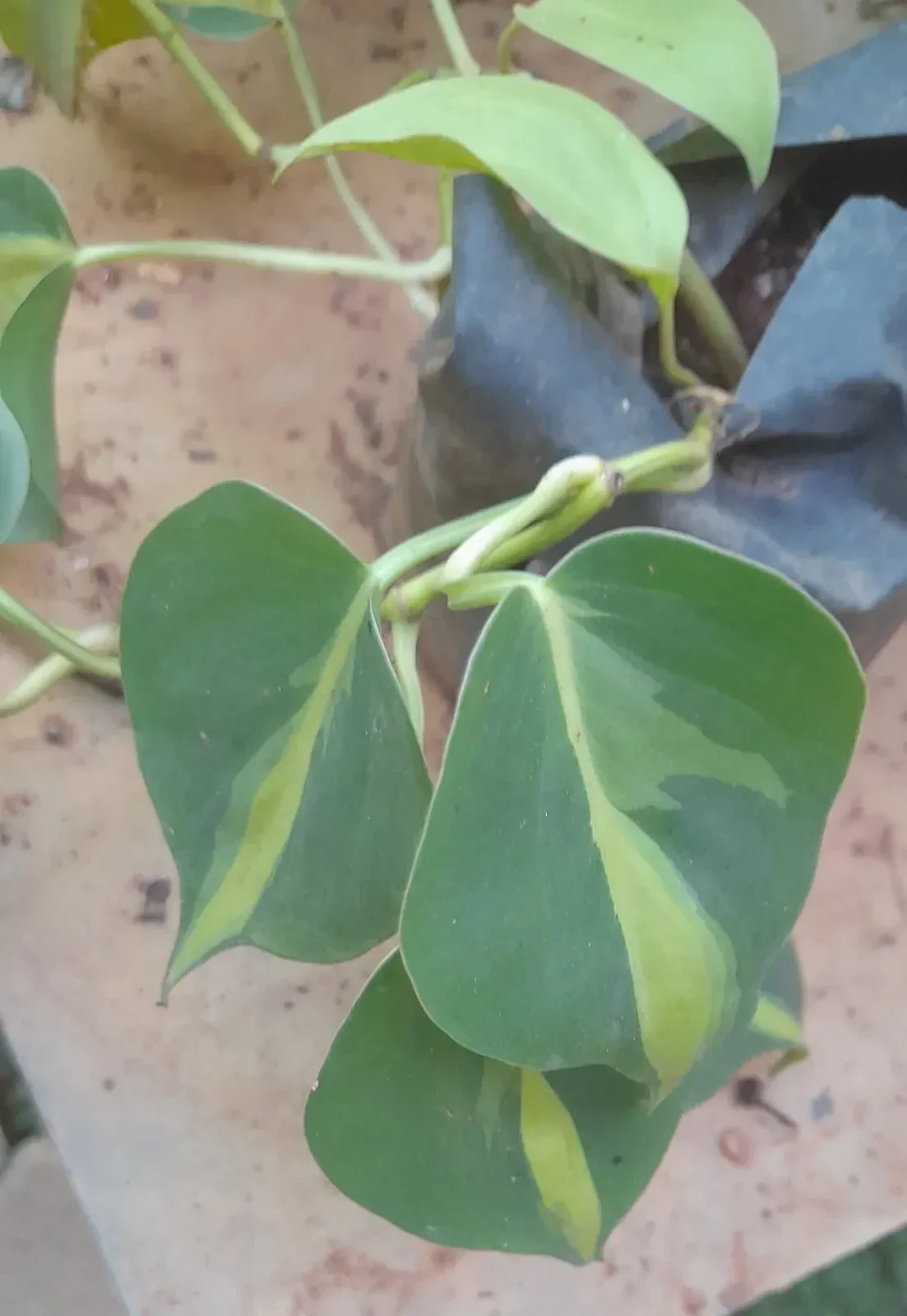
The leaf shape is the same as plain heartleaf philodendron: a heart-shaped base and a long, pointed tip. NC State Extension describes 'Brasil' as having a variegated centre stripe of yellow to light green, with dark green borders. The stripe is irregular. On one leaf it might be a thin line along the midrib, on the next a wide band that covers half the leaf.
The US plant patent for 'Brasil' adds some useful details. Young stems and leaf stalks start reddish pink, turn reddish orange, and then become light green as they age. Leaves are smooth, waxy and somewhat glossy, with an elongated tip.
Brazilian philodendron or Brasil: what the name means
The cultivar name is 'Brasil', with an s. It refers to where it was found, and many people say the green and yellow leaves remind them of the Brazilian flag. Here is the short history from the records:
- The plant was found as a single plant within a crop in Holambra, Brazil, in 1991. It was a whole-plant mutation of an unnamed selection of what the patent calls Philodendron scandens oxycardium.
- It was patented in the United States as plant patent PP12,956.
- The International Aroid Society registry lists 'Brasil' as accepted and established, a sport, with Ruben Ernesto Acosta as the originator.
- RHS lists it as Philodendron hederaceum 'Brasil', with the synonym Philodendron scandens 'Brasil'. RHS marks the name status as unresolved, which mainly reflects the tangled species naming.
The species today is Philodendron hederaceum. The old name in the patent, P. scandens oxycardium, maps to Philodendron hederaceum var. oxycardium in Kew's checklist. So "philo Brasil" is not a separate species. It is a striped form of the heartleaf philodendron.
Brasil vs look-alikes
Several vines with heart-shaped leaves and light markings are sold side by side. Here is how to tell them apart:
- 'Lemon Lime' philodendron: the whole leaf is bright yellow to chartreuse (NC State). No dark green edge.
- 'Rio' philodendron: silver and cream in the centre with dark green edges (NC State). Cooler, whiter colours than Brasil.
- 'Silver Stripe' and 'Cream Splash' philodendron: cream to light green centres, sometimes with silver (NC State).
- Pothos 'Neon': solid neon yellow-green leaves, a bit thicker. Pothos leaf stalks have a groove along the top; heartleaf philodendron stalks are round (NC State).
- Pothos 'Marble Queen': white to cream speckles and streaks over the whole leaf, not a central band.
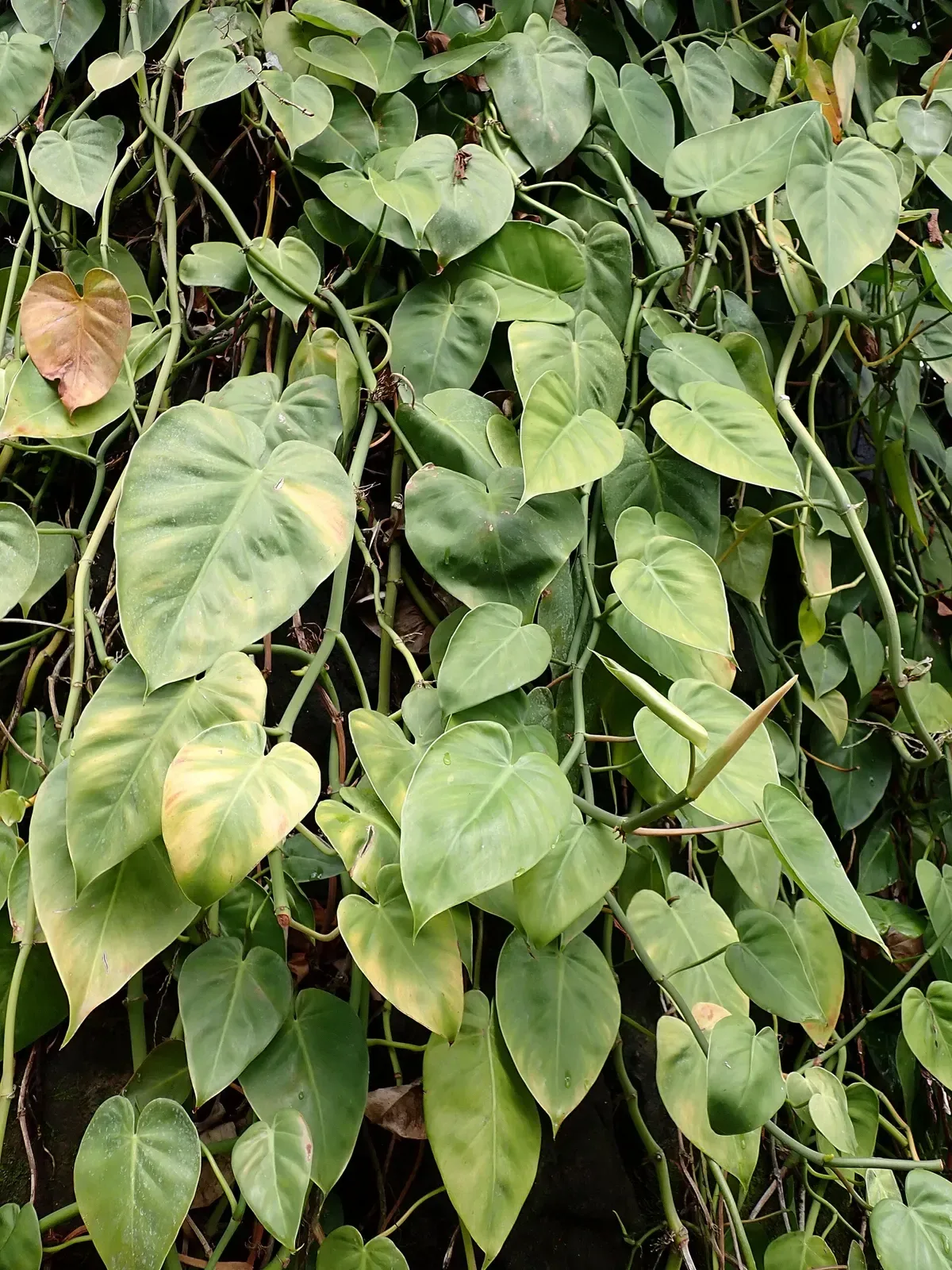
- Plain heartleaf philodendron: all green, no stripe.
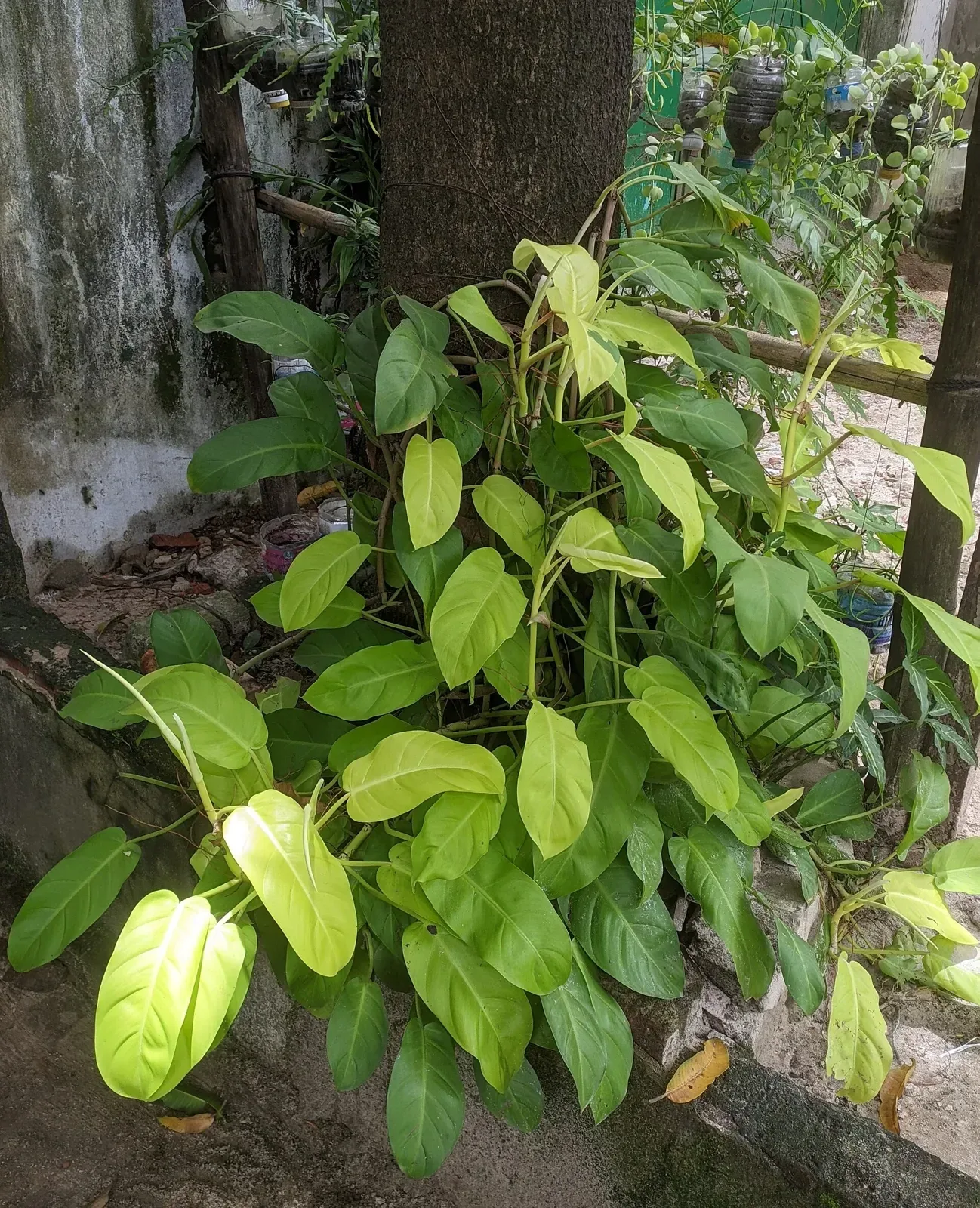
Not sure if your vine is a philodendron or a pothos? Check how a new leaf comes out. NC State Extension notes that heartleaf philodendron has obvious stipules on new growth, thin sheaths that dry to brown papery strips. Pothos does not. A full comparison guide is planned: Philodendron vs pothos.
Buying a Philodendron Brasil in Canada
Brasil is easy to find at garden centres, big-box stores and plant shops, often in hanging baskets. It is usually affordable. Look for:
- A stripe on most of the newest leaves. If the newest growth is plain green on several stems, the plant may have started reverting, or it may be a mislabelled plain heartleaf.
- Short gaps between leaves and no long bare stems.
- Firm, pale roots and mix that is not soggy.
- No pests in the leaf joints or under leaves.
In winter, wrap it well for the trip home. Even a short walk through sub-zero air can damage the leaves. Keep a new plant apart from your others for two or three weeks and check for pests.
Light in a Canadian home
RHS advises bright filtered light with shade from hot sun for 'Brasil'. That means a spot near a window, but not baking in direct summer sun through the glass.
- East window: good all year.
- South window: excellent from October to March. In summer, set it back or use a sheer curtain.
- West window: good with a sheer curtain in summer.
- North window: fine in summer; often too dim from November to February.
Does more light mean more stripe?
This one surprises people. The Brasil patent says that low light conditions enhanced variegation development in the breeder's growing trials. At the same time, University of Minnesota Extension notes that variegated houseplants in general may revert to solid green in poor light, and dim light makes any vine leggy.
So do not push a Brasil into hot sun to get more yellow. Bright indirect light is the goal. If your plant is in a reasonable spot and one stem starts growing plain green leaves, that is most likely reversion, which you fix by pruning (see below), not by moving the plant into stronger sun.
Grow lights in winter
In a dim Canadian winter, a grow light keeps Brasil compact and growing. University of Minnesota Extension suggests 12 to 14 hours a day for foliage plants, with the light 30 to 60 cm above the leaves. A shelf with an LED strip above it and a hanging Brasil below is a simple, good-looking setup.
Soil mix, pots and repotting
RHS suggests a peat-free, loam-based potting compost. A good indoor potting mix with extra drainage works well in Canadian homes:
- 2 parts indoor potting mix
- 1 part perlite
- 1 part small orchid bark (optional, for more air)
This is a starting point. Use less bark if the pot dries too fast in a very dry house, and more perlite if it stays wet for long.
Use a pot with a drainage hole. Hanging baskets dry faster than shelf pots, because warm air collects near the ceiling. Repot in spring, April to June, into a pot only 2 to 5 cm wider. Brasil has a fairly small root system for its long vines, so it rarely needs a big pot.
Watering by season
RHS says to water moderately while Brasil is growing and sparingly at other times. In practice: water when the top few centimetres of mix are dry, then water until it drains. Empty the saucer or the drip tray of the basket. There is no fixed day.
Spring and summer
The plant grows fast and drinks more. Hanging baskets near a warm ceiling may need checking every few days.
Autumn
Growth slows. Once the furnace starts, the top dries quickly while the middle stays damp. Check deeper.
Winter
Water much less. A plant in a cool, dim room may go two weeks or more between waterings. If leaves droop and the mix is wet, do not add water: check the roots. Use room-temperature water.
Humidity and temperature
Like the green heartleaf, Brasil handles normal home humidity. NC State Extension says the species tolerates dry air but prefers medium humidity. In a very dry January house, crispy edges and spider mites are the warning signs. Group plants, run a humidifier and keep it away from heat registers. RHS suggests misting. It helps only briefly, so use it as an extra, not as the main fix.
RHS rates 'Brasil' H1A, which means it should stay above 15°C. Keep it off cold windowsills on winter nights and away from drafty doors. If you summer it outdoors, wait until nights stay above about 15°C, keep it in full shade, and bring it in early in September.
Fertilizer
RHS advises a balanced liquid fertilizer monthly while the plant is growing. In Canada, that is about April to September. Half strength is plenty for a vine in a small pot. Water first, then feed.
Stop in October. Feeding a slow winter plant builds salts in the mix and can brown leaf edges. Fertilizer will not bring back a stripe on a reverted stem.
Pruning
RHS says no pruning is needed beyond trimming length. Brasil does look fuller with regular trims, and the patent notes that pinching enhances branching, with potential branching at every node.
- Cut just above a node with clean scissors.
- Trim long stems in spring and summer. Root the pieces and plant them back in the same pot for a fuller look.
- Remove any all-green stem as soon as you notice it (see the next section).
- Wear gloves. RHS lists the sap as a skin and eye irritant.
Propagation
Brasil roots as easily as plain heartleaf. Because it is a sport, the only way to keep its stripe is to grow it from cuttings. RHS notes that very few variegated plants come true from seed.
- Pick a stem with good stripes on its leaves.
- Cut a piece with two to four leaves and at least one node.
- Remove the lowest leaf so the node can sit in water or mix.
- Root in water or straight into damp mix, in bright indirect light.
- Pot up once roots are a few centimetres long.
Roots usually show within a few weeks in spring and summer, slower in winter. You can also pin a long stem onto a second pot of mix until it roots, then cut it free. Step-by-step photos will be in our philodendron propagation guide.
Why is my Brasil losing its yellow stripe?
Three things usually explain a fading stripe.
1. Reversion
Brasil began as a mutation, and RHS explains that such mutations are not always stable. A stem may start producing all-green leaves. Those green shoots grow more strongly and can take over. RHS advises pruning reverted shoots out completely, or cutting back to a part with variegated leaves.
So, follow the stem back from the tip to the last leaf with a good stripe, and cut just above that leaf. The next shoot from that node has a much better chance of being striped.
2. Very low light
In a dark winter corner, growth gets thin, leaves get small and colour can look washed out. Even though the patent noted better variegation in low light, very dim light is a different thing. Give it bright, indirect light and a grow light in winter.
3. Normal variation and age
Every leaf has a different amount of yellow. Older leaves can also darken a little as they age. Judge the plant by its newest few leaves, not a single one.
A full guide to fading variegation across all philodendrons is planned: Why is my variegated philodendron losing colour?.
Problem troubleshooter
| What you see | Likely cause | What to do first |
|---|---|---|
| One stem growing plain green leaves | Reversion | Cut back to the last striped leaf. |
| Long bare stems, tiny leaves | Low light, often in winter | More light or a grow light; trim and root the tips. |
| Yellow leaves, wet mix | Overwatering | Let the mix dry more; check drainage. |
| Soft, dark stems at soil level | Root or stem rot | Take healthy cuttings, then repot what is left into fresh mix. |
| Brown, papery patches on the yellow stripe | Hot sun through glass | Move back from the window or add a sheer curtain. |
| Brown crispy edges | Dry air, heat register, too much fertilizer | Move from heat, raise humidity, flush the pot, stop winter feeding. |
| Fine webbing, speckles | Spider mites | Shower the plant weekly; use a houseplant-labelled insecticidal soap if needed. |
| White fluff in leaf joints | Mealybugs | Isolate; cotton swab with rubbing alcohol, then a labelled product. |
| Brown bumps on stems | Scale | Scrape off, then treat with a labelled product. |
NC State Extension lists aphids, spider mites, mealybugs and scale for this species, and RHS names scale and red spider mite for 'Brasil'. Use products labelled for indoor plants in Canada and follow the label. You can also check our plant problems page.
Month-by-month care calendar for Canada
| Month | What to do |
|---|---|
| January | Brightest window or grow light. Water rarely. No feeding. Check for mites. |
| February | Dust leaves. Keep off cold glass. Look for green shoots and mark them for spring pruning. |
| March | New growth starts. Water a little more often as the mix dries faster. |
| April | Start half-strength feeding. Repot if roots fill the pot. Cut out green stems. |
| May | Trim and root long stems. Plant cuttings back in the pot to fill it. |
| June | Pull back from hot south or west glass. If going outside, wait for nights above about 15°C, full shade only. |
| July | Check hanging baskets often in heat. Watch the stripe for sunburn. |
| August | Last month for easy cuttings and repotting. |
| September | Bring outdoor plants in early; rinse and check for pests. Last feed. |
| October | Stop feeding. Heat goes on; check mix deeper. Move closer to light. |
| November | Water less. Set the grow light timer to 12 to 14 hours. |
| December | Keep away from drafty doors and heat registers. |
Safety for pets, children and skin
Philodendron Brasil is not pet safe. RHS lists 'Brasil' as harmful if eaten and a skin and eye irritant, for people and pets. ASPCA lists the species, Philodendron hederaceum (heartleaf philodendron), as toxic to dogs, cats and horses because it contains insoluble calcium oxalates. Signs include mouth pain and swelling, drooling, vomiting and trouble swallowing. NC State Extension notes the species can cause contact dermatitis.
- Hang it out of reach. Dangling stems are a magnet for cats.
- Wear gloves when you prune and wash your hands after.
- If a pet chews it, call your vet. The ASPCA Animal Poison Control line is (888) 426-4435 (a fee may apply). For a child, call your provincial poison centre.
See our pet-safe plants list for safer options.
Common mistakes
- Leaving reverted green stems on the plant.
- Putting it in strong direct sun to boost the stripe. The yellow burns.
- Watering a hanging basket on the same schedule in January as in July.
- Using a pot that is far too large.
- Feeding through winter.
- Hanging it right above a heat register.
- Calling it a pothos and following pothos advice. Care is similar, but ID matters for pest and safety lookups.
Watch: Philodendron Brasil care
A practical care walkthrough. Use the watering advice as a guide only. In a Canadian winter, check the mix before you water.
Related plants and guides
- Philodendron types and care for Canadian homes, our main philodendron guide
- Heartleaf philodendron, the plain green form
- Philodendron micans, the velvet-leaf form
- Pink Princess philodendron
- Tradescantia zebrina, another colourful trailing plant
- Heartleaf vs Brasil vs micans
Sources
- International Aroid Society cultivar registry: Philodendron 'Brasil'. Accessed 10 Nov 2026.
- US Plant Patent PP12,956: Philodendron plant named 'Brasil'. Accessed 10 Nov 2026.
- RHS: Philodendron hederaceum 'Brasil' (v). Accessed 10 Nov 2026.
- NC State Extension Plant Toolbox: Philodendron hederaceum (cultivars, ID, pests, toxicity). Accessed 10 Nov 2026.
- Kew Plants of the World Online: P. hederaceum var. oxycardium. Accessed 10 Nov 2026.
- ASPCA: Heartleaf Philodendron. Accessed 10 Nov 2026.
- RHS: Reversion. Accessed 10 Nov 2026.
- University of Minnesota Extension: Lighting for indoor plants. Accessed 10 Nov 2026.
Seasonal rhythm
Seasonal Calendar
A month-by-month calendar for Philodendron Brasil in Canada is coming soon. See the light, water and temperature notes above.
Diagnostics
Common Problems & Troubleshooting
Plain green stem: reversion, prune back. Leggy small leaves: low light. Yellow leaves with wet mix: overwatering. Brown papery patches on the stripe: hot sun through glass.
Pests & seasonal watch: Aphids, spider mites, mealybugs and scale (NC State); scale and red spider mite (RHS). Root rot in wet mix. Use products labelled for indoor plants in Canada.
Q&A
Frequently Asked Questions
Is Philodendron Brasil the same as heartleaf philodendron?
Yes, it is the same species. 'Brasil' is a cultivar of Philodendron hederaceum, found as a natural mutation of the green heartleaf in Brazil in 1991. The difference is the lime to yellow stripe through each leaf. Care is almost the same, except you should cut out any stem that turns plain green.
Is philo Brasil the same as Brazilian philodendron?
Yes. Philo Brasil, Brazilian philodendron, Philodendron Brasil and Philodendron scandens 'Brasil' are all names for the same plant. The correct cultivar spelling is 'Brasil' with an s, as used in its US plant patent and the International Aroid Society registry. The accepted species name is Philodendron hederaceum.
Why is my Brasil losing its yellow stripe?
Most often, one stem is reverting to plain green. RHS says reverted shoots grow strongly and can take over, so prune them back to a variegated leaf. Very dim winter light can also give thin, washed-out growth, so give bright indirect light. Some leaves simply carry less yellow than others; judge the newest few leaves.
Can Philodendron Brasil revert to plain green?
Yes. Brasil began as a mutation, and RHS explains such mutations are not always stable. A stem can start making all-green leaves. Cut it back to just above the last striped leaf, or remove it completely. The new shoot from that node usually has a better chance of coming in striped.
How do I tell Brazilian philodendron from pothos 'Neon' or 'Marble Queen'?
Look at the colour pattern and leaf stalks. Brasil has a lime-yellow band in the centre with dark green edges. 'Neon' pothos is solid yellow-green, and 'Marble Queen' has white speckles all over. NC State Extension notes philodendron leaf stalks are round, while pothos stalks have a groove along the top.
Is Philodendron Brasil toxic to pets?
Yes. RHS lists 'Brasil' as harmful if eaten, also to pets, and a skin and eye irritant. ASPCA lists the species, Philodendron hederaceum, as toxic to dogs, cats and horses because of insoluble calcium oxalates. Signs include mouth pain, drooling and vomiting. Hang it out of reach and wear gloves when pruning.
How much light does Philodendron Brasil need?
RHS advises bright, filtered light with shade from hot sun. An east window works all year, and a south window is best in winter. Do not push it into strong direct sun for more yellow; the stripe burns. In a dim Canadian winter, a grow light for 12 to 14 hours a day keeps it compact.
How often should I water Philodendron Brasil?
Water when the top few centimetres of mix are dry, then let it drain fully. RHS says to water moderately during growth and sparingly at other times. Hanging baskets near a warm ceiling dry faster. In a Canadian winter, the gap between waterings gets much longer, so always check first.
Can I grow Philodendron Brasil outside in Canada?
Only as a summer holiday. It is a tropical plant, and RHS rates it H1A, needing more than 15°C. Put it out only once nights stay above about 15°C, keep it in full shade, and bring it inside early in September. For the rest of the year it lives indoors.
How do I make my Philodendron Brasil fuller?
Pinch and trim. The 'Brasil' patent notes pinching enhances branching, with potential branching at every node. Trim long stems in spring and summer, root the cuttings, and plant them back into the same pot. More light also gives shorter gaps between leaves and a denser plant.
Is Philodendron Brasil the same as Lemon Lime?
No. Both are cultivars of Philodendron hederaceum, but NC State Extension describes 'Lemon Lime' as bright yellow to chartreuse all over, while 'Brasil' has a yellow to light green centre stripe with dark green edges. Care for both is the same.
Similar Botanical Matches
Keep exploring
Related plants


Grower field notes
Reader Field Notes in Canada
Share how this plant performs in your local Canada climate.