
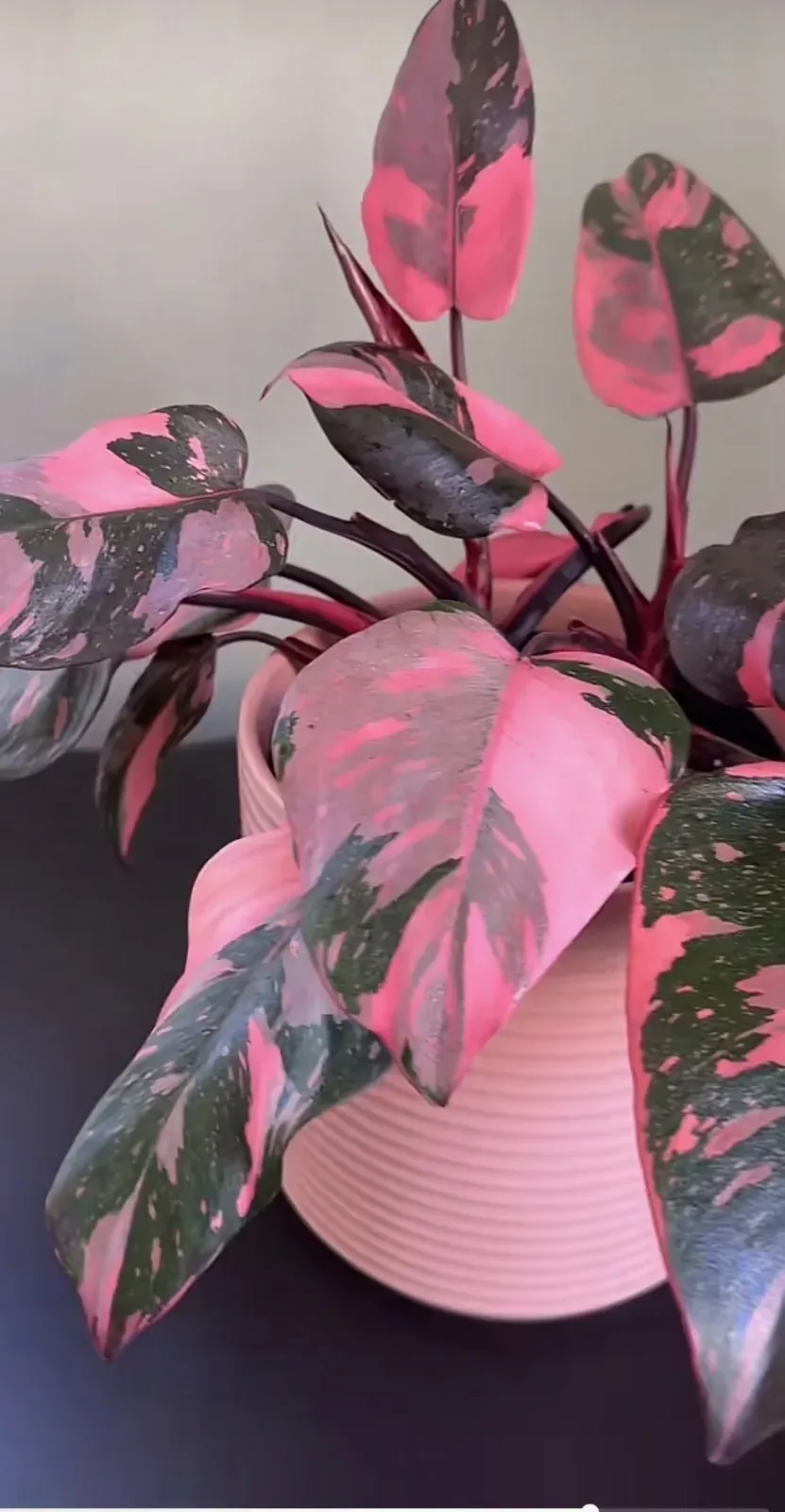
| ☀️ Light | Bright indirect light |
|---|---|
| 💧 Water | Moderate (lightly moist) |
| 🪴 Soil | Loose, free-draining houseplant compost (RHS) |
| 🌡️ Temp | 18°C – 29°C |
| 🐾 Safety | Cats: toxic · Dogs: toxic |
| 📏 Mature size | 1.5 m |
Where It Grows & Climate Tolerance
Pet & Companion Animal Toxicity (Pink Princess Philodendron)
A dark-leaved climbing philodendron with natural pink patches that change from leaf to leaf. Needs bright light to keep its pink, and is not pet safe.
Care instructions
Care Guide & Maintenance Routine
Bright filtered or indirect light, plus a grow light in winter. Water when the top few centimetres of mix are dry, less in winter. Keep 18 to 29°C, never below 15°C. Feed monthly April to September. Prune green stems back to a pink leaf. Harmful to pets.
Light & Sunlight
Bright, filtered or indirect light (RHS); avoid direct sun (NC State, P. erubescens). East window all year, south window October to March. Grow light 12 to 14 h a day, 30 to 60 cm above leaves in winter (UMN Extension). Low light can lead to green reversion (UMN).
Watering Schedule
Water when the top few centimetres are dry, then until it drains. Water freely in growth, moderately at other times (RHS). Much longer gaps in a cool Canadian winter. Water at the base to help prevent leaf spot (NC State).
Potting Mix & Drainage
Loose, free-draining houseplant compost (RHS)
Temperature & Humidity
NC State gives 65 to 85°F (about 18 to 29°C) for P. erubescens. RHS rates Pink Princess H1A (keep above 15°C). Protect from cold drafts, cold windowsills and unheated sunrooms.
The Pink Princess philodendron is the dark-leaved climber with splashes of bubblegum pink that made philodendrons a collector's hobby. Every leaf is different. One might be mostly green, the next half pink, the next almost black with a single pink streak. That randomness is part of the fun, and it is also why the plant needs a bit more care than a plain green vine. In a Canadian home the hardest part is winter, when short days and dry furnace air push it to grow slowly and lose colour. This guide shows you how to buy a good one, keep the pink coming, and get through November to March without losing leaves.
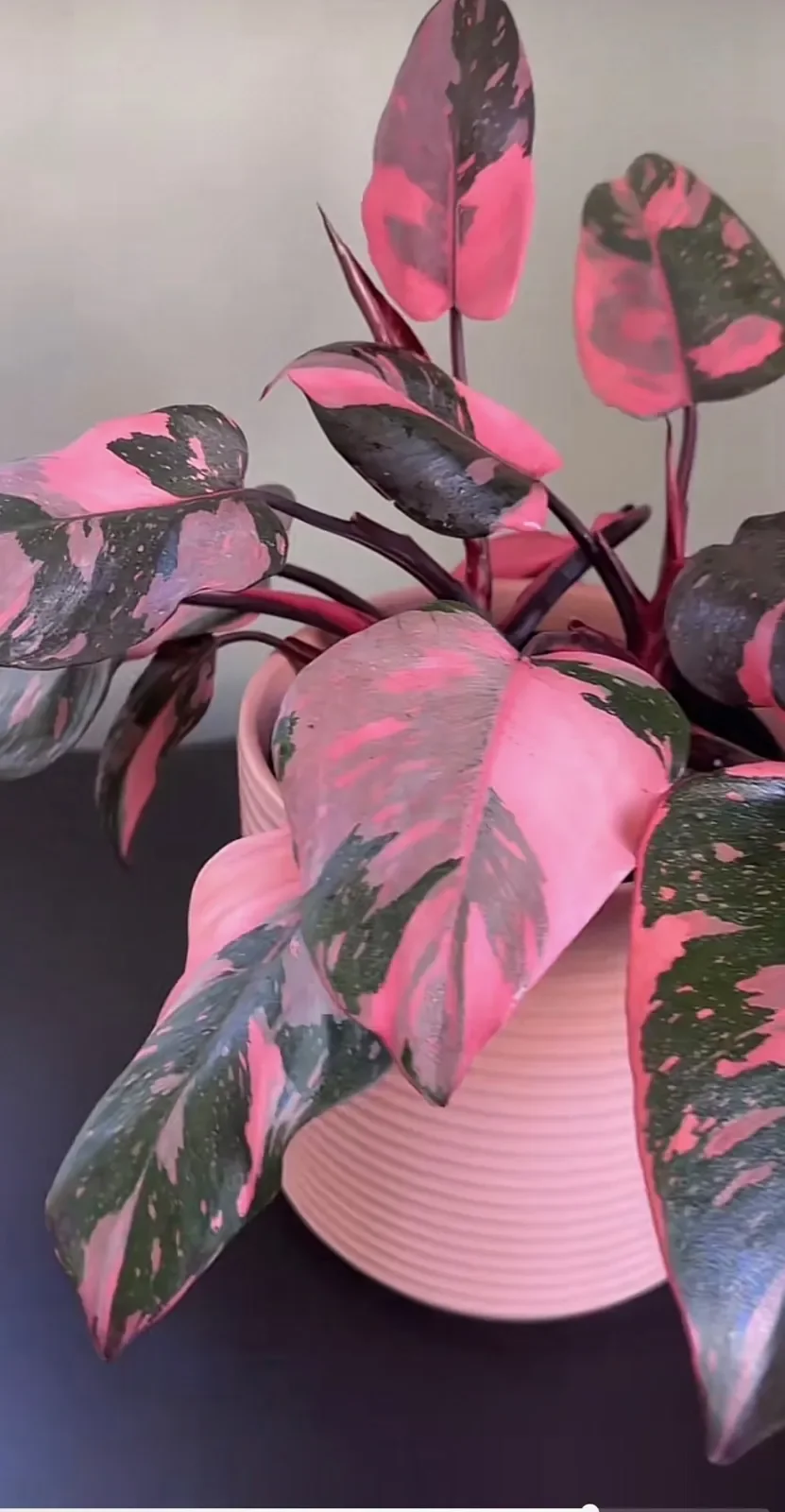
Pink Princess philodendron at a glance
| What you need to know | Short answer |
|---|---|
| Name | Philodendron 'Pink Princess', usually listed under Philodendron erubescens; arum family (Araceae) |
| Habit | Climbing to trailing, with thick stems that are bright red when young (RHS) |
| Size indoors | RHS gives up to 1 to 1.5 m tall and 0.5 to 1 m wide over 5 to 10 years |
| Light | Bright, filtered or indirect light; a grow light helps a lot in winter |
| Water | When the top few centimetres of mix are dry; less often in winter |
| Warmth | About 18°C to 29°C is comfortable (NC State, for P. erubescens); keep above 15°C |
| Difficulty | Intermediate |
| Pets | Not pet safe. RHS lists it as harmful if eaten, also to pets |
| In Canada | Indoors all year |
Identification, naming and varieties
What a Pink Princess looks like
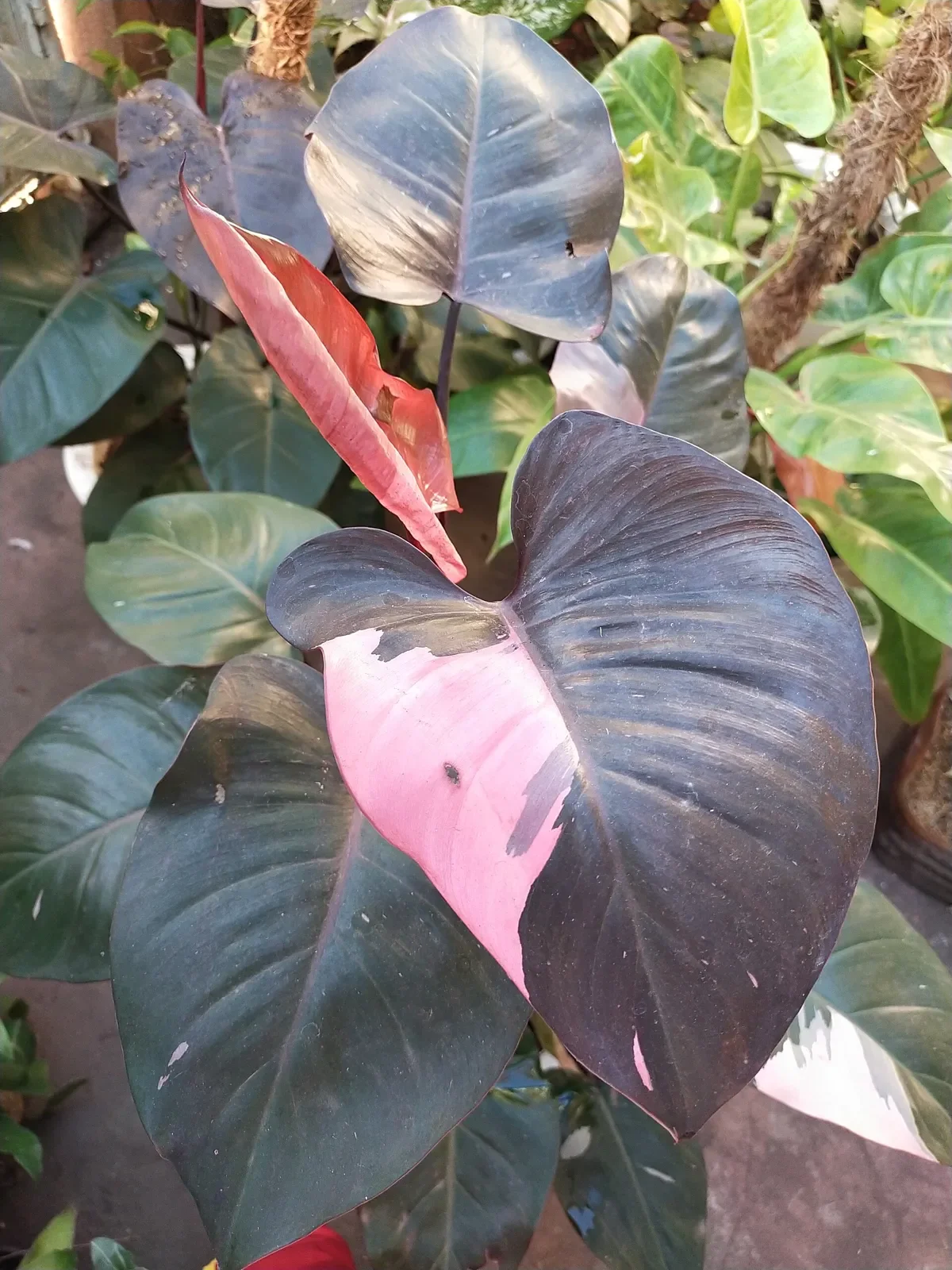
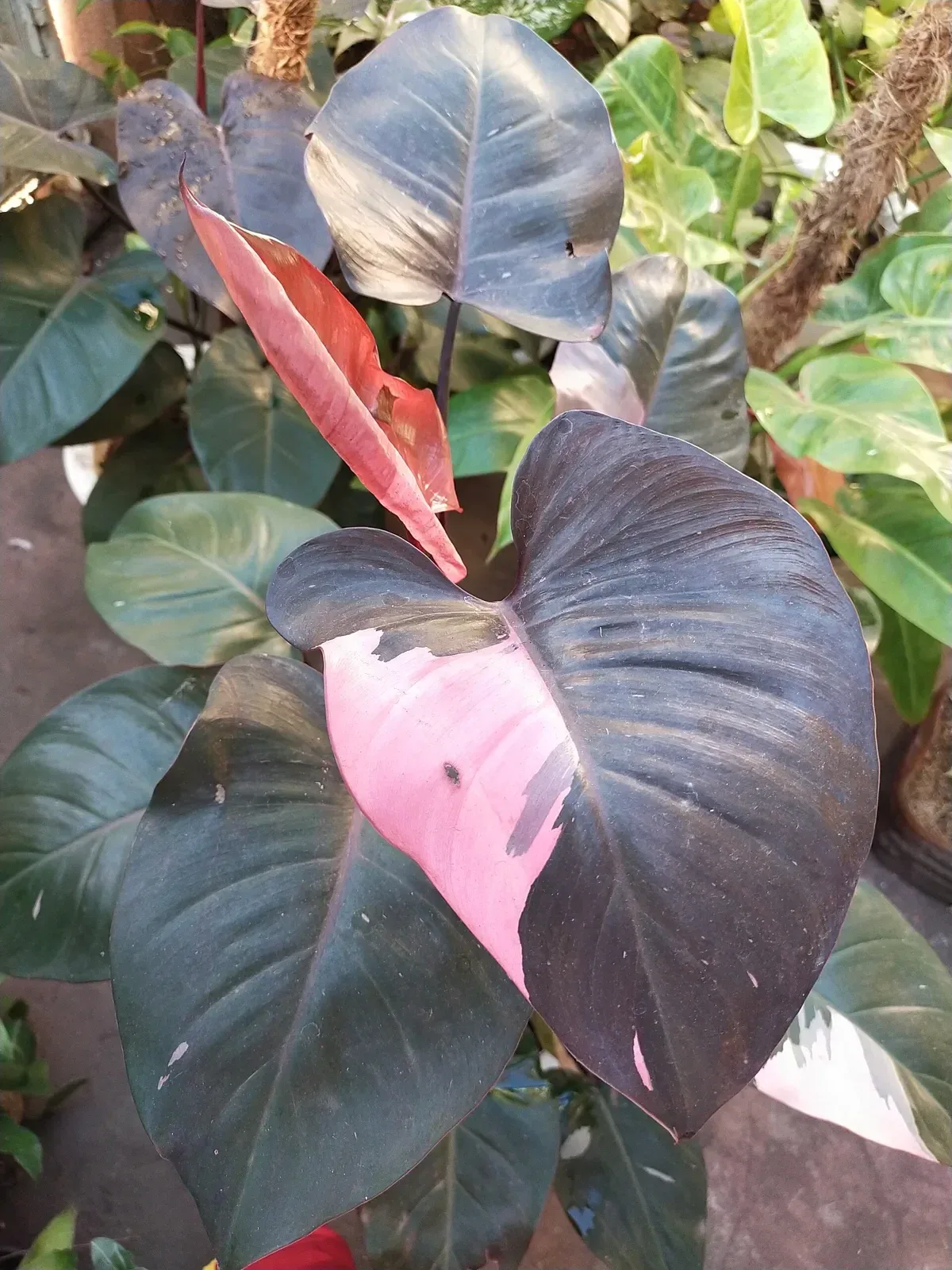
RHS describes Philodendron 'Pink Princess' as a tropical perennial with thick, clinging or trailing stems that are bright red when young. The leaves are oval to heart-shaped with a tapering tip, glossy deep green splashed with cream and pink. On many plants the green looks so dark it is close to black, which makes the pink stand out even more.
The pink comes in patches, streaks, speckles or whole half-leaves. No two leaves match. Stems and leaf stalks often carry pink stripes too, and many growers watch the stem colour as a hint of what the next leaf might do. That is a rule of thumb, not a promise.
Is it a species or a cultivar?
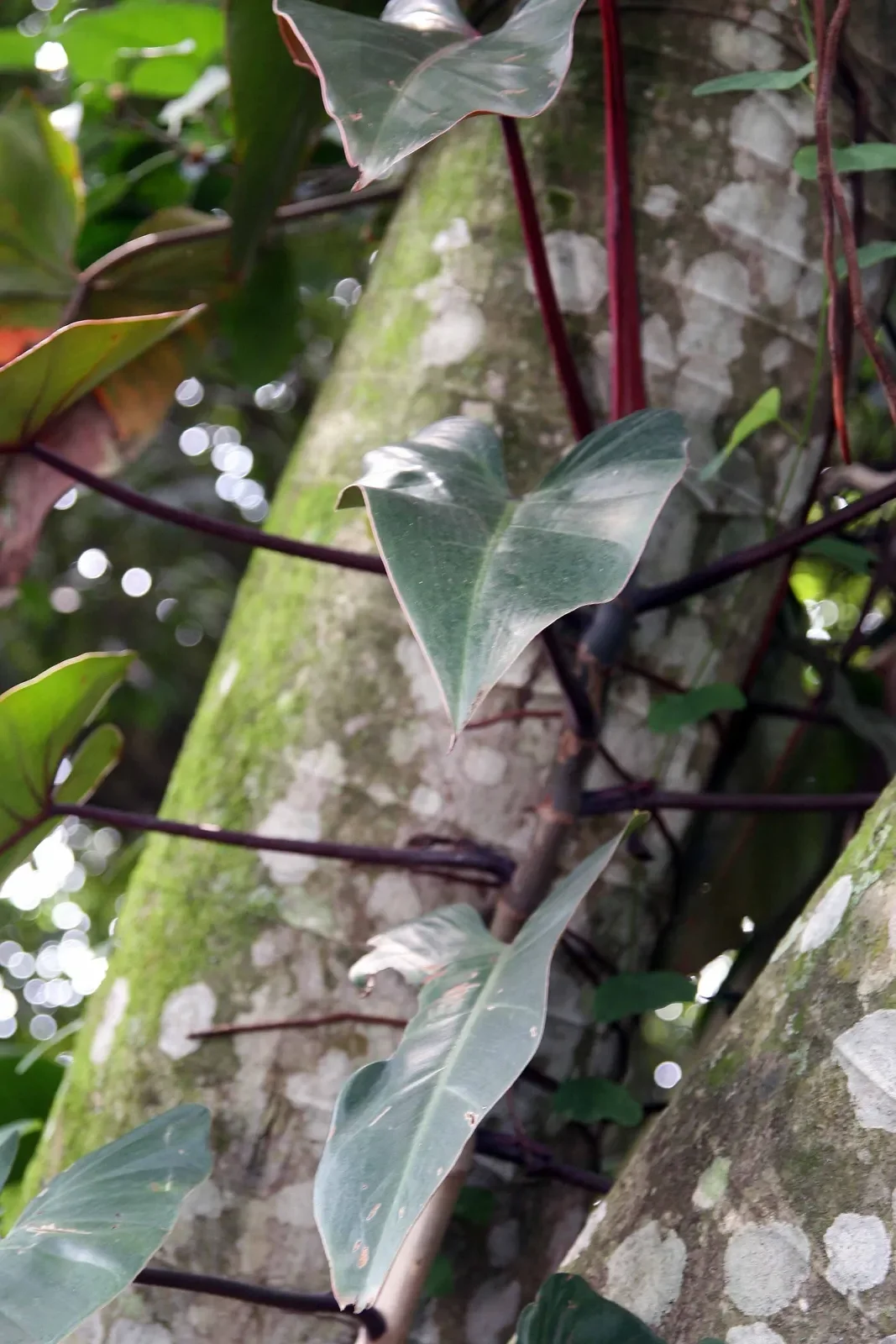
Pink Princess is a cultivar name, written in single quotes. RHS lists it as Philodendron 'Pink Princess' with an accepted name status, but without a species attached. Most growers and NC State Extension place it under Philodendron erubescens, the blushing philodendron, a climber native to Colombia. We have not found an entry for it in the International Aroid Society cultivar registry. So on this page we write it as Philodendron 'Pink Princess', usually listed under P. erubescens.
Is a pink philodendron always a Pink Princess?
No. "Pink philodendron" is a loose term, and a few different plants get sold that way:
- Pink Princess: dark green to near-black leaves with natural pink patches. The pink varies leaf to leaf.
- 'Pink Congo': all-pink leaves that look striking in the shop. The International Aroid Society says plants that need regular chemical treatments to keep their look, such as 'Pink Congo', are not recognised as cultivars. Once the treatment wears off, new leaves come in green.
- Strawberry Shake and other newer trade names: sold with pink or cream marks, but with little published record. See the note in our philodendron types guide.
If every leaf on a "Pink Princess" is evenly pink from base to tip, and the price is low, be suspicious. A real Pink Princess almost always shows a mix of green and pink.
Similar Princess plants
'White Princess' looks similar but has white patches instead of pink. NC State Extension describes it as green leaves splashed with white. RHS lists its name as unresolved. A separate White Princess page is planned: White Princess philodendron.
Buying a philodendron Pink Princess plant in Canada
Pink Princess is sold at most larger garden centres, independent plant shops and online sellers across Canada. Prices vary a lot with the amount of pink. A few tips:
- Buy the plant you can see. With online sellers, ask for a photo of the exact plant, and look at the newest leaf, not only the prettiest old one.
- Look for a balance of green and pink. A plant with good green on most leaves and pink on several is stronger than one with mostly pink leaves. Pink parts have no green chlorophyll, so they cannot feed the plant.
- Check the newest leaf and the stem below it. If the last two or three leaves are fully green and the stem has no pink, that stem may be reverting.
- Avoid seeds. RHS notes that very few variegated plants can be raised from seed. "Pink Princess seeds" sold online are not a reliable way to get a pink plant.
- Check for pests. Turn leaves over and look in the leaf joints for webbing, cottony tufts or brown bumps.
- Shipping in winter: order from a seller who uses heat packs and ships early in the week, so the box does not sit in a cold depot over a weekend. Open the box as soon as it arrives.
When you bring it home, keep it away from other plants for two or three weeks and watch for pests. Do not repot straight away unless the mix is soggy or the roots are rotting. Let it settle first.
Light: the key to keeping the pink
RHS recommends bright, filtered or indirect light for Pink Princess. NC State Extension says direct sunlight should be avoided for P. erubescens. In practice that means a bright spot near a window, out of hot midday sun through the glass.
Light matters more for this plant than for a plain green philodendron. The pink parts cannot make food, so the plant relies on its green parts. In low light it may also push out more green leaves. The University of Minnesota Extension notes that a variegated plant may revert to solid green when it does not get enough light.
- East window: a good choice all year. Morning sun is gentle.
- South window: best from October to March. In summer, set it back a metre or use a sheer curtain.
- West window: good with a sheer curtain in summer. Late afternoon sun through glass can burn pink patches.
- North window: usually too dim for good colour, especially in winter. Add a grow light.
Pink patches burn more easily than green ones. Brown, crispy pink edges after a sunny week mean the light was too strong. Move the plant back a little.
Grow lights in a Canadian winter
From November to February, a grow light is the single most useful thing you can buy for a Pink Princess. The University of Minnesota Extension suggests 12 to 14 hours a day for foliage houseplants, with the light 30 to 60 cm above the leaves. Use a timer. A white full-spectrum LED bar or bulb above a shelf works well and looks normal in a living room.
Soil mix, pots and repotting
RHS advises a loose, free-draining houseplant compost. Pink Princess roots like air as well as water, so a chunky mix works well:
- 2 parts good indoor potting mix
- 1 part small orchid bark
- 1 part perlite
This is a starting recipe. If the pot dries out in two days in a warm, dry room, use a little less bark. If it stays wet for over a week, add more perlite or bark.
Use a pot with a drainage hole, only a little wider than the root ball. RHS suggests repotting every 2 to 3 years. Do it in spring, April to June, when new leaves are coming. Avoid repotting in December or January, when roots grow slowly and take longer to recover.
Support
Pink Princess is a climber. Without support the stems lean and flop, and leaves tend to stay small. A moss pole, coir pole or wooden plank in the pot gives the aerial roots something to grab. Tie stems loosely with soft ties. Put the pole in when you repot so you do not stab through roots later.
Watering by season
Water when the top few centimetres of mix feel dry, then water slowly until it drains from the bottom. Empty the saucer. Do not follow a fixed day. The same plant can need water every few days in July and only every couple of weeks in January.
Spring and summer
RHS says to water freely during the growing season. "Freely" still means letting the top layer dry first. In warm rooms or bright windows, check every two or three days.
Autumn
Growth slows in September and October. When the heat comes on, the surface dries fast but the middle of the pot stays damp. Push a finger or a wooden chopstick deep into the mix before you water.
Winter
RHS says to water moderately outside the growing season. In a cool Canadian room with low light, the mix stays wet for a long time. Wet mix plus cold roots is the usual road to root rot. Water less, and use room-temperature water.
NC State Extension notes that P. erubescens is prone to leaf spot, and that watering at the base, keeping water off the leaves, helps prevent it.
Humidity and temperature
NC State Extension says P. erubescens prefers high humidity. Canadian homes in January can be very dry, especially in the Prairies. Signs of air that is too dry include brown, crispy tips, new leaves that tear as they unfurl, and spider mites. Ways to help:
- Run a humidifier in the room during the heating season.
- Group plants together.
- Keep the plant away from heat registers, baseboard heaters, fireplaces and wood stoves.
- A clear plant cabinet or a spare room with a humidifier works well if you grow several tropicals.
RHS suggests daily misting. Misting wets the leaves for a short time, so do it in the morning if you choose to, and do not rely on it alone in a very dry house.
NC State Extension gives 65°F to 85°F (about 18°C to 29°C) as the preferred range for P. erubescens, and advises protecting it from cold drafts. RHS rates Pink Princess H1A, which means it needs to be kept above 15°C. In Canada, keep it off cold windowsills on January nights, away from exterior doors, and out of unheated sunrooms.
Fertilizer
RHS advises a balanced liquid fertilizer once a month during the growing season. In Canada that usually means April to September. Water first, then feed, so roots do not get a strong dose on dry mix. Half the label strength is a safe start.
From October to March, stop feeding unless the plant is under a grow light and still putting out new leaves. Extra fertilizer does not add pink. Variegation comes from the plant's own cells, not from food. Too much fertilizer builds up salts in the pot and can brown the edges of leaves, and the pink edges show it first.
Pruning
RHS says no pruning is required, but most Pink Princess owners prune for two reasons: to remove reverting stems, and to make a lanky plant bushier.
- Cut just above a node, using clean, sharp scissors or a knife.
- Cut off yellow or badly burned leaves at the base of the leaf stalk.
- To keep the pink, cut back a stem that has made several all-green leaves (see the section below).
- Prune in spring or summer, when the plant grows back quickly.
- Wear gloves. RHS lists the sap as a skin and eye irritant.
Propagation
RHS lists softwood stem tip and leaf bud cuttings for Pink Princess. A leaf bud cutting is a short piece of stem with one node and one leaf.
- Choose a stem with good pink on its leaves. A cutting from an all-green stem will most likely grow green.
- Cut just below a node, ideally one with a small aerial root.
- Root it in water, damp sphagnum moss or a damp mix of perlite and potting mix.
- Keep it warm and in bright indirect light. A clear tub or bag over the pot helps in a dry Canadian winter, but open it every day for air.
- Pot it up once it has a few roots several centimetres long.
Spring and summer are the easiest times. Winter cuttings work but root more slowly. Our philodendron propagation guide will cover each method in detail.
Why is my Pink Princess losing its pink?
This is the question almost every owner asks. There are three different things going on, and they need different fixes.
1. Normal variation
Some leaves come out mostly green, others mostly pink. That is how this plant grows. One green leaf is not a problem. Look at the trend over the last four or five leaves on a stem.
2. Low light
The University of Minnesota Extension notes that variegated plants may revert to solid green in poor light. If the whole plant is producing smaller, darker, greener leaves through winter, give it more light: move it to a south or east window, or add a grow light for 12 to 14 hours a day.
3. Reversion on one stem
RHS calls it reversion when a variegated plant puts out pure green shoots. Those green shoots have more chlorophyll and grow more strongly, so over time they can take over. RHS advises pruning them out completely or cutting back to a point with variegated leaves.
For Pink Princess, that means: if one stem has made several all-green leaves in a row, cut it back to just above the last leaf that had good pink. The new shoot from that node has a better chance of carrying pink. You can root the green cutting if you like a green plant, but expect it to stay green.
Are all-pink leaves good or bad?
They look beautiful, but they are weak. A fully pink leaf has no chlorophyll, so it cannot feed itself. RHS notes that all-white or pale shoots on variegated plants are very weak. These leaves often brown and die early. Enjoy them while they last. If a whole stem keeps making only pink leaves, cut it back to a node with a mixed green and pink leaf so the stem can feed itself.
A dedicated guide on this topic is planned: Why is my variegated philodendron losing colour?
Problem troubleshooter
| What you see | Likely cause | What to do first |
|---|---|---|
| New leaves all green for weeks | Low winter light or a reverting stem | Add light. If one stem keeps making green leaves, cut back to the last pink leaf. |
| Pink patches turning brown and crispy | Pink parts are weak; sun through glass; dry air | Move out of direct sun, raise humidity. Some browning of large pink patches is normal. |
| Yellow lower leaves, mix wet | Overwatering, especially in winter | Let the mix dry more. Check the drainage hole. |
| Wilting with wet mix, soft dark stem base | Root or stem rot (NC State lists root rot from overwatering) | Unpot, cut away mushy roots, repot in fresh airy mix. Take cuttings from healthy stems as a backup. |
| New leaf tears as it opens | Dry air | Raise humidity. Do not pull the leaf open. |
| Leggy stem, small leaves | Low light, no support | More light, add a moss pole, trim in spring. |
| Fine webbing, speckled leaves | Spider mites, common in dry heated rooms | Rinse in the shower, repeat weekly, use a houseplant-labelled insecticidal soap if needed. |
| White fluff in leaf joints | Mealybugs | Isolate. Remove with a cotton swab and rubbing alcohol, then a labelled product. |
| Brown bumps on stems | Scale insects | Scrape off and follow with a labelled product. |
| Dark spots with a yellow ring | Leaf spot | Keep water off leaves; remove spotted leaves. |
NC State Extension lists spider mites, mealybugs, aphids and scale for P. erubescens, and RHS lists scale and red spider mite for Pink Princess. Choose a pest product labelled for indoor plants in Canada and follow the label. Check more symptoms on our plant problems page.
Month-by-month care calendar for Canada
| Month | What to do |
|---|---|
| January | Darkest month. Grow light on a timer, plant off cold glass. Water sparingly. No feeding. Check for spider mites. |
| February | Wipe dust from leaves. Keep humidity up while the furnace runs. |
| March | Growth starts again. Watch new leaves for colour. Plan repotting and pole work. |
| April | Start monthly feeding at half strength. Repot if needed and add a moss pole. |
| May | Cut back any stem that has turned green. Take cuttings from well-variegated stems. |
| June | Strong light: move back from south or west glass, or use a sheer curtain. |
| July | Check moisture often in heat waves. Watch pink edges for sunburn. |
| August | Last month for easy cuttings and repotting. Feed monthly. |
| September | Last feed. Move closer to the window as days shorten. |
| October | Stop feeding. Heat goes on: check mix deeper before watering. Set up the grow light. |
| November | Water less. Run the humidifier. Keep away from heat registers. |
| December | Keep away from drafty doors. Do not repot. Keep the timer at 12 to 14 hours. |
Safety for pets, children and skin
Pink Princess is not pet safe. RHS lists Philodendron 'Pink Princess' as harmful if eaten and a skin and eye irritant, for people and for pets. ASPCA does not have a separate Pink Princess entry, but it lists philodendrons, including the related P. erubescens types sold as 'Red Emerald', as toxic to dogs and cats because of insoluble calcium oxalates. Chewing causes mouth pain, drooling, vomiting and trouble swallowing. NC State Extension lists P. erubescens as a problem for children, cats and dogs.
- Keep it on a high shelf or in a room pets do not use.
- Wear gloves for pruning and repotting, and wash your hands after.
- If a pet chews it, call your vet. The ASPCA Animal Poison Control line is (888) 426-4435 (a fee may apply). If a child eats part of the plant, call your provincial poison centre.
For safer choices, see our pet-safe plants list.
Common mistakes
- Buying the plant with the most pink. Very pink plants are weaker.
- Feeding more to "bring the pink back". Fertilizer does not create variegation.
- Leaving a green stem to grow. It can take over the plant.
- Putting it in hot direct sun to boost colour. The pink burns first.
- No grow light in a dim winter room.
- Watering on a schedule through winter.
- Skipping a moss pole, so stems flop and leaves stay small.
- Buying Pink Princess seeds online.
Watch: Pink Princess care
A clear walkthrough of light, watering, mix and staking. The grower is in New York, so the indoor winter conditions are close to many Canadian cities.
Related plants and guides
- Philodendron types and care for Canadian homes, our main philodendron guide
- Heartleaf philodendron, an easier green vine
- Philodendron Birkin, another variegated philodendron
- Philodendron Birkin care guide for Canada
- Anthurium, a related aroid with similar needs
- White Princess philodendron
- Philodendron Strawberry Shake
- Pink Princess vs White Princess
- Philodendron winter care in Canada
Sources
- RHS: Philodendron 'Pink Princess' (v) (description, size, H1A, cultivation, propagation, harm). Accessed 10 Nov 2026.
- NC State Extension Plant Toolbox: Philodendron erubescens (native range, temperature, pests, leaf spot, cultivars). Accessed 10 Nov 2026.
- International Aroid Society cultivar registry guidelines ('Pink Congo' not recognised as a cultivar). Accessed 10 Nov 2026.
- RHS: Reversion (green shoots, weak all-pale shoots, seed). Accessed 10 Nov 2026.
- University of Minnesota Extension: Lighting for indoor plants. Accessed 10 Nov 2026.
- ASPCA: Split Leaf Philodendron (lists Red Emerald and Red Princess; toxic to dogs and cats). Accessed 10 Nov 2026.
Seasonal rhythm
Seasonal Calendar
A month-by-month calendar for Pink Princess Philodendron in Canada is coming soon. See the light, water and temperature notes above.
Diagnostics
Common Problems & Troubleshooting
All-green new leaves: low light or reversion, add light and prune back. Browning pink patches: weak pink tissue, sun or dry air. Yellow leaves with wet mix: overwatering. Torn new leaves: dry air.
Pests & seasonal watch: Spider mites, mealybugs, aphids and scale (NC State); scale and red spider mite (RHS). Root rot from overwatering; leaf spot. Use products labelled for indoor plants in Canada.
Care encyclopedia · 2 guides
Guides & Articles for Pink Princess Philodendron
Pink Princess vs White Princess Philodendron: Differences and Care
Pink Princess and White Princess are both sold as Philodendron erubescens. Compare colour, naming, look-alikes, care and how to keep the variegation.
Read guide
Variegated Philodendron Losing Colour: Causes and Fixes
Why variegated philodendrons go green, fade or brown, and what you can do about it, from winter light in Canada to pruning out reverted stems.
Read guideQ&A
Frequently Asked Questions
Why is my Pink Princess turning green?
Usually low light or reversion. University of Minnesota Extension notes variegated plants can revert to green when light is too low, so add light first, especially from November to February. If one stem keeps making all-green leaves, RHS advises cutting reverted shoots back to variegated growth. Cut just above the last leaf with good pink.
Why is my pink philodendron turning green?
If it is a Pink Princess, the cause is usually low winter light or a reverting stem; add light and prune green stems back to a pink leaf. If it was sold as 'Pink Congo', the pink came from chemical treatment, which the International Aroid Society says does not make a true cultivar, so new leaves grow in green.
Are all-pink leaves good or bad for Pink Princess?
Both. They look stunning, but a fully pink leaf has no chlorophyll and cannot feed itself, so it often browns and dies early. RHS notes all-pale shoots on variegated plants are weak. Enjoy the leaf, but if a stem keeps making only pink leaves, cut it back to a node with a mixed green and pink leaf.
Is a pink philodendron always a Pink Princess?
No. Pink Princess is the best known, with natural pink patches on dark leaves. 'Pink Congo' plants are sold with all-pink leaves, but the International Aroid Society says their look relies on chemical treatment and they are not recognised cultivars. Newer trade names such as Strawberry Shake also carry pink but have thin records.
Is Pink Princess philodendron safe for cats?
No. RHS lists Philodendron 'Pink Princess' as harmful if eaten, also to pets, and a skin and eye irritant. ASPCA lists philodendrons such as the related 'Red Emerald' as toxic to cats and dogs because of insoluble calcium oxalates. Chewing causes mouth pain, drooling and vomiting. Keep it well out of reach.
How do I care for Pink Princess in a dry, heated room?
Run a humidifier during the heating season, group it with other plants, and keep it away from heat registers and fireplaces. NC State Extension says its species prefers high humidity. Water the mix, not the leaves, and check for spider mites often, because they spread fast in dry winter air.
How much light does Pink Princess need in Canada?
Bright, filtered or indirect light, as RHS advises. An east window works all year, and a south window is best from October to March. In winter, a grow light for 12 to 14 hours a day, 30 to 60 cm above the leaves, keeps growth and colour going. Avoid hot direct sun, which burns pink patches.
How often should I water Pink Princess philodendron?
Check the mix, not the calendar. Water when the top few centimetres feel dry, then water until it drains and empty the saucer. RHS says to water freely in the growing season and moderately at other times. In a cool Canadian winter, the gap between waterings gets much longer.
Can I grow Pink Princess from seed?
Not reliably. RHS notes very few variegated plants can be raised from seed, because variegation is usually a growth disorder, not something passed on in seed. Pink Princess seeds sold online are unlikely to give pink plants. Buy a rooted plant or a cutting from a well-variegated stem instead.
Does Pink Princess need a moss pole?
It does better with one. Pink Princess is a climber, and RHS describes its thick clinging stems. Without support, stems lean and leaves tend to stay small. A moss pole, coir pole or plank gives the aerial roots something to grip. Add it at repotting time in spring so you do not damage roots.
Will fertilizer bring back the pink on my Pink Princess?
No. Variegation comes from the plant's own cells, not from food. RHS advises a balanced liquid fertilizer monthly in the growing season, which in Canada is about April to September. Extra feeding builds salts that brown leaf edges. Better light and pruning green stems are what help the pink.
How big does a Pink Princess philodendron get indoors?
RHS gives a maximum height of 1 to 1.5 m and a spread of 0.5 to 1 m, reached over 5 to 10 years. In a Canadian home, size depends on light and support. On a moss pole with good light it grows taller with bigger leaves; in dim light it stays smaller.
Similar Botanical Matches
Keep exploring
Related plants


Grower field notes
Reader Field Notes in Canada
Share how this plant performs in your local Canada climate.