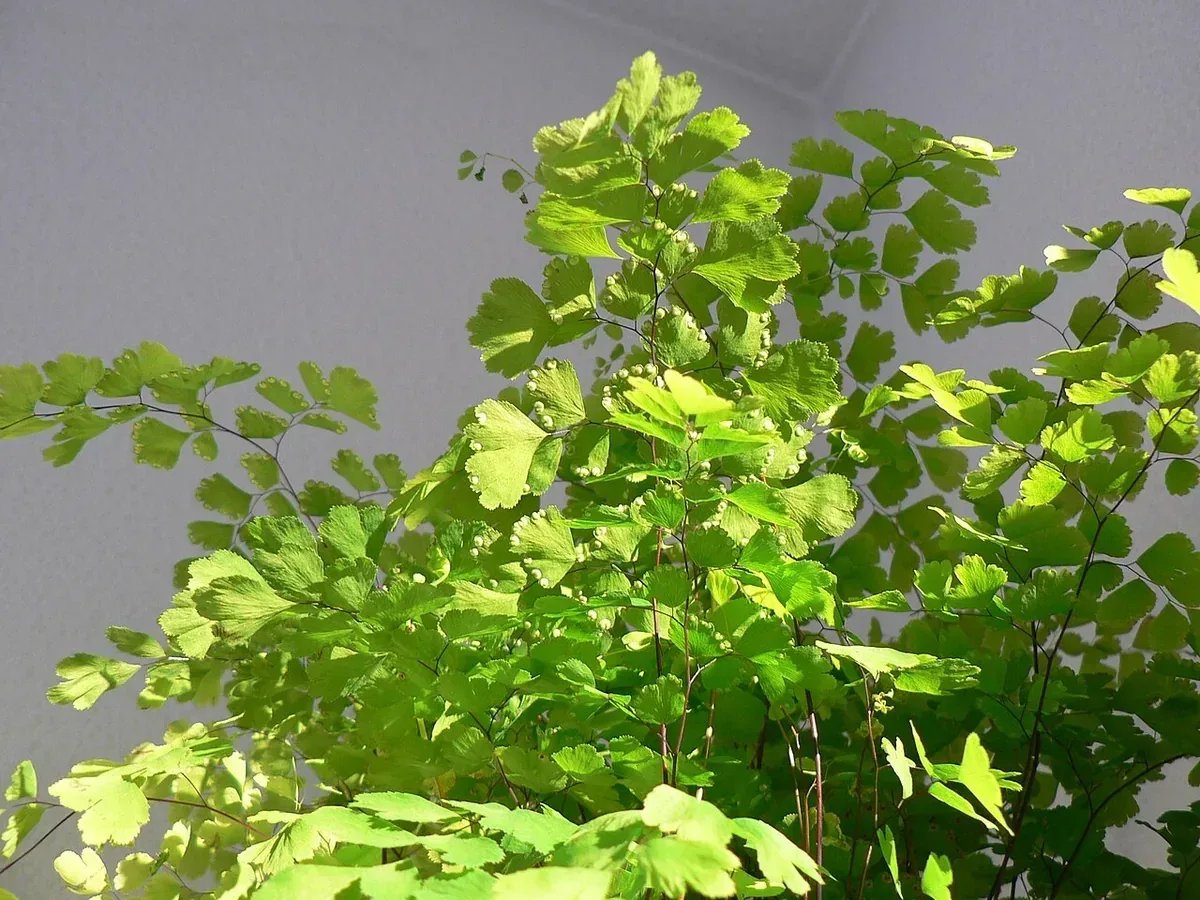
| ☀️ Light | Bright indirect light |
|---|---|
| 💧 Water | High (consistently moist) |
| 🪴 Soil | Moisture-retentive, slightly acidic houseplant mix with good drainage |
| 🌡️ Temp | 10°C – 24°C |
| 🐾 Safety | Cats: not verified · Dogs: not verified |
| 📏 Mature size | 60 cm |
Where It Grows & Climate Tolerance
Pet & Companion Animal Toxicity (Maidenhair Fern Care in Canada)
Delta maidenhair is a tropical houseplant in Canada, not the hardy woodland fern of eastern forests. It needs steady moisture and humid air, which is hardest to give once the furnace is running.
Care instructions
Care Guide & Maintenance Routine
From Thanksgiving to Easter, park it in a bright bathroom, under a glass cloche or beside a room humidifier, out of reach of forced-air registers. Prairie homes need the most help, coastal BC and Maritime homes the least. Indoors year round; balcony wind shreds fronds.
Light & Sunlight
The RHS recommends bright, indirect light. NC State lists partial shade to shade and notes it loses vigour in too much shade or full sun. NYBG suggests a north window or a short distance from an east or west window.
Watering Schedule
NC State says the roots should not be allowed to dry out. NYBG warns that letting the root ball dry and then soaking it is a common cause of failure; water moderately so the mix stays evenly moist, letting only the top 2 to 3 cm dry. Water less in winter.
Potting Mix & Drainage
Moisture-retentive, slightly acidic houseplant mix with good drainage
Temperature & Humidity
NYBG says not to let it drop below 10°C, so it never goes outdoors from fall to spring anywhere in Canada; even Zone 9a Victoria gets far colder. Icy panes, drafty vestibules and baseboard heaters all scorch fronds.
Maidenhair through a Canadian winter
Delta maidenhair is one of the most-asked-about houseplants in Canada because it so often crisps up in January. The reason is simple: furnace-heated air is far drier than the fern wants, and one dry day can brown a whole flush of fronds.
Not the native maidenhair
Garden centres in Ontario, Quebec and the Maritimes also sell northern maidenhair (Adiantum pedatum), a native woodland fern of eastern Canada, for shade gardens. It is hardy outdoors and dies back in winter. The houseplant is a different, tropical species and will not survive outside.
Buying and getting it home
Grocery chains, IKEA, garden centres and plant shops stock it in 4 or 6 inch pots. Fronds are thin and chill fast, so between November and March, carry it in a closed bag or box and go straight home. Online sellers may pause shipping or add a heat pack in deep cold.
Furnace air and humidity
This fern wants more humidity than most Canadian homes can offer in winter. The best options are a bathroom with a window, a humidifier running nearby, a large pebble tray, or a glass terrarium or cloche. Keep it well away from floor registers, baseboard heaters and wood stoves, and back from windows where frost forms on the inside of the glass.
Prairie cold versus coastal damp
Homes in Winnipeg, Regina, Saskatoon, Edmonton and Calgary face the driest winter air in the country, because frigid outdoor air holds almost no moisture once it is heated. Cranking a whole-house humidifier on a -30°C night just fogs and ices the windows. A glass cloche, an old aquarium or a clear storage tote with the lid ajar keeps the fern's own pocket of damp air without soaking the window frames. In Vancouver, Victoria, Halifax and St. John's, winters are milder and damper, so a pebble tray in a bright bathroom is often enough.
Light from November to February
An east-facing window or a spot a metre or two back from southern exposure works. In basement suites and north-facing condo units in Toronto or Montréal, clip an LED grow light to the shelf and plug it into a timer.
Summer
Summer is its easiest time in Canada, once the furnace is off and windows are open. It does not need to go outside, and wind on a balcony shreds fronds. Air conditioning dries the air again, so keep the pebble tray topped up in July heat waves in Toronto, Montréal or Winnipeg.
Zones
NRCan's 1991-2020 map puts Toronto in Zone 7a, Ottawa in 5a and Halifax in 6b. Northern maidenhair handles those zones; the delta houseplant does not handle any of them.
After a January crisp-up
Snip every browned frond at soil level, put the pot into its cloche or the bathroom, and wait. NYBG points to dry air and uneven watering as the usual causes. Fresh fiddleheads by late February or March mean the rhizome survived.
Pests
- Fungus gnats: small black flies over damp mix; see our fungus gnats guide.
- Mealybugs: white fluff at the base.
Cat owners: ASPCA has no listing, so we have not marked it safe or toxic. More tips: winter watering.
Seasonal rhythm
Seasonal Calendar
| Month | Care Tasks | Seasonal Focus |
|---|---|---|
| Jan | protect | Deep-freeze weeks on the Prairies: cloche or terrarium rather than a whole-house humidifier that frosts windows. |
| Feb | prune, protect | February long weekend: snip crispy fronds and check that the cloche is not dripping. |
| Mar | repot | Clocks spring forward. Divide or repot crowded rhizomes. |
| Apr | feed | Fiddleheads unroll; begin half-strength fertilizer once a month. |
| May | feed, protect | Furnace cycles less. Shift back from south glass as the May sun strengthens. |
| Jun | feed | Windows open across Ontario and Quebec; the easiest weeks of the year for this fern. |
| Jul | feed, protect | Heat waves in Toronto, Montréal, Winnipeg: air conditioning dries rooms, so top up the pebble tray. |
| Aug | feed, repot | Final feeding. Split large clumps before school starts. |
| Sep | protect | Labour Day: dust off the humidifier and wash the cloche before furnaces kick in. |
| Oct | protect | Thanksgiving: heating season begins. Pull the pot away from cold window glass. |
| Nov | protect | Remembrance Day grey: dimmest weeks begin. Water slightly less, but never let it go dry. |
| Dec | protect | Holiday fireplaces and space heaters dry the air fast. Terrarium ferns need only a splash. |
Diagnostics
Common Problems & Troubleshooting
Crispy brown fronds from dry air or a dry root ball; pale, bleached fronds in direct sun; yellowing and rot in soggy, cold mix; sudden collapse near heaters, AC or open windows.
Pests & seasonal watch: Few pests. Fungus gnats in the always-moist mix, especially under low winter light. Mealybugs now and then at the base. Avoid leaf shine and oily sprays.
- Yellow leaves — Leaves fade from green to yellow, often starting at the bottom.
- Brown tips — Leaf tips and edges turn dry, brown and papery.
- Drooping — Stems and leaves hang limp even though the plant was recently fine.
- Root rot — Roots turn brown and mushy in soil that stays wet.
- Mealybugs — White cottony clumps in leaf joints, often with sticky honeydew.
- Overwatering — Soil stays wet, leaves yellow or droop, and the pot feels heavy.
- Underwatering — Soil is bone dry and leaves are crispy, curled or dull.
- Sun scorch — Bleached or crispy patches on the side that faces strong sun.
- Cold damage — Dark, water-soaked or blackened patches after a cold night or an AC blast.
- Pale leaves — Whole leaves look washed out, not spotted.
Similar Botanical Matches
Grower field notes
Reader Field Notes in Canada
Share how this plant performs in your local Canada climate.