
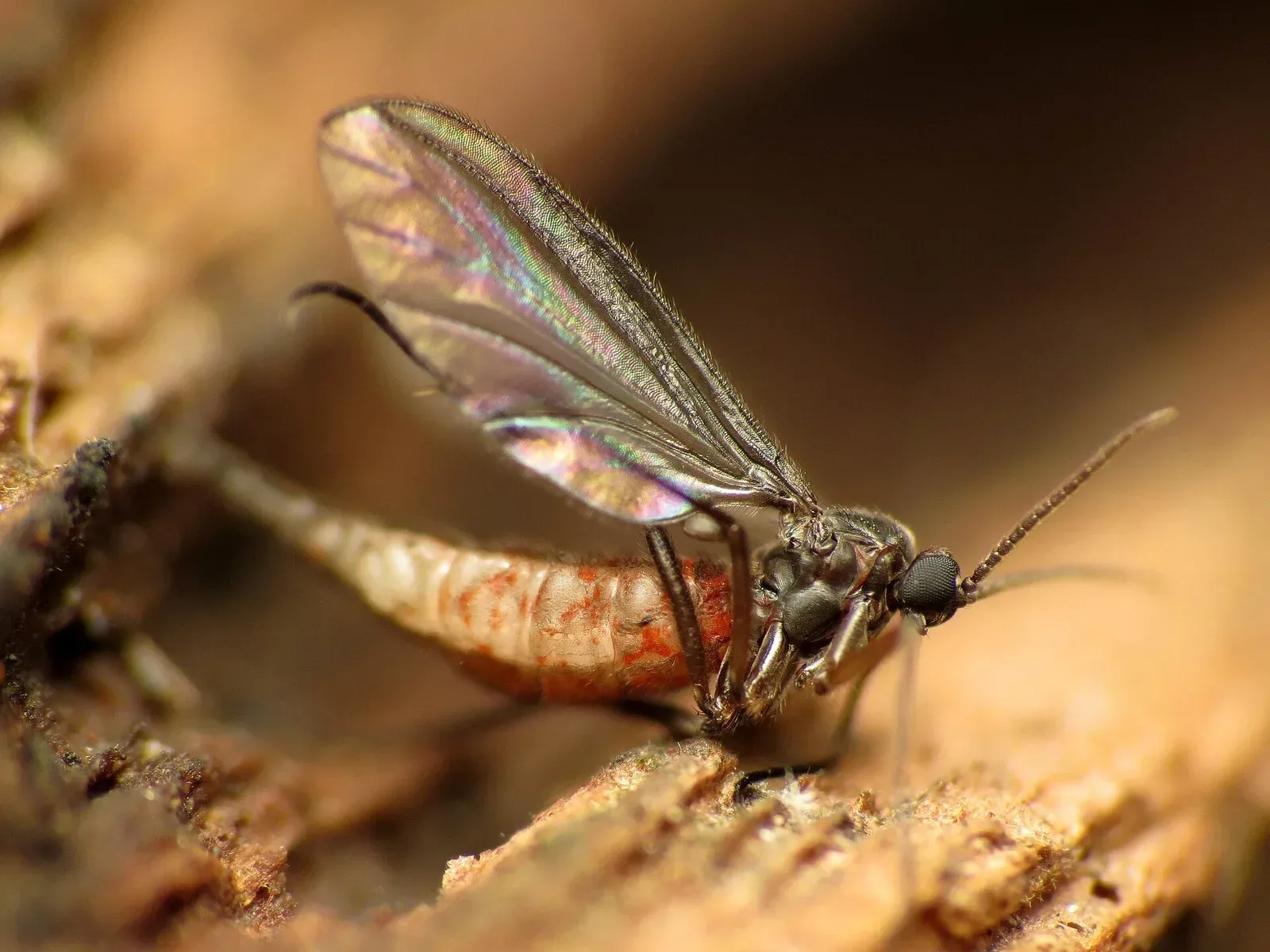
Fungus gnats are the tiny dark flies that rise from houseplant pots when you water or brush past. They breed in damp potting mix, and their larvae live in the top few centimetres of soil. On healthy, established houseplants they are mostly a nuisance. The fix is to make the soil a poor place to breed: let the top layer dry out between waterings, trap the adults, and, if needed, use a product registered in Canada for this use.
In Canadian homes, fungus gnats often show up in late fall and winter, when plants are moved indoors and the potting mix stays wet for longer in low light.
How to tell fungus gnats from other small flies
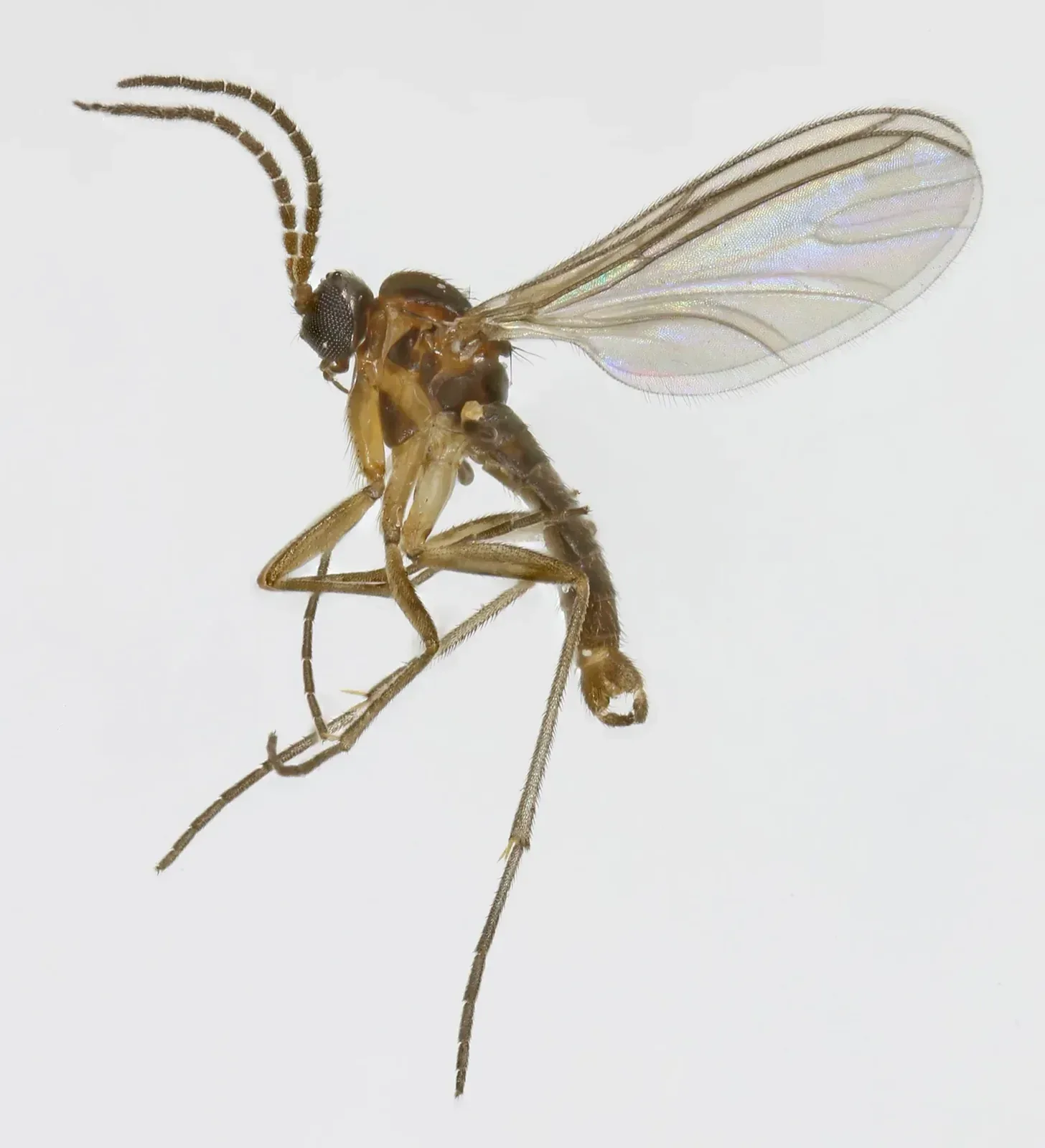
- Adults: small, delicate, dark grey to black flies with long legs and antennae. They look like tiny mosquitoes but do not bite. They are weak fliers and tend to walk over the soil or flutter near the pot.
- Larvae: the RHS describes them as slender, whitish maggots up to 6 mm long, with black heads and semi-transparent bodies. They live in the potting mix.
- Where they hang around: on and just above the soil surface of damp pots, around drainage holes and saucers.
Fruit flies are a common mix-up. They are tan with red eyes, fly more strongly, and hang around fruit bowls, compost bins and drains rather than plant pots. Whiteflies are white and live on the undersides of leaves.
How to confirm you have them
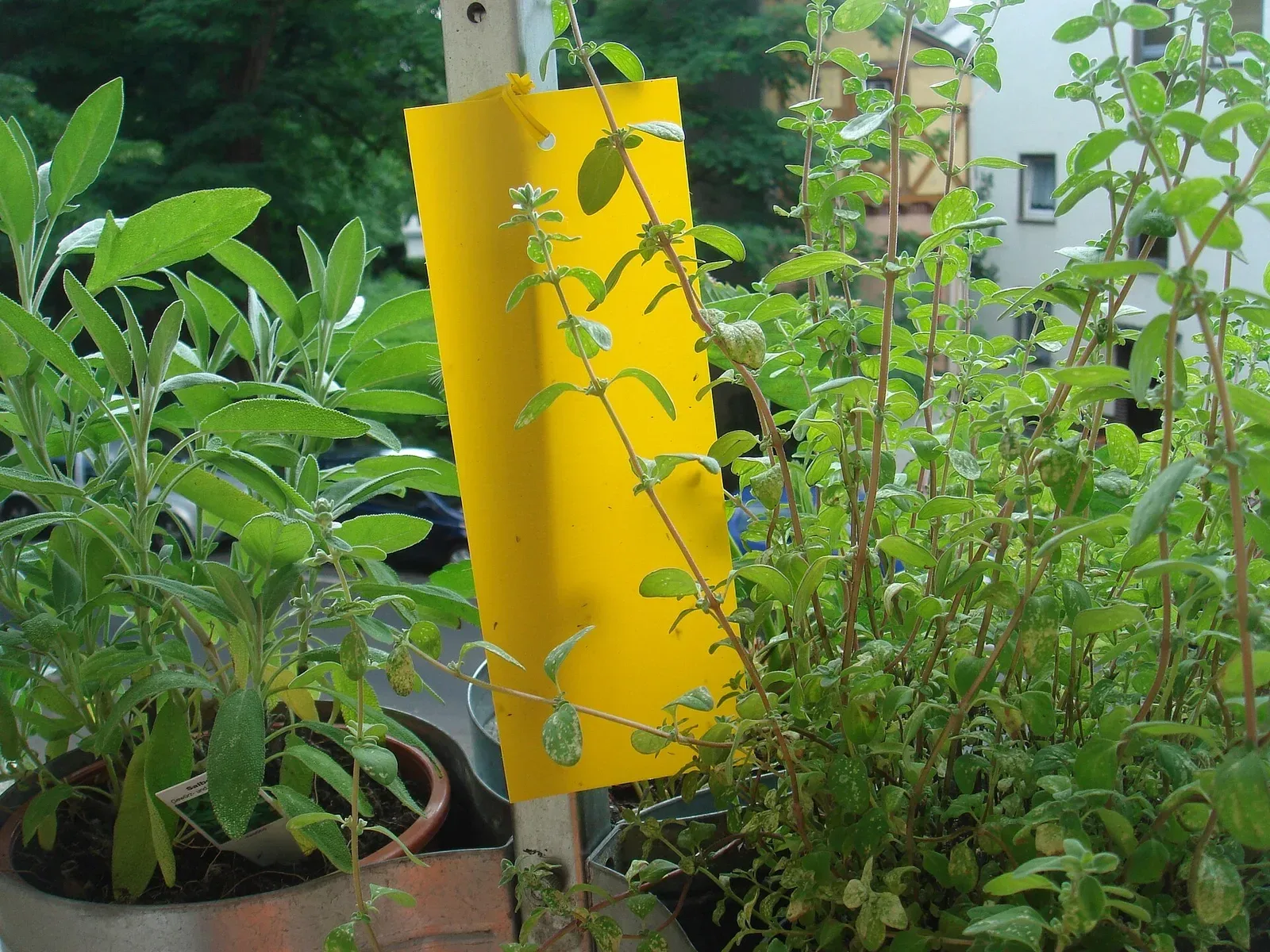
- Put a yellow sticky trap flat on the soil or on a stick just above it. University of Vermont Extension suggests laying a trap horizontally over the soil to monitor for fungus gnats. Check it after a few days.
- Scratch gently at the top 2 to 3 cm of the mix in the dampest pot and look closely for small, clear-bodied larvae with dark heads.
- Some gardeners place a slice of raw potato on the soil for a few days and then look underneath for larvae. It is a handy extra check, not a control.
Do fungus gnats harm houseplants?
Usually not much. The RHS says the larvae feed mainly on dead roots, decaying plant material and the fungi growing in damp compost, and that established plants with healthy foliage are unlikely to be damaged. Some species also feed on soft growth such as seedling roots and the base of cuttings, so trays of seedlings and newly rooted cuttings are most at risk.
If an established plant is wilting or yellowing and also has gnats, the gnats are more likely a sign of a wet, struggling root system than the cause of it. Check for overwatering and root rot.
Step 1: Dry out the breeding ground
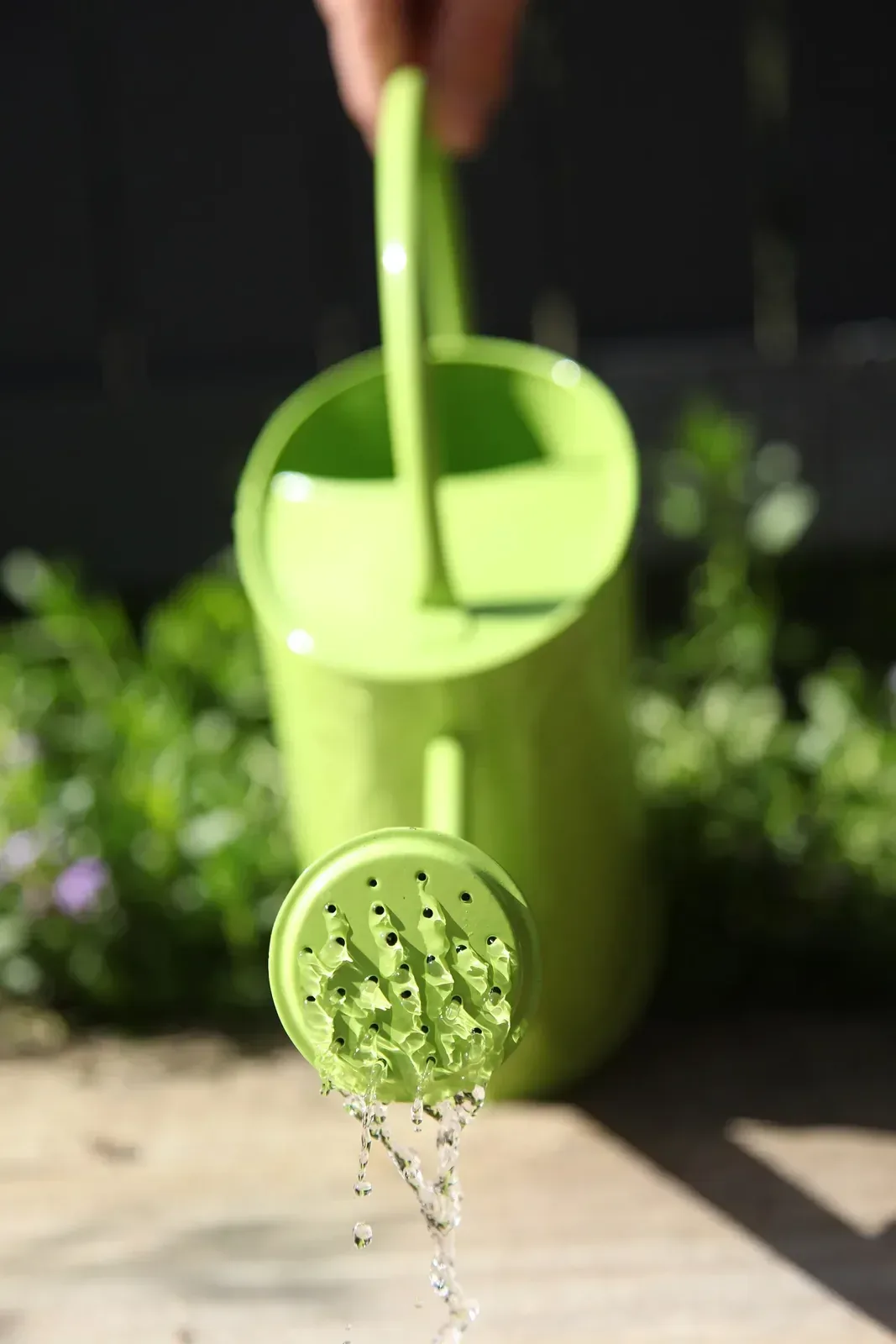
This is the most important step, and the one that makes every other step work. Fungus gnats lay eggs in moist potting mix. Let the top few centimetres dry out between waterings so eggs and young larvae struggle to survive.
- Check the mix with your finger before watering. Only water when the top layer is dry, and water less often in winter when plants grow slowly.
- Empty saucers and cachepots after watering.
- For plants that like to stay evenly moist, such as calatheas and ferns, try watering from below: stand the pot in a bowl of water for 15 to 20 minutes, then drain. The surface stays drier than when you water from above.
- Remove dead leaves and other decaying material from the soil surface.
- Do not leave bags of potting mix open and damp. The RHS also suggests that discarding old compost, rather than reusing it, removes eggs and larvae.
Our guide to watering houseplants in a Canadian winter covers how to judge when a pot needs water.
Step 2: Trap the adults
Yellow sticky traps catch adults before they lay more eggs and show you whether numbers are falling. Place them flat on or just above the soil in affected pots. The RHS warns that the traps also catch other insects, including beneficial ones, so use them indoors and remove them once the problem is under control. Change them when they are full.
Traps alone will not solve the problem, because larvae keep developing in the soil. Use them with Step 1.
Step 3: Repot badly infested plants
If one pot is full of larvae, it is often quickest to repot it. Shake off as much old mix as possible outdoors or into a sealed bag, rinse the pot, and repot in fresh, free-draining mix. Avoid mixes heavy in fine peat or unfinished compost, which stay wet. Bag and discard the old mix rather than adding it to other pots.
Step 4: Biological and product options in Canada
Pest control products sold in Canada must be registered by Health Canada's Pest Management Regulatory Agency. Registered products carry a PCP registration number on the label, and the label says where and how they can be used. That matters here, because a lot of online advice comes from the United States and recommends products or uses that are not on Canadian labels.
- Bti (Bacillus thuringiensis subsp. israelensis): a bacterium that kills fly larvae. University of Minnesota Extension describes using it against fungus gnat larvae in houseplants. In Canada, only use a Bti product whose label includes fungus gnats on indoor plants. Many Bti products sold here are labelled for mosquitoes or for commercial greenhouses only.
- Beneficial nematodes and predatory mites: the RHS lists the nematode Steinernema feltiae, predatory soil mites and a predatory rove beetle as biological controls for fungus gnat larvae. Some Canadian garden centres and mail-order suppliers sell these, mainly for greenhouse and indoor use. Follow the supplier's instructions on storage, timing and soil moisture.
- Other products: search Health Canada's pesticide label database for products that list fungus gnats and indoor or houseplant use. If the label does not list the use, do not use the product for it.
What we do not recommend: neem oil drenches, hydrogen peroxide drenches, cinnamon, vinegar traps used as a soil treatment, and other home remedies. Neem oil is often suggested online, but neem oil sold for houseplants in Canada does not normally carry a pest-control registration for this use, so check for a PCP number before you rely on any product. Watering changes and traps are safer and usually enough.
How long does it take?
Fungus gnats can breed all year indoors. The RHS notes that in summer the life cycle can be completed in about a month, and it is slower in cool conditions. Expect to keep the soil drier and change traps for at least three to four weeks before the adults disappear, because eggs and larvae already in the soil will keep hatching for a while. Steady drops in the number caught on traps are the sign it is working.
Preventing fungus gnats next winter
- Before bringing plants indoors in early fall, check the soil surface and drainage holes, and let pots dry slightly.
- Store potting mix sealed and dry.
- Quarantine new plants for a couple of weeks with a sticky trap in the pot.
- From November, water less often and check by touch.
- Keep saucers empty and remove fallen leaves from pots.
Are fungus gnat controls safe around pets?
Fungus gnats do not bite people or pets. Sticky traps can catch pet hair, small animals and birds, so place them where pets cannot reach and use them indoors. For any product, follow the label's directions on pets and children. If a pet eats a product or a plant, contact your veterinarian.
More help: our fungus gnats symptom page, the plant problems hub, and profiles for plants that often host gnats, such as African violet, peperomia and calathea.
Watch: a video walk-through
Cristina Tropicals shows a practical routine for clearing fungus gnats from houseplants. Before using any product shown in a video, check that its Canadian label covers fungus gnats on indoor plants.
Sources
Sources last checked 10 November 2026. Advice varies with your home, region and plant; use these as a starting point.
- RHS: Fungus gnats (sciarid flies)
- University of Minnesota Extension: How to treat pesky fungus gnats in houseplants
- University of Vermont Extension: Houseplant care during the winter months
- Health Canada: Pesticide product search (label search)
- Iowa State University Extension: How often should houseplants be watered during the winter months?
Comments
No comments yet — share what worked in your climate.