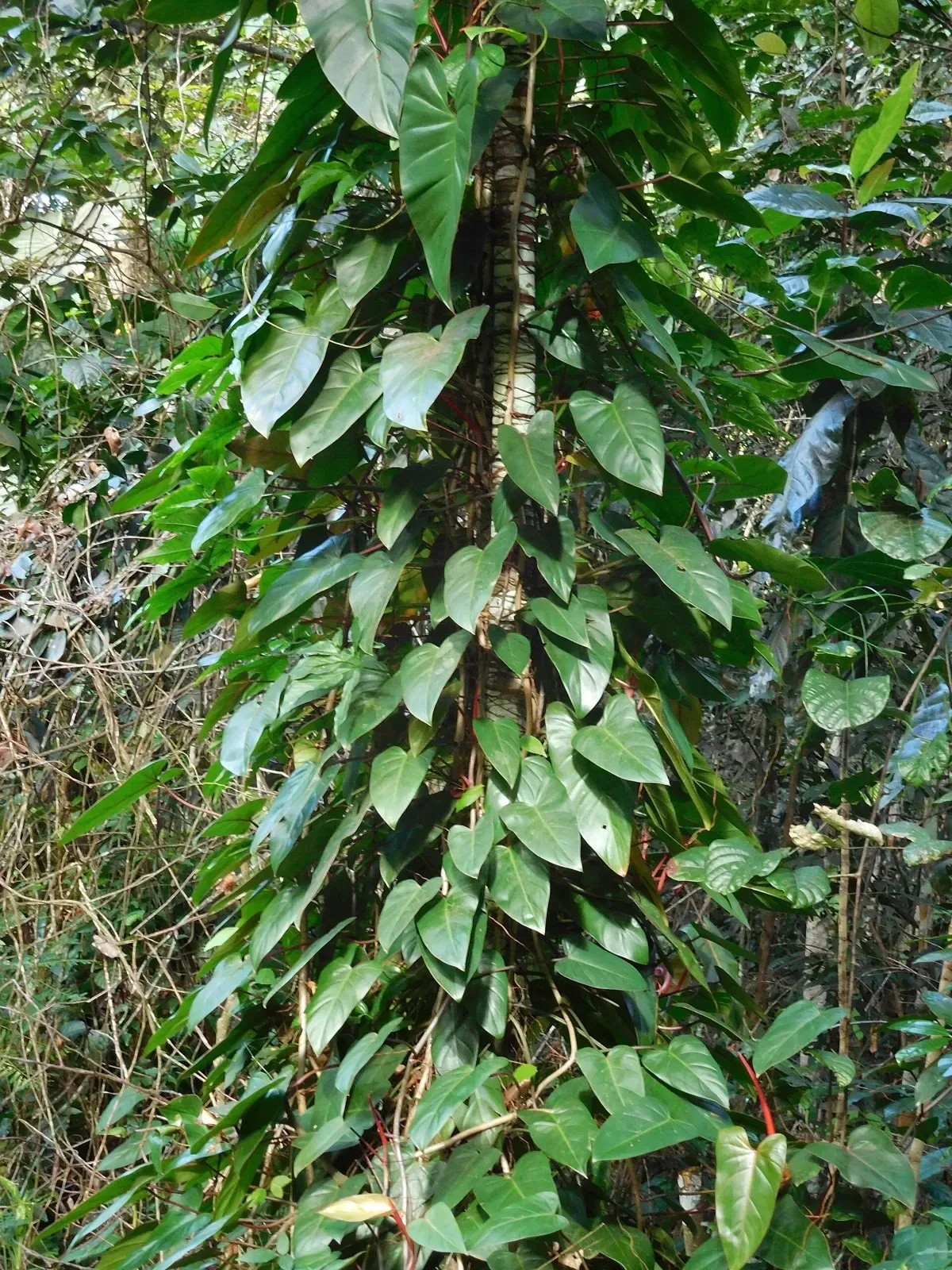
| ☀️ Light | Bright indirect light |
|---|---|
| 💧 Water | Moderate (lightly moist) |
| 🪴 Soil | Airy, well-drained indoor mix |
| 🌡️ Temp | 15°C – 29°C |
| 🐾 Safety | Cats: toxic · Dogs: toxic |
| 📏 Mature size | 90 cm |
Where It Grows & Climate Tolerance
Pet & Companion Animal Toxicity (White Princess Philodendron)
A slow climbing philodendron with dark green leaves splashed with white. The name is a trade name with no official register entry, so buy by the plant in front of you, not the label.
Care instructions
Care Guide & Maintenance Routine
Bright indirect light, plus a grow light in winter. Water when the top few centimetres are dry, less in cool months. Keep above 15°C and off cold glass. Feed April to September. Remove all-green stems. Toxic to pets.
Light & Sunlight
Avoid direct sun (NC State, species). White areas need more light than plain green leaves. In Canadian winters add a grow light; move back from hot summer glass.
Watering Schedule
Water when the top of the mix has dried (RHS genus guide), then drain fully. Check by touch; no fixed schedule. Water less in winter.
Potting Mix & Drainage
Airy, well-drained indoor mix
Temperature & Humidity
NC State gives 18 to 29°C for the species; RHS genus guide says keep above 15°C. Leaves touching frosty glass can be damaged.
The White Princess philodendron is a climbing philodendron with dark green leaves splashed and streaked with white. Some leaves carry a thin white line, some a big white half, and a few come out almost plain. It is often bought next to the Pink Princess, and it needs the same kind of care: bright light, a support to climb, and a careful hand with water in winter. The name is less settled than the plant's popularity suggests, so this page starts with what the records actually say. Then it covers how to buy one in Canada, how to keep the white, and how to care for it through a long, dry, heated winter.

White Princess philodendron at a glance
| What you need to know | Short answer |
|---|---|
| Name | Philodendron 'White Princess' (trade name; usually sold under P. erubescens); arum family (Araceae) |
| Name status | RHS: unresolved. No International Aroid Society registry record found. |
| Habit | Climber; grows best on a moss pole or plank |
| Light | Bright, indirect light; a grow light helps from November to February |
| Water | When the top few centimetres of mix are dry; much less often in winter |
| Warmth | Ideally 18 to 29°C; keep above 15°C and away from cold drafts |
| Humidity | Prefers it high; struggles in very dry furnace air |
| Difficulty | Intermediate |
| Pets | Not pet safe |
Identification and naming
What a White Princess looks like
NC State Extension lists 'White Princess' among the cultivars of Philodendron erubescens and describes it simply as green leaves splashed with white variegation. That is the only plant-specific description we found in a university or botanical source. The rest of what you can check at home comes from the species:
- Leaves are arrow to heart shaped, glossy and fairly long on a mature plant.
- It climbs. Given a pole, it puts out aerial roots and the leaves get bigger as it goes up.
- The white pattern is random. It can be fine streaks, larger patches or whole white sections, and it changes from leaf to leaf.
Because the pattern varies so much, judge a plant by its newest three or four leaves, not by one striking leaf.
Is White Princess a real cultivar?
It is a real plant that is widely sold, but its name has not been formally sorted out. Here is what the records say:
- RHS lists Philodendron 'White Princess' (v) and marks its name status as unresolved. RHS does not attach a species to it.
- We found no entry for it in the International Aroid Society cultivar registry, which is the official registry for aroid cultivar names.
- NC State Extension lists it under Philodendron erubescens, the same species Pink Princess is usually sold under.
So the fair way to describe it is "Philodendron 'White Princess', usually sold under P. erubescens". We do not repeat claims about who bred it or what it was crossed with, because we could not find a record that confirms them.
Philodendron White Princess vs look-alikes
Two other white-variegated philodendrons are often sold beside it: 'White Knight' and 'White Wizard'. Shops and buyers mix the three up all the time. We could not find a botanical or registry description that reliably separates them, so we will not give you a checklist that might be wrong. What we can say:
- Buy from a seller who shows the exact plant you will receive, including the stems and the newest leaf.
- Ask the seller where the plant came from and what it was sold as originally.
- If the label matters to you, for example for a collection, keep the seller's listing and photos.

For a side-by-side with its pink cousin, see our guide Pink Princess vs White Princess philodendron.
Buying a White Princess philodendron in Canada
White Princess is usually sold by plant shops and online sellers rather than big-box garden centres, and prices change a lot with the amount of white. A few checks help:
- Look at the newest leaf and the bud that is about to open. A plant whose last few leaves are all green may be heading back to green on that stem.
- Avoid plants where most leaves are mostly white. White tissue cannot feed the plant, and very white plants are often weak.
- Check the roots if you can. They should be firm and pale, not soft and brown.
- Look under leaves and in the leaf joints for spider mites, mealybugs and scale.
Ordering online from November to March is a gamble. Tropical plants can be damaged by cold in transit. If you must order in winter, choose a seller who ships with heat packs, and open the box as soon as it arrives. Keep a new plant away from your others for two or three weeks and check it for pests.
Light in a Canadian home
Light is the single biggest factor for a White Princess. The white parts have no chlorophyll, so the green parts must do all the feeding. That means it wants more light than a plain green philodendron. At the same time, NC State Extension says the species should be kept out of direct sun, and white tissue scorches quickly.
- East window: good all year.
- South window: excellent from October to March. From May to August, set it back from the glass or filter the light with a sheer curtain.
- West window: good with a sheer curtain in summer.
- North window: usually too dim for good variegation, especially in winter.
Grow lights in winter
From November to February, even a south window gives few hours of useful light in most of Canada. University of Minnesota Extension suggests 12 to 14 hours of light a day for foliage plants, with lights 30 to 60 cm above the leaves. A simple LED fixture on a timer makes a real difference to leaf size and colour. Keep the light far enough away that white areas do not bleach or brown.
Moss pole and support
As a climber, White Princess grows larger, better leaves when it has something to hold. RHS advises giving climbing philodendrons support, such as a moss pole they can root into if it is kept moist. Add the pole when you pot up in spring, push it in carefully to avoid roots, and tie the main stem loosely with soft ties. Aerial roots will find the pole over a few weeks.
Soil mix, pots and repotting
RHS suggests a loose, free-draining houseplant compost for the closely related Pink Princess, and its general philodendron advice suggests about two parts orchid compost to one part peat-free ericaceous compost. A simple mix that works in Canadian homes:
- 2 parts indoor potting mix
- 1 part small orchid bark
- 1 part perlite
This is a starting point, not a lab formula. In a very dry house, a little less bark helps the pot hold water. If the mix stays wet for more than a week or two, add more perlite next time.
Always use a pot with a drainage hole. Repot in spring, April to June, into a pot only a few centimetres wider. RHS says philodendrons can often stay in the same pot for a couple of years. A pot that is too big stays wet in a cool winter room and invites root rot.
Watering by season
Water when the top few centimetres of mix feel dry, then water until it drains and empty the saucer. RHS advice for Pink Princess is to water freely while growing and moderately at other times. There is no fixed number of days; it depends on light, warmth, pot size and mix.
Spring and summer
Growth is fast and the pot dries quicker. Check every few days in warm weather.
Autumn
Growth slows as days shorten. Once the furnace starts, the top of the pot dries fast while the middle stays damp. Push a finger or a wooden skewer deeper before you water.
Winter
Water much less often. A plant in a cool room near a window may go two weeks or more. Use room-temperature water. NC State Extension notes that watering at the base, keeping water off the leaves, helps prevent leaf spot diseases.
Humidity and temperature
NC State Extension says Philodendron erubescens prefers warm temperatures of about 18 to 29°C, high humidity, and protection from cold drafts. That makes January in a heated Canadian home the hardest month. Furnace air on the Prairies and in much of Ontario and Quebec can get very dry.
- Run a humidifier in the room, or group plants together. University of Minnesota Extension also suggests a tray of pebbles and water under the pot, with the pot above the water line.
- Keep the plant away from heat registers, wood stoves and baseboard heaters.
- Keep leaves off cold window glass on winter nights. RHS advises keeping philodendrons above 15°C.
- Keep it away from entry doors that let in blasts of cold air.
Misting gives only a short boost and can leave water sitting on leaves. Use it as an extra, not as your main humidity plan.
Fertilizer
RHS advises feeding philodendrons during the growing season, April to September, with a general houseplant fertilizer. Monthly at half strength is enough for most homes. Water first, then feed, so the roots are not hit by strong fertilizer on dry mix.
Stop feeding in October. A slow winter plant cannot use it, and salts build up and brown the leaf edges, which shows badly on white sections. Fertilizer will not bring white back to a stem that has gone green.
Pruning
Most of the time a White Princess needs little pruning beyond removing damaged leaves. RHS suggests pruning climbing philodendrons in spring, just as they start to grow, with the cut made just after a leaf node.
- If one stem has made several all-green leaves in a row, cut it back to just above the last leaf with good white. RHS advises removing reverted shoots or cutting back to variegated growth.
- Remove leaves that have turned fully brown. A leaf that is mostly white but still firm can stay until it starts to fail.
- Wear gloves. NC State Extension notes the sap may cause skin irritation.
Propagation
White Princess is grown from cuttings. Seed would not reliably copy the variegation, and RHS explains that variegated plants are usually kept going by cuttings from the variegated parts.
- In spring or summer, choose a stem whose leaves show a good balance of white and green.
- Cut a section with at least one node and, ideally, an aerial root. RHS suggests about 10 cm, cut just below a leaf joint.
- Root it in water or in damp, airy mix in bright, indirect light and a warm spot.
- Pot it up once roots are a few centimetres long.
A cutting with almost no green leaf area roots slowly and often fails, so avoid taking a mostly white piece. Full steps, including winter timing, are in our philodendron propagation guide.
Why is my White Princess going all green?
New leaves coming in plain green worry every owner. There are three common reasons.
1. Reversion on one stem
RHS explains that variegated plants usually start as a sport, a mutation of a green plant, and that green shoots can appear and grow more strongly because they have more chlorophyll. If one stem keeps making green leaves, cut it back to the last well-variegated leaf.
2. Too little light
University of Minnesota Extension notes that variegated plants may revert to solid green in poor light. In a Canadian winter, low light is the usual suspect. Add light first, then judge the next few leaves.
3. Normal variation
Some leaves are simply greener than others. One green leaf among variegated ones is not a problem. Several green leaves in a row on the same stem is.
Our guide why is my variegated philodendron losing colour? walks through all of this with photos.
Why do the white parts turn brown?
White sections are the weakest part of the leaf. They have no green tissue to feed themselves and they dry out easily. Browning is common and often not a sign of a bigger problem, but these causes are worth checking:
- Dry winter air: crisp, brown edges on white areas, often worst near a heat register.
- Sun through glass: brown or bleached patches that appear after a sunny spell, usually on the side facing the window.
- Fertilizer salts: brown tips and edges after winter feeding. Flush the pot with plenty of water and stop feeding until April.
- Root trouble: brown, soft patches together with wet mix and drooping. Check the roots.
A leaf that is almost all white will often brown and die on its own. RHS notes that all-white shoots are weak and do not take over a plant the way green ones do.
Problem troubleshooter
| What you see | Likely cause | What to do first |
|---|---|---|
| Several all-green leaves on one stem | Reversion or low light | Add light; cut back to the last variegated leaf. |
| Small leaves, long gaps on the stem | Low light, often in winter | Brighter window or grow light 12 to 14 hours a day. |
| Brown, crispy white sections | Dry air or heat register | Move away from heat; humidifier or grouping. |
| Bleached or brown patches facing the window | Hot sun through glass | Move back or use a sheer curtain. |
| Yellow lower leaves, wet mix | Overwatering | Let the mix dry more; check drainage and roots. |
| Soft, dark stem at soil level | Root or stem rot | Take healthy cuttings, then repot what is left in fresh mix. |
| Fine webbing, speckled leaves | Spider mites | Rinse the plant; use a houseplant-labelled insecticidal soap if needed. |
| White fluff in leaf joints | Mealybugs | Isolate; dab with rubbing alcohol on a swab, then a labelled product. |
| Brown bumps on stems | Scale | Scrape off and treat with a labelled product. |
NC State Extension lists spider mites, mealybugs, aphids and scale for Philodendron erubescens, plus root rot from overwatering and leaf spot diseases. Use products labelled for indoor plants in Canada and follow the label. Our plant problems page covers more symptoms.
Month-by-month care calendar for Canada
| Month | What to do |
|---|---|
| January | Grow light on 12 to 14 hours. Water rarely. No feeding. Humidifier on. Check for spider mites. |
| February | Wipe dust off leaves. Keep off cold glass. Note any green stems for spring pruning. |
| March | Growth starts again. Water a little more often as the mix dries faster. |
| April | Start half-strength feeding. Repot or add a moss pole if needed. Cut back reverted stems. |
| May | Take cuttings from well-variegated stems. Pull back from south glass as the sun gets stronger. |
| June | Sheer curtain on south and west windows. Keep the moss pole moist so roots attach. |
| July | Check water more often in heat. Watch white areas for sunburn. |
| August | Last month for easy repotting and cuttings. |
| September | Last feed. If it summered outdoors, bring it in early and check for pests. |
| October | Stop feeding. Furnace on: check mix deeper. Move closer to the brightest window. |
| November | Water less. Start the grow light. Set up the humidifier. |
| December | Keep away from heat registers and drafty doors. Do not repot now. |
Safety for pets, children and skin
Treat White Princess as toxic. ASPCA does not have a separate White Princess entry, but it lists philodendrons, including Philodendron erubescens trade names such as Red Emerald and Red Princess, as toxic to dogs and cats because of insoluble calcium oxalates. Signs include mouth irritation, drooling, vomiting and trouble swallowing. NC State Extension describes Philodendron erubescens as poisonous if eaten, causing mouth and stomach irritation, and says the sap may irritate skin. RHS says the same for philodendrons in general.
- Keep it out of reach of cats, dogs and small children.
- Wear gloves when pruning or taking cuttings, and wash your hands after.
- If a pet chews it, call your vet. The ASPCA Animal Poison Control line is (888) 426-4435 (a fee may apply). For a child, call your provincial poison centre.
See our pet-safe plants list for safer choices.
Common mistakes
- Paying extra for a plant that is mostly white. It looks great for a few weeks, then struggles.
- Keeping it in a dim corner and expecting white leaves.
- Moving it into hot summer sun to "boost" the white. The white burns first.
- Watering on the same schedule in January as in July.
- Using a pot far bigger than the root ball.
- Feeding through winter to fix pale or green leaves.
- Leaving reverted green stems on the plant until they take over.
Watch: White Princess philodendron care
A practical care video from a grower. Use the watering tips as a guide only. In a Canadian winter, always check the mix before you water.
Related plants and guides
- Philodendron types and care for Canadian homes, our main philodendron guide
- Pink Princess philodendron, its pink cousin
- Pink Princess vs White Princess: key differences
- Philodendron Strawberry Shake
- Philodendron Birkin, another white-marked philodendron
- Why is my variegated philodendron losing colour?
- Philodendron care in Canadian winters
Sources
- RHS: Philodendron 'White Princess' (v) (name status unresolved). Accessed 10 Nov 2026.
- NC State Extension Plant Toolbox: Philodendron erubescens (cultivar list, care, pests, toxicity). Accessed 10 Nov 2026.
- RHS: Philodendron 'Pink Princess' (v) (cultivation advice for the related cultivar). Accessed 10 Nov 2026.
- RHS: How to grow philodendrons. Accessed 10 Nov 2026.
- RHS: Reversion. Accessed 10 Nov 2026.
- International Aroid Society: cultivar registry (no White Princess record found). Accessed 10 Nov 2026.
- ASPCA: Split Leaf Philodendron (lists Red Emerald and Red Princess). Accessed 10 Nov 2026.
- University of Minnesota Extension: Lighting for indoor plants. Accessed 10 Nov 2026.
- University of Minnesota Extension: Winter houseplant tips. Accessed 10 Nov 2026.
Seasonal rhythm
Seasonal Calendar
A month-by-month calendar for White Princess Philodendron in Canada is coming soon. See the light, water and temperature notes above.
Diagnostics
Common Problems & Troubleshooting
All-green new leaves: low light or reversion. Brown white patches: dry air, hot sun or salts. Yellow lower leaves with wet mix: overwatering.
Pests & seasonal watch: Thrips, mealybugs, scale and spider mites are the usual indoor pests. Use products labelled for indoor plants in Canada.
Q&A
Frequently Asked Questions
Is White Princess a real cultivar?
It is a real, widely sold plant, but its name is not formally settled. RHS lists Philodendron 'White Princess' with the name status unresolved, and we found no record in the International Aroid Society cultivar registry. NC State Extension lists it under Philodendron erubescens. Treat it as a trade name and buy the plant you can see.
How can I tell a real philodendron White Princess?
There is no official description to check against, so no test is certain. NC State describes it only as green leaves splashed with white. Buy from a seller who shows the exact plant, its stems and its newest leaf, and keep the listing. Be wary of very cheap plants with heavy white variegation.
White Princess vs White Knight: how do I tell them apart?
We could not find a botanical or registry description that reliably separates them, so we will not give a checklist that might be wrong. Both are sold with white variegation on green leaves. Ask the seller for the plant's origin and photos of the stems and newest leaf, and judge the plant on its health and variegation rather than the label.
Why is my White Princess going all green?
Usually low light or reversion. If every new leaf is greener and smaller, add light, ideally a grow light for 12 to 14 hours a day in winter. If one stem keeps making all-green leaves, cut it back to the last well-variegated leaf, as RHS advises for reverted shoots. One green leaf on its own is normal.
Why do the white parts of my White Princess turn brown?
White tissue has no chlorophyll, dries out easily and is the first part to suffer. Common causes are dry furnace air, a nearby heat register, sun through glass, and fertilizer salts from winter feeding. Raise humidity, move the plant from heat and stop feeding until April. Mostly white leaves often brown on their own.
Is White Princess philodendron toxic to cats and dogs?
Yes, treat it as toxic. ASPCA lists philodendrons, including erubescens trade names such as Red Emerald and Red Princess, as toxic to dogs and cats because of insoluble calcium oxalates. NC State lists Philodendron erubescens as poisonous if eaten. If a pet chews it, call your vet or the ASPCA Animal Poison Control line.
How much light does a White Princess need in Canada?
More than a green philodendron. Give it the brightest indirect light you have: an east window all year, or a south window from October to March. From November to February, add a grow light for 12 to 14 hours a day, 30 to 60 cm above the leaves, as University of Minnesota Extension suggests. Avoid hot summer sun through glass.
How often should I water White Princess in winter?
There is no fixed schedule. Water when the top few centimetres of mix feel dry, then water until it drains and empty the saucer. In a cool Canadian winter room that may be every two weeks or longer. Check the mix with your finger first, and use room-temperature water.
Does White Princess need a moss pole?
It does not have to have one, but it grows better with one. It is a climber, and RHS advises giving climbing philodendrons a moss pole they can root into if kept moist. Climbing plants usually make larger leaves. Add the pole when you repot in spring and tie the stem loosely.
Should I buy a White Princess with mostly white leaves?
No, not if you want a healthy plant. White tissue cannot feed the plant, so very white plants are weak and often brown. RHS notes that all-white shoots are weak. Pick a plant with a good balance of white and green on its newest leaves.
Can I put my White Princess outside in summer in Canada?
Yes, for a few warm months, if nights stay above about 15°C, the minimum RHS gives for philodendrons. Keep it in full shade, since white areas burn quickly in sun. Bring it back in early in September and check it for pests before it rejoins your other plants.
Similar Botanical Matches
Grower field notes
Reader Field Notes in Canada
Share how this plant performs in your local Canada climate.