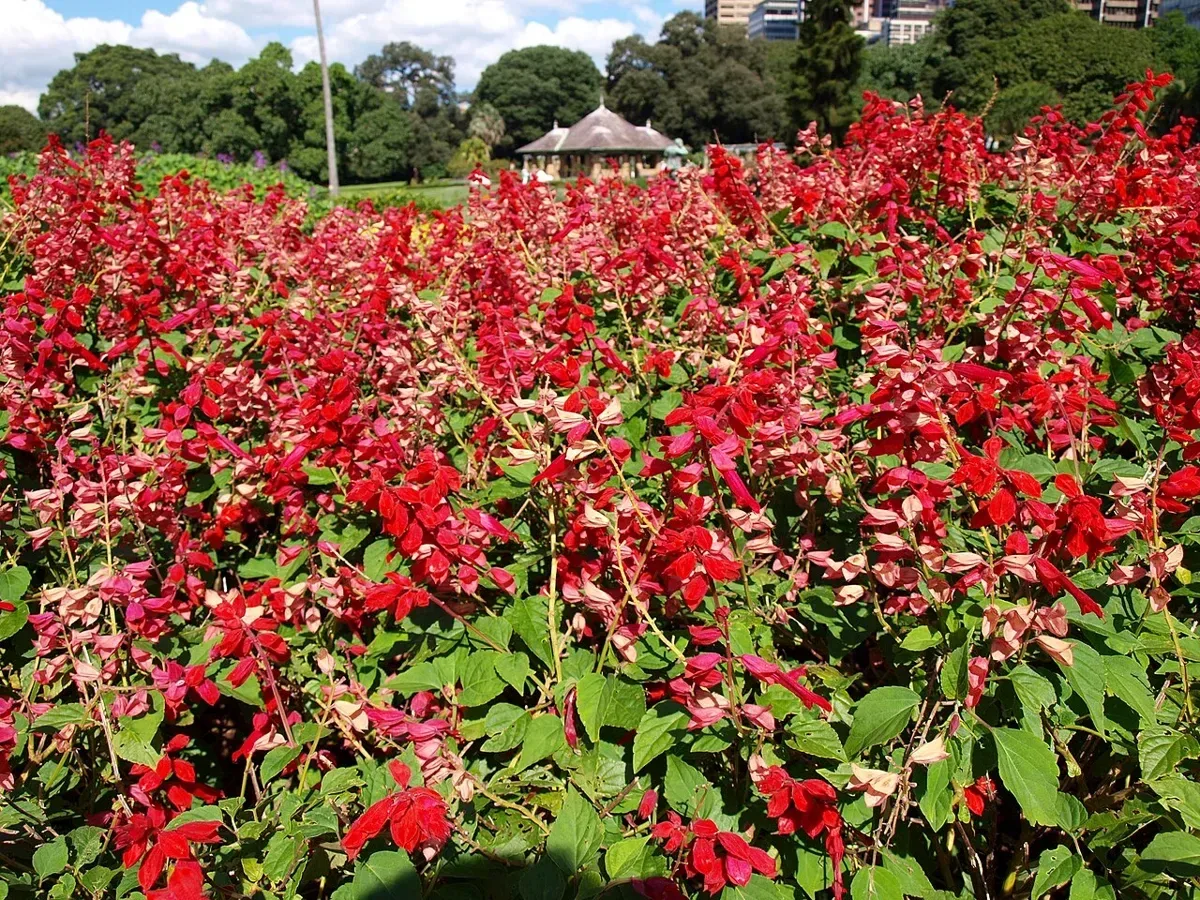
| ☀️ Light | Full sun |
|---|---|
| 💧 Water | Moderate (lightly moist) |
| 🪴 Soil | Fertile, moisture-retentive, well-drained soil |
| 🌡️ Temp | 2°C – 35°C |
| 🐾 Safety | Cats: not verified · Dogs: not verified |
| 📏 Mature size | 45 cm |
Where It Grows & Climate Tolerance
Pet & Companion Animal Toxicity (How to Grow Scarlet Sage in Canada)
Across Canada, red salvia is a June-to-September bedding annual: sold in flats at garden centres around Victoria Day, tucked into front walks, window boxes and civic carpet beds, and finished by the first autumn frost. It is a summer-only plant from Nanaimo to St. John's.
Care instructions
Care Guide & Maintenance Routine
Pick up budded flats at the garden centre in late May, or sow on the surface under shop lights around March break. Transplant into a sunny, well-drained spot once nights stay mild. Soak beds weekly in a dry July, snip spent spikes, and fertilize patio planters monthly until Labour Day.
Light & Sunlight
Full sun gives the most flowers; NC State lists full sun to partial shade. In the hot Indian plains, some afternoon shade keeps flowers fresher in March and April.
Watering Schedule
Keep the soil evenly moist. NC State notes scarlet sage is not drought tolerant; wilting plants drop flowers and the lower leaves yellow. Avoid soggy soil, which causes root and stem rot.
Potting Mix & Drainage
Fertile, moisture-retentive, well-drained soil
Temperature & Humidity
Frost-tender coast to coast. Chilly June nights in Calgary or Thunder Bay stall transplants and purple the foliage. Prairie displays usually end in mid-September; Ontario, Quebec and BC coastal beds often last until Thanksgiving.
Scarlet sage in Canadian gardens
Scarlet sage is one of the standard red bedding plants in Canadian cities, used in municipal carpet beds, boulevard planters and front-yard borders. NC State notes it needs warmth and is hardy only in zones 10 and 11, so in Canada it is grown strictly as an annual.
Starting from seed
Seed needs a long, warm start. Sow indoors 8 to 10 weeks before your last frost date, usually in March. Press the seed onto the surface of moist mix and do not cover it; NC State notes the seed needs light. Keep the tray warm, around 21 to 24°C, under lights. Give air once seedlings appear to avoid damping-off, and pot them on at the two-leaf stage.
Planting out
Wait until the soil has warmed and frost is past. Cold nights below about 10°C check growth and turn leaves purple. RHS advises planting tender salvias in late May or June, which matches most of Canada.
- Vancouver, Victoria: mid-May.
- Toronto, Montréal, Ottawa: after Victoria Day.
- Calgary, Edmonton, Regina, Saskatoon, Winnipeg: early June.
- Halifax, Charlottetown, St. John's: early to mid-June.
Summer care
Water whenever the top few centimetres dry; NC State notes scarlet sage is not drought tolerant. Containers on hot decks may need watering daily in July. Deadhead faded spikes, and feed container plants monthly with a potassium-rich fertiliser, as RHS recommends.
End of the season
The first fall frost ends the show. RHS notes bedding salvias are composted in autumn. Tip cuttings taken in late August can be rooted indoors and kept on a bright windowsill over winter, but most gardeners start fresh each spring.
Civic beds and cottage pots
Many Canadian parks departments use red salvia in carpet bedding, planted in early June and often swapped in September for mums and ornamental kale. At home, it suits a sunny front walk, a window box under a south-facing sill, or a planter on the dock at a Muskoka or Kawartha cottage. In Edmonton or Saskatoon, choose early dwarf strains and buy plants already in bud, because seed sown at home may only start flowering by mid-July. On Vancouver Island, cool, damp summers can bring grey mould; space plants wider and water in the morning. Garden centres in Halifax or Moncton sell plants in flats from late May; pick compact ones with buds, not tall ones already in full flower.
A typical season in Winnipeg
Seed goes in under lights in mid-March. Seedlings are hardened off on the deck in late May and planted in early June, once the last frost has passed. Spikes colour up by Canada Day and keep going until the first frost, often in mid-September.
Questions from Canadian readers
- Why are my salvia leaves purple after planting? Usually from cold nights. Growth resumes once the weather warms.
Seasonal rhythm
Seasonal Calendar
| Month | Care Tasks | Seasonal Focus |
|---|---|---|
| Jan | sow | January: browse seed catalogues for dwarf red strains. |
| Feb | sow | Family Day: clean trays, buy fresh mix and LED shop lights. |
| Mar | sow | March break: press seed onto damp mix; keep near 22°C. |
| Apr | repot | April: move seedlings into cell packs; pinch once. |
| May | plant | Victoria Day long weekend: buy budded flats; harden off. |
| Jun | plant, feed | June: Prairie transplanting; soak the root balls. |
| Jul | prune | Canada Day: spikes colouring; snip faded ones weekly. |
| Aug | feed | Civic holiday heat: water window boxes every morning. |
| Sep | prune | Labour Day: last fertilizer; root a few tip cuttings. |
| Oct | protect | Thanksgiving: frost blackens beds in Ontario and Quebec. |
| Nov | protect | Remembrance Day: pull spent plants into the compost bin. |
| Dec | sow | December: keep rooted cuttings on a bright sill. |
Diagnostics
Common Problems & Troubleshooting
Seedlings collapsing from damping-off; few flowers in shade or rich soil; leaf drop and wilting when the soil dries; powdery mildew and grey mould in crowded, damp beds; spider mites in dry heat; aphids and whitefly on young growth.
Pests & seasonal watch: Whiteflies and aphids hitchhike on greenhouse flats, so check leaf undersides before buying. Spider mites flare in hot, dry Okanagan or Prairie summers. Grey mould spreads in drizzly Maritime and Vancouver Island weather.
- Yellow leaves — Leaves fade from green to yellow, often starting at the bottom.
- Leggy — Long weak stems with big gaps between small leaves, leaning to the window.
- Spider mites — Fine webbing and pale speckled leaves, worse in dry heated rooms.
- Aphids — Clusters of small soft insects on new tips, often sticky.
- Whitefly — Tiny white insects fly up in a cloud when you touch the plant.
- White powder — A white powdery film on leaves, usually in still, humid air with dry soil at the roots.
- Grey mould — Fuzzy grey mould on faded flowers, damaged leaves or soft stems.
- Underwatering — Soil is bone dry and leaves are crispy, curled or dull.
Similar Botanical Matches
Grower field notes
Reader Field Notes in Canada
Share how this plant performs in your local Canada climate.