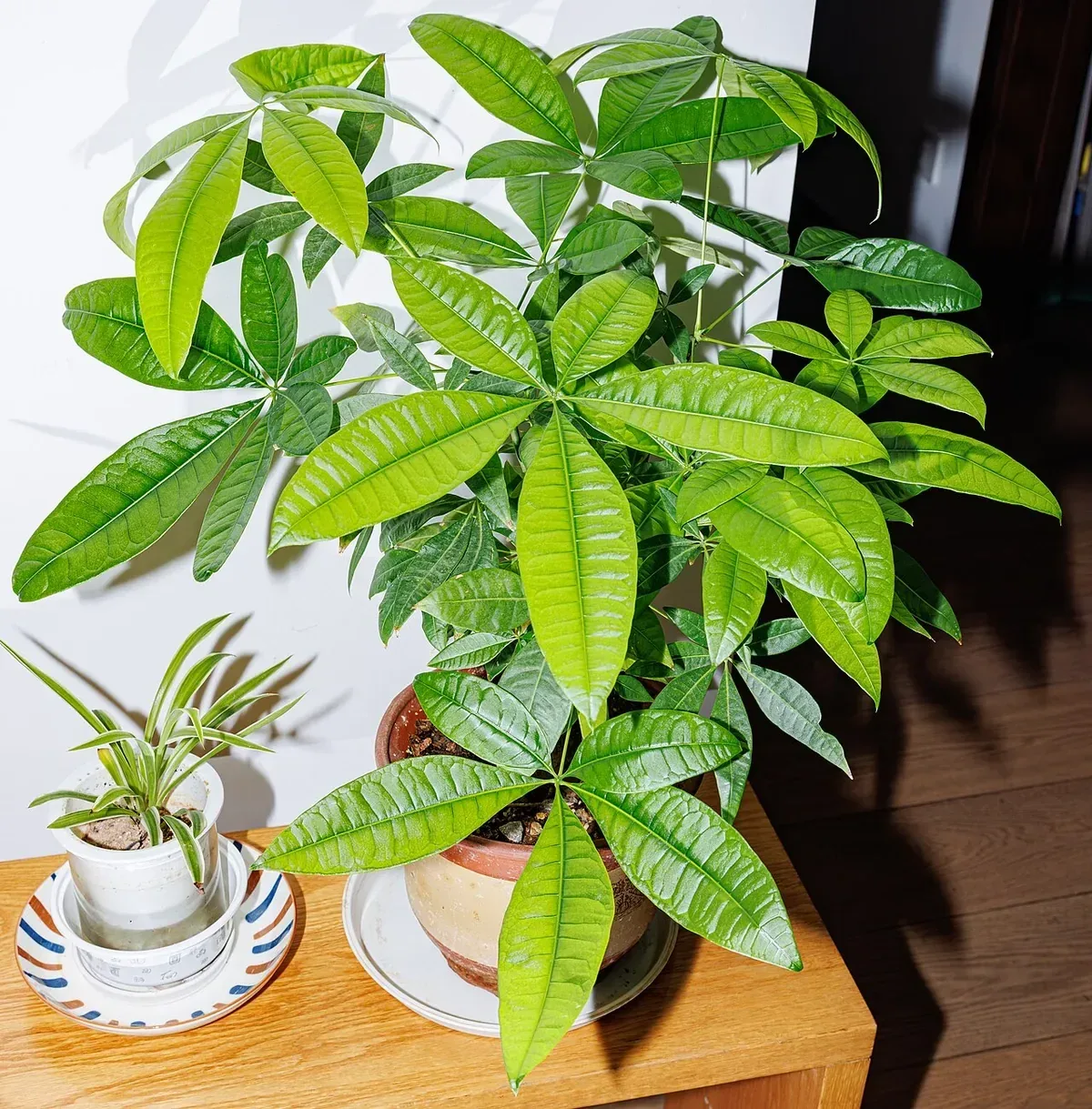
| ☀️ Light | Bright indirect light |
|---|---|
| 💧 Water | Moderate (lightly moist) |
| 🪴 Soil | Free-draining peat or coir-based potting mix with perlite or coarse sand |
| 🐾 Safety | Cats: non-toxic · Dogs: non-toxic |
Where It Grows & Climate Tolerance
Pet & Companion Animal Toxicity (Money Tree Care in Canada)
In Canada, Pachira is a year-round houseplant sold at grocery stores, IKEA and garden centres. The challenges are furnace-dried air, short December days and chilling on the trip home, not care itself.
Care instructions
Care Guide & Maintenance Routine
Brightest window from Thanksgiving to Easter, ideally south or west. Humidifier or pebble tray once the furnace starts. Optional summer on a shaded balcony in coastal BC or southern Ontario after nights warm up; back inside before September chills on the Prairies.
Light & Sunlight
An east window or a spot a little back from a south or west window suits it. NC State Extension notes that direct sun can scorch the leaves. In weak light the stems stretch and the plant drops lower leaves.
Watering Schedule
Water thoroughly, let the excess drain out, then wait until the top few centimetres are dry before watering again. Standing water leads to root rot. Water less in cool months when growth slows.
Potting Mix & Drainage
Free-draining peat or coir-based potting mix with perlite or coarse sand
Temperature & Humidity
No Canadian hardiness zone suits it; even Vancouver and Victoria sit at Zone 9a on the NRCan 1991-2020 map. NC State advises bringing it inside before 7°C. Keep foliage off icy panes and away from baseboard heaters and forced-air registers.
Pachira through a Canadian year
Money tree is an indoor plant everywhere in Canada. Natural Resources Canada's 1991-2020 map puts Vancouver and Victoria in Zone 9a, Toronto in 7a, Montréal in 5b, Halifax in 6b and Calgary and Edmonton in 4a, and none of those is close to warm enough. Canadian zones also use a different formula from US Department of Agriculture zones, so the USDA 10 to 12 range on American plant tags does not map straight onto a Canadian zone.
Buying one, and the trip home
Grocery chains, IKEA, Home Depot, Canadian Tire, Rona and independent garden centres all stock small braided plants, mostly in 4 or 6 inch plastic pots. From November to March the risk is the walk across the parking lot. Ask for a paper sleeve or bag, warm the car first and drive straight home. Some online sellers hold live plants during deep cold or pack them with a heat pack; read the shipping policy before you order in January. Leaves that turn dark, glassy or limp a day or two after arrival point to chilling in transit.
Furnace air and winter humidity
Once the furnace runs, indoor air gets very dry, especially in Prairie homes, while frost forms on the inside of cold window frames. Keep the plant off the sill so leaves do not touch icy glass, and away from forced-air registers and baseboard heaters. A room humidifier, a pebble tray or a cluster of houseplants helps more than misting, which dries within minutes.
Low winter light and grow lights
Between the end of daylight saving in November and its return in March, a south or west window is the best seat in the house. In a basement suite or a north-facing condo, an LED grow light on a plug-in timer keeps the day length steady. Hang it close enough that the new growth stays compact rather than stretching toward the window.
Patio summer, by region
- BC coast: Vancouver's average last spring frost is about 26 March and Victoria's about 14 April, but nights stay cool well into May. A covered balcony works from June.
- Ontario and Quebec: last frost averages about 4 May in Toronto, 7 May in Ottawa, 29 April in Montréal and 11 May in Québec City. Wait for warm nights in June.
- Prairies: last frost averages around 22 May in Edmonton and Saskatoon, 24 May in Winnipeg and 26 May in Calgary, and the first fall frost can come by about 10 September in Calgary. Many growers skip the patio entirely.
- Atlantic Canada: last frost averages about 8 May in Halifax, 18 May in Charlottetown and 1 June in St. John's. A short July and August stint in shade is plenty.
Introduce it to outdoor light over a week, starting in full shade, and bring it in before the first cool September nights.
Questions Canadian readers ask
- Leaf drop in week one? Usually chilling between store and driveway, or a darker room. Patience fixes it.
- Under a skylight? Yes, though July midday glare through glass can scorch.
- Cats? ASPCA lists Pachira as non-toxic.
- Condo with radiant floor heating? Raise the pot on plant feet so roots do not cook and dry out.
Read our notes on plants near cold windows and winter watering.
Seasonal rhythm
Seasonal Calendar
| Month | Care Tasks | Seasonal Focus |
|---|---|---|
| Jan | protect | Furnace season: humidifier or pebble tray, leaves clear of frosty glass. Water only when the top few centimetres are dry. |
| Feb | protect | Darkest weeks on the Prairies and in the North. An LED grow light on a timer keeps growth compact. No fertilizer. |
| Mar | prune, repot | Daylight saving returns. Prune leggy stems and repot root-bound plants toward month end. |
| Apr | feed, repot | Begin feeding at label strength. Cuttings taken now root on a warm kitchen counter. |
| May | feed | Coastal BC frost risk is over, but nights are chilly. Prairies and Atlantic provinces: indoors. |
| Jun | plant, feed | Vancouver, Victoria and southern Ontario: a shaded, covered balcony once nights are warm. Elsewhere, a bright indoor window. |
| Jul | feed | Peak heat in Toronto and Montréal condos: watch for spider mites near sunny glass. Patio pots dry quickly. |
| Aug | feed | Last fertilizer of the season. Calgary and Edmonton nights cool fast late in the month; have a plan to bring pots in. |
| Sep | protect | Prairie first frosts arrive around 10 to 15 September. Inspect for pests, then bring every patio plant inside. |
| Oct | protect | Thanksgiving to Halloween: furnaces switch on. Move closer to the brightest window and stretch the gap between waterings. |
| Nov | protect | Clocks fall back. Wipe dust from leaves so they catch the weak light. No repotting until spring. |
| Dec | protect | Holiday-season drafts from entry doors and space heaters cause leaf drop. Keep watering light and expect slow growth. |
Diagnostics
Common Problems & Troubleshooting
Yellow lower leaves and soft trunk base from overwatering; leaf drop after a move or a cold draft; brown crispy edges from dry air or underwatering; scorched patches from direct sun; leggy growth in low light.
Pests & seasonal watch: Spider mites and scale flare up once furnaces dry the air. Fungus gnats breed in damp mix under dim winter light. Patio plants coming back in September can carry aphids and ants, so quarantine them for a couple of weeks.
- Yellow leaves — Leaves fade from green to yellow, often starting at the bottom.
- Brown tips — Leaf tips and edges turn dry, brown and papery.
- Root rot — Roots turn brown and mushy in soil that stays wet.
- Mealybugs — White cottony clumps in leaf joints, often with sticky honeydew.
- Leggy — Long weak stems with big gaps between small leaves, leaning to the window.
- Spider mites — Fine webbing and pale speckled leaves, worse in dry heated rooms.
- Fungus gnats — Tiny dark flies hover around wet potting mix.
- Scale — Hard or soft brown bumps stuck to stems and leaf ribs, often with sticky honeydew.
- Overwatering — Soil stays wet, leaves yellow or droop, and the pot feels heavy.
- Leaf drop — Many leaves fall in a short time, sometimes still green.
- Sun scorch — Bleached or crispy patches on the side that faces strong sun.
- Cold damage — Dark, water-soaked or blackened patches after a cold night or an AC blast.
Care encyclopedia · 1 guide
Guides & Articles for Money Tree Care in Canada
Similar Botanical Matches
Grower field notes
Reader Field Notes in Canada
Share how this plant performs in your local Canada climate.