
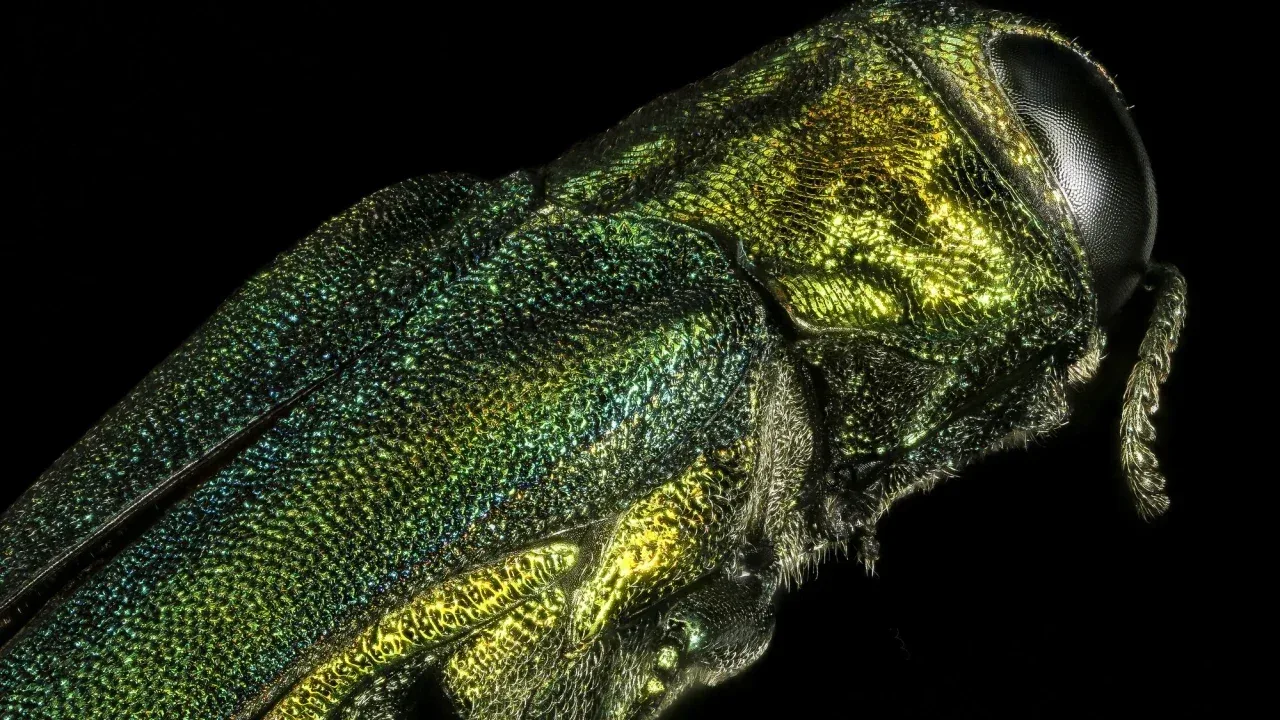
Emerald Ash Borer in Canada: Signs, Spread and What Homeowners Can Do
If there's an ash tree on your street, the emerald ash borer (Agrilus planipennis) has probably already reached it, or soon will. This small, metallic green beetle from Asia attacks and kills every species of true ash. The Canadian Food Inspection Agency (CFIA) says it has killed millions of trees in North America, and the City of Toronto alone has lost more than 800,000 ash trees to it since 2007.
This guide explains how to recognise an infested tree, where the beetle is regulated in Canada as of November 2026, the firewood and yard-waste rules that apply to you, and your real options for an ash on your property: treat it, remove it, or replace it.
Emerald ash borer at a glance
- What it is: An invasive wood-boring beetle native to China and eastern Asia. CFIA notes that it was first confirmed in Canada in 2002. Ontario's government says it was discovered in Ontario in June 2002 and most likely crossed at Windsor from the Detroit area, where it probably arrived in wood packaging or pallets.
- What it attacks: All species of ash (Fraxinus). Ontario lists green, red, white, black and blue ash, plus non-native European ash. CFIA notes that in North America only ash has been found infested.
- Where it's found: Parts of Ontario, Quebec, New Brunswick, Nova Scotia, Manitoba and British Columbia.
- How fast it kills: CFIA says infested ash trees generally die within 2 to 3 years, and heavily infested trees have died in just 1 year.
- How it spreads: Mostly through firewood and other infested ash wood. CFIA notes that adults can also fly up to 10 km.
One clarification before you worry: mountain ash (Sorbus) is not a true ash, despite its name. The beetle attacks Fraxinus species.
How to identify an emerald ash borer infestation
The beetle
According to CFIA's fact sheet, the adult is a narrow, metallic blue-green beetle 8.5 to 14 mm long and about 3 mm wide, with a flat head and kidney-shaped, bronze or black eyes. It is small and hard to spot, so CFIA advises focusing on what's happening to the tree rather than looking for the insect.
The larva
Larvae are creamy white, flat and broad, with bell-shaped body segments and a pair of brownish, pincer-like appendages at the tail. CFIA's fact sheet gives a mature length of 26 to 32 mm. You'll only see them if bark is removed or a woodpecker has exposed them.
Signs on the tree
CFIA and Ontario's forest health information list these signs and symptoms:
- Thinning crown and branch dieback. The canopy gets sparse, usually starting at the top, and branches die back.
- Yellowing or wilting leaves. Ontario explains that larval galleries girdle the tree and cut off the flow of water and nutrients.
- Epicormic shoots. Clusters of new sprouts grow from the trunk and main branches as the tree tries to survive.
- Woodpecker damage. Woodpeckers chip off outer bark to reach larvae, leaving pale, light-coloured patches on the trunk.
- Vertical bark cracks. The tree produces callus tissue over the galleries, which splits the bark above them.
- S-shaped galleries. Under the bark, larvae carve flat, winding tunnels about 6 mm wide, packed with fine brownish frass. CFIA notes that galleries are typically 9 to 16 cm long and get wider as the larva grows.
- D-shaped exit holes. Adults chew their way out through small D-shaped holes. CFIA measures them at about 3.5 by 4.1 mm and warns that they are very hard to find.
Many of these symptoms can have other causes, such as drought, root damage or other borers. If you're in a non-regulated area and see several of them on an ash, report it to CFIA. If you're in a regulated area, ask an arborist to inspect the tree.
Life cycle
Ontario's government describes the life cycle this way:
- Adults emerge in June and July through D-shaped exit holes, and feed on ash leaves.
- Females lay 60 to 90 eggs, one at a time, in bark crevices.
- Larvae bore into the tree and feed on the inner bark and outer sapwood through summer and fall, creating the S-shaped galleries.
- Larvae overwinter under the bark, pupate in April or May, and emerge as adults about two weeks later.
In southwestern Ontario the beetle completes its life cycle in one year. Farther north, Ontario says about 30% of the population takes two years. The City of Toronto notes that adults lay eggs from late May to August.
Where emerald ash borer is regulated in Canada (November 2026)
CFIA sets regulated areas to slow the spread. As of its regulated areas page (last updated in summer 2026), they are:
| Province | Regulated area |
|---|---|
| Ontario | Southern and central Ontario, including Toronto, Ottawa, Hamilton, Greater Sudbury, Muskoka, Nipissing, Parry Sound, Timiskaming, Manitoulin and parts of Sudbury and Algoma districts (including Sault Ste. Marie), plus the City of Thunder Bay |
| Quebec | Southern and central Quebec, including Montréal, Laval, Longueuil, Québec City, Les Collines-de-l'Outaouais, Sherbrooke, Trois-Rivières, Saguenay, Charlevoix, Charlevoix-Est, Bonaventure and La Tuque |
| New Brunswick | Madawaska, Victoria, Carleton, York, Sunbury, Queens, Kings, Westmorland and Albert counties |
| Nova Scotia | Halifax County and part of Hants County |
| Manitoba | City of Winnipeg |
| British Columbia | Vancouver, the University of British Columbia, the University Endowment Lands, Burnaby, Surrey and New Westminster |
CFIA also lists recent detections outside these areas where movement of materials from the affected properties is prohibited. In 2025 and 2026 these included Cumberland, Kings and Colchester counties in Nova Scotia, Restigouche and Saint John counties in New Brunswick, and the City of Coquitlam in British Columbia. Regulated areas often expand after detections like these, so always check CFIA's current map before moving wood.
The beetle's westward jumps show how it travels. CFIA confirmed it in Winnipeg in December 2017. In British Columbia, a larva collected in Vancouver was confirmed on March 12, 2024, the first established population west of Manitoba, according to CFIA's report to the International Plant Protection Convention.
Alberta, Saskatchewan, Prince Edward Island, Newfoundland and Labrador and the territories have no regulated areas for emerald ash borer. CFIA's "Stop the spread" advice for Alberta still asks residents to learn the signs, report them and not move firewood.
Firewood and yard-waste rules
This is the part that applies to everyone, whether or not you own an ash.
If you live in a regulated area
CFIA's rules say:
- Ash firewood cannot be moved out of a regulated area, whether for commercial or personal use, such as taking firewood to the cottage or camping.
- Firewood of any other species can only be moved out of a regulated area by facilities registered under CFIA's Emerald Ash Borer Approved Facility Compliance Program.
- Any ash material, including whole trees, nursery stock, logs, branches, lumber, wood or bark chips, cannot leave the regulated area without CFIA's consent.
- Yard waste cannot be moved outside regulated areas, because it may contain ash bark, branches or trimmings. Your municipality may have special collection or disposal rules.
CFIA warns that moving these materials without approval can lead to fines or legal consequences. If a property is found to be infested, CFIA can issue a Notice of Prohibition of Movement for that location.
Everywhere in Canada
CFIA's "Don't Move Firewood" campaign asks everyone to buy local, burn local. It warns that moving untreated firewood even a few kilometres to or from a campground or cottage is a common way for invasive insects and diseases to spread, and that firewood is the fastest way emerald ash borer spreads. Its advice:
- Ask where firewood comes from when you buy it, and never bring it home from a trip.
- Burn local or heat-treated (kiln-dried) firewood.
- Report sightings of pests that are new to your area to CFIA.
The same firewood can carry other invaders, including the spongy moth, whose egg masses are often laid on firewood and items stored outdoors.
What homeowners can do about an ash tree
Treat a healthy, valuable tree
Trees can be protected by injecting them with a registered insecticide, according to Ontario's government. The product most Canadian cities use is TreeAzin, a systemic insecticide made from an extract of neem seeds. The City of Toronto explains:
- TreeAzin (PCP# 30559) contains azadirachtin and stops larvae from moulting, so they can't keep growing.
- It is injected under the bark by a licensed pesticide applicator, and protects the tree for up to two years.
- It is registered by Health Canada's Pest Management Regulatory Agency (PMRA) for emerald ash borer on ash, and it is allowed under Ontario's cosmetic pesticide ban.
- Toronto treats selected City-owned ash trees and, since 2025, has moved to a three-year rotation. For a healthy privately owned ash, the City suggests asking your arborist whether TreeAzin injections would help.
Ontario's management guide adds some important details:
- Timing: Inject while the tree is actively transpiring, generally May to August after leaves are fully expanded, and preferably before late summer. If the soil is dry, water the root zone deeply before treatment.
- Start early: Systemic insecticides need healthy conducting tissue to reach the crown. Ontario notes that some researchers suggest that if more than 50% of the canopy has been lost, it's probably too late to save the tree.
- Re-treat: Because the beetle stays in the landscape, protection requires repeat treatments. Avoid annual injections where possible, because each one wounds the tree.
- Protect pollinators: Registered injectable products are toxic to bees, so labels allow injection only after bloom.
Treatment is a long-term cost, so it makes most sense for a healthy, well-placed tree you value. Some municipalities offer help. For example, in 2019 the City of Pointe-Claire, Quebec, offered residents a preferential rate and a grant covering half the cost of TreeAzin treatment, and required ash trees with more than 30% dead branches to be cut down. Programs change, so check your own city's current rules.
Remove a dying tree promptly
The City of Pointe-Claire warns that dead ash trees are dangerous and more expensive to fell, so don't wait. Toronto recommends hiring an arborist certified by the International Society of Arboriculture (ISA) or registered with the American Society of Consulting Arborists, and notes that removing a tree over 30 cm in diameter may need a City permit. Many other Canadian cities have similar tree bylaws, so check before cutting.
In a regulated area, the wood, branches and chips from your tree must stay inside the regulated area. Ontario recommends chipping or burning infested material as soon as possible. Follow your municipality's rules for disposal.
Replace with diversity
CFIA recommends replanting dead ash with alternative species. Ontario's guide notes that landscapes with a diverse mix of tree species are less vulnerable to host-specific pests, and that blue ash (Fraxinus quadrangulata) has shown good tolerance of emerald ash borer when growing on its own roots. Ask a local nursery or your municipality which large shade trees suit your hardiness zone and soil, and avoid planting the same species your neighbours already have.
Under and around new trees, native shrubs such as saskatoon berry and red osier dogwood add diversity and food for wildlife. For flowers that support bees and butterflies, see our guide to native pollinator plants for Canadian gardens.
What doesn't work
Ontario's guide says there is no evidence that pruning out infested branches prolongs the life of an ash tree after an emerald ash borer attack. The guide also explains that trunk injection delivers insecticide directly into the tree and minimises exposure to non-target organisms, compared with spraying the outside of the tree.
Biological control
CFIA is releasing tiny parasitic wasps from the beetle's native range as biological control agents. Ontario explains that these stingless parasitoids were discovered in China and are being evaluated for how well they suppress emerald ash borer populations. They won't save an individual tree, but they may help keep populations lower over time.
How to report emerald ash borer
If you see signs of emerald ash borer outside a regulated area:
- Photograph the signs. Take clear photos of the tree, the crown, any exit holes, galleries or woodpecker damage, and the beetle if you find one.
- Note the exact location. Record the address or GPS coordinates.
- Contact CFIA. Use CFIA's online "Report an emerald ash borer sighting" form or call 1-800-442-2342.
- Don't move any wood from the tree until CFIA tells you what to do.
CFIA asks for reports from outside regulated areas. Inside them, contact your municipality about infested trees on public land, such as street trees.
How to protect ash trees: a homeowner's checklist
- Confirm it's a true ash. Make sure your tree is a Fraxinus species, not mountain ash. An ISA-certified arborist can confirm.
- Check the crown every summer. Look for thinning, dieback, yellowing leaves and epicormic shoots.
- Look at the trunk. Watch for woodpecker damage, vertical bark cracks and D-shaped exit holes.
- Decide early. If the tree is healthy and valuable, book an arborist to discuss TreeAzin injection before more than half the canopy is lost.
- Keep the tree healthy. Ontario recommends watering 15 to 20 mm every 7 to 10 days during hot, dry weather, mulching and avoiding root compaction.
- Remove dead ash promptly. Hire a qualified arborist and check your city's permit rules.
- Never move firewood. Buy local, burn local, and follow CFIA's rules for regulated areas.
Frequently asked questions
Can emerald ash borer hurt people or pets?
No. CFIA says the beetle poses no threat to human health. It's a threat to ash trees only.
Is emerald ash borer in Alberta or Saskatchewan?
There are no CFIA regulated areas for emerald ash borer in Alberta or Saskatchewan as of November 2026. The closest regulated area is Winnipeg. CFIA asks Prairie residents to learn the signs, report them and never move firewood.
Can I save my ash tree?
Often, if you act early. Trunk injection with a registered insecticide such as TreeAzin can protect a healthy tree for up to two years per treatment. Ontario notes that if more than half the canopy is gone, it's probably too late.
How much does it cost to treat an ash tree?
It depends on the size and health of the tree, so get quotes from licensed applicators. Some cities, such as Pointe-Claire, Quebec, have offered residents reduced rates or grants, so check with your municipality first.
Can I take firewood to the cottage?
Not if you live in a regulated area and the wood is ash. Other firewood species can only leave a regulated area through CFIA-registered facilities. Everywhere else, CFIA advises buying firewood near where you'll burn it.
Should I cut down a healthy ash before it gets infested?
Not necessarily. A healthy ash can be protected with regular treatment. If you don't plan to treat it, talk to an arborist about when to remove and replace it, because dead ash trees become hazardous and more expensive to remove.
Is mountain ash affected by emerald ash borer?
No. Mountain ash (Sorbus) is not a true ash. The beetle attacks Fraxinus species, such as green, white, black and blue ash.
Related guides
- Japanese beetle in Canada: identify, control and regulated areas
- Spongy moth in Canada: identify, control and regulated areas
- Natural vs chemical pest control in Canada: what's legal and what works
- The 7 best native pollinator plants for Canadian gardens
Sources
- Canadian Food Inspection Agency, Emerald ash borer and Agrilus planipennis (emerald ash borer) fact sheet.
- Canadian Food Inspection Agency, Regulated areas and items: Emerald ash borer and Directive D-03-08.
- Canadian Food Inspection Agency, Don't move firewood: buy local, burn local (PDF) and Stop the spread.
- Canadian Food Inspection Agency, Emerald ash borer confirmed in Winnipeg (news release, December 2017).
- International Plant Protection Convention, Report of the emerald ash borer in British Columbia, Canada (2024).
- Government of Ontario, Emerald ash borer and Managing emerald ash borer and bronze birch borer for landscape trees.
- City of Toronto, Emerald ash borer (Agrilus planipennis).
- City of Pointe-Claire, Ash tree treatment period (2019).
Image credits
- Featured image (Emerald ash borer): Sam Droege (USGS) / Wikimedia Commons / Public domain. Source.
- Emerald ash borer: Benjamin Smith / Wikimedia Commons / CC BY 2.0. Source.
- Ash: TheLostPariah / Wikimedia Commons / CC BY 4.0. Source.
- Ash: Daniel Herms, The Ohio State University, Bugwood.org / Wikimedia Commons / CC BY 3.0. Source.
- Ash: Greg Aydelotte, USDA / Wikimedia Commons / Public domain. Source.
- Ash: Greg Aydelotte, USDA / Wikimedia Commons / Public domain. Source.
- Ash: Famartin / Wikimedia Commons / CC BY-SA 4.0. Source.
Comments
No comments yet — share what worked in your climate.