
Japanese Beetle in Canada: How to Identify It, Control It and Where It's Regulated
Every summer, gardeners in southern Ontario, Quebec and the Maritimes find shiny green and copper beetles chewing their roses, raspberries and grapevines into lace. The Japanese beetle (Popillia japonica) is one of the most destructive garden insects in Eastern Canada, and the Canadian Food Inspection Agency (CFIA) is working hard to stop it from spreading west.
This guide explains how to identify Japanese beetles and their grubs, where they are established and regulated in Canada as of 2026, how to protect your garden without making the problem worse, and what to do if you find one in British Columbia, Newfoundland or the Prairies.
Japanese beetle at a glance
- What it is: An invasive scarab beetle from Japan. CFIA notes that it reached eastern North America in 1916 and was first found in Canada in 1939, in a tourist's car arriving in Yarmouth, Nova Scotia, by ferry from Maine.
- Where it's established: Ontario, Quebec, New Brunswick, Nova Scotia and Prince Edward Island, according to CFIA.
- Where CFIA is fighting it: British Columbia, which has regulated areas in Vancouver, Burnaby, Coquitlam, Port Coquitlam and Kamloops, and Newfoundland and Labrador, where it has been found in St. John's.
- When adults are active: CFIA says to look for adult damage from late June to mid-October, with most feeding in July and August.
- Damage: Adults skeletonize leaves and eat flowers and fruit. Grubs eat grass roots and kill patches of lawn.
How to identify Japanese beetle
Adults
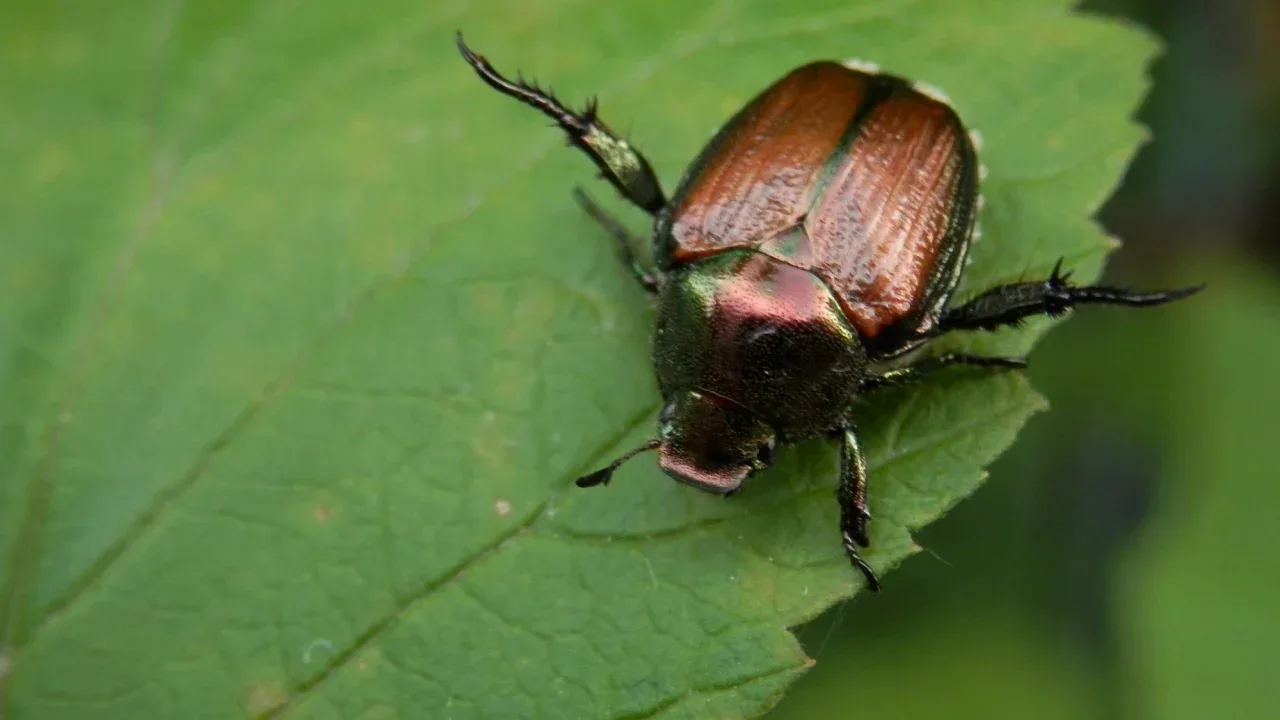
CFIA's plant pest card describes the adult as:
- About 10 mm long and 6 mm wide, oval from above.
- Metallic green head, thorax and abdomen.
- Metallic copper-brown wing covers.
- 12 white tufts of hair, six along each side of the abdomen, counting the pair at the tip. These white tufts are the easiest way to tell it apart from look-alikes.
The University of Minnesota Extension describes the same pattern as five white patches along each side plus two at the tip of the abdomen.
Grubs (larvae)
CFIA describes the grub as a typical C-shaped, creamy white grub with a yellowish-brown head, up to about 25 mm long, living in the root zone of turf and other plants. Many other white grubs look almost identical, including June beetle and European chafer grubs. CFIA notes that the V-shaped arrangement of spines on the last body segment is what identifies a Japanese beetle grub, so you'll need a hand lens.
Damage
- Lace-like leaves. CFIA explains that adults chew the tissue between the veins, leaving a skeleton of veins behind. Damaged leaves soon turn brown and drop.
- Ragged flowers. On roses and other thin-petalled flowers, beetles chew out large irregular holes and can ruin the blooms.
- Clusters of beetles. The University of Minnesota notes that damaged leaves give off odours that attract more beetles, which is why you often find dozens on one plant while a neighbouring plant is barely touched.
- Dead lawn patches. Grubs feeding on grass roots produce patches of brown, dead grass that feel spongy and pull up easily, according to CFIA. The University of Minnesota compares it to rolling back a loose carpet.
Life cycle
CFIA's scientific fact sheet describes one generation per year:
- Adults emerge from the soil in late June or early July. In the Niagara region, numbers peak in late July and August. Adults live 30 to 45 days.
- Beetles feed most heavily on sunny days between 21 and 35 °C, starting at the top of plants and working down. There is little feeding on cloudy or windy days and none on rainy days.
- Females lay up to 60 eggs about 8 cm deep in the soil of lawns and other grassy areas.
- Grubs hatch in about two weeks and feed on grass roots until cold weather.
- Grubs overwinter 5 to 31 cm below the surface, then move up in spring to feed again before pupating.
CFIA notes that adults can fly up to 8 km with the wind, but most flights are short. The real danger is human-assisted spread: CFIA warns that beetles hitchhike long distances on plant material, in soil, and even on cars, trains and planes.
What Japanese beetles eat
CFIA's fact sheet lists more than 250 host plants, and its main page says adults feed heavily on over 300 species. Plants CFIA lists as severely injured include:
- Trees: elm, maple, and fruit trees such as apple, cherry, plum, peach and apricot.
- Shrubs and flowers: roses, including hardy Explorer roses, and zinnias.
- Fruit: grapevines, blueberries, raspberries and blackberries.
- Crops: corn, asparagus and soybeans.
The University of Minnesota also lists linden, birch, Virginia creeper, hollyhock, marigold and basil among preferred plants.
Plants Japanese beetles usually leave alone
The University of Minnesota lists plants that are seldom damaged, including conifers such as arborvitae (eastern white cedar), spruce, fir and pine, as well as common lilac, daylilies, clematis, boxwood, forsythia, red and silver maple, oak, rhododendron and yew. If you garden in an area with heavy beetle pressure, these are good choices for new plantings.
Where Japanese beetle is regulated in Canada
Canada's regulatory categories
CFIA's directive D-96-15 sets rules for moving plants with soil or growing media attached between provinces and to and from the United States. Each province and territory is placed in a category, as listed in Appendix 1 of the directive (updated April 2024):
| Province or territory | Status | CFIA category |
|---|---|---|
| Ontario, Quebec, New Brunswick, Nova Scotia, Prince Edward Island | Infested | 3: Partially or generally infested |
| British Columbia | Not infested; eradication under way | 1: Uninfested / quarantine pest |
| Newfoundland and Labrador | Not infested (detections in St. John's) | 2: Uninfested or partially infested |
| Alberta, Saskatchewan, Manitoba, Yukon, Northwest Territories, Nunavut | Not infested | 4: Not known to be infested / unlikely to become established |
D-96-15 explains that plants with soil moving into Category 1 and 2 areas may need certification that they are free of Japanese beetle. Moving plants into Category 3 or 4 areas does not require this certification. The directive does not apply to houseplants grown indoors that have never been set outside as patio plants.
British Columbia's regulated areas
CFIA describes British Columbia as the only Category 1 Japanese beetle pest-free area in Canada. Japanese beetle was first detected in the False Creek area of Vancouver in 2017, and has been found every year since.
As of June 1, 2026, CFIA has established regulated areas in parts of:
- Vancouver
- Burnaby
- Coquitlam and Port Coquitlam
- Kamloops (including the Westsyde area)
If your address is inside a regulated area, CFIA requires a movement certificate to move plants with soil, soil-related matter or growing media, such as peat moss or bark mulch, out of the area. The restriction applies year-round. CFIA's website has a map and street-by-street boundary descriptions; check it before moving plants, soil or yard waste.
The numbers show why: CFIA reports 2,226 beetles confirmed in BC in 2025, up from 576 in 2024. Most came from Port Coquitlam (1,417) and Kamloops (769), and beetles were also trapped in Abbotsford, which is outside the regulated areas. The BC Ministry of Agriculture and Food is leading the eradication effort, treating public turf and landscape beds with Acelepryn, an insecticide approved by Health Canada's Pest Management Regulatory Agency. Treatment of private property is voluntary.
Newfoundland and Labrador
CFIA notes that there are no regulated areas in Newfoundland and Labrador, but it has mapped an "area of concern" in St. John's where beetles have been found. CFIA asks residents not to move plants with soil or growing media, such as potted plants, turf or ornamental grasses, out of that area, and to report sightings.
The Prairies and the North
If you find signs of Japanese beetle in Manitoba, Saskatchewan, Alberta or the territories, CFIA asks you to report it.
How to report a Japanese beetle
If you live in BC, Newfoundland and Labrador, the Prairies or the North and think you've found one, CFIA recommends:
- Catch it in a clear, hard-sided, sealable container and put it in the fridge.
- Take a clear close-up photo of the beetle or the damage.
- Note the exact location.
- Report it to CFIA by calling 1-800-442-2342 or using the online form on CFIA's Japanese beetle page.
Don't move or tamper with the Japanese beetle traps you may see in parks and neighbourhoods; CFIA uses them for surveillance. Report broken or knocked-down traps to CFIA.
How to control Japanese beetles in your garden
In Ontario, Quebec and the Maritimes, the goal is to protect your plants, not to eliminate the beetle. The University of Minnesota notes that in most cases the damage is cosmetic and healthy, mature trees and shrubs can tolerate a lot of feeding. Young plants, flowers and fruit need the most protection.
- Start early. Check plants daily from late June. The University of Minnesota stresses starting as soon as beetles appear, because damaged leaves attract more beetles. Feeding usually lasts six to eight weeks.
- Hand-pick into soapy water. For small gardens, knock or pick beetles into a bucket of soapy water. The University of Minnesota recommends doing it in the early morning or evening, when beetles are cool and sluggish.
- Cover high-value plants. Fine netting can protect plants, but the University of Minnesota warns not to cover fruit plants while they are flowering, because pollinators need to reach the blooms.
- Skip the beetle traps. Pheromone traps catch impressive numbers, but the University of Minnesota cites University of Kentucky research showing that they attract more beetles than they catch, usually increasing damage nearby.
- Pick fruit and flowers often. Regular harvesting in July and August reduces feeding on the parts you want to eat, as the University of Minnesota notes.
- Choose less preferred plants. In areas with heavy beetle pressure, add lilacs, daylilies, conifers and other plants the beetles seldom touch.
- Treat lawns only if grubs are damaging them. The University of Minnesota notes that controlling grubs in your lawn is unlikely to reduce the number of adult beetles on your plants, because adults fly in from elsewhere.
Protect the natural enemies
The University of Minnesota reports that the parasitic Winsome fly (Istocheta aldrichi) lays small white eggs on the backs of adult beetles, which kill the beetle within days. If you find beetles with small white eggs on the head or body, leave them alone so the flies can multiply.
Grubs in the lawn
The University of Minnesota notes that healthy turf can usually tolerate up to about 10 grubs per square foot (roughly 100 per square metre), and CFIA notes that dead patches appear when there are more than 90 grubs per square metre. Keep your lawn healthy, and if you need to act:
- Beneficial nematodes (Heterorhabditis bacteriophora) can be applied after eggs hatch, on a cool, overcast day or evening, with watering before and after. The University of Minnesota notes that results are inconsistent.
- Milky spore products have not been shown to provide benefit in modern university trials, according to the University of Minnesota.
Insecticides in Canada
If you decide to use an insecticide, use only products registered by Health Canada's Pest Management Regulatory Agency (PMRA) for Japanese beetle on your plant or lawn. Check for a PCP number and follow the label exactly. Products named in US guides may not be registered for home use in Canada, and Ontario and many other provinces and municipalities restrict cosmetic pesticide use on lawns and gardens. Protect pollinators by never spraying open flowers.
Frequently asked questions
Is the Japanese beetle in Alberta, Saskatchewan or Manitoba?
Not as an established pest. CFIA places all three Prairie provinces in Category 4, not known to be infested. If you see a beetle matching the description, catch it, photograph it and report it to CFIA.
Can I bring plants from Ontario to British Columbia?
Plants with soil or growing media moving into BC, a Category 1 area, may need certification that they are free of Japanese beetle under CFIA directive D-96-15. Houseplants grown indoors that have never been outside are not covered. Check with CFIA before moving garden plants.
Do Japanese beetle traps work?
Not for protecting your garden. The University of Minnesota cites University of Kentucky research showing that traps attract more beetles than they catch. CFIA uses traps for surveillance, not control.
How do I tell a Japanese beetle from a June beetle?
Japanese beetles are smaller, about 10 mm long, metallic green with copper wing covers and white tufts of hair along their sides. June beetles are larger and brown, without the white tufts. The grubs look very similar, so you need to check the spine pattern on the grub's rear end.
Will Japanese beetles kill my roses?
Rarely. The University of Minnesota notes that healthy roses survive feeding, although the blooms are often ruined. Young plants are more at risk from heavy, repeated feeding.
What should I do if I live in a BC regulated area?
Don't move plants with soil, soil, or growing media such as peat moss or bark mulch out of the area without a CFIA movement certificate. Check CFIA's map to see if your address is inside the boundary, and report any beetles you find.
When do Japanese beetles appear in Canada?
Adults usually emerge in late June or early July. CFIA notes that in the Niagara area they peak in late July and August, and says to watch for adult damage from late June to mid-October.
Related guides
- The 7 best native pollinator plants for Canadian gardens
- Top 10 hardy perennials for zones 3 and 4 on the Prairies
Sources
- Canadian Food Inspection Agency, Japanese beetle, Scientific fact sheet: Popillia japonica and Printable resources: Learn to spot the Japanese beetle.
- Canadian Food Inspection Agency, Regulated areas for Japanese beetle in British Columbia and Japanese beetle in British Columbia: an ongoing response.
- Canadian Food Inspection Agency, Japanese beetle in Newfoundland.
- Canadian Food Inspection Agency, D-96-15: Phytosanitary requirements to prevent the spread of Japanese beetle and Appendix 1: Regulatory status of areas in Canada and the United States.
- University of Minnesota Extension, Japanese beetles in yards and gardens.
- Health Canada, Pesticide label search.
Image credits
- Featured image (Japanese beetle): Ryan Hodnett / Wikimedia Commons / CC BY-SA 4.0. Source.
- Rose: ImagePerson / Wikimedia Commons / CC BY 4.0. Source.
- Pasture rose: D. Gordon E. Robertson / Wikimedia Commons / CC BY-SA 3.0. Source.
- Rose: SB_Johnny / Wikimedia Commons / CC BY-SA 3.0. Source.
- Japanese beetle: Gilles San Martin / Wikimedia Commons / CC BY-SA 2.0. Source.
- Japanese beetle: Whitney Cranshaw / Wikimedia Commons / CC BY 3.0 US. Source.
Comments
No comments yet — share what worked in your climate.