
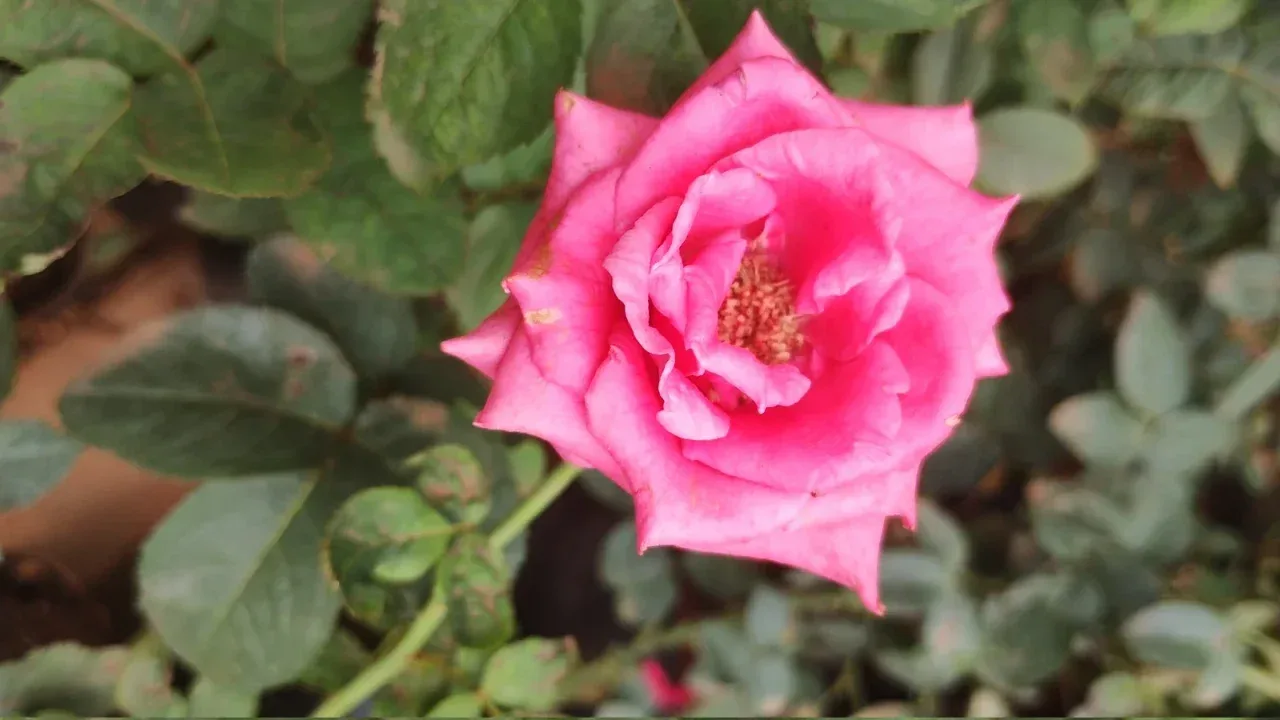
In much of north India, October is when gardeners cut back their gulab bushes so that fresh shoots can flower in the cool months. That date is not a rule for the whole country. In the hills the main prune comes after the hard cold, usually in March or April. In the south, many hybrid roses are cut twice, around October and again in March. A single "winter prune" copied from a temperate-country video will often hit your plant at the wrong time.
This page is about when and how to prune, and how to check for dieback and black spot before you decide what is wrong. Year-round rose care is in our rose plant profile. For winter balcony flowers such as petunia and pansy, see winter flowering plants in north India. General frost and watering advice is in plant care in winter in India.

Know the plant before you pick up the secateurs
Gulab is the common Hindi name for rose. The word covers several quite different plants, and they are not all cut in the same way.
- Hybrid teas: large flowers, often one to a long stem. These take the hardest annual prune.
- Floribundas: flowers in clusters. They are usually cut more moderately.
- Polyanthas and miniatures: smaller plants, often in pots. They need thinning and a light tip, not a hard cut to a few short canes.
- Climbers and ramblers: these should not be given the same hard annual prune as a hybrid tea. Sher-e-Kashmir University of Agricultural Sciences and Technology, Jammu, says climbers and ramblers do not require that kind of pruning. Take out dead, diseased or badly tangled stems, and leave the healthy framework that will carry flowers.
- Desi, Edward and Damask roses, grown for loose flowers, gulkand or rose water: these follow a different calendar from a garden hybrid tea, as noted below.

On a grafted plant, find the bulge where the named rose was budded onto the rootstock. Do not cut below it. Shoots that come from below the graft are rootstock suckers and should be removed as they appear, as SKUAST-Jammu advises. A plant in its first year in your pot or bed should not get a hard structural prune. Take off only dead or diseased wood and let it establish.
Once-flowering roses bloom on older wood. If you cut them hard just before their season, you can remove the flower. If you are unsure what you have, photograph the habit and the flower and ask a nursery or a KVK before you take off a lot of healthy canes.
When to prune, by region
TNAU's commercial rose page puts it simply: the best time is when the plant is least active, at a dormant or near-dormant stage, and the exact month depends on the climate of the region. In practice that usually means after the monsoon has finished, and not just before a hard frost that would damage the new shoots.
North Indian plains
For ordinary garden roses in Punjab and the neighbouring plains, Punjab Agricultural University's current farm operations for October say bushes are pruned in the second fortnight of the month. In September, the same series says irrigation should be withheld in the second half of the month to prepare the plants for that prune. SKUAST-Jammu, writing for plains and low hills, gives a slightly wider window: October to November, once the rains are over and winter is starting.
That timing is meant to give a flush of flowers in the cool season. TNAU notes that flowering commonly begins about 45 days after pruning, so an October cut in Delhi or Ludhiana is aimed at blooms from late November into winter. This is also when many north Indian rose shows are held. The Division of Floriculture and Landscaping at ICAR-IARI, Pusa, has long been the public breeding centre for garden roses suited to the northern plains; the October window used around Delhi is in that tradition. Do not copy a British or American "late-winter" prune here if you want those winter flowers.
Desi roses grown as a loose-flower crop are a separate case. PAU's 2022 Ornamental Crops booklet, in the chapter on desi rose, gives the pruning time as December to January, when the plants are dormant, with the main flush in March and April. If your bush is a desi or Edward type grown for loose flowers, follow that later date rather than the mid-October garden-rose prune. SKUAST-Jammu similarly places Damask pruning in December in the plains.
The September "withhold water" advice is for field and garden bushes in Punjab, not an instruction to drought a pot on a hot terrace. In a container, let the mix dry a little more than in the monsoon, but do not leave the plant wilted for days.
Hills
SKUAST-Jammu's package of practices is clear: pruning in the hills is done in March and April. New growth that follows an October cut would sit through severe winter cold. Wait until the hardest frost has passed, then take out wood that is clearly dead, and shape the bush. If you are in a mid-hill town where winters are cold but not severe, check a local KVK rather than following the Punjab plains date blindly.
Central India and the Deccan
In Pune, Nagpur, Indore and similar climates, the useful principle is the same as for other plains and low hills: prune after the monsoon has clearly ended, usually in October or November, so that the plant grows into the dry, cooler months. SKUAST's October to November window for plains and low hills is the nearest official seasonal range. ICAR-Directorate of Floricultural Research is based in Pune, but a current DFR pruning-date bulletin could not be loaded for this article, so do not treat a single calendar day as a Pune rule. If late rains are still falling, wait for a dry spell.
South India and the coasts
TNAU says to cut the vigorous shoots of the past season back to half their length during October to December, and to remove weak, diseased, criss-crossing and unproductive shoots. In its floriculture FAQ, TNAU also says hybrid roses should be pruned in March and in October. That second, lighter or repeat prune is common in places such as Bengaluru and the Tamil Nadu rose districts, where the plant never goes fully dormant and flowers can be timed about 45 days after a cut. Manuring in the TNAU commercial page is linked to pruning in October and again in July, which is another sign that southern bushes are often worked more than once a year.
Do not hard-prune into a wet monsoon. Wait until the foliage can dry, and keep water off the cuts.
Eastern India
The monsoon often ends later here than in the north-west. Follow the same rule: wait until the rains have actually stopped and the plant has slowed, then prune. That may be later in October or into November. A date copied from Punjab is useful only if your weather has already turned dry.
How to prune a garden bush
Work on a dry day with sharp, clean bypass secateurs. A blunt tool crushes the stem and leaves a ragged wound that is harder to heal.
- Stand back and look at the whole plant. For a typical hybrid tea in the north plains, PAU says to keep only three or four strong canes that grow outwards from the bush, and to head those back with a slanting cut to about 45 cm from the ground, after all dead, drying and diseased branches have been removed.
- Always start with dead, dry and diseased wood. Cut back to healthy tissue. A live cane has moist, greenish bark when you nick it lightly; dead wood is brown, dry and brittle.
- Next, take out weak, thin, inward and crossing shoots so that the centre of the plant stays open. PAU's desi-rose chapter and TNAU both stress an open centre, which helps light and air through the bush and lets leaves dry after dew or rain.
- TNAU's usual cut for vigorous past-season shoots is back to half their length. That is a moderate prune, and it is the one to prefer on floribundas, on bushes in the south, and on a plant that is not strong enough for a hard cut to 45 cm. SKUAST-Jammu says hybrid teas take a hard prune, keeping three or four main shoots with three or four eyes (buds); floribundas are pruned moderately, and polyanthas more lightly. Miniatures should be treated gently, mostly by thinning crowded twigs.
- Make each cut just above an outward-facing bud, sloping away from the bud, without leaving a long stub. Do not cut so close that you damage the bud itself.
- Collect the prunings and fallen diseased leaves and take them away from the pot or bed. Do not leave them as a mulch under the plant.
In a pot, use the same timing and the same order of cuts, but do not strip a small plant as hard as a large in-ground bush. Leave enough live wood and leaves for it to recover. Climbers, as already noted, keep their main framework.
Protecting the cut
Official Indian sources still advise sealing fresh rose cuts, because dieback often starts at a pruning wound. PAU's October farm operations say to paste the cut ends with a suitable fungicidal paste, and they name copper oxychloride (the trade product they mention is Blitox) mixed in linseed oil. PAU's 2022 ornamental-crops chapter says a fungicidal paste is applied on the cuts to avoid dieback. TNAU says the cut ends should be protected with Bordeaux paste or copper oxychloride paste. The National Horticulture Board's rose project note likewise says that because infection occurs at pruned ends and the stem then dries, a copper fungicide should be applied to the cuts immediately after pruning. TNAU's dieback page also mentions Chaubatia paste on the pruned area.
Use a product as its current label, or a KVK demonstration, directs. This page does not give a mixing rate. Work the paste onto a clean, fresh cut the same day you prune. Do not smear an unknown household paint or random oil on the wound and call it a seal.
After the prune
PAU says to put well-rotted farmyard manure in a shallow trench around the bush, cover it, and water thoroughly. SKUAST-Jammu also advises well-rotted FYM on established bushes after pruning. Those field quantities (several kilograms a bush) are for plants in the ground, not for a 12-inch pot. In a container, a thin layer of mature compost on the surface, then a thorough watering, is enough. Do not tip a field basket of manure into a pot, and do not pour on a strong fertiliser while the plant is still bare and the weather is very cold.
Keep the mix moist but not waterlogged while new shoots appear. Flowers often start about 45 days after a well-timed prune. If nothing moves after several warm weeks, check that the remaining canes are still alive, that the pot is draining, and that the plant has sun for a good part of the day. Roses want bright sun and open air, which is already covered in the rose profile.
Dieback and black spot: check before you name the cause
A dry twig or a spotted leaf is not, by itself, a diagnosis. Look at the pattern, the timing and the inside of the wood before you spray.
Dieback
TNAU describes rose dieback (it names Diplodia rosarum) as drying of the twigs from the tip downwards, with blackening of the twigs, and, when it is severe, spread that can kill the plant. NHB notes that infection often begins at a pruned end and the stem then dries. Before you call every brown cane dieback, work through these checks:
- Where does the drying start? Dieback usually begins at a tip or at a recent cut and moves down the cane. A cane that is brown only on the side facing a west wall, or only after a frost night in the hills, may be weather damage instead.
- Scratch or nick the bark. Green, moist tissue underneath means that part is still alive. Brown, dry, crumbly wood means it is dead. Cut that cane back into healthy wood, a little into the green, and protect the new cut as above.
- Look for a clean slanting cut versus a torn stub, and for discoloration just below an old wound. A ragged cut left unsealed in wet weather is a common starting point.
- Rule out other causes: a dry pot and wilted leaves on the whole plant, a stem borer hole, or a break from wind. If many canes die back quickly, or the decline reaches the crown, take a clear photograph of the cuts, the wood inside and the base of the plant to a KVK, rather than spraying from a guess.
TNAU's management note is to prune so that lesions on young shoots are removed, and to protect the pruned area. That is hygiene and a sealed cut, not a reason to strip every green cane.
Black spot

PAU describes black spot (Diplocarpon rosae) as black spots with fringed margins on the leaf. In favourable weather the spots join into larger irregular patches, and infection may run onto the stalk and stem. TNAU describes black lesions with feathery margins, surrounded by yellow tissue, and says infected leaves drop early. Purple or red bumpy marks may also show on first-year canes. PAU notes that rain and temperatures between about 10 and 25°C encourage the disease, which is why it is often bad in the monsoon and in mild, wet spells, not only after an October prune.
Before you treat:
- Look at both sides of several leaves, including ones that have just fallen. Fringed or feathery black spots with a yellow surround are the pattern to match. Plain yellowing without spots is a different problem; see our yellow leaves and leaf drop pages.
- Sooty mould sits on sticky honeydew and often rubs off. It points to aphids or similar pests, not to black spot.
- A few old, lower leaves with spots after the rains is not the same as a rapid defoliation of the whole bush.
Cultural steps come first and are the ones official pages agree on. TNAU says to plant where the sun can dry the night's dew, to leave space for air, to avoid watering over the leaves, and to remove infected canes and diseased leaves (and burn or bin them, do not compost them if they are badly infected). PAU says to avoid overhead watering that keeps plants wet for a long time, and to prune infected canes back to two buds if the canes themselves are infected. Improve airflow when you do the annual prune. If new spots keep appearing after hygiene, ask a KVK to identify the disease and use only a product that is labelled for the crop, at the rate on that label. This page does not give a spray dose.
White powder on young leaves is more likely powdery mildew than black spot. See our powdery mildew page and confirm the growth before you treat.
Mistakes that cost a season of flowers
- Pruning a north-plains garden rose in January because an overseas video said "prune in late winter". You will have missed the cool-season flush that the October cut is meant to give, and you may be cutting into cold weather.
- Pruning a hill bush in October, then watching frost burn the new shoots.
- Cutting a climber or a once-flowering rose as if it were a hybrid tea.
- Hard-pruning a newly planted or very weak pot plant down to a few short sticks.
- Leaving torn stubs, and not protecting cuts, then blaming "bad luck" when dieback starts at the wound.
- Watering over the leaves every evening, especially in a humid spell, and then treating every yellow leaf as a fertilizer shortage.
- Tipping a field dose of manure or a strong feed into a small pot the day after a hard prune.
Watch: rose care at the October prune
This Indian video looks at rose care in October, which is the main pruning month for garden bushes in the northern plains. Use it as a demonstration of handling a bush, together with the official timing and checks above, not in place of them. Methods and products on screen are not a recommendation unless they match a current label or a local KVK.
Related pages
- Rose care in India
- Winter flowering plants in north India
- Plant care in winter in India
- Petunia not flowering in pots
- Chrysanthemum not flowering
- How to grow dahlia in pots
- Powdery mildew
Sources
- Punjab Agricultural University, Farm Operations for October (garden roses: second fortnight prune, slant cut to about 45 cm, three to four outward canes, fungicidal paste on cuts) and Farm Operations for September (withhold irrigation in the second half of September to prepare for that prune)
- Punjab Agricultural University, Ornamental Crops (2022, Publication No. PAU/2022/F/792/E): desi rose chapter, December to January pruning, black spot description and cultural notes
- Sher-e-Kashmir University of Agricultural Sciences and Technology, Jammu, Package of Practices for Cultivation of Flowers and Landscape Gardening (2020): plains and low hills October to November, hills March to April, hard or moderate or light cuts by rose group, climbers and ramblers, Damask in December in the plains, removal of rootstock suckers
- TNAU Agritech Portal, Commercial rose and Floriculture FAQs (timing by region, October to December cut to half length, hybrid roses in March and October, flowering about 45 days after pruning, protection of cut ends)
- TNAU Agritech Portal, Rose black spot and Rose dieback
- National Horticulture Board, Rose DPR (model project note): dieback starting at pruned ends, and the need to apply a copper fungicide to cuts immediately after pruning
- ICAR-Indian Agricultural Research Institute, Division of Floriculture and Landscaping, Pusa, New Delhi: public breeding centre for Indian garden rose varieties. Timing above follows current SAU operations rather than a single IARI circular.
Comments
No comments yet — share what worked in your climate.