
A rose bush flowers on fresh shoots. Every time you prune it or cut a bloom, the plant pushes out new growth, and the buds form at the tips of that growth. So feeding a rose is not about giving the same powder every Sunday. It is about making sure there is food in the soil when a new round of shoots starts, and holding back when the plant is resting or the weather is against it.
This guide covers only feeding: what a gulab needs, which organic and packaged fertilisers work, what Indian agricultural universities recommend for bushes in the ground, how to feed a rose in a pot, and when to feed in your part of India. For soil mix, watering and choosing a healthy plant, see our rose plant profile. Since feeding follows pruning so closely, keep our rose pruning time guide for India open as well.
How a rose uses food
Think of a rose year as a series of flushes. You prune, new shoots grow, buds form at their tips and open, and then you cut the faded flowers and the cycle starts again. Tamil Nadu Agricultural University (TNAU) notes that flowering usually begins about 45 days after pruning. Most of the food the plant takes up goes into that burst of new shoots, leaves and buds.
The three main nutrients
- Nitrogen (N) builds shoots and leaves. A rose short of nitrogen is pale and makes thin, weak shoots. Too much gives soft, leafy growth, more pests and fewer flowers.
- Phosphorus (P) supports roots and flowering. Roses need it, but much less than nitrogen and potassium, and many garden soils already hold enough.
- Potassium (K, potash) helps flower quality, colour and the plant's ability to cope with heat and dry spells.
The smaller ones
Magnesium, iron, manganese and zinc are needed in small amounts but cause a lot of the yellow leaves people see on roses. ICAR-Indian Institute of Horticultural Research (IIHR) advises applying iron and zinc to roses only on the basis of a soil test or when clear symptoms appear, not as a routine. TNAU recommends a foliar micronutrient mixture for field roses for brighter flower colour. In a pot, a packaged fertiliser that already lists micronutrients on the label is the simplest way to cover them.
Start with the soil, not the fertiliser bag
Many feeding problems in roses are really soil problems. IIHR's good practice guide for open-field roses gives a soil pH of 5.5 to 6.5 as suitable, and TNAU gives 6 to 7. Soil and well water in many parts of North and West India are alkaline, and in alkaline soil a rose cannot take up iron easily even when there is plenty present. Adding more fertiliser does not fix that.
- For garden beds, get a soil test through your local Krishi Vigyan Kendra (KVK) or state soil testing lab before planting a rose bed. IIHR lists regular soil, water and leaf testing as the best guide to feeding.
- For pots, start with a fresh, well-drained mix with plenty of mature compost. Our rose profile has a simple recipe.
- Do not use fresh dung. IIHR is clear that only well-decomposed manure or compost should go to roses.
- Too much chemical fertiliser can harm the soil. Scientists from ICAR-Directorate of Floricultural Research, Pune, found that heavy, unplanned fertiliser use in polyhouse roses had raised soil alkalinity and salt levels, and they now push soil-test-based feeding and more use of biofertilisers. In a pot, a white crust on the soil or pot rim is a sign of the same salt build-up; see white crust on soil.
Organic fertilisers for roses
Well-rotted cow dung manure (gobar khad) and compost
This is the base of rose feeding in India, and every official recommendation for garden roses starts with it. Punjab Agricultural University (PAU) advises putting well-rotted farmyard manure in a shallow trench around the bush after the October prune, covering it with soil and watering well. Manure and compost feed slowly, improve the soil and rarely burn roots. On their own they are usually not enough for a heavily flowering hybrid tea in a pot, which is why many growers add a packaged feed on top.
Vermicompost
Vermicompost is finer and richer than ordinary compost and suits pots well. Spread a thin layer on the surface away from the main stem, scratch it in lightly and water. It should smell earthy, not sour.
Oil cakes (sarson khali, neem khali)
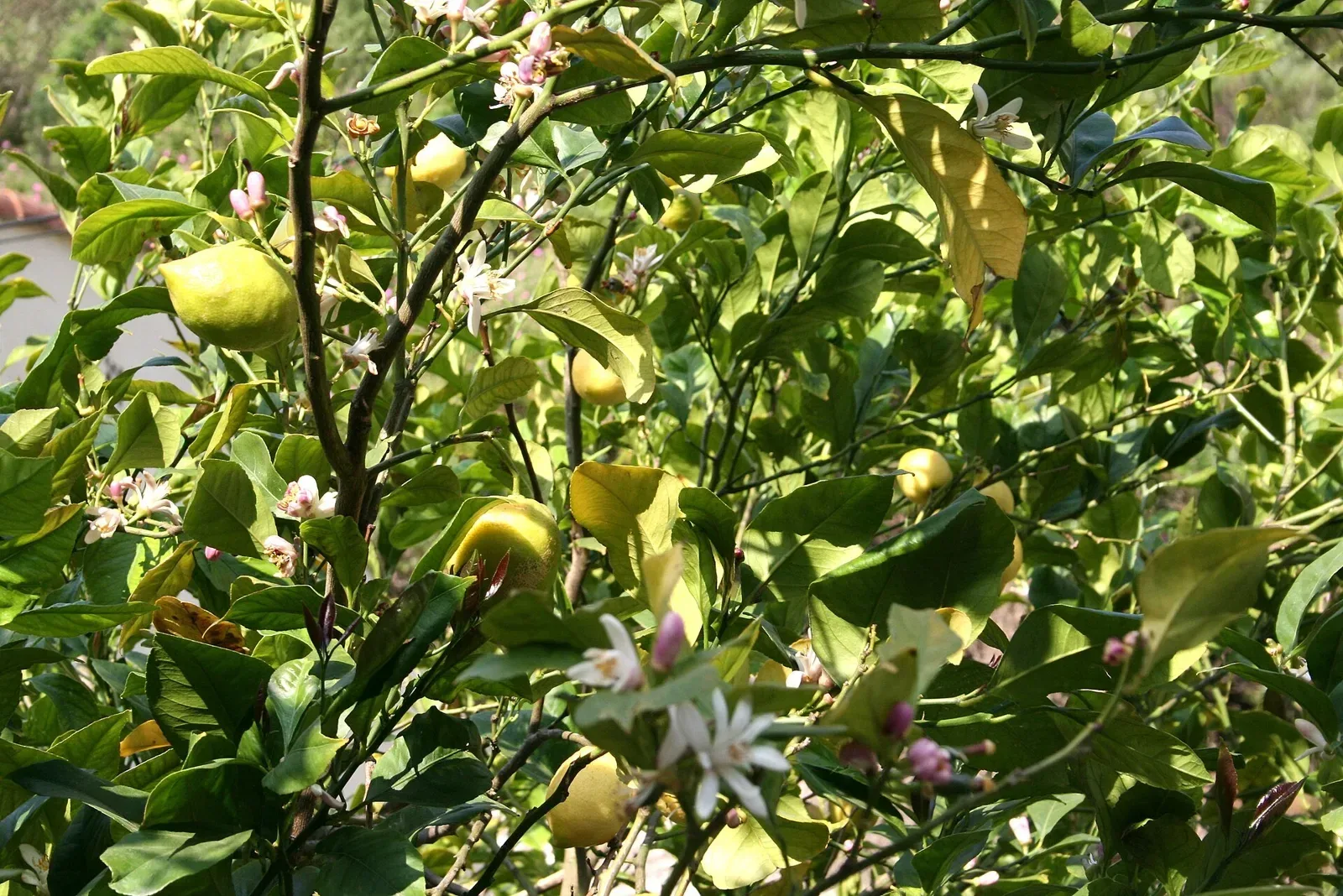
Mustard cake and neem cake are popular rose feeds in North India. They release nitrogen slowly as soil microbes break them down. Use them powdered and mixed into the top layer of soil, start small, and follow the pack. Our lemon plant fertilizer guide explains how to use oil cakes in pots without smell, mould or root burn, and the same care applies to roses.
Bone meal
Bone meal is a slow source of phosphorus and calcium. It is useful mixed into the soil at planting or repotting, when it can reach the roots. Sprinkled on the surface of an established pot, it does little.
Kitchen leftovers
Banana peels, tea leaves, eggshells and vegetable scraps are better composted first. Buried raw in a rose pot they rot slowly, attract flies and ants, and do not give a balanced feed. Our banana peel fertilizer guide explains what peels can and cannot do.
Packaged fertilisers
Every fertiliser bag shows three numbers, for example 19-19-19 or 12-32-16. These are the percentages of nitrogen, phosphorus and potassium, always in that order. Our guide to fertilizer for indoor plants at home explains label numbers and dilution in more detail, and the same reading applies to rose feeds. A few practical points:
- A balanced fertiliser (similar numbers) suits the growing phase after pruning, when the plant is making new shoots.
- A "bloom" or flowering fertiliser has a lower first number and higher second or third numbers. It suits the stage when buds are forming. It will not make a rose flower if it lacks sun or has not been pruned.
- Water-soluble fertilisers act quickly but wash out of pots quickly too. Slow-release granules feed for weeks or months; check the period on the label.
- Products sold as rose food or flowering plant food usually include magnesium and trace elements. Read the label to see what you are getting.
- Use the rate printed on the pack, and measure it. If the label gives no rate for pots, follow the dilution given for container or kitchen garden use. When in doubt, use less, not more.
Magnesium sulphate (Epsom salt) is often sold as a rose booster. Use it only if the leaves show signs of magnesium shortage (see below) and at the rate on the pack. A rose that is not short of magnesium gets no benefit from it.
What the universities recommend for roses in the ground
These figures come from Indian agricultural universities. They are for established bushes planted in open ground or field beds, under the conditions those universities work in. They are given here so you can see how much food a rose bush is expected to need, not as a rule for pots.
- TNAU (Tamil Nadu plains, commercial roses): after pruning in October and again in July, give each plant 10 kg farmyard manure (FYM) and 6:12:12 g of N:P:K. TNAU also gives a foliar micronutrient spray for brighter flowers.
- SKUAST-Jammu, Package of Practices for flowers (2020): on established bushes, apply 8 to 10 kg well-rotted FYM after pruning, and about 40 g of a fertiliser mixture made of urea (7 g), DAP (24 g) and MOP (9 g), given three times at 15-day intervals after pruning.
- PAU (Punjab, October farm operations): after the second-fortnight October prune, apply well-rotted FYM in a trench 4 to 6 inches deep around each bush, cover with soil and water thoroughly.
Do not try to scale these down to a pot by guesswork. A 12-inch pot holds a tiny fraction of the soil a field bush can reach, and the same grams of urea or DAP in a pot can burn the roots. For pots, follow the label of a packaged fertiliser and use organic matter as the base. If you grow roses in beds and want a precise schedule for your soil, a soil test through your KVK will give you one.
When to feed: by region
The rule everywhere is the same: feed when the plant is starting a new round of growth after pruning, keep feeding lightly while buds form, and ease off when the plant slows down because of heat, heavy rain or cold. What changes across India is when those moments come.
North Indian plains (Delhi, Punjab, Haryana, UP, Rajasthan, MP, Bihar)
PAU's farm operations advise holding back irrigation in the second half of September and pruning garden roses in the second fortnight of October. That makes October to March the main feeding season:
- Late September: no fertiliser. You want the plant to slow down before pruning.
- Late October, after pruning: manure or compost around the bush (in a pot, a thin top layer). Start a packaged feed once new shoots are a few centimetres long.
- November to February: feed regularly at the label interval while the plant is growing and budding. This is the main flowering season, and it is when the bush most needs food. Roses share the season with the plants in our list of winter flowering plants for North India.
- March and April: keep feeding while it flowers, but lighter as the heat rises.
- May and June: little or no fertiliser. PAU notes that roses can tolerate 38 to 40°C but produce fewer flowers, and feeding a heat-stressed plant in dry soil can scorch roots. Focus on water, mulch and some afternoon shade for pots; see how to protect plants from heat.
- July and August: light feeding only in dry spells. Heavy rain washes fertiliser out of pots and waterlogged roots cannot use it.
Desi or Damask roses grown for loose flowers follow a different calendar. PAU's 2022 ornamental crops guide puts their pruning in December and January, with the peak flowering in March and April, so feed those bushes after that later prune.
South India (Tamil Nadu, Karnataka, Andhra Pradesh, Telangana)
There is no real winter rest in most of the southern plains, so roses are often pruned and fed more than once a year. TNAU links manuring to pruning in October and again in July, and its floriculture FAQ says hybrid roses are pruned in March and in October. Plan a feeding round after each prune, then light feeding through the flush. Ease off in the hottest weeks of April and May on the plains. Bengaluru and other cooler plateau towns can keep roses growing and flowering for most of the year, so feed by the plant's growth, not by the month.
Coastal areas (Mumbai, Konkan, Goa, Kerala, coastal Karnataka, Chennai, Odisha and Bengal coast)
Here the monsoon is the main problem. Long spells of rain wash nutrients out of pots, keep roots wet and encourage leaf disease. Feed in the drier months after the rains end and through winter. During heavy rain, skip feeding, and keep pots where they drain freely or under a light cover. If your water or air is salty, watch for white crust and flush pots with plenty of fresh water now and then.
Hills (Himachal, Uttarakhand, Jammu and Kashmir, North-east hills, Nilgiris)
SKUAST-Jammu puts rose pruning in the hills in March and April, after the hard cold. Start feeding when new shoots appear after that prune, and continue through the summer flowering. Stop strong feeding by late summer so the new growth can firm up before cold nights. Do not feed in winter while the plant is dormant. Mid-hill towns with mild winters fall in between; check timing with your local KVK.
Roses in pots and roses in the ground
Roses in pots and grow bags
- Feed little and often. Every watering washes some food out of the drainage hole, so smaller, regular feeds suit pots better than one big dose.
- Always water before feeding. Fertiliser on dry roots is the commonest cause of burnt roots and sudden leaf drop.
- Top up with a thin layer of compost or vermicompost after each prune.
- Every few months, water the pot slowly and heavily until plenty drains out, to wash out built-up salts.
- Grow bags dry out faster than clay or plastic pots, so they also lose more food. See grow bags vs pots.
- Repot or refresh the top soil about once a year. Old, compacted mix holds salts and drains badly, and no fertiliser makes up for that.
Roses in garden beds
A bush in the ground has far more soil to draw on and needs less frequent feeding. The trench method from PAU works well: dig a shallow ring a little away from the stem, put in well-rotted manure, cover and water. Add a packaged feed only if growth is weak or a soil test shows a shortage.
Reading the leaves before you feed more
Yellow leaves on a rose make most people reach for fertiliser. Sometimes that is right, but often the cause is something else, and extra feeding makes it worse. Leaf colour alone cannot confirm a nutrient shortage. Use the patterns below as a guide, and check the other causes first.
Patterns that suggest a nutrient shortage
- Nitrogen: the whole plant is pale, older leaves yellow first and new shoots are thin and short.
- Magnesium: older leaves yellow between the veins, sometimes with reddish tints, and later develop dead patches and drop. The Royal Horticultural Society lists roses among the plants where this is common.
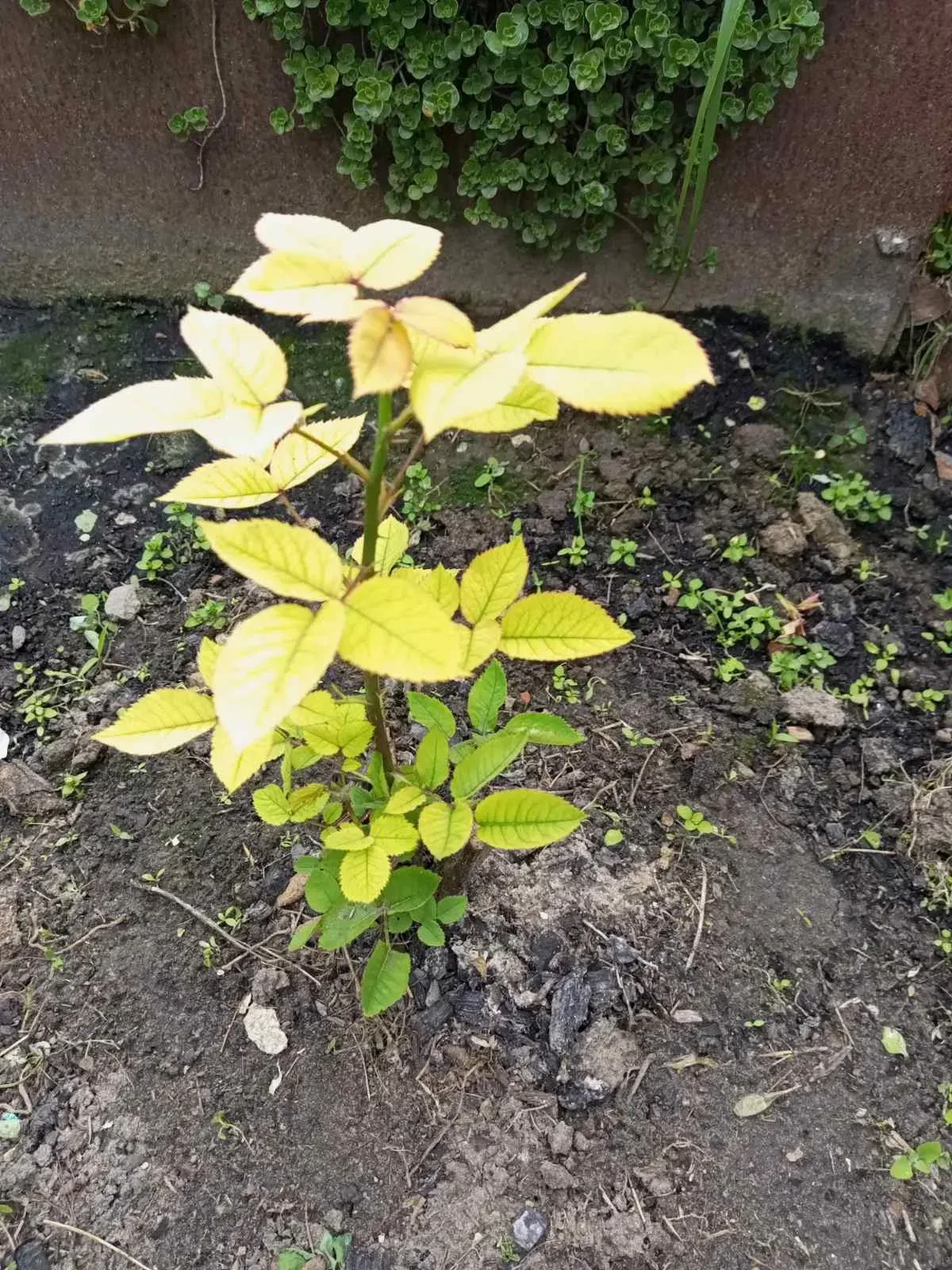
- Iron: the youngest leaves at the tips turn pale yellow while the veins stay green, as in the photo above. In India this is often linked to alkaline soil or hard water, or to roots that are too wet to work properly.
- Potassium: older leaves brown and scorch from the edges, and flowering is poor.
Check these first
- Waterlogging or rotten roots. Tip out a pot and look: healthy roots are firm and pale; dark, mushy roots point to root rot, and fertiliser will not help.
- Black spot. If yellow leaves also have black spots with fringed edges, it is likely the fungal disease black spot, not hunger. PAU notes that rain and mild temperatures favour it. See leaf spot for how to handle spotted leaves.
- Spider mites. Fine pale speckles on the leaves and faint webbing underneath in hot, dry weather point to spider mites.
- Natural ageing. A few lower leaves yellowing and dropping while new growth looks healthy is normal.
- Recent heavy feeding. Brown leaf edges soon after a strong feed, or a white crust on the soil, point to too much fertiliser, not too little.
If you still suspect a nutrient problem, our nutrient deficiency and yellow leaves pages walk through more checks. For roses in beds, a soil test settles the question.
Plenty of leaves but few flowers?
This is one of the commonest rose complaints, and fertiliser is rarely the full answer.
- Sun: TNAU says roses need at least six hours of bright sunshine for good flowering. A rose on a shady balcony will stay leafy whatever you feed it.
- Too much nitrogen: lots of soft, dark green leaves and few buds often follow heavy use of urea, oil cake or other nitrogen-rich feeds. Switch to a balanced or flowering feed and cut back.
- No pruning: old, unpruned canes make fewer and smaller flowers.
- Heat: in May and June on the plains, flowering drops whatever you do. PAU gives 15 to 25°C as ideal for rose flowers.
- Rootstock suckers: shoots coming from below the graft can take over. Remove them at the base.
Our no flowers page covers more causes.
Common feeding mistakes
- Feeding on a fixed weekly schedule all year, including in peak summer heat and during heavy rain.
- Pouring fertiliser onto dry soil.
- Using fresh cow dung or lumps of raw oil cake in a pot.
- Stacking several products on the same day: oil cake, NPK, Epsom salt and a "booster", all at once.
- Copying field doses meant for a bush in open ground into a pot.
- Feeding a newly bought or newly repotted plant heavily before it has settled. Let new roots grow first.
- Treating every yellow leaf as hunger without checking roots, pests and disease.
- Feeding strongly in late summer in the hills, so soft new growth meets the cold.
Watch: rose care through the year
In this Hindi video, the presenter, who grows about ten roses on a terrace and in the garden, walks through the care routine followed through the year, including feeding. Use it as a practical demonstration alongside the timing and checks above. Products and amounts shown on screen are the grower's own choices, not a recommendation; follow the label of whatever you use.
Sources
- Tamil Nadu Agricultural University, TNAU Agritech Portal: Commercial rose (soil, climate, manuring after October and July pruning, micronutrient spray, pruning, flowering about 45 days after pruning), Fertilizer schedule for flower crops, and Floriculture FAQs.
- Punjab Agricultural University: Farm Operations for September and October (rose irrigation before pruning, pruning time, trench manuring), and Ornamental Crops (2022), desi rose chapter.
- SKUAST-Jammu, Directorate of Extension: Package of Practices, Cultivation of Flowers and Landscape Gardening (2020), rose chapter.
- ICAR-Indian Institute of Horticultural Research, Bengaluru: Good Agricultural Practices for Commercially Important Flower Crops, Technical Bulletin ETB-01/2021 (rose under open cultivation).
- ICAR-Directorate of Floricultural Research, Pune: awareness programme on balanced fertiliser use among rose growers (ICAR news).
- Royal Horticultural Society: Nutrient deficiencies.
Comments
No comments yet — share what worked in your climate.