
| ☀️ Light | Bright indirect light |
|---|---|
| 💧 Water | Moderate (lightly moist) |
| 🪴 Soil | Airy houseplant mix that holds some moisture |
| 🌡️ Temp | 10°C – 32°C |
| 🐾 Safety | Cats: non-toxic · Dogs: non-toxic |
| 📏 Mature size | 30 cm |
Where It Grows & Climate Tolerance
Pet & Companion Animal Toxicity (Polka Dot Plant (Hypoestes, Freckle Face))
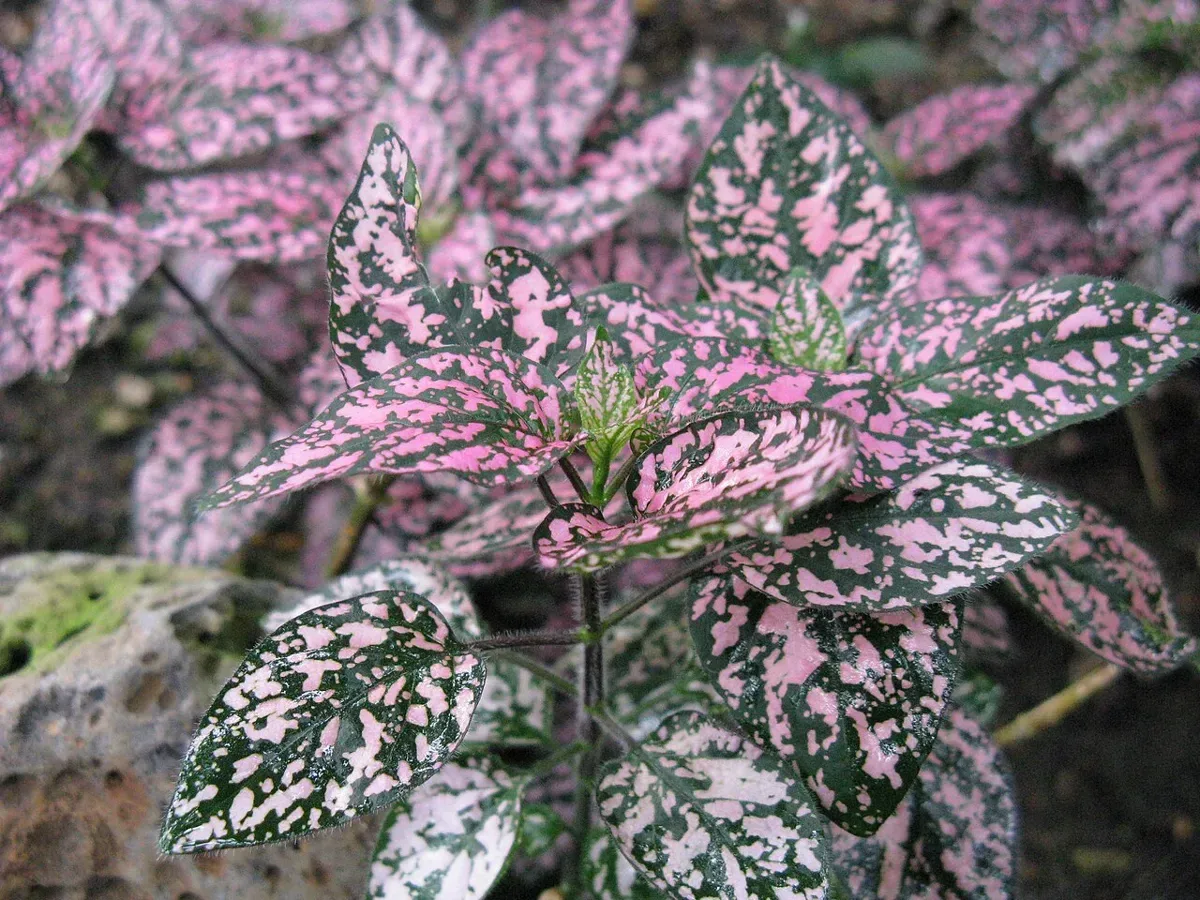
Polka dot plant is a small, bushy foliage plant from Madagascar with soft oval leaves splashed with pink, red or white on green. It is grown as a houseplant and as a shade bedding plant. It gets leggy with age, roots easily from cuttings, and ASPCA lists it as non-toxic to pets.
Care instructions
Care Guide & Maintenance Routine
Give bright, filtered light; too much sun crinkles the leaves and too little fades the spots. Keep the mix lightly moist and let the surface dry slightly between waterings. Pinch the tips often, remove flower spikes, and take cuttings to replace old, leggy plants.
Light & Sunlight
NC State and Wisconsin Horticulture both recommend bright, filtered light. NC State notes too much sun crinkles the leaves, while too little fades the colour and makes plants leggy. Wisconsin Horticulture notes colour is better in partial shade than full sun.
Watering Schedule
Wisconsin Horticulture advises watering well while plants grow actively and letting the mix dry slightly between waterings. The plant wilts quickly when dry but usually recovers after watering. Soggy soil causes root rot.
Potting Mix & Drainage
Airy houseplant mix that holds some moisture
Temperature & Humidity
NC State gives hardiness zones 10 and 11 only. Wisconsin Horticulture advises waiting until temperatures stay above 10°C before planting outdoors, and notes it does not grow well until temperatures exceed about 16°C.
About the polka dot plant
Polka dot plant, Hypoestes phyllostachya, belongs to the acanthus family and is native to Madagascar. Wisconsin Horticulture describes it as a bushy plant with oval, softly downy leaves, once regarded as a novelty houseplant and now also popular as an annual for borders and containers. In ideal conditions the species reaches about 75 cm tall and wide; most cultivars stay much smaller.
The original form has dark green leaves dotted with pink. Breeders have added red, white and light green splashes and reversed patterns where pink dominates and green forms the spots. Stems may also be coloured.
Cultivars
Wisconsin Horticulture lists several:
- 'Confetti' series: compact, about 20 cm, vigorous, in white, pink, red, carmine rose and burgundy.
- 'Splash' series: large blotches of pink, red, rose or white.
- 'Carmina': bright red splotches.
- 'Pink Brocade' and 'Pink Dot': pink spotting.
- 'Purpuriana': purplish leaves.
- 'Wit': marbled white leaves.
Light
Light is the key to good colour. NC State and Wisconsin Horticulture both recommend bright, filtered light. NC State notes that too much direct sun crinkles the leaves, while too little fades the colour and makes the plant leggy. A spot near a bright window screened by a sheer curtain is ideal. Plants can also be grown under artificial light.
Watering
Water well while the plant is growing and let the mix dry slightly between waterings, as Wisconsin Horticulture advises. The thin leaves wilt quickly when dry, which is a useful signal, but repeated wilting weakens the plant. Never let the pot stand in water.
Humidity
Wisconsin Horticulture notes polka dot plant prefers humid conditions and may need misting indoors during winter. Grouping plants together or standing pots on a tray of moist pebbles also helps. Dry air browns leaf edges and encourages spider mites.
Soil and feeding
Use a porous mix high in organic matter. Wisconsin Horticulture recommends periodic feeding with dilute liquid fertiliser once plants are established. Too much fertiliser makes soft, leggy growth.
Pinching
Regular pinching is the single most important task. Remove the top pair of leaves on each stem every few weeks. This keeps plants compact and full. Without it, stems stretch and flop within months.
Flowers
Small lilac or pink tubular flowers appear on spikes, usually as days shorten in late summer or autumn. Wisconsin Horticulture notes long days keep plants in leafy growth. NC State suggests cutting off the flowers, since plants often decline after blooming.
Propagation
Cuttings root easily. Wisconsin Horticulture suggests 10 cm cuttings with the lower leaves removed, placed in water or straight into moist mix, sand or vermiculite, especially in spring and summer. Seed also works: Wisconsin Horticulture notes it germinates in as little as four days at 20°C, and the first true leaves already show colour. Transplant seedlings at the four-leaf stage.
A short-lived plant
Polka dot plants are not long-lived. Wisconsin Horticulture notes they get leggy with age and houseplants eventually need replacing. Root a few cuttings each spring so you always have young plants. Think of it like a long-lasting annual: one parent plant can supply dozens of rooted tips over a year, enough to fill several small pots, line a planter or share with friends. Three or four rooted cuttings potted together make a fuller plant faster than a single stem.
Outdoor use
As a bedding plant, it adds colour to partly shaded areas and combines well with impatiens and caladiums, Wisconsin Horticulture notes. It also suits dish gardens, window boxes and patio containers. Wisconsin Horticulture notes it reseeds freely in warm-season areas.
Pests and problems
- Powdery mildew: white coating in still, humid air.
- Root rot: wilting and collapse in soggy mix.
- Whiteflies, aphids and mealybugs: listed by Wisconsin Horticulture.
- Spider mites: fine speckling in dry air.
Dish gardens and terrariums
Wisconsin Horticulture lists dish gardens among its uses. Its small leaves and bright colour make it a good accent beside ferns, fittonia and small peperomias. In a closed terrarium, it grows quickly in the humid air, so trim it often or it will smother slower neighbours. Open bowls suit it better than sealed jars. Use a shallow layer of grit under the mix for drainage, because bowls rarely have holes.
Choosing a healthy plant
Look for compact, bushy plants with several stems from the base and bright, even spotting. Avoid plants already flowering, stretched between leaves, or sitting in soggy compost. Check leaf undersides for whitefly and mealybug before buying.
Troubleshooting by symptom
- Long gaps between leaves: too little light or overdue pinching.
- Plain green new leaves: low light; move to brighter, filtered light.
- Bleached, crisp patches: direct sun scorch.
- Whole plant limp: dry mix, or roots rotting in wet mix; check which.
- Brown, papery edges: dry air or irregular watering.
- White powder on leaves: powdery mildew; improve air movement.
Pets
ASPCA lists polka dot plant as non-toxic to dogs, cats and horses. It notes mild vomiting or diarrhoea are possible if eaten.
Companions
Group it with other colourful foliage plants such as fittonia, coleus, prayer plant, peperomia and tradescantia zebrina. Do not confuse it with polka dot begonia, a different plant.
Common mistakes
- Putting it in a dark corner, where the spots fade.
- Placing it in hot, direct sun, which scorches the leaves.
- Forgetting to pinch, which leads to tall, floppy stems.
- Letting it dry out repeatedly.
- Keeping an old, woody plant instead of starting fresh from cuttings.
Local seasons and buying tips are covered in the country sections.
Seasonal rhythm
Seasonal Calendar
A month-by-month calendar for Polka Dot Plant (Hypoestes, Freckle Face) in Global is coming soon. See the light, water and temperature notes above.
Diagnostics
Common Problems & Troubleshooting
Leggy, floppy stems in low light or with age; faded spots in shade; crinkled, scorched leaves in direct sun; sudden wilting when dry; root rot in soggy mix; powdery mildew; whitefly and mealybugs.
Pests & seasonal watch: Wisconsin Horticulture lists powdery mildew, root rot, whiteflies, aphids and mealybugs. Spider mites appear in dry indoor air.
Q&A
Frequently Asked Questions
Is polka dot plant safe for cats and dogs?
Yes. ASPCA lists it as non-toxic to dogs, cats and horses, though eating it may cause mild vomiting or diarrhoea.
Why is my polka dot plant leggy?
Low light and age. NC State and Wisconsin Horticulture both note plants get leggy over time. Pinch regularly and replace old plants with cuttings.
Why are the spots fading?
Too little light. NC State notes low light fades the colour; move it to brighter, filtered light.
Why are the leaves crinkled and pale?
Too much direct sun. NC State notes strong sun crinkles the leaves.
Should I remove the flowers?
Yes. NC State suggests cutting off flower spikes; plants often decline after flowering.
How do I propagate polka dot plant?
Take 10 cm stem cuttings and root them in water or moist mix. Wisconsin Horticulture notes they root quickly.
Why does my plant wilt suddenly?
It is usually dry. Water thoroughly; it normally recovers within hours. Repeated severe wilting weakens it.
Can I grow it outdoors?
In warm climates, yes, in partial shade. Wisconsin Horticulture notes it is used as a shade bedding plant and reseeds freely in warm areas.
Is it the same as polka dot begonia?
No. Polka dot begonia is Begonia maculata, a different plant with silver-spotted, wing-shaped leaves.
Similar Botanical Matches
Keep exploring
Related plants
Grower field notes
Reader Field Notes in Global
Share how this plant performs in your local Global climate.