
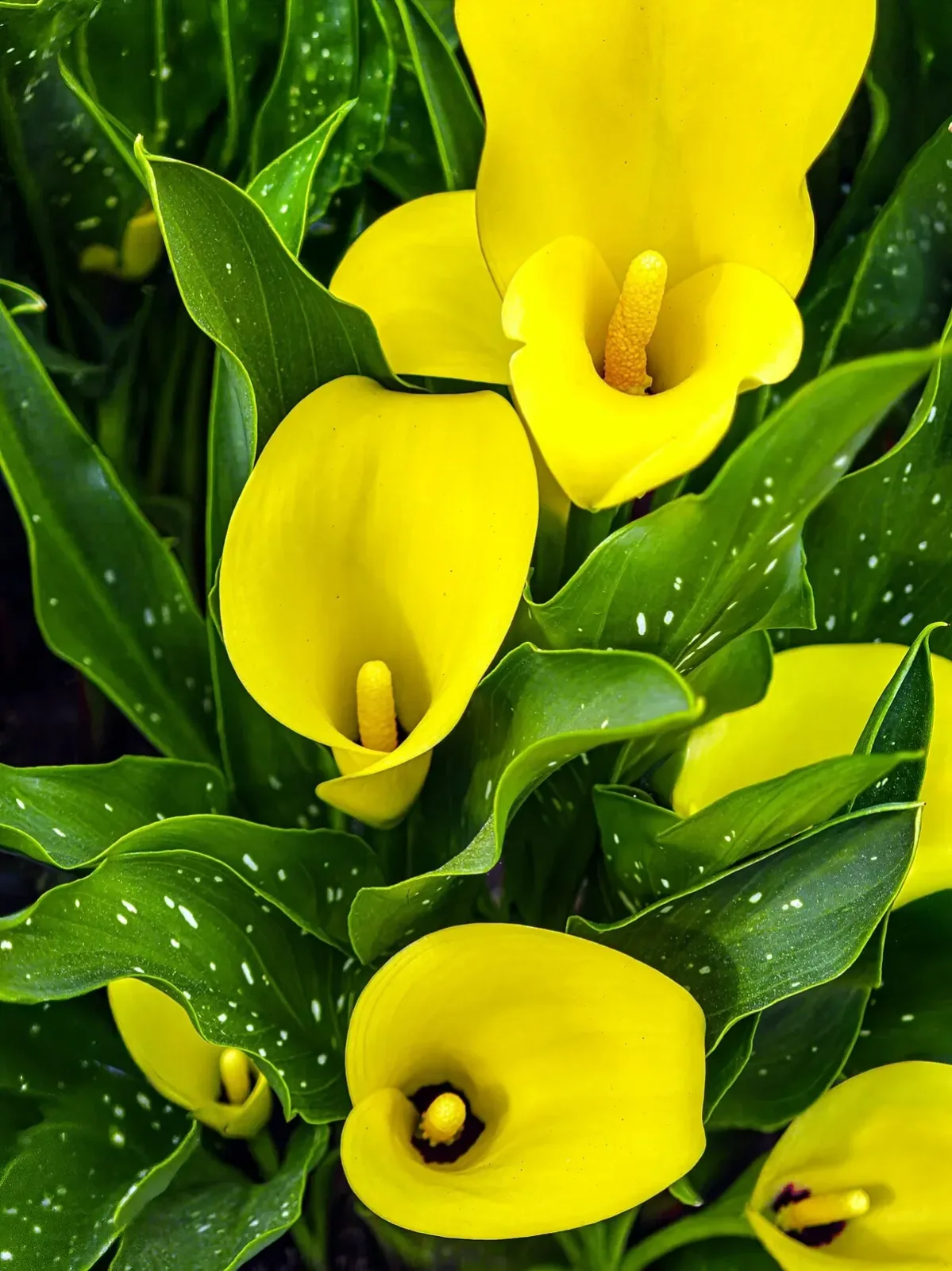
| ☀️ Light | Full sun |
|---|---|
| 💧 Water | High (consistently moist) |
| 🪴 Soil | Rich, moisture-retentive soil high in organic matter |
| 🌡️ Temp | -10°C – 30°C |
| 🐾 Safety | Cats: toxic · Dogs: toxic |
| 📏 Mature size | 75 cm |
Where It Grows & Climate Tolerance
Pet & Companion Animal Toxicity (Calla Lily (Arum Lily))
Calla lilies are not true lilies but rhizomatous perennials in the arum family from southern Africa. A funnel-shaped spathe in white, yellow, pink, orange or deep purple wraps around a finger-like spadix above arrow-shaped, often white-flecked leaves. All parts are toxic to cats and dogs.
Care instructions
Care Guide & Maintenance Routine
Grow the white arum lily in moist, rich soil, even at a pond edge; grow the smaller coloured callas in a well-drained pot that is allowed to dry out after flowering. Give sun with afternoon shade in hot climates, feed while in leaf, and protect or lift the rhizomes before frost.
Light & Sunlight
NC State lists full sun to partial shade and advises partial shade in hot climates. UMN Extension notes callas flower more freely in full sun in cool summers. In Indian plains summers, shade from the afternoon sun.
Watering Schedule
The white arum lily, Z. aethiopica, likes soil that never dries out; RHS notes it can grow as a pond marginal in water up to 30 cm deep. Coloured hybrid callas want moist but well-drained soil in growth and a drier rest after flowering. Too little water browns leaf edges; stagnant wet soil rots coloured callas.
Potting Mix & Drainage
Rich, moisture-retentive soil high in organic matter
Temperature & Humidity
NC State rates Z. aethiopica hardy in zones 8a to 10b, to zone 7 with protection. Coloured hybrid callas are tender: RHS advises keeping them above 10°C to stay in growth, or storing them dry and frost-free. Long spells of heat above about 30°C push plants into early dormancy.
About calla lilies
Calla lilies belong to Zantedeschia, a small genus of rhizomatous perennials from southern Africa. NC State notes the name honours the Italian botanist Giovanni Zantedeschi and that callas are not true lilies but members of the arum family, the same family as anthurium and peace lily. UMN Extension describes Z. aethiopica as a weed in its native range and invasive in California.
What looks like a single petal is a spathe, a modified leaf that wraps around the spadix, the yellow spike bearing the tiny true flowers. Leaves are arrow-shaped, plain green or flecked with white.
White arum lily and coloured callas
Two quite different plants share the calla name.
- Z. aethiopica (white arum lily): a large plant, 60 to 90 cm tall, with white spathes. It likes wet soil and is the hardier type. NC State rates it to zone 8, zone 7 with shelter.
- Coloured or hybrid callas: smaller plants, usually 30 to 60 cm, bred mainly from Z. elliottiana and Z. rehmannii, in yellow, pink, orange, red, purple and near black. They are tender and need a dry rest after flowering.
Check the label before planting, because the two need different watering.
Light
NC State lists full sun to partial shade and advises partial shade in hot climates. In cool summers callas flower best in full sun. Deep shade gives plenty of leaves and few flowers.
Soil
NC State recommends moist soil rich in organic matter. The white arum lily is happy in heavy, wet ground and grows beside ponds. Coloured callas need soil that holds moisture but drains, so add grit or plant in raised beds and pots.
Planting
NC State gives 10 cm deep and 30 to 45 cm apart for Z. aethiopica, planted after the danger of frost has passed. For the genus it suggests covering rhizomes with about 5 cm of soil. Plant with the growing points facing up. Rhizomes that have started to sprout show which way is up.
Watering
Water the white arum lily freely; it does not like to dry out. Coloured callas need regular watering in leaf and flower, then less as the leaves start to yellow. After flowering they rest; keep them nearly dry until new shoots appear. Overwatering a resting coloured calla is the usual way to lose it.
Feeding
RHS suggests a balanced liquid feed every two weeks in poor soil, and a high-potassium feed for pot-grown plants from the time buds appear until the leaves die back. Use the rate on the label. Rich soil needs little extra.
Dormancy and winter
After flowering, the leaves of coloured callas yellow and die down over several weeks. Let this happen; the rhizome is storing food. In frost-prone areas, lift rhizomes once the foliage dies back, dry them, and store them frost-free. RHS defines frost-free as a minimum of 4°C. Wisconsin Horticulture cures calla rhizomes for two to three weeks in a warm room before storage at 7 to 13°C.
Propagation
Divide established clumps or remove offsets from the main rhizome. NC State advises dividing in early spring or late summer and letting the pieces callus for a day or two before planting. Each piece needs at least one growing point.
Cut flowers
Callas are a classic cut flower and last well in a vase. Cut or pull stems when the spathe has fully unrolled.
Pests and diseases
- Soft rot: a bacterial rot that turns rhizomes mushy and foul-smelling in warm, wet soil. Discard affected plants and do not replant in the same spot.
- Aphids: on new leaves and buds.
- Spider mites: indoors and in hot, dry weather.
- Slugs and snails: chew emerging shoots.
- Viruses: streaked, mottled or twisted leaves; remove the plant.
Toxicity
ASPCA lists calla lily as toxic to dogs and cats because of insoluble calcium oxalates, causing burning of the mouth, drooling, vomiting and trouble swallowing. NC State rates the genus as high severity, and the sap can irritate skin. Wear gloves when dividing rhizomes.
Growing callas indoors
UMN Extension notes callas can be grown as houseplants in a sunny window or under grow lights, although they perform best outdoors in summer. Potted coloured callas are often sold in flower as gift plants. Give them bright light, keep the compost moist while they bloom, and then let them die down and rest instead of throwing them out.
Choosing a site
Look for a spot with morning sun and some protection from strong wind, which tears the broad leaves. Near water features or in low, damp corners, the white arum lily is at home. Coloured callas prefer a raised bed, a large container or the front of a border where the soil drains freely. Space gives air movement, which reduces leaf spots and rot.
Common mistakes
- Watering coloured callas heavily while they rest.
- Throwing away a gift plant once it stops flowering, instead of letting it go dormant.
- Planting rhizomes upside down; look for the knobbly growing points.
- Cutting off leaves while still green, which weakens next year's flowers.
Companions
Callas suit moist, part-shaded spots with hosta, and the white arum lily grows well near a pond with Egyptian white water lily. Indoors, compare peace lily and anthurium, both aroids with a spathe. For other summer bulbs, see amaryllis and tuberose.
India and Canada in brief
In India callas are a hill-station and shade-house flower, grown in the open in the Nilgiris and the eastern Himalaya. In Canada they are summer container plants, lifted before frost except on the mildest parts of the BC coast.
Seasonal rhythm
Seasonal Calendar
A month-by-month calendar for Calla Lily (Arum Lily) in Global is coming soon. See the light, water and temperature notes above.
Diagnostics
Common Problems & Troubleshooting
Soft rot in wet, warm soil; no flowers from too much shade, too small a rhizome or overcrowding; brown leaf tips in dry air or dry soil; yellow leaves after flowering as plants go dormant; aphids and slugs.
Pests & seasonal watch: Aphids and spider mites on young leaves, slugs and snails on shoots, and bacterial soft rot in waterlogged soil, which turns the rhizome mushy and foul smelling. Streaked or distorted leaves may mean a virus.
Q&A
Frequently Asked Questions
Is a calla lily a true lily?
No. NC State notes callas belong to the arum family, Araceae, and come from Africa. True lilies are Lilium, in the Liliaceae.
Are calla lilies poisonous to pets?
Yes. ASPCA lists calla lily as toxic to dogs and cats. Insoluble calcium oxalate crystals cause mouth irritation, drooling, vomiting and difficulty swallowing.
Why is my calla lily not flowering?
Common causes are too much shade, rhizomes that are too small, overcrowded clumps, and coloured callas that did not get a proper dry rest. Feed while in leaf and divide crowded clumps.
Do calla lilies come back every year?
Yes, as perennials. The white arum lily is hardy to about zone 8 by NC State's rating. Coloured callas are lifted or kept frost-free in pots in cold areas.
How do I store calla rhizomes over winter?
Wisconsin Horticulture advises drying calla rhizomes for two to three weeks in a warm place, removing soil and dead stems, and storing them at 7 to 13°C.
Can calla lilies grow in water?
The white arum lily can. RHS notes it can grow as a pond marginal in up to 30 cm of water. Coloured callas rot if kept wet.
Why are the leaves turning yellow?
Yellowing after flowering is normal dormancy. Yellow leaves with a soft, smelly base suggest rot from waterlogged soil.
When should I divide callas?
NC State suggests early spring or late summer. Let cut pieces dry for a day or two before replanting.
Do callas need full sun?
In cool climates, yes. In hot climates NC State advises partial shade, and in Indian plains summers they need afternoon shade.
Similar Botanical Matches
Keep exploring
Related plants
Grower field notes
Reader Field Notes in Global
Share how this plant performs in your local Global climate.