
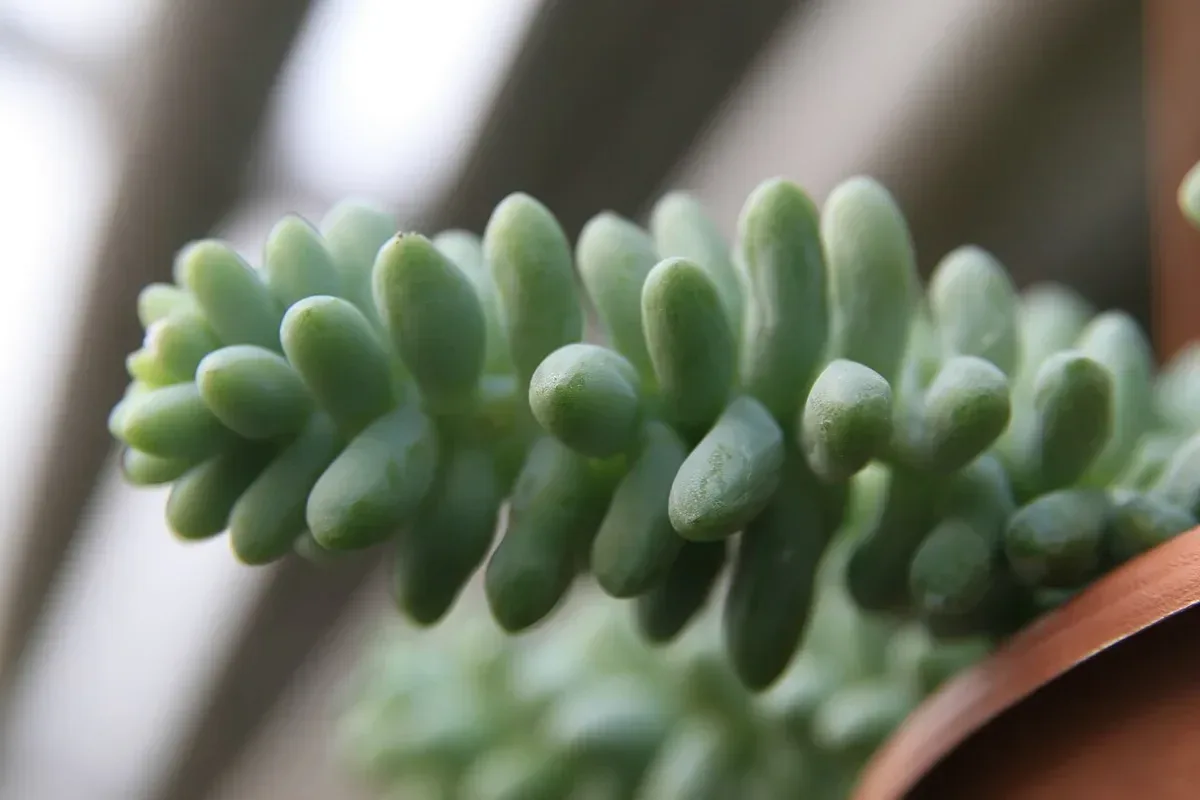
| ☀️ Light | Bright indirect light |
|---|---|
| 💧 Water | Low (allow soil to dry) |
| 🪴 Soil | Cactus and succulent mix with extra perlite, pumice or baked clay granules |
| 🌡️ Temp | 5°C – 35°C |
| 🐾 Safety | Cats: non-toxic · Dogs: non-toxic |
| 📏 Mature size | 60 cm |
Where It Grows & Climate Tolerance
Pet & Companion Animal Toxicity (Burro's Tail Care in India)
Burro's tail grows well in Indian homes, on balconies and on terraces. It likes bright light and dry weather, so the main jobs are shading it from peak summer sun and keeping it out of monsoon rain.
Care instructions
Care Guide & Maintenance Routine
Hang it on a bright balcony with morning sun. Use cocopeat-free gritty mix with perlite or brick pieces. Water deeply only when nearly dry: about weekly in summer, much less in the monsoon and winter. Keep it under a shade or roof in heavy rain, and away from frost in the North.
Light & Sunlight
Wisconsin Horticulture says it grows best in bright light to full sun; in poor light the stems stretch and the leaves sit further apart. Very strong sun bleaches leaves yellowish, so in hot climates give morning sun and bright shade after noon.
Watering Schedule
Let the mix nearly dry out between waterings, then water deeply and let it drain. Reduce watering in autumn and give only enough in winter to stop the mix drying out completely (Wisconsin Horticulture). Plump leaves mean enough water; wrinkled leaves mean it needs a drink.
Potting Mix & Drainage
Cactus and succulent mix with extra perlite, pumice or baked clay granules
Temperature & Humidity
Keep above about 5°C. Bring pots in on frosty nights in the North Indian plains and hills in December and January. Above about 40°C on terraces in May and June, give afternoon shade and water early in the morning.
Burro's tail on Indian balconies
Burro's tail, often sold as donkey tail, has become a common succulent in Indian apartments because it trails so well from hanging pots. It is easy in most of the country if you manage two things: harsh summer sun and monsoon wet.
Light at home
An east-facing balcony or a window that gets sun until about 11 am is ideal. On a south or west terrace in Delhi, Jaipur, Nagpur or Hyderabad, move it under 30 to 50 per cent shade net from April to June, when afternoon sun bleaches the leaves.
Potting mix
Many nursery plants arrive in heavy cocopeat. Repot in spring into a mix of about one part garden soil, one part coarse sand or brick pieces, and one part perlite or pumice. A terracotta pot dries faster than plastic and helps in humid cities.
Watering by season
- March to June: water deeply when the mix is almost dry, often every 5 to 8 days on hot terraces.
- Monsoon: keep it under a roof or balcony slab. In Mumbai, Goa, Kochi and Kolkata it may need almost no water for weeks. Monsoon onset is normally around 1 June in Kochi and 11 June in Mumbai (IMD), so move pots before then.
- October to February: water every 2 to 4 weeks, less in cold North Indian winters.
Region notes
- North Indian plains: nights in Delhi, Lucknow and Chandigarh can approach freezing in January. Bring pots indoors or to a covered spot.
- Hills: in Shimla, Mussoorie and Darjeeling, keep it on a sunny windowsill indoors in winter.
- Peninsular India: Pune, Bengaluru and the Deccan suit it almost all year in a covered balcony.
- Coastal and North-East India: high humidity and long rains raise rot risk. Use the grittiest mix and the smallest sensible pot.
Rot in the rains
If leaves turn translucent and the stem base goes black in July or August, take healthy tips straight away and root them in dry mix. A rotting base rarely recovers.
Pests
Mealybugs hide between leaves in the dry months. Dab them with rubbing alcohol on a cotton bud.
Hanging it safely
A full basket gets heavy right after watering. Use a steel S-hook on the balcony grill or a ceiling hook strong enough for the weight, with a coir-lined or macramé hanger. Pigeons like to perch on hanging pots in Mumbai, Delhi and Bengaluru flats and knock off whole strands; a loose bird net around the balcony stops that.
Gifting cuttings
Rooted pieces in small terracotta katoris make neat Diwali or housewarming gifts. Pot them by September so roots settle before the festival.
Making more plants
February to April is a good time to root cuttings, before the monsoon. Fallen leaves can be laid on a tray of dry mix in light shade.
Seasonal rhythm
Seasonal Calendar
| Month | Care Tasks | Seasonal Focus |
|---|---|---|
| Jan | Protect from frost/heat | North: protect from cold nights; water every 3 to 4 weeks. South: steady growth. |
| Feb | Repot | Repot pot-bound plants into gritty mix; start cuttings. |
| Mar | Fertilize | One light feed. Root cuttings before the heat. |
| Apr | Protect from frost/heat | Plains: shade from afternoon sun on terraces. |
| May | Protect from frost/heat | Peak heat: water early, shade net from noon. |
| Jun | Protect from frost/heat | Move pots under cover before monsoon onset (IMD: Kochi 1 June, Mumbai 11 June). |
| Jul | Protect from frost/heat | Monsoon: minimal water; check stem bases for rot. |
| Aug | Protect from frost/heat | Humid weeks: keep airflow; rescue healthy tips from any rotting plants. |
| Sep | Fertilize | Second light feed as rains ease in the North. |
| Oct | Repot | South: repot if needed after the rains. North: reduce watering. |
| Nov | Protect from frost/heat | Water every 2 to 4 weeks. Give the brightest spot. |
| Dec | Protect from frost/heat | North and hills: bring pots in on frosty nights. |
Diagnostics
Common Problems & Troubleshooting
Soft, translucent or yellow leaves and black stem bases from overwatering; wrinkled leaves from long dry spells; leaves dropping when the plant is moved or brushed; stretched, sparse stems in low light; bleached yellow leaves in harsh sun.
Pests & seasonal watch: Mealybugs between leaves in dry months. Root and stem rot in the monsoon. Snails on ground-level pots in the rains.
- Root rot — Roots turn brown and mushy in soil that stays wet.
- Mealybugs — White cottony clumps in leaf joints, often with sticky honeydew.
- Leggy — Long weak stems with big gaps between small leaves, leaning to the window.
- Overwatering — Soil stays wet, leaves yellow or droop, and the pot feels heavy.
- Underwatering — Soil is bone dry and leaves are crispy, curled or dull.
- Leaf drop — Many leaves fall in a short time, sometimes still green.
- Sun scorch — Bleached or crispy patches on the side that faces strong sun.
- Stem rot — The stem goes soft, dark or black at soil level and the top collapses.
- Pale leaves — Whole leaves look washed out, not spotted.
Care encyclopedia · 3 guides
Guides & Articles for Burro's Tail Care in India
10 Houseplants That Cope With Dry Winter Air in North Indian Homes
When heaters and closed windows dry the air in a North Indian winter, some houseplants cope better than others. Ten plants that handle dry rooms, with notes for the South, coasts and hills.
Read guide
11 Best Indoor Hanging Plants for Indian Homes (and Where Each One Grows Best)
For a first hanging pot, money plant, spider plant and inch plant (zebrina) are the easiest in Indian homes. Here are 11 trailing plants, with light, watering, pet-safety and region notes.
Read guide
10 Best Indoor Hanging Plants for Indian Homes
Choose from ten hanging plants for Indian homes. See what suits the light near your balcony, what to check during monsoon, and which pots are easier to water.
Read guideQ&A
Frequently Asked Questions
Why are my burro's tail leaves falling off?
Most often because the plant has been bumped, moved or handled; the leaves are attached very loosely. Soft, mushy leaves that drop point to overwatering, while shrivelled ones point to a long dry spell.
How often should I water burro's tail?
Water deeply only when the mix is nearly dry, then let it drain. Wisconsin Horticulture notes indoor plants may need water only about once a month in winter.
Is burro's tail safe for cats and dogs?
Yes. ASPCA lists Sedum morganianum as non-toxic to dogs, cats and horses.
How do I propagate burro's tail?
Take stem cuttings or root fallen leaves. Let them dry for a day or two, then set them in gritty mix and keep it barely damp.
Why are the stems long with gaps between leaves?
Too little light. Move the plant to a brighter spot with a few hours of direct sun.
Does burro's tail flower?
Rarely indoors. Wisconsin Horticulture says stems must be at least about 25 cm long, and a cooler winter rest can help pink to red flowers appear in summer.
Can burro's tail grow outdoors?
Yes, in warm weather. Move it outside once nights stay above about 4°C and bring it back before they fall below that. Introduce it to strong sun gradually.
What is the difference between burro's tail and 'Burrito'?
'Burrito' has shorter stems with smaller, rounder, lime-green leaves. Wisconsin Horticulture notes it is unclear whether it is a cultivar, a hybrid or another species.
What soil does burro's tail need?
A cactus mix with extra perlite, pumice or baked clay granules. Avoid plain sand, which clogs drainage.
Similar Botanical Matches
Keep exploring
Related plants
Grower field notes
Reader Field Notes in India
Share how this plant performs in your local India climate.