
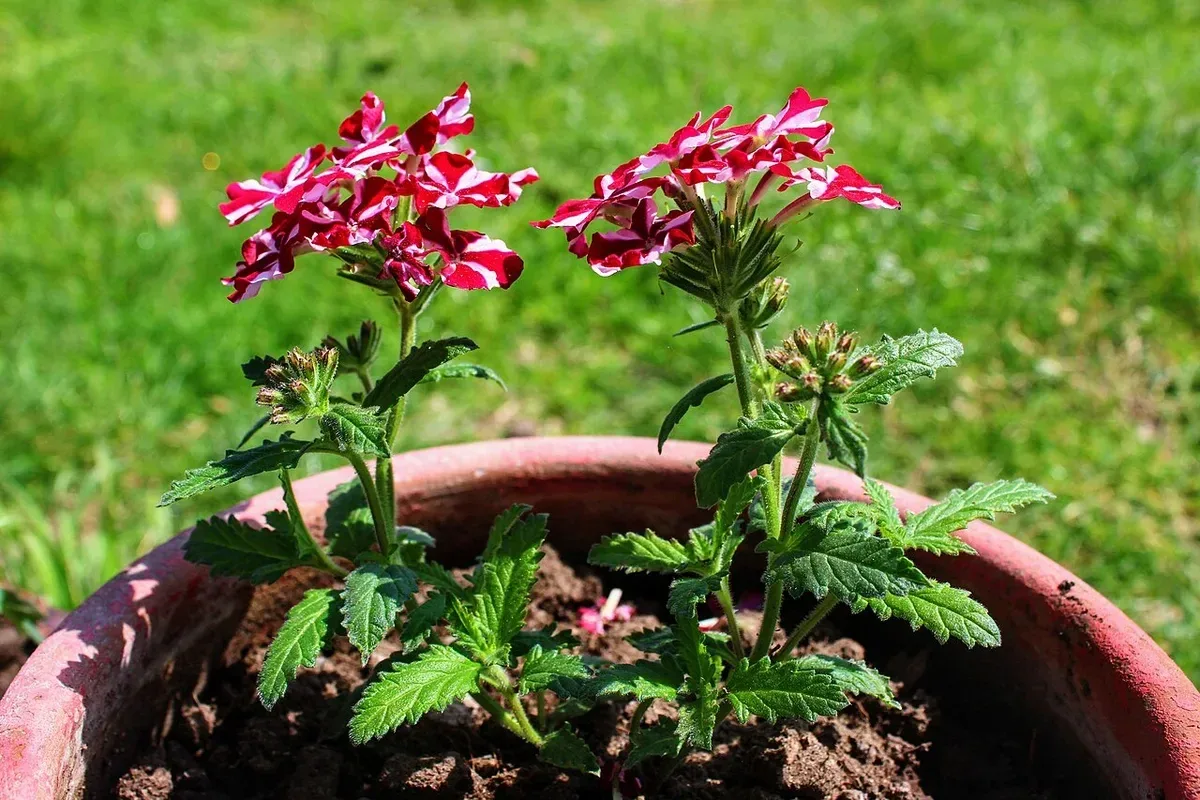
| ☀️ Light | Full sun |
|---|---|
| 💧 Water | Moderate (lightly moist) |
| 🪴 Soil | Well-drained garden soil or potting mix; not soggy |
| 🌡️ Temp | 0°C – 38°C |
| 🐾 Safety | Cats: not verified · Dogs: not verified |
| 📏 Mature size | 30 cm |
Where It Grows & Climate Tolerance
Pet & Companion Animal Toxicity (How to Grow Verbena in Canada)
Not yet verified: Toxicity status for cats, dogs, and horses has not yet been confirmed against veterinary poison-control records. Keep out of reach of pets or consult your veterinarian.
Across Canada, garden verbena is a patio and porch-basket flower for June to October. Treat it as an annual from Nanaimo to Moncton; tall purpletop vervain (V. bonariensis) usually comes back only as volunteer seedlings in Niagara, Toronto and Victoria yards.
Care instructions
Care Guide & Maintenance Routine
Set plants out once nights stay above freezing, typically late May in Ontario and Quebec. Give them the sunniest deck or south wall. Soak porch baskets whenever the top 2.5 cm feels parched, which can mean every day in a July heat wave. Feed planters with tomato fertiliser at label rate, snip spent heads weekly, and pot a few tip slips in August for the windowsill.
Light & Sunlight
NC State, the RHS and Wisconsin Horticulture all call for full sun. In shade, plants flower poorly and are more prone to powdery mildew.
Watering Schedule
NC State notes garden verbenas are fairly drought tolerant once established but that overwatering causes root rot. The RHS says pots and baskets need regular watering, sometimes daily in hot weather, when the mix is dry 2.5 cm down; border plants need water only in long dry spells. Avoid wetting the flowers and leaves.
Potting Mix & Drainage
Well-drained garden soil or potting mix; not soggy
Temperature & Humidity
Garden verbena collapses at the first hard freeze, often around Thanksgiving in Ontario and earlier on the Prairies. Purpletop vervain survives winter only in the mildest coastal BC and Lake Erie pockets, near zone 7a, and is otherwise treated as an annual that reseeds.
Verbena in Canadian gardens
Verbenas are among the most reliable flowers for Canadian hanging baskets and patio pots, flowering from June until frost and drawing butterflies and bees. They handle heat and short dry spells better than many annuals.
Planting dates
Verbenas are tender, so plant after the last frost. Average dates from ECCC 1991-2020 normals, compiled by GrowersGuide.ca, are 26 March in Vancouver, 22 April in Windsor, 29 April in Montréal, 7 May in Ottawa, 8 May in Halifax, 16 May in Fredericton, 22 May in Edmonton and 26 May in Calgary.
Baskets and window boxes
A trailing verbena basket on a sunny porch can dry out in a day in July. Check the mix 2.5 cm down, as the RHS suggests, and water before it becomes bone dry. From late June, add a potassium-rich liquid feed at the rate on the label.
Mildew in humid summers
Southern Ontario and southern Quebec summers are humid, and crowded verbenas often get powdery mildew by August. Choose mildew-resistant cultivars, give each plant space and water early in the day.
Verbena bonariensis in Canada
Wisconsin Horticulture rates V. bonariensis hardy only to zone 7a, so it rarely overwinters in most of Canada, but it self-seeds. Volunteers appear in late May in Toronto, Niagara and Victoria gardens. Wisconsin Horticulture notes it is not overly aggressive in cold climates.
Starting seed under lights
Wisconsin Horticulture advises sowing purpletop vervain 8 to 12 weeks ahead of the last frost. In Ottawa that means early March, around March break; in Calgary, mid March. A shop light on a basement shelf works well.
Saving a favourite colour
In late August, take 5 to 8 cm cuttings and root them on a bright sill. Keep them cool and on the dry side through winter.
Prairie sunshine
Long, bright days in Alberta and Saskatchewan suit verbenas well. Hail and drying winds are bigger threats; place baskets where they are sheltered from the west.
A typical Ontario season
In Toronto or Ottawa, garden centres stock verbena flats in early May, but nights can still drop near freezing until Victoria Day. Harden plants off on a balcony for a week, then plant out. Baskets fill out by Canada Day, and by the August long weekend trailing stems may need a trim. After Labour Day nights cool and growth slows, and the first frost, often around Thanksgiving, finishes them off.
Region notes
- Lower Mainland and Vancouver Island: the longest season; V. bonariensis self-seeds freely and sometimes overwinters.
- Calgary and Edmonton: short season; buy larger plants and use south-facing walls.
- Winnipeg and Regina: hot summers suit verbena; water baskets daily in July heat waves.
- Atlantic provinces: cool, damp coasts slow flowering; use the sunniest, most sheltered spot.
- Québec City and Saguenay: plant in early June after the last frost.
Questions from Canadian readers
- Is verbena deer resistant? NC State notes deer usually do not browse garden verbena.
Seasonal rhythm
Seasonal Calendar
| Month | Care Tasks | Seasonal Focus |
|---|---|---|
| Jan | Protect from frost/heat | Deep winter: rooted cuttings on a cool sill; keep on the dry side. |
| Feb | Protect from frost/heat | Family Day: check overwintered cuttings for aphids. |
| Mar | Sow | Start V. bonariensis under lights early in the month. |
| Apr | Sow | Prick out seedlings; pot on rooted cuttings. |
| May | Plant out | Victoria Day: plant out baskets and beds after frost. |
| Jun | Plant out, Fertilize | Prairies: plant out. Start potassium-rich feeds. |
| Jul | Prune, Harvest | Canada Day blooms: water baskets daily; deadhead. |
| Aug | Prune | Trim straggly stems by a third. Root cuttings late in the month. |
| Sep | Protect from frost/heat | Labour Day: pot rooted cuttings. Watch for mildew. |
| Oct | Protect from frost/heat | Thanksgiving frost ends the show; compost plants. |
| Nov | Protect from frost/heat | Leave V. bonariensis seed heads for birds. |
| Dec | Protect from frost/heat | Keep cuttings away from heat vents. |
Diagnostics
Common Problems & Troubleshooting
Powdery mildew in shade, crowding or humid weather; root rot in soggy soil; fewer flowers if not deadheaded; straggly growth by late summer; frost kill in autumn.
Pests & seasonal watch: Powdery mildew appears in muggy Ontario and Quebec Augusts, especially in crowded planters. Aphids and thrips ride in on nursery stock. Spider mites flare on hot Prairie decks. Soggy porch baskets after a rainy week can rot at the crown.
- Root rot — Roots turn brown and mushy in soil that stays wet.
- Leggy — Long weak stems with big gaps between small leaves, leaning to the window.
- Spider mites — Fine webbing and pale speckled leaves, worse in dry heated rooms.
- Thrips — Silvery streaks and twisted new leaves, sometimes with black specks of frass.
- Aphids — Clusters of small soft insects on new tips, often sticky.
- White powder — A white powdery film on leaves, usually in still, humid air with dry soil at the roots.
- Overwatering — Soil stays wet, leaves yellow or droop, and the pot feels heavy.
- No flowers — A flowering houseplant stays leafy and will not bloom.
Similar Botanical Matches
Keep exploring
Related plants
Grower field notes
Reader Field Notes in Canada
Share how this plant performs in your local Canada climate.