
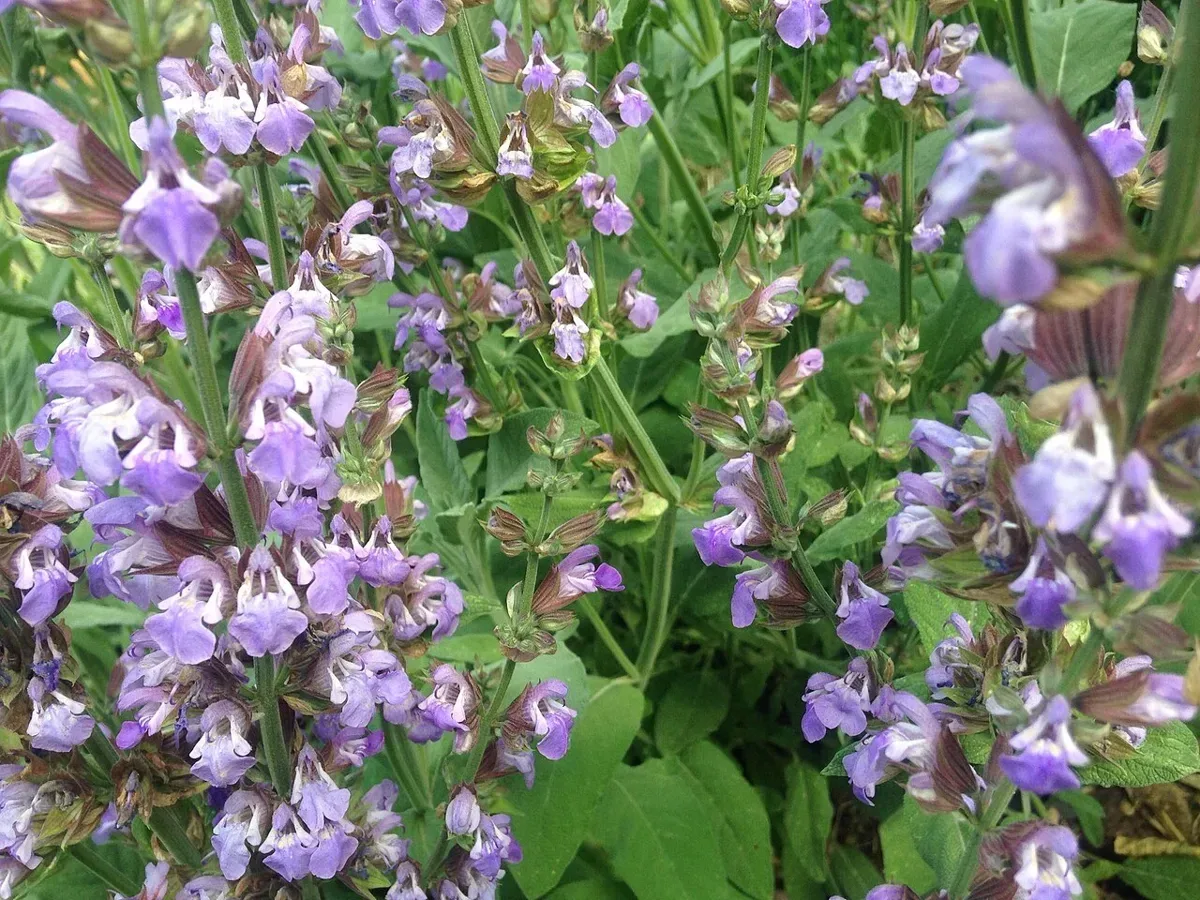
| ☀️ Light | Full sun |
|---|---|
| 💧 Water | Low (allow soil to dry) |
| 🪴 Soil | Gritty, well-drained, medium to dry soil; neutral to slightly alkaline |
| 🌡️ Temp | -29°C – 32°C |
| 🐾 Safety | Cats: non-toxic · Dogs: non-toxic |
| 📏 Mature size | 60 cm |
Where It Grows & Climate Tolerance
Pet & Companion Animal Toxicity (How to Grow Sage in Canada)
Common sage is a hardy perennial in much of southern Canada if its roots stay dry over winter. Coloured varieties are less hardy, and on the colder Prairies sage is often grown in a pot and brought in.
Care instructions
Care Guide & Maintenance Routine
Plant after the last frost in full sun and sharp drainage. Water only when dry. Harvest up to half the plant at a time through summer. Stop cutting by early fall so it can harden off. Protect coloured forms and Prairie plants over winter or bring pots indoors.
Light & Sunlight
NC State Extension and Wisconsin Horticulture both list full sun. In shade, sage grows thin and floppy and is more prone to mildew.
Watering Schedule
NC State notes sage tolerates drought and does not tolerate wet soil. Wisconsin Horticulture adds that it produces better with consistent water. In practice, water deeply and then let the top several centimetres dry before watering again.
Potting Mix & Drainage
Gritty, well-drained, medium to dry soil; neutral to slightly alkaline
Temperature & Humidity
Common sage tolerates frost and survives most winters in Zone 5 and warmer if the soil drains. Late fall pruning and wet soil make winter loss more likely. Last frost ranges from late March on the BC coast to early June in Newfoundland; plant tender coloured forms after it.
Sage in Canadian gardens
Sage is a favourite for Thanksgiving stuffing, and in many parts of southern Canada one plant lasts for several years. Wisconsin Horticulture, writing for a climate similar to southern Ontario and the Prairies, notes that common sage is hardy to USDA zone 4a. NRCan's Canadian zones are calculated differently, so treat that as a guide and plant in the most sheltered, best-drained spot you have.
Zones and survival
NRCan's 1991-2020 map places Toronto, Windsor and Kelowna in Zone 7, Halifax and London in 6b, Montréal and Charlottetown in 5b, Ottawa, Québec City and Fredericton in 5a, Calgary and Edmonton in 4a, and Regina and Saskatoon in 3a. Common sage usually survives in Zone 5 and warmer if the soil drains well. In Zone 4 it may come back after a snowy winter. In Zone 3 most gardeners treat it as an annual or keep it in a pot.
Coloured forms
Wisconsin Horticulture lists purple sage as hardy only to zone 6, and golden and tricolor sage to zone 5b or 6a. 'Berggarten' is listed to zone 5a and resists mildew. In Ottawa or Montréal, grow the coloured ones in pots or replace them each spring.
Planting and spacing
Plant after your last frost. Average dates from ECCC 1991-2020 normals, compiled by GrowersGuide.ca, run from 26 March in Vancouver to 4 May in Toronto, 22 May in Edmonton and 1 June in St. John's. Wisconsin Horticulture suggests 45 to 60 cm between plants.
Winter wet on the coast
On the BC coast and in Nova Scotia, cold is less of a threat than soggy winter soil. Plant on a slope or raised bed, mix in grit, and avoid mulching right up to the stems.
Prairie pots
In Regina, Saskatoon or Winnipeg, grow sage in a 30 cm pot. Wisconsin Horticulture notes smaller varieties can be brought inside for fresh sage through the winter. Before the first fall frost, which comes around 10 to 15 September in Calgary, Regina and Saskatoon, move the pot to a cool, bright window and water sparingly.
Southern Ontario and Quebec herb beds
In Toronto, Hamilton and the Niagara region, sage in a raised herb bed often stays partly evergreen and gives leaves from April to November. Around Montréal and the Eastern Townships, a sheltered south-facing wall and good snow cover make the difference. Gravel mulch keeps the crown dry during the March thaw.
Spring pruning
Wait until new leaves show in May before cutting back winter damage, then trim to live buds without cutting into bare wood.
Questions from Canadian readers
- Should I mulch sage in winter? A loose layer of evergreen boughs after the ground freezes helps in Zone 4 and 5. Avoid heavy, wet mulch on the crown.
- Is it safe with cats? ASPCA lists sage as non-toxic to dogs, cats and horses.
Seasonal rhythm
Seasonal Calendar
| Month | Care Tasks | Seasonal Focus |
|---|---|---|
| Jan | Protect from frost/heat | Indoor pots: bright, cool window; water sparingly. |
| Feb | Sow, Protect from frost/heat | Start seed indoors 6 to 8 weeks before last frost on the coast. |
| Mar | Sow | Start seed indoors in Ontario, Quebec and the Maritimes. |
| Apr | Plant out, Prune | BC coast: trim winter damage. Plant out after frost. |
| May | Plant out, Prune | Prune to live buds once new leaves show. Plant new sage after last frost. |
| Jun | Harvest | First harvests. Flowers for bees; shear spent spikes. |
| Jul | Plant out, Harvest | Pick leaves. Take softwood cuttings and layer low branches. |
| Aug | Harvest | Cut up to half the plant. Dry bunches indoors. |
| Sep | Protect from frost/heat | Stop heavy cutting so plants harden off. Prairies: bring pots in before frost. |
| Oct | Harvest, Protect from frost/heat | Final light harvest for Thanksgiving. Clear fallen leaves from the crown. |
| Nov | Protect from frost/heat | After the ground freezes, cover with evergreen boughs in Zones 4 and 5. |
| Dec | Protect from frost/heat | Check indoor pots for spider mites. |
Diagnostics
Common Problems & Troubleshooting
Root rot and collapse in wet soil; powdery mildew in humid, crowded conditions; woody, bare centre on old plants; leggy growth in shade; winter dieback of coloured forms.
Pests & seasonal watch: Powdery mildew in humid Ontario and Quebec summers. Spittlebugs in June. Spider mites on sage brought indoors for winter. Root rot in heavy clay and wet coastal soils.
- Root rot — Roots turn brown and mushy in soil that stays wet.
- Leggy — Long weak stems with big gaps between small leaves, leaning to the window.
- Spider mites — Fine webbing and pale speckled leaves, worse in dry heated rooms.
- White powder — A white powdery film on leaves, usually in still, humid air with dry soil at the roots.
- Overwatering — Soil stays wet, leaves yellow or droop, and the pot feels heavy.
- Cold damage — Dark, water-soaked or blackened patches after a cold night or an AC blast.
- Stem rot — The stem goes soft, dark or black at soil level and the top collapses.
Care encyclopedia · 1 guide
Guides & Articles for How to Grow Sage in Canada
Similar Botanical Matches
Keep exploring
Related plants
Grower field notes
Reader Field Notes in Canada
Share how this plant performs in your local Canada climate.