| ☀️ Light | Bright indirect light |
|---|---|
| 💧 Water | Moderate (lightly moist) |
| 🪴 Soil | Chunky, airy aroid mix |
| 🌡️ Temp | 15°C – 29°C |
| 🐾 Safety | Cats: toxic · Dogs: toxic |
Where It Grows & Climate Tolerance
Pet & Companion Animal Toxicity (Philodendron Splendid)
A velvet-leaved climbing hybrid of P. verrucosum and P. melanochrysum. Needs warmth, humidity and a pole to grow big leaves.
Care instructions
Care Guide & Maintenance Routine
Bright indirect light, grow light in winter. Keep the mix lightly moist, never soggy. Keep warm, above 15°C, with good humidity. Give it a moss pole. Feed April to September. Toxic to pets.
Light & Sunlight
No direct sun on velvet leaves. Many Canadian homes need a grow light from October to March.
Watering Schedule
Water when the top of the mix starts to dry, then drain. Do not let a fine-rooted velvet plant dry right out or sit wet. No fixed schedule.
Potting Mix & Drainage
Chunky, airy aroid mix
Temperature & Humidity
RHS genus guide minimum 15°C. Keep away from cold glass and drafts. Upper figure is an editorial comfort guide.
Philodendron Splendid is a velvet-leaf climbing hybrid with long, dark green leaves, pale green veins and a reddish blush underneath. It is a collector's plant, not a garden-centre regular, and it is usually sold by specialist shops. The good news is that its parentage is on record, so we know more about it than about many trendy philodendrons. The challenge in Canada is winter air: velvet leaves dislike dry furnace heat and cold glass. This page sets out what the records say, how to tell Splendid apart, and how to keep it growing well in a Canadian home all year.

Philodendron Splendid at a glance
| What you need to know | Short answer |
|---|---|
| Name | Philodendron 'Splendid'; arum family (Araceae) |
| What it is | A hybrid: Philodendron verrucosum x Philodendron melanochrysum (International Aroid Society registry) |
| Registry status | Accepted, pending publication; not yet "established" |
| Habit | Active climber; needs a moss pole or plank |
| Light | Bright, indirect light; no direct sun on the leaves |
| Water | When the top few centimetres of mix are just dry; less in winter |
| Warmth | Keep above 15°C, away from cold glass and drafts |
| Humidity | Benefits from added humidity in a heated home |
| Difficulty | Intermediate to advanced |
| Pets | Not pet safe |
What is Philodendron Splendid?
The International Aroid Society (IAS) runs the official cultivar registry for aroids. Its record for 'Splendid' says:
- Cultivar type: hybrid.
- Seed parent: Philodendron verrucosum. Pollen parent: Philodendron melanochrysum.
- Originator: Keith Henderson. Namer: Neil Crafter.
- Released: 1990.
- Status: accepted, pending publication. The registry marks it as not yet established.
- Name origin: a remark on the beauty of the leaves, and part of a series of Henderson hybrids that includes 'Majestic' and 'Glorious'.
Both parents are accepted species in Kew's World Checklist of Vascular Plants. "Pending publication" means the registry accepts the name but the formal publication step is not complete. It does not mean the plant is fake. It does mean you should be careful with plants sold as Splendid that look very different from the description below.
How to recognise Splendid
Everything in this list comes from the IAS registry description:
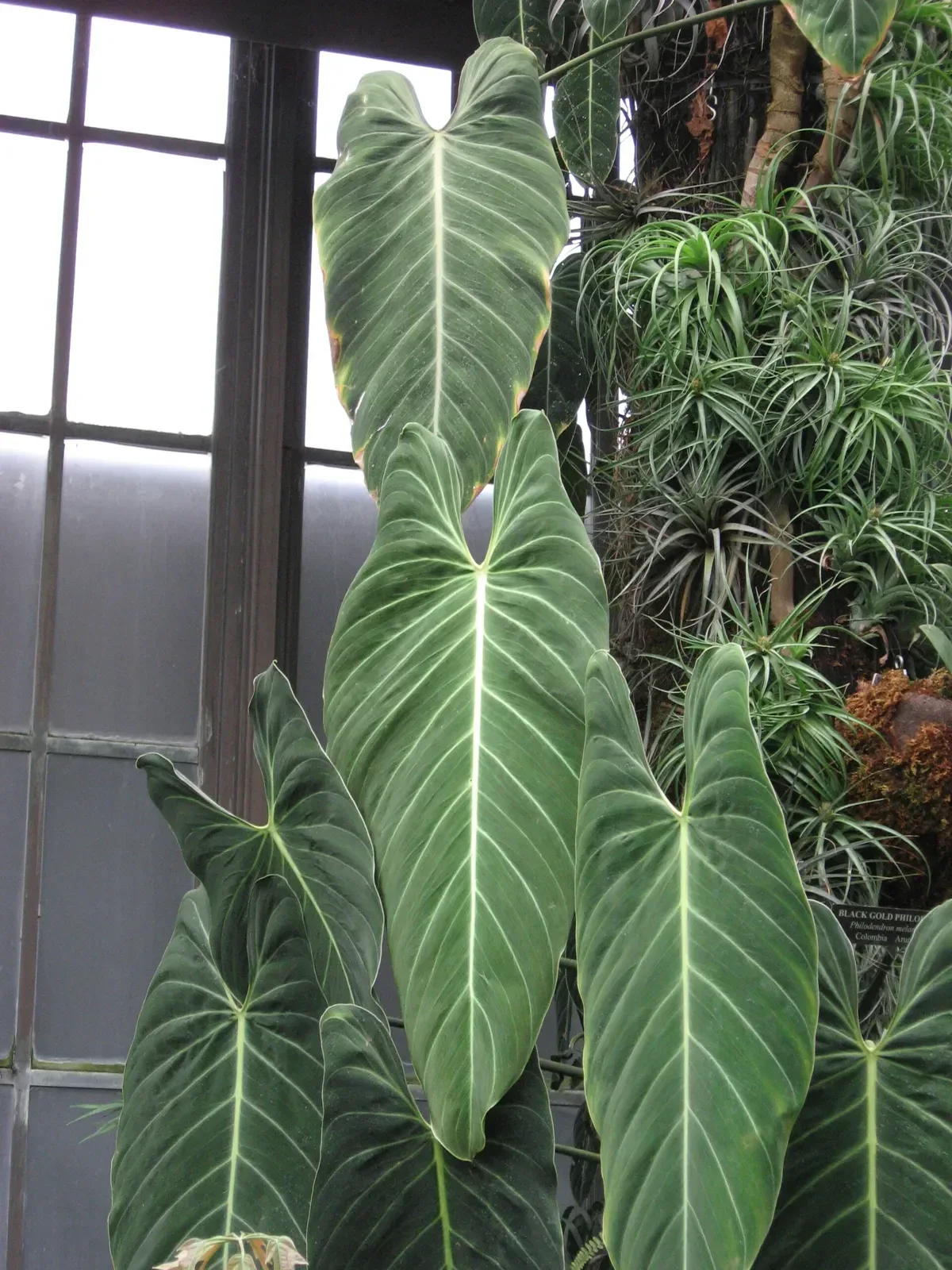
- Leaves are oblong and long, with a deeply heart-shaped base, and velvety on top.
- The upper side is dark green. The underside has reddish-purple blocks between the veins.
- Veins are a much lighter green, with visible branching near the edge.
- Leaf stalks are green and round, with white streaks along them, roughened, and reddish near the top.
- The thin sheaths around new leaves (cataphylls) dry and stay on the stem for a while.
- It grows as an active climber.
The registry says it keeps the best features of both parents: velvet leaves slightly rounder than P. verrucosum, with verrucosum's branching veins, a red blush on the underside, and a noticeable red blush in the notch where the stalk meets the leaf.
About the photos on this page
We could not find a properly licensed photo of a Splendid plant. The photos here show its two parents, clearly labelled. They help you see where Splendid's velvet texture and pale veins come from, but they are not pictures of Splendid itself. We will replace them with an original photo.

Buying a Philodendron Splendid in Canada
Splendid is sold mostly by specialist plant shops, plant fairs and online sellers, often as a rooted cutting. Before you pay:
- Ask for photos of the exact plant, including the leaf underside and the stalk.
- Compare those with the registry description: velvet surface, pale veins, reddish underside between veins, roughened stalk.
- Choose a cutting with at least one healthy leaf and a visible root system.
- Check for pests under the leaves and around the node.
Shipping in winter is risky. Velvet leaves mark easily with cold. If you order between November and March, pick a seller who uses heat packs and insulated boxes, and unpack the plant straight away in a warm room. Keep a new plant apart from your others for two or three weeks.
Light in a Canadian home
RHS advises bright but indirect light for philodendrons, out of direct summer sun, and warns that too little light leads to leggy growth with fewer, smaller leaves. For a velvet climber like Splendid:
- East window: good all year.
- South window: good from October to March, set back from the glass or behind a sheer curtain.
- West window: use a sheer curtain in summer.
- North window: too dim for good growth in winter.
Growing Splendid under LED lights is a good option in Canada, because the light is steady and the plant can sit away from cold windows. University of Minnesota Extension suggests 12 to 14 hours of light a day for foliage plants, with the light 30 to 60 cm above the leaves.
Moss pole and support
The IAS describes Splendid as a hemiepiphyte and an active climber. In plain words, it wants to climb something. RHS advises giving climbing philodendrons a moss pole, which they will root into if it is kept moist. Climbing usually brings bigger leaves.
- Add a moss pole or a wooden plank when you pot up in spring.
- Lay the stem against it with the nodes touching the support, and tie loosely.
- Keep the pole damp so aerial roots grab on.
- Add an extension to the pole as the plant reaches the top.
Soil mix, pots and repotting
Velvet climbers want roots that stay moist but never airless. RHS suggests a loose, free-draining, slightly acidic mix for philodendrons, roughly two parts orchid compost to one part peat-free ericaceous compost. A practical home mix:
- 2 parts orchid bark
- 1 part indoor potting mix
- 1 part perlite
- A handful of chopped sphagnum moss (optional)
This is a starting recipe, not a fixed rule. Use a pot with drainage holes, only a few centimetres wider than the roots. A clear plastic nursery pot inside a decorative pot lets you see roots and moisture. Repot in spring.
Watering by season
RHS advises waiting until the top of the compost dries out before watering philodendrons, never leaving them standing in water, and using rainwater or filtered water where tap water is hard. For Splendid, let the top few centimetres dry, then water thoroughly and let it drain.
Spring and summer
Active growth and warm air mean the mix dries faster. Check every few days.
Autumn
Growth slows. The furnace dries the surface while the middle stays damp, so check deeper.
Winter
Water less often. If the plant is in a warm cabinet or under lights, it may keep growing and need more water than a windowsill plant. Check rather than guess. Use room-temperature water, and keep water off the velvet leaves.
Humidity and temperature
This is where Splendid differs most from easy philodendrons. RHS says philodendrons in general prefer moderately humid air but cope with the lower humidity in most homes. Velvet hybrids are less forgiving in practice. In a Canadian winter, when indoor air can be very dry, plan to add humidity.
- Run a humidifier in the room.
- Group plants together. University of Minnesota Extension says grouping and pebble trays raise humidity around plants.
- Consider a clear plant cabinet or a large terrarium. University of Minnesota Extension suggests these for humidity-loving plants.
- Keep it away from heat registers and wood stoves.
- Keep it above 15°C, as RHS advises for philodendrons, and keep leaves off cold glass.
We do not give a single humidity number, because we found no source that sets one for Splendid. Watch the plant: if new leaves get stuck or crisp at the edges, add humidity.
Fertilizer
RHS suggests feeding philodendrons from April to September with a general houseplant fertilizer. For Splendid, a balanced liquid fertilizer at half strength once a month is enough. If it grows under lights all year and keeps putting out leaves, a weaker feed in winter is reasonable. Otherwise stop in October.
Pruning
RHS suggests pruning climbing philodendrons in spring, cutting just after a leaf node, and wearing gloves because the sap can irritate skin.
- Remove damaged or yellow leaves at the stalk.
- If the plant outgrows its pole, you can cut the top section off and root it, then let the base make a new shoot.
- Leave the dry cataphylls on the stem. The registry notes they persist; they fall in time.
Propagation
Splendid is a hybrid, so it must be grown from cuttings to stay true. RHS says climbing philodendrons propagate easily from stem cuttings from spring to late summer.
- Cut a section with at least one node and, ideally, an aerial root.
- Root it in damp sphagnum moss, perlite or water, in a warm spot with bright, indirect light.
- Cover with a clear bag or box to keep humidity high, with a little air.
- Pot up into your airy mix once roots are a few centimetres long.
Velvet cuttings root more slowly in winter. If you must take one then, keep it warm under a grow light. Full steps are in our philodendron propagation guide.
Why are new leaves getting stuck or crisp?
New leaves that tear as they open, or that come out with crisp brown edges, are the most common Splendid complaint in a Canadian winter. Likely causes:
- Dry air: the new leaf dries before it unfurls. Add humidity before the next leaf opens.
- Cold: a stem near cold glass grows slowly and the leaf can stall.
- Dry roots: if the mix dried completely, the plant pulls water from the newest leaf.
Do not pull a stuck leaf open; that tears it. Raise the humidity, keep the plant warm and wait. Fixing the air usually helps the next leaf more than the stuck one.

Problem troubleshooter
| What you see | Likely cause | What to do first |
|---|---|---|
| New leaf stuck or torn | Dry air | Humidifier, cabinet or grouping. |
| Brown, crispy edges | Dry air, heat register, fertilizer salts | Move from heat; flush the pot; stop winter feeding. |
| Small leaves, long gaps | Low light or no climbing support | More light; add a moss pole. |
| Yellow leaves, wet mix | Overwatering | Let the mix dry more; check roots. |
| Soft, dark stem at soil level | Stem or root rot | Cut healthy sections and re-root them. |
| Pale or bleached patches | Direct sun | Move back from the window. |
| Fine webbing | Spider mites | Rinse gently; use a houseplant-labelled soap. |
| White fluff at nodes | Mealybugs | Dab with rubbing alcohol on a swab. |
RHS lists mealybugs, red spider mites and scale insects as the main pests of philodendrons. Use products labelled for indoor plants in Canada and test any spray on one leaf first, because velvet leaves mark easily. See also our plant problems page.
Month-by-month care calendar for Canada
| Month | What to do |
|---|---|
| January | Humidifier on. Grow light 12 to 14 hours. Water less. Watch for stuck leaves. |
| February | Check for spider mites. Keep off cold glass. |
| March | Growth picks up. Water a little more often. |
| April | Start half-strength feeding. Repot or add a pole extension. |
| May | Take cuttings if needed. Keep the moss pole damp. |
| June | Filter strong sun on south and west windows. |
| July | Check water often in heat; keep air moving. |
| August | Last good month for repotting. |
| September | Last feed. Set up humidity before the heat goes on. |
| October | Stop feeding. Furnace on: check mix deeper. |
| November | Move under lights or to the brightest window. |
| December | Keep away from heat registers and drafty doors. |
Safety for pets, children and skin
Treat Splendid as toxic. There is no ASPCA entry for Splendid or its two parents. RHS says philodendrons are poisonous and their sap can irritate skin, and advises keeping them away from children and pets. ASPCA lists philodendrons as toxic to dogs and cats because of insoluble calcium oxalates, which cause mouth irritation, drooling, vomiting and trouble swallowing.
- Keep it where pets and children cannot reach it.
- Wear gloves when pruning or taking cuttings.
- If a pet chews it, call your vet. The ASPCA Animal Poison Control line is (888) 426-4435 (a fee may apply). For a child, call your provincial poison centre.
See our pet-safe plants list for alternatives.
Common mistakes
- Expecting it to cope with dry furnace air like a heartleaf philodendron.
- Letting it trail instead of giving it something to climb.
- Spraying the velvet leaves with water or leaf shine.
- Repotting into a dense, peaty mix that stays wet.
- Buying from photos that do not show the actual plant.
Watch: growing Philodendron Splendid
A grower shows how a small Splendid cutting became a large plant on a support. Their home climate is warmer and more humid than a Canadian winter, so add humidity and water less from November to March.
Related plants and guides
- Philodendron types and care for Canadian homes
- Philodendron micans, an easier velvet-leaf philodendron
- Philodendron Birkin, another named philodendron
- Philodendron care in Canadian winters
- How to propagate philodendron
- Anthurium, a related aroid
Sources
- International Aroid Society cultivar registry: Philodendron 'Splendid'. Accessed 10 Nov 2026.
- International Aroid Society: cultivar registry. Accessed 10 Nov 2026.
- Kew World Checklist of Vascular Plants (via GBIF) (P. verrucosum, P. melanochrysum). Accessed 10 Nov 2026.
- RHS: How to grow philodendrons. Accessed 10 Nov 2026.
- ASPCA: Split Leaf Philodendron. Accessed 10 Nov 2026.
- University of Minnesota Extension: Lighting for indoor plants. Accessed 10 Nov 2026.
- University of Minnesota Extension: Winter houseplant tips. Accessed 10 Nov 2026.
Seasonal rhythm
Seasonal Calendar
A month-by-month calendar for Philodendron Splendid in Canada is coming soon. See the light, water and temperature notes above.
Diagnostics
Common Problems & Troubleshooting
Small leaves: no support or low light. Crispy edges: dry air. Rotting stem: cold wet mix.
Pests & seasonal watch: Thrips, spider mites, mealybugs and scale. Use products labelled for indoor plants in Canada.
Q&A
Frequently Asked Questions
What is Philodendron Splendid a cross of?
The International Aroid Society registry lists 'Splendid' as a hybrid with Philodendron verrucosum as the seed parent and Philodendron melanochrysum as the pollen parent. The originator is Keith Henderson and the namer is Neil Crafter, with a release year of 1990.
Is Philodendron Splendid a real cultivar?
Yes. The International Aroid Society registry lists 'Splendid' as accepted, pending publication. That means the name is accepted but the formal publication step is not complete, so the registry marks it as not yet established. It is one of the better-documented collector philodendrons.
Is Splendid hard to grow in a Canadian home?
It is harder than a heartleaf philodendron, mainly because of dry winter air. Velvet leaves and new growth suffer when the furnace runs. With bright indirect light, a moss pole, an airy mix and added humidity from a humidifier or plant cabinet, it grows well indoors.
Does Philodendron Splendid need a moss pole?
Yes, it grows best with one. The IAS describes it as an active climber. RHS advises giving climbing philodendrons a moss pole they can root into if kept moist. Climbing usually brings larger leaves.
Why are my Splendid's new leaves getting stuck or crisp?
Dry air is the usual cause, especially in a Canadian winter. The new leaf dries before it can open. Cold spots near windows and a pot that dried out completely can also cause it. Raise humidity, keep the plant warm and do not pull a stuck leaf open.
Is Philodendron Splendid toxic to pets?
Yes, treat it as toxic. There is no ASPCA entry for Splendid itself, but RHS says philodendrons are poisonous and their sap can irritate skin, and ASPCA lists philodendrons as toxic to dogs and cats because of insoluble calcium oxalates.
How do I tell a real Splendid from other velvet philodendrons?
Compare it with the IAS registry description: long velvety leaves with a deeply heart-shaped base, light green veins, reddish-purple patches between the veins underneath, and roughened stalks with white streaks. Ask the seller for photos of the leaf underside and stalk.
How much humidity does Philodendron Splendid need?
We found no source that sets a number for Splendid, so we will not give one. RHS says philodendrons prefer moderately humid air. Velvet types do better with added humidity in a heated home. Watch new leaves: if they stick or crisp, add more.
How do I propagate Philodendron Splendid?
By stem cuttings, since it is a hybrid. Cut a piece with at least one node, ideally with an aerial root, and root it in damp sphagnum, perlite or water in a warm, bright spot with a clear cover. RHS says spring to late summer is the best time.
How should I clean velvet philodendron leaves?
Gently. Use a soft brush or a very soft, dry cloth to lift dust. Avoid leaf shine and harsh wiping, which can mark the velvet. Keep water off the leaves where you can, and test any pest spray on one leaf first.
Similar Botanical Matches
Grower field notes
Reader Field Notes in Canada
Share how this plant performs in your local Canada climate.