| ☀️ Light | Full sun |
|---|---|
| 💧 Water | Moderate (lightly moist) |
| 🪴 Soil | Free-draining loam with mature compost; a stable heavy pot prevents a tall shrub tipping. |
| 🌡️ Temp | 18°C – 32°C |
| 🐾 Safety | Cats: toxic · Dogs: toxic |
| 📏 Mature size | 2.5 m |
Where It Grows & Climate Tolerance
Pet & Companion Animal Toxicity (Raat Ki Rani)
A strongly scented outdoor shrub that needs careful placement away from bedrooms and chewing pets.
Care instructions
Care Guide & Maintenance Routine
4–6 hours of sun or bright open light; avoid a closed room with little ventilation. Water when the top 2–3 cm dries. Keep an established root ball evenly moist during warm growth, never boggy.
Light & Sunlight
4–6 hours of sun or bright open light; avoid a closed room with little ventilation.
Watering Schedule
Water when the top 2–3 cm dries. Keep an established root ball evenly moist during warm growth, never boggy.
Potting Mix & Drainage
Free-draining loam with mature compost; a stable heavy pot prevents a tall shrub tipping.
Temperature & Humidity
These are comfortable growing temperatures, not frost-hardiness limits. Protect tropical growth from cold nights and move a potted plant under cover before frost.
Raat Ki Rani: a practical growing guide for India
A strongly scented outdoor shrub that needs careful placement away from bedrooms and chewing pets.
Quick facts
| What you need to know | At a glance |
|---|---|
| Names | Raat Ki Rani; Raat ki rani |
| Botanical name and family | Cestrum nocturnum; Solanaceae |
| Plant type and difficulty | Outdoor; Beginner |
| Managed container size | 250 cm tall; about 180 cm wide. Variety and pruning change this. |
| Light | 4–6 hours of sun or bright open light; avoid a closed room with little ventilation. |
| Water | Water when the top 2–3 cm dries. Keep an established root ball evenly moist during warm growth, never boggy. |
| Soil | Free-draining loam with mature compost; a stable heavy pot prevents a tall shrub tipping. |
| Comfortable growing temperature | 18–32°C; not a frost-survival limit |
| Flowers or harvest | Warm-season flowering flushes; scent becomes strong in the evening. |
| Pet safety | Cestrum nocturnum is poisonous if eaten; berries and foliage are not food. No exact ASPCA entry verified here; use the NC State poison information rather than a true-jasmine safety label. |
The botanical and safety references are linked at the end. A common name may cover several species. Confirm the label before applying food or pet-safety advice.
Identification and varieties: which one should you choose?
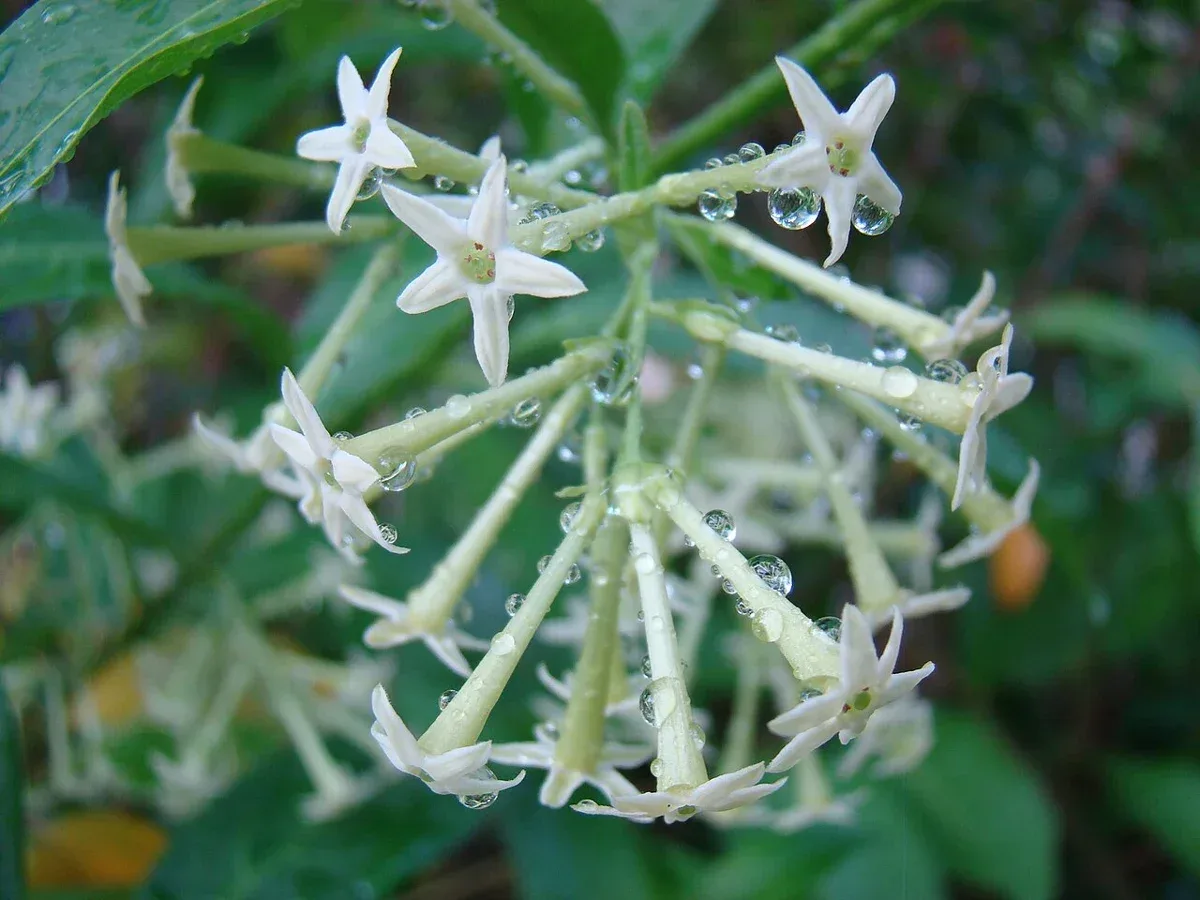
Raat ki rani is Cestrum nocturnum, with narrow tubular greenish-white flowers and strong night scent. It is not true jasmine, parijat or the night-flowering cactus often called brahma kamal. Check the botanical name rather than buying any plant labelled queen of the night.
Where to grow it: light, direction and pot choice
Use a balcony, open terrace or garden bed with the direct light described above. An east-facing balcony is often gentler; south- and west-facing spaces usually get stronger sun but can overheat pots. A north-facing space shaded by buildings may not provide enough direct light. Direction alone is not a light measurement: watch the leaves at several times of day. A 35–45 cm pot for a pruned shrub; do not crowd a narrow doorway. Repot when roots crowd the container, during suitable warm growth; keep the original planting depth. Terracotta dries faster and is heavier; plastic holds moisture longer and is easier to move. Both need open drainage holes. A decorative outer pot is not drainage: remove trapped runoff. On a terrace, check wet container weight, waterproofing and a secure wind-safe position before installing a large pot or support.
Temperature, humidity and cold protection
These are comfortable growing temperatures, not frost-hardiness limits. Protect tropical growth from cold nights and move a potted plant under cover before frost. Ordinary outdoor humidity is adequate; leave space between pots so leaves dry after rain. The comfort range above is not a survival test. Keep a new plant away from hot glass, AC exhaust and cold drafts; change its position gradually.
Buying a healthy plant or seed
Look for a bush with healthy fresh growth and no sticky scale or whitefly. Check the space you can offer before buying a large shrub. Avoid placing a berry-bearing plant where a toddler or pet can reach it. Ask for the botanical name, mature size and previous spray history, not just a care card saying water daily. After delivery, unpack promptly, photograph damage and keep the plant separate from your collection while inspecting it. Let it recover from travel before feeding heavily or disturbing healthy roots.
When to plant in different Indian regions
These are practical planning windows, not trial-validated dates for every district. Plant when roots can grow without severe heat, frost or standing water. Eastern hills, western deserts and high-altitude sites can differ greatly from nearby plains. For sowing a specific cultivar, follow its packet and local KVK advice.
| Region | Starting window |
|---|---|
| North Indian plains | February–March or July–August |
| South and coastal India | February–April or June–September away from heavy rain |
| East Indian lower plains | February–April after cold, or July–August with rain protection |
| West India | February–March in inland plains; June–August only where drainage and rain shelter allow |
| Cooler hills | April–May only in mild frost-free valleys |
Planting step by step
- Choose a mild day in the regional window. Prepare the container, labelled planting material and clean tools before disturbing roots.
- Check drainage holes and pre-moisten the mix so it is damp and crumbly, not dripping. Do not add a gravel layer at the bottom as a substitute for drainage.
- Slide a nursery root ball out gently and inspect it. Do not buy or plant a sour, mushy root ball. Keep delicate roots together; avoid unnecessary washing or deep cutting.
- Set the plant at the nursery depth and fill around it without burying the stem base. Leave a little watering space below the rim. Fit a support now if the plant needs one.
- Water to settle the mix, let excess escape and return it to suitable sheltered light. Increase sun gradually for a shade-grown nursery plant.
- Watch new growth and the root-zone moisture. Feed only after establishment; do not try to repair transplant shock with a strong fertiliser dose.
A potting mix using easy-to-find ingredients
2 parts crumbly garden loam + 1 part mature compost or vermicompost + 1 part rinsed buffered cocopeat + 1 part perlite or washed coarse horticultural grit. Measure parts by volume with the same mug or scoop, not by weight. Mix thoroughly before filling the pot.
This is a practical starting recipe, not a tested requirement for every cultivar. If local loam is sticky clay, replace some of it with a good container mix; fine sand mixed into clay can make it denser. Use washed coarse horticultural sand only if it drains well; avoid fine plastering sand, beach sand, salty cocopeat and fresh manure. Vermicompost should smell earthy, not sour. Test a small pot by watering it: water should drain freely rather than sit on top.
Watering in summer, monsoon and winter
Water when the top 2–3 cm dries. Keep an established root ball evenly moist during warm growth, never boggy.
| Season | How to decide |
|---|---|
| Hot summer | Check early in the day and again after strong dry wind if needed. Water the root ball thoroughly when its drying test is met. A wilted plant with wet soil is not automatically thirsty. |
| Monsoon | Check below the surface after rain. Skip watering if already damp, empty saucers and move rain-sensitive pots under a bright cover. Rain falling on leaves does not always wet a sheltered root ball. |
| Winter | Reduce frequency if growth and drying slow. Cold wet roots are risky. Warm southern sites may still need regular checking; do not copy a Delhi interval in Chennai. |
Push a finger into the mix at more than one point, away from the stem. If the surface is dry but deeper mix is cool and damp, wait unless this plant needs steady moisture. A light pot can help confirm drying. Water slowly at soil level and let excess drain; do not give a daily spoonful that wets only the top.
Fertiliser: organic and packaged options
Apply mature compost in spring and a balanced container feed every 4–6 weeks during active growth. Pause when cold slows growth.
For an organic approach, use a thin surface layer of mature compost or vermicompost, keeping it away from the stem and leaving watering space. Let the existing mix and plant response guide the amount. Do not stack manure, mustard-cake liquid, seaweed and NPK on the same day. Raw banana peels, tea waste, milk and fresh manure are not a balanced container feed.
For packaged feed, NPK numbers such as 19:19:19 describe nutrient percentages, not a dose. Choose a product labelled for this plant group and container use; ixora needs an acid-loving shrub option and palms benefit from palm-specific guidance. Use the pack rate and supplied measuring tool. One gram per litre on one product is not permission to use that dose for a different concentrate. Never guess an unknown scoop weight. If the label gives no suitable container rate, choose a product that does instead of converting a hectare dose.
Apply to a moist healthy root ball, not to dry, resting, newly damaged or waterlogged roots. Pause during cold slowdown or persistent wet weather. Stop and inspect if leaf edges scorch or white salts build up. A single high-phosphorus bloom booster does not solve shade, juvenile age or insect-damaged buds.
Pruning, pinching and repotting
Prune after a flowering flush to contain size. Wear gloves and bag berries and cuttings out of reach. Use a sharp clean tool and cut above a healthy leaf joint where appropriate. Take off dead or diseased material without repeatedly removing every healthy tip. Check roots when water runs through without wetting the ball, the pot dries unusually fast, or roots circle tightly and growth stalls. Move up one pot size in suitable active growth rather than putting a tiny plant into a huge wet tub.
Propagation: seed, cutting or division?
Take a healthy semi-ripe cutting without flowers, cut below a joint and remove lower leaves. Put the bare lower nodes into a small draining pot with equal parts cocopeat and perlite. Keep warm in bright shade and lightly humid, with daily ventilation. Move it into stronger light gradually after rooting. Use gloves, clean tools and safe disposal of leaves and berries. Do not root poisonous cuttings in drinking glasses used by children.
Flowers, fruit or a useful leaf harvest
Use it as a fragrant outdoor shrub in a ventilated location. Keep it away from a bedroom window if the scent bothers anyone. It is not a tea plant or edible jasmine, and berries and leaves must not be eaten. Remove fallen berries where children or pets play and avoid allowing it to spread into nearby natural areas. For better flowering or fruiting, check actual sun, maturity, root health and the timing of pruning before changing feed. Warm-season flowering flushes; scent becomes strong in the evening.
Problem solver: symptom, cause and first action
These are possible causes, not a diagnosis from one symptom. Some pests are uncommon on particular plants, so confirm what is present before treatment. Photograph both leaf surfaces, the stem base and the full plant; record recent rain, watering and sprays.
| What you see | What to check | First practical action |
|---|---|---|
| No smell during daylight | The flowers release their strongest scent at night | Check an open flower after dusk before diagnosing poor health. If there are no flowers, check light and repeated pruning. More feed does not create daytime scent. |
| Yellow lower leaves | Old leaves ageing, saturated roots, cold or poor nutrition | Check root moisture and recent weather first. A few old leaves differ from rapid whole-plant yellowing; do not assume every yellow leaf needs iron. |
| Leaf drop or wilting | Travel shock, drought, cold, wet roots or changing light | Check the mix before watering, keep conditions stable and inspect stems. Soft stems in wet mix need isolation and root inspection. |
| Curled or distorted new leaves | Heat or water stress, sap-sucking pests; sometimes disease | Inspect both sides with a hand lens. Check recent sprays and root conditions. Persistent distortion needs identification rather than a stronger blind spray. |
| White cottony patches or sticky leaves | Mealybugs, soft scale or aphids; black sooty mould may grow on honeydew | Isolate, wipe or rinse small colonies and inspect crevices. Control ants where relevant. Use a labelled insecticidal soap or oil only if the pest remains. |
| Tiny white insects fly up | Whiteflies on leaf undersides | Inspect the younger leaves, rinse manageable colonies and remove badly infested material. Monitor nearby plants; a yellow card is monitoring, not a complete cure. |
| Fine webbing and pale speckling | Spider mites, often in hot dry conditions | Check leaf undersides with magnification, isolate and rinse where the plant tolerates it. Use a mite-labelled treatment only after confirming the problem. |
| Spreading spots or powdery patches | Possible leaf disease; splash and crowded humid growth can help spread | Remove affected debris, keep leaves dry overnight and improve spacing. Ask for diagnosis if it spreads; neem is not a universal fungicide. |
| Black soft roots or a sour wet pot | Root or stem rot after poor drainage or infection | Isolate and stop adding water to saturated mix. Remove badly diseased material and sanitise the pot. Advanced crown rot may mean replacing the plant, not feeding it. |
Neem oil: measure the formulation, not a social-media recipe
Start with hand removal, rinsing and isolation. Use a labelled garden neem or horticultural-oil product only for a confirmed pest and a listed crop. Maryland Extension describes 1% as a common growing-season horticultural-oil concentration: that means 10 ml in a final litre of spray, but it is not a universal rate for every neem product. Concentrated azadirachtin products have different rates. Your bottle label takes priority; do not replace a crop-specific label with this example.
Test a few leaves and wait one or two days. Avoid hot sun, drought-stressed plants, open flowers and very humid slow-drying conditions; Maryland warns of injury above about 29°C. Do not add dishwashing liquid or combine oils with sulphur or copper unless the label permits it. For herbs and fruit, use only a crop-approved product and obey its harvest interval. Ready-to-use spray needs no extra dilution unless stated. Neem does not cure a plant virus or bring rotten roots back to life.
Month-by-month care calendar
This table follows a broad north-plains seasonal pattern; use the regional planting table and your weather to shift jobs. Southern coasts can have a different rainy season, and hill gardens must wait until frost has passed. Do not prune, feed or water simply because a month appears in a table.
| Month | What to do; adjust to your local season |
|---|---|
| January | Protect tropical plants from frost; reduce water if resting. |
| February | Prepare for warm growth, but wait out local cold snaps. |
| March | Plant or repot in mild conditions; begin light feeding after growth resumes. |
| April | Train new shoots and check leaf undersides weekly. |
| May | Check moisture early; shade the pot wall if concrete gets very hot. |
| June | Prepare rain shelter and clear every drainage hole. |
| July | Skip water after rain if the root zone is still damp. |
| August | Inspect for leaf spots and pests; remove diseased debris. |
| September | Review crowding and actual sun as the season changes. |
| October | Allow flowers or harvest; trim only at the correct stage. |
| November | Reduce feeding in cold areas; protect young tender growth. |
| December | Check stems and root moisture, not only fallen leaves. |
Safety for children, pets and the gardener
Cestrum nocturnum is poisonous if eaten; berries and foliage are not food. No exact ASPCA entry verified here; use the NC State poison information rather than a true-jasmine safety label. Food use by people does not prove safety for pets. Keep fertiliser, spray and treated runoff out of reach as separate hazards. Wash hands after handling and wear gloves for sap, thorns or irritating fruit. If ingestion or eye exposure occurs, contact a veterinarian or medical professional with the botanical name and a photo. Do not induce vomiting or give a home antidote unless instructed.
Beginner mistakes to avoid
- Buying by a common name without checking the botanical identity.
- Following a fixed daily watering rule instead of checking the root zone.
- Using a sealed decorative pot, a blocked saucer or a gravel layer to disguise poor drainage.
- Repotting, pruning and strong feeding together immediately after delivery.
- Treating yellow leaves with several fertilisers before checking pests, light and drainage.
- Assuming a nursery flower, herb or fruit is ready to eat without checking spray history.
Photos and identification


Watch a related growing video
Raat ki Rani || Cestrum Nocturnum || How to Grow and Care of Night Blooming Jasmine || (Hindi) — Budget Gardening. This is a supplementary demonstration, not a substitute for local seasonal guidance. Availability was checked through YouTube oEmbed; browser playback still needs checking.
Related plants and guides
Sources and safety references
- Botanical and growing reference. Regional planting windows above are practical editorial guidance, not dates quoted from an overseas hardiness zone.
- No exact-species ASPCA entry was verified. Do not describe an unverified plant as pet-safe. ASPCA plant directory.
Spray safety reference
University of Maryland Extension: horticultural oil rates and precautions. Read alongside the specific product label; overseas pesticide permissions do not establish approval for an Indian food crop.
Seasonal rhythm
Seasonal Calendar
A month-by-month calendar for Raat Ki Rani in India is coming soon. See the light, water and temperature notes above.
Diagnostics
Common Problems & Troubleshooting
No smell during daylight; The flowers release their strongest scent at night; Check an open flower after dusk before diagnosing poor health. If there are no flowers, check light and repeated pruning. More feed does not create daytime scent.
Pests & seasonal watch: Check an open flower after dusk before diagnosing poor health. If there are no flowers, check light and repeated pruning. More feed does not create daytime scent. Inspect pests before choosing a crop-labelled soap or oil; obey harvest intervals.
Q&A
Frequently Asked Questions
Where should I keep raat ki rani in India?
4–6 hours of sun or bright open light; avoid a closed room with little ventilation. Measure actual light on the leaves rather than relying only on window direction.
How often should I water raat ki rani?
Water when the top 2–3 cm dries. Keep an established root ball evenly moist during warm growth, never boggy. Check the root zone first; season, wind and pot material change the interval.
What size pot does raat ki rani need?
A 35–45 cm pot for a pruned shrub; do not crowd a narrow doorway. Choose a container with open holes and no trapped runoff.
Which month should I plant raat ki rani?
For the north Indian plains, start with February–March or July–August. For southern or coastal sites, consider February–April or June–September away from heavy rain. In cooler hills, use April–May only in mild frost-free valleys. Adjust these planning windows to local heat, rain and frost.
How do I propagate raat ki rani?
Semi-ripe cuttings root during warm humid weather; keep the rooting mix airy. Use clean tools and healthy stock, and protect new roots from harsh heat and waterlogging.
Is raat ki rani safe for cats and dogs?
Cestrum nocturnum is poisonous if eaten; berries and foliage are not food. No exact ASPCA entry verified here; use the NC State poison information rather than a true-jasmine safety label. Contact a veterinarian promptly if a pet eats it or develops symptoms.
How should I care for raat ki rani during monsoon?
Check below the surface after rain and do not water a root ball that is still damp. Keep drainage holes open and empty saucers. Rain-sensitive plants need bright shelter and airflow, not a dark indoor corner.
Why does raat ki rani have no fragrance in daytime?
Its strongest scent is normally released after dusk. Check open flowers at night rather than adding fertiliser. If buds are absent, look at sun and pruning.
Is raat ki rani poisonous?
Yes, Cestrum plant material must not be eaten. Keep berries, leaves and cuttings away from children and pets. Do not borrow a true-jasmine safety label for it.
Can I keep raat ki rani in a bedroom?
A ventilated outdoor position is a better choice. Strong fragrance can bother sensitive people, and the poisonous plant should not be within reach of children or pets. It also needs useful daylight.
Why is my raat ki rani not flowering?
Check whether it gets enough light and whether new tips are repeatedly clipped. Allow growth after a post-flowering trim. Cold slowdown and root stress can also reduce bloom.
What should I check before buying raat ki rani?
Look for a bush with healthy fresh growth and no sticky scale or whitefly. Check the space you can offer before buying a large shrub. Avoid placing a berry-bearing plant where a toddler or pet can reach it.
Similar Botanical Matches
Grower field notes
Reader Field Notes in India
Share how this plant performs in your local India climate.