
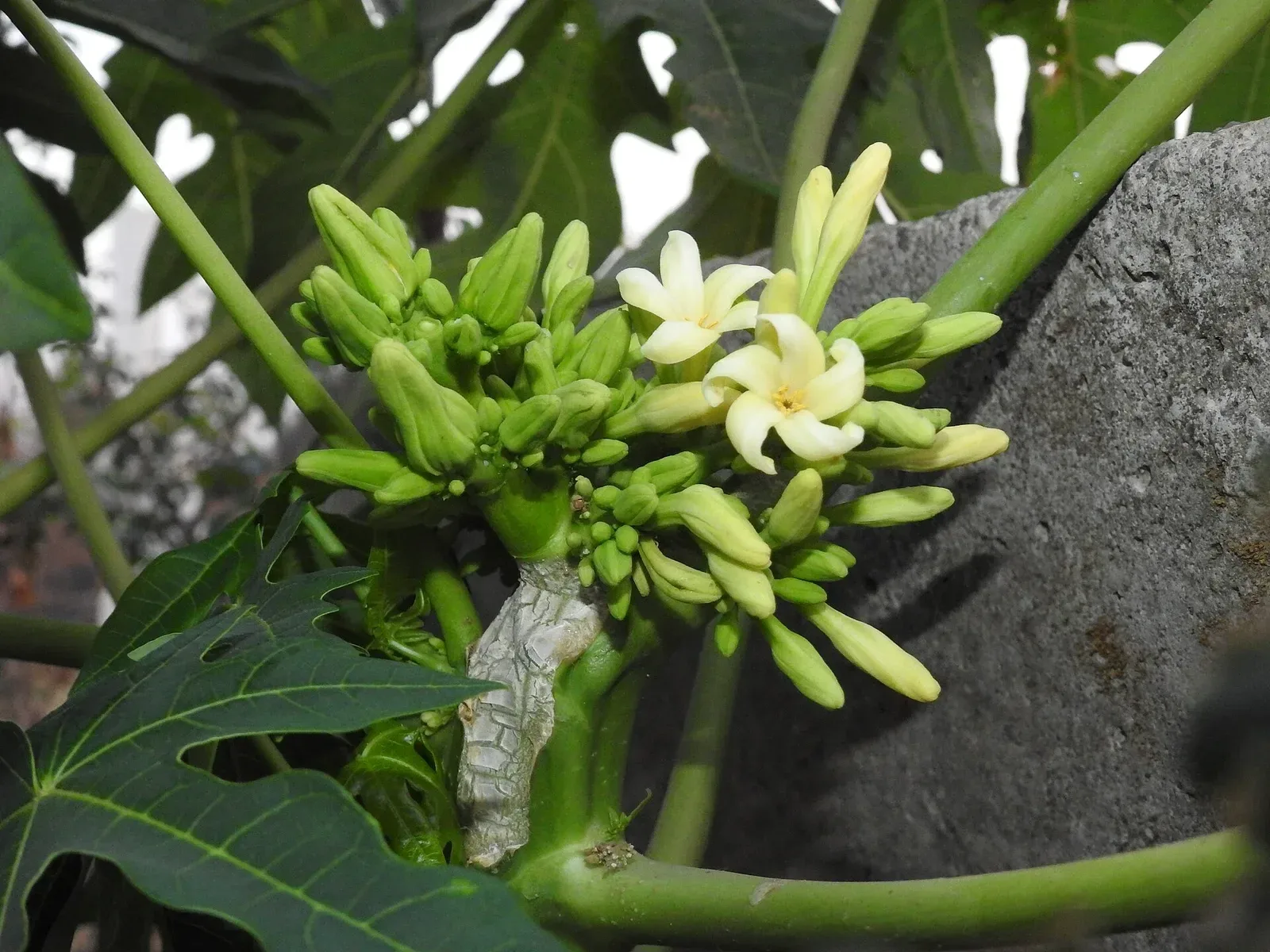
If your papaya (papita) tree flowers but gives no fruit, look at where and how the flowers are borne. Long, hanging stalks with many small flowers mean it is a male tree, and male trees rarely fruit. A female tree with flowers close to the trunk needs pollen from a male or bisexual tree nearby. Bisexual trees can fruit on their own. Heat, cold, waterlogging and virus disease can also cause flowers to drop. Seed-grown papaya can turn out male, female or bisexual, so you only find out when it flowers.
Three kinds of papaya tree
Papaya plants can be male, female or bisexual (also called hermaphrodite or perfect). Which you get depends on the variety and the seed.
| Tree type | How the flowers look | Will it fruit? |
|---|---|---|
| Male | Small flowers in long, branched, hanging sprays, often 30 cm or more | Usually no. Some male trees occasionally set small, slender fruits at the tip of a spray. |
| Female | Larger flowers on very short stalks close to the trunk; a round ovary in the centre; no pollen | Yes, but only if pollen reaches it from a male or bisexual tree. Fruits are round or oval. |
| Bisexual | Flowers on short stalks with both yellow anthers and a slender ovary | Yes, on its own. Fruits are usually long or pear-shaped. |
These descriptions follow Julia Morton's classic account in Fruits of Warm Climates (hosted by Purdue University) and TNAU's papaya guidance.
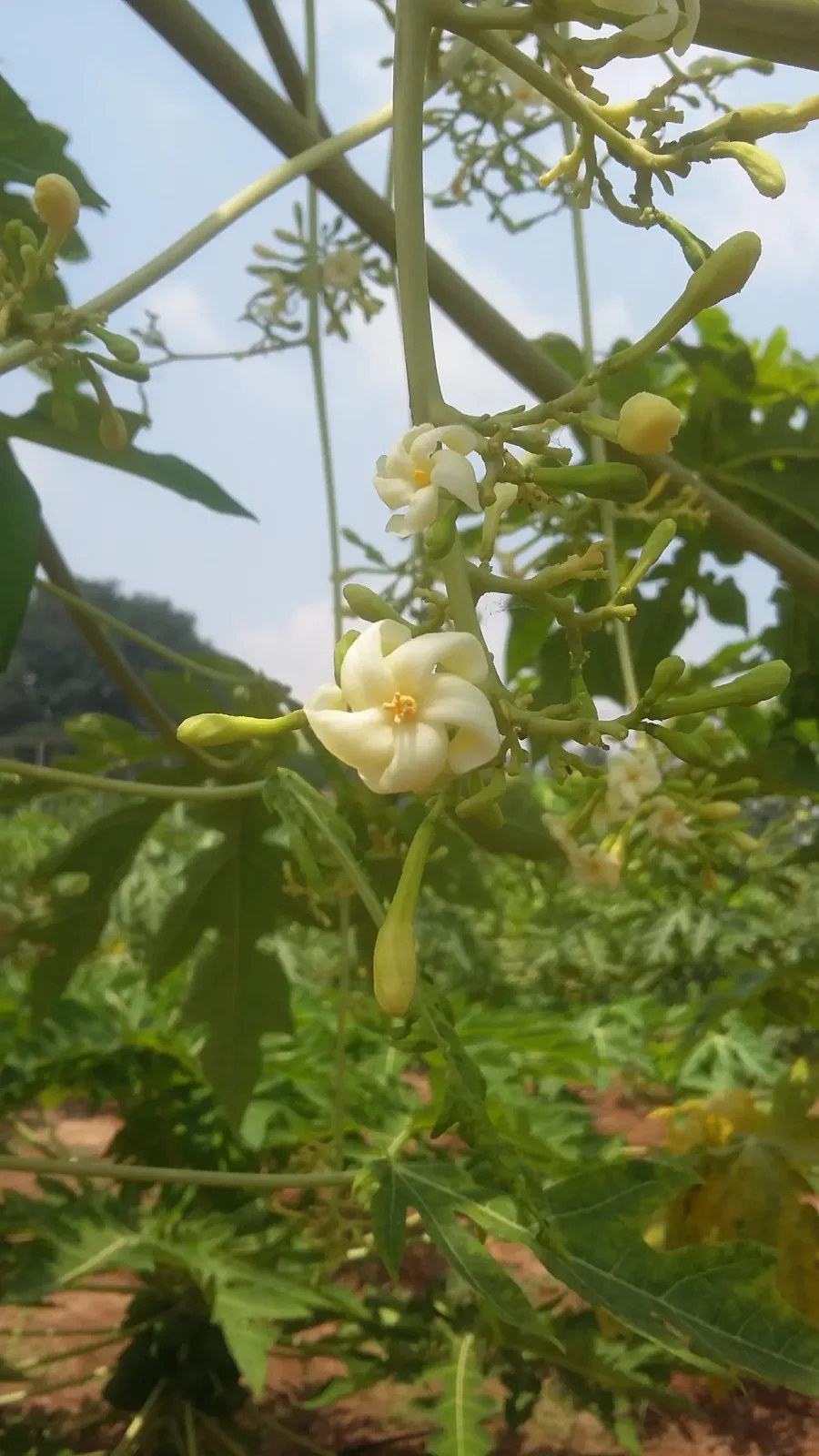
Reasons a papaya flowers but does not fruit
It is a male tree
This is a very common reason in home gardens. With dioecious varieties (separate male and female plants), roughly half of the seedlings can be male. You cannot tell from the leaves. If your tree has only long hanging flower stalks after several months of flowering, it is male.
What to do: keep it only if a female tree nearby needs pollen. TNAU's commercial guidance is to remove male trees once they flower, keeping about one male for every 20 female trees for proper fruit set. In a small garden, replace the male tree with a seedling of a bisexual or gynodioecious variety.
It is a female tree with no pollen source
A female tree on its own may flower well but drop its flowers unfertilised. Morton notes that poorly pollinated papaya bears a light crop of uneven fruit. If you have a lone female tree, a neighbour's male or bisexual tree within easy reach of insects may be enough. If not, plant a bisexual-type seedling nearby.
Hand pollination is possible. Take pollen (one or two anthers) from a fresh male or bisexual flower and place it on the stigma of a female flower that is just opening. Morton describes this method from commercial plantations.
Hot or cold weather
Morton records that bisexual papaya can temporarily switch to producing short-stalked male flowers during high midsummer temperatures, and switch back later. So a bisexual tree that stops setting fruit in May or June may recover after the heat. She also notes that cold weather can interfere with pollination and cause unfertilised female flowers to shed. Papaya is very sensitive to frost.
In practice that means papaya fruits most reliably in warm, frost-free areas. In the northern plains, protect young plants in December and January, and expect fewer fruits to set in peak cold and peak heat. TNAU notes that papaya does well where summer temperatures run 35 to 38°C, but much hotter spells are a stress.
Waterlogging and root problems
Papaya roots cannot stand standing water. Morton notes that flooding for 48 hours is fatal, and TNAU stresses well-drained soil to avoid collar rot. A stressed tree drops flowers before it shows other damage. In the monsoon, check that water drains away from the base.
Virus disease
Two virus diseases can stop fruiting. TNAU describes papaya ringspot virus as causing vein clearing, puckered and mottled leaves, dark green blisters, and leaves narrowed to a "shoestring" look, with circular rings on fruit; plants infected early form no fruit. It is spread by aphids and also infects cucurbits. Papaya leaf curl virus, spread by whitefly, causes curled, crinkled, leathery leaves with thickened veins, and TNAU notes affected plants do not produce flowers and fruits.
Look-alikes: nutrient shortage (more even yellowing, often on older leaves), mite damage (fine speckling, webbing under leaves) and herbicide drift (sudden twisting after nearby spraying). Viruses cannot be cured. Ask your KVK to confirm, and TNAU advises removing affected plants promptly. Do not grow cucurbits right next to papaya, and for leaf curl, keep tomato and tobacco away.
Too young
Seedlings flower some months after planting, and early flowers may drop before the tree settles. Give it a few flushes of flowers before judging.
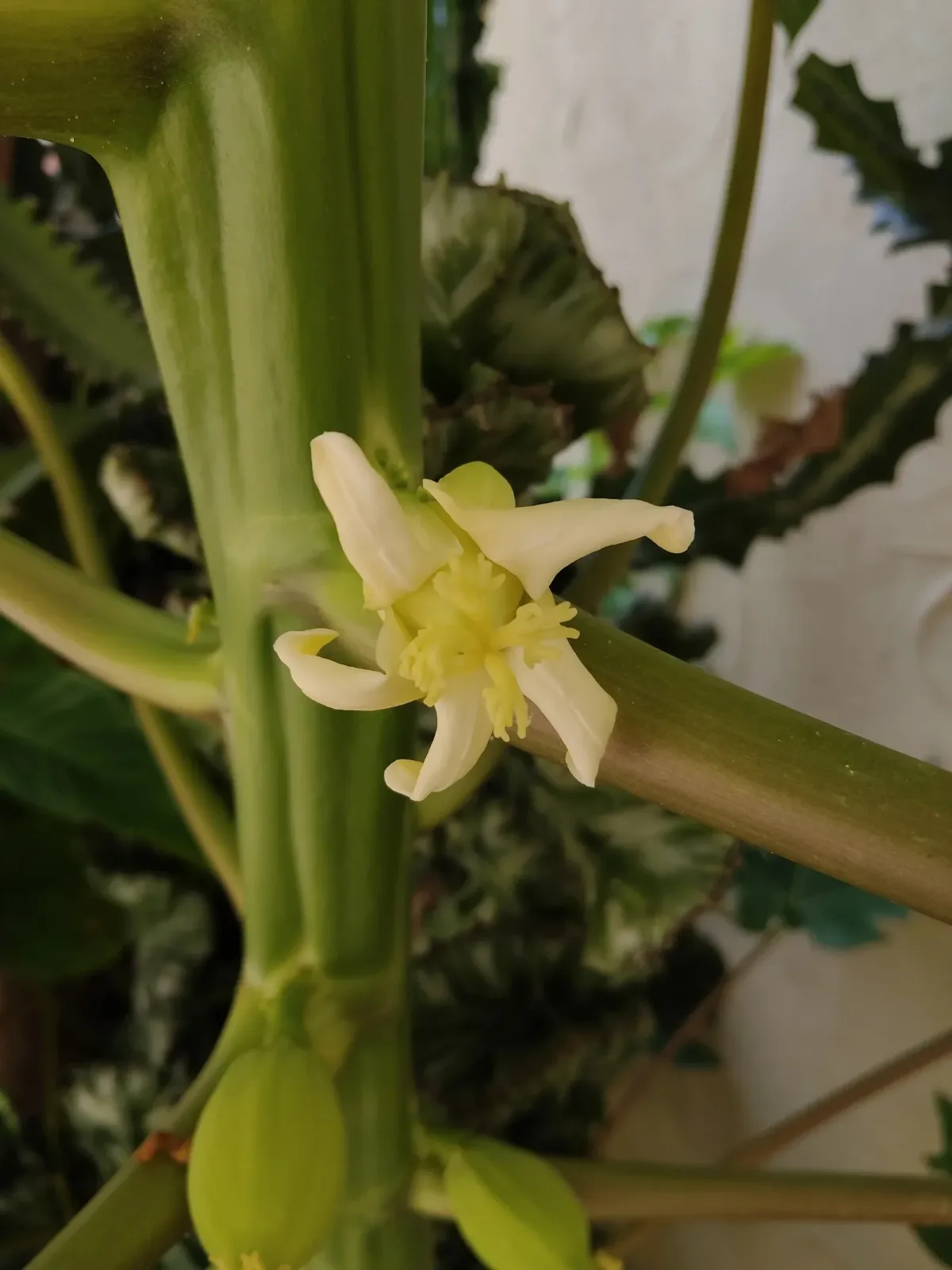
Choosing papaya for a home garden
TNAU lists CO 3, CO 7 and Surya as gynodioecious varieties, which produce only female and bisexual plants and no males. Morton notes that Coorg Honey Dew, selected at IIHR, also has no male plants, with female and bisexual plants in roughly equal numbers. Choosing such a variety means every tree you plant has a chance of fruiting.
Planting time affects when the tree flowers and whether early flowers meet cold or heat:
| Region | Planting time | Source |
|---|---|---|
| General Indian guidance | Spring (February to March), monsoon (June to July) or autumn (October to November) | NHB |
| Northern plains | February to March, after frost. NHB says nights below 12 to 14°C for several hours in winter hurt growth badly. | NHB |
| Tamil Nadu | June to September (TNAU and the state agriculture department). TNAU also advises against planting in heavy rain. | TNAU; Tamil Nadu Department of Agriculture |
| Hills | NHB says papaya does well up to about 1,000 m. Above that, expect poor fruiting. | NHB |
Quick checklist
- Long, hanging sprays of small flowers only: male tree.
- Flowers on the trunk, no pollen, flowers drop: female tree without a pollen source.
- Bisexual flowers that suddenly go male in peak summer: heat; wait for it to cool.
- Flowers dropping in winter: cold.
- Mottled, puckered or curled, leathery leaves: possible virus; ask your KVK.
Pets
We did not find an ASPCA toxicity listing for papaya, so we make no claim either way.
Watch: male, female and bisexual papaya flowers
A short video showing the three papaya flower types side by side.
Related pages
Sources
- National Horticulture Board: Papaya model project report (planting in spring (February to March), monsoon (June to July) and autumn (October to November); grows up to about 1,000 m; night temperatures below 12 to 14°C in winter hurt growth). Accessed 10 Nov 2026.
- Tamil Nadu Department of Agriculture: Cropping season for major horticulture crops (Tamil Nadu planting seasons for banana, papaya, pomegranate, tomato, brinjal, okra, gourds and drumstick). Accessed 10 Nov 2026.
- TNAU Agritech: Papaya (varieties; gynodioecious CO 3, CO 7, Surya; summer 35 to 38°C; June to September planting; one male per 20 female trees). Accessed 10 Nov 2026.
- TNAU Agritech Crop Protection: Papaya ring spot virus (symptoms; aphid spread; no fruit if infected early; rogue affected plants). Read on 9 Nov 2026; the site returned errors on the 10 Nov 2026 recheck.
- TNAU Agritech Crop Protection: Papaya leaf curl virus (symptoms; whitefly spread; affected plants do not flower or fruit). Accessed 10 Nov 2026.
- Morton, J. (1987) Fruits of Warm Climates: Papaya, hosted by Purdue University NewCROP (male, female and bisexual flowers; temporary sex change in midsummer heat; cold causes female flower shedding; frost and flooding sensitivity; hand pollination; Coorg Honey Dew). Accessed 10 Nov 2026.


Comments
No comments yet — share what worked in your climate.