
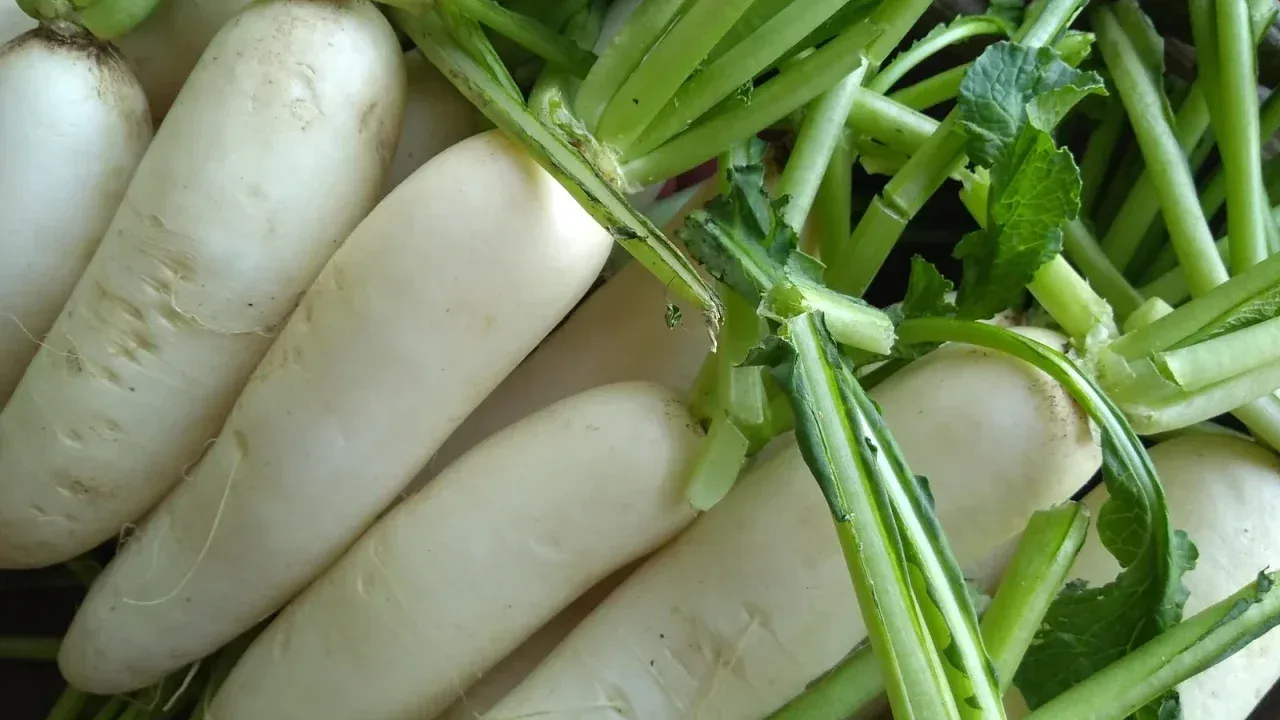
Mooli is one of the fastest winter vegetables you can grow in a pot or a tall grow bag. Sow the right variety at the right time, keep the mix loose and evenly moist, and thin the seedlings, and you can pull tender white roots in about 45 to 60 days. Sow the wrong variety in the heat, or leave the plants crowded, and the roots come out tough, pithy or forked.
This guide is for home pots in India. The sowing months and variety names come from Punjab Agricultural University (PAU), SKUAST-Jammu, TNAU, the National Horticulture Board and IARI. For the wider winter kitchen garden, start with winter vegetables to grow in pots in India. Leafy neighbours that share the same cool season are covered in how to grow palak in pots and how to grow peas (matar) in pots.

Asiatic mooli and European radish are not the same crop
SKUAST-Jammu and the National Horticulture Board both split radish into two groups. Asiatic, or tropical, types make a long white root in the first season and can take more heat than European types. European, or temperate, types are often shorter, milder and quicker, and they are the ones that turn pithy first if you leave them in the pot.
Useful official varieties, with the season each source gives them:
- Punjab Safed Mooli-2 (PAU, 2015): long, semi-stumped, cylindrical white roots about 34 cm long. First harvest about 47 days after an early October sowing. Mildly pungent, and PAU says it stays non-pithy until 65 days after sowing. Mid September to October in the PAU schedule.
- Punjab Pasand (PAU): early, edible in about 45 days, long, pure white, hair-free roots. Main season mid September to October; PAU also lists a second-fortnight-of-March sowing for a late-spring crop.
- Japanese White: cylindrical, pure white, blunt-ended roots, about 25 to 30 cm long. PAU recommends it for late sowing in the main season in the north Indian plains, and from July to September in the hills. NHB gives October to December in the plains and July to September in the hills, with maturity in 60 to 65 days.
- Pusa Chetki (IARI, listed by PAU from 1988): snow-white, medium-long, stumpy roots, ready in about 40 to 45 days. This is the heat-tolerant one. PAU sows it from April to August. NHB says mid March to mid August in northern and central India, and that in southern and western India it can be grown through the year.
- Pusa Himani (IARI): a temperate type. PAU sows it in January and February in Punjab, with harvest in 60 to 65 days. NHB sows it from December to February in the northern plains, and notes it can be grown through the year in the hills except in the coldest months of November to January. SKUAST sows it in the subtropical zone from the end of November to January, and from March to June in the high hills. Roots are white with a green shoulder, about 30 to 35 cm long.
- Pusa Desi and Pusa Reshmi (IARI, also listed by SKUAST and TNAU): Pusa Desi is for mid August to October in the northern plains (NHB, SKUAST). Pusa Reshmi, also written Pusa Rashmi, is an early cooler-month type; NHB sows it from mid September to mid November, and SKUAST from September to October in the subtropical zone.
- Arka Nishant (IIHR, listed by SKUAST, TNAU and NHB): long, marble-white roots. SKUAST and NHB note resistance to pithiness, premature bolting and forking.
- European kitchen types such as White Icicle and Rapid Red White Tipped: TNAU lists these for the hills, along with Scarlet Globe. NHB says White Icicle is a short, 12 to 15 cm root that matures in 25 to 30 days and suits a kitchen garden, sown from mid October to February.
PAU's warning is the one to remember: except for Pusa Chetki, the other varieties do not tolerate high temperature if you plant them early. If you plant Asiatic types too late in the season, they start bolting without forming edible roots. With a careful choice of variety, radish can be grown in almost every month, but one packet is not right for every month.

When to sow, by region
North Indian plains
PAU's variety schedule for Punjab, which also guides Delhi, Haryana and western UP, is:
| Variety | Sowing time (PAU) | Roots ready (PAU) |
|---|---|---|
| Punjab Safed Mooli-2, Punjab Pasand, Japanese White | Mid September to October | October to December |
| Japanese White | November to December | December to January |
| Pusa Himani | January to February | February to April |
| Punjab Pasand | Second fortnight of March | End of April to May |
| Pusa Chetki | April to August | May to September |
SKUAST-Jammu, for the subtropical plains, sows Pusa Reshmi and Minowase in September and October, and Japanese White, Arka Nishant, Minowase, Pusa Desi and Pusa Himani from the end of November to January. If you missed the mid-September window, that later SKUAST slot is the useful one, matching the winter-vegetables pillar.
Hills
In SKUAST's intermediate low hills, Japanese White and Minowase go in from mid August to November. In the high hills, Pusa Himani is sown from March to June, and Pusa Reshmi, Japanese White and Minowase from August to September. PAU and NHB both give July to September in the hills for Japanese White. TNAU, writing for the Tamil Nadu hills, gives June to July as the best sowing time, and lists White Icicle, Scarlet Globe and Rapid Red White Tipped for hill planting. In the high, cold hills, mid-winter is the wrong season for open sowing.
South, west and the coasts
TNAU says September is the best sowing month in the Tamil Nadu plains, and lists Co 1, Pusa Rashmi, Pusa Chetki, Pusa Desi, Japanese White and Arka Nishant as popular plains varieties. NHB says Pusa Chetki can be grown through the year in southern and western India. Wait until heavy rain has actually finished, so the pot is not sitting waterlogged. A fresh, tender root still takes about 45 to 60 days, which is TNAU's usual harvest window.
Pot depth and a loose mix
The root grows straight down until something stops it. Official variety notes tell you how long that root is meant to be: about 12 to 15 cm for White Icicle, about 15.5 cm for Pusa Chetki, and 25 to 35 cm for Japanese White, Punjab Safed Mooli-2, Pusa Himani and Pusa Desi. Choose a pot or grow bag deeper than that, with a little extra for drainage. The winter-vegetables pillar uses a practical minimum of 25 to 30 cm for small types and 30 cm or more, in a tall grow bag, for long mooli. That matches the long official root lengths. A wide, shallow tray is not enough for a 34 cm Punjab Safed Mooli-2.

PAU, SKUAST and TNAU all prefer a sandy loam that is friable and rich in organic matter, with a pH around 5.5 to 6.8. Heavy, clayey soil produces misshapen roots with many small side roots, which is the start of forking. Use only well-rotted manure or compost. SKUAST, in its carrot chapter, says undecomposed organic matter is a cause of forked roots, and the same logic applies here. A home mix of garden soil, coarse sand or cocopeat, and mature compost, rubbed free of stones and hard lumps, stays close to that official advice. See grow bags vs pots if you are choosing a tall bag for a terrace. Every container needs drainage holes.
Sowing and thinning
- Sow seed directly in the final pot. Do not raise radish in a seedling tray and transplant it. A bent tap root at moving time is a common route to a forked root.
- SKUAST sows radish about 1.5 to 2 cm deep, in a moist mix. Water immediately after sowing, as both PAU and SKUAST advise.
- When the first true leaves appear, thin. PAU says thinning at true-leaf formation is very important for superior roots, and keeps about 7.5 cm between plants on field ridges. SKUAST gives 8 to 10 cm for Asiatic types and 5 to 6 cm for European types. In a pot, aim for a similar gap: more room for long mooli, a little closer for short European types. Snip extras at the mix surface so you do not tug the neighbours.
- TNAU also thins at the second weeding. One weeding two to three weeks after sowing is enough in PAU's field advice, followed by a light earthing-up, especially on desi types whose shoulders push above the soil.
Keep the pot in full winter sun. Radish is a cool-season crop. PAU says main-season varieties develop the best flavour, texture and size at 10 to 15°C, and that in hot weather the roots become pungent and tough before they reach a useful size. TNAU similarly puts the best size, flavour and texture at about 15°C.
Watering and feeding
Water right after sowing, then keep the mix evenly moist, never soggy and never bone dry. PAU's field interval is every 6 to 7 days in summer and 10 to 12 days in winter, with about five or six irrigations in all. TNAU irrigates once a week in the plains. In a small pot on a windy terrace, check with your finger rather than following those field days. PAU warns that excessive irrigation results in misshapen roots and numerous hair roots. A light watering just before a summer harvest, PAU says, keeps the roots fresher and less pungent.
Mix well-rotted compost into the pot at filling, which is the home version of the well-rotted farmyard manure both PAU and SKUAST insist on at sowing. After that, a light, balanced feed is enough if the plants look pale; use a packaged product only at the label rate. Field fertiliser quantities in the university books are for an acre, not for a 12-inch pot, so they are not copied here. SKUAST notes that excess fertiliser, together with moisture stress and heat in the three weeks before harvest, is linked to pithiness. Do not push a strong nitrogen feed onto a pot of nearly ready roots.
Forked, cracked or pithy roots: check before you guess
A misshapen mooli is not, by itself, a diagnosis. Look at the mix, the spacing, the weather and the calendar.
- Forked or branched roots, or a cluster of small laterals. PAU and SKUAST point to heavy, clayey or hard soil, and to undecomposed organic matter. Stones and a pot that is shallower than the variety's root also stop the tap root and make it split. Confirm that the mix is loose and stone-free, that you used only well-rotted compost, and that the bag is deep enough. Crowding from skipped thinning gives small, poorly shaped roots too.
- Hairy, misshapen roots. PAU links this pattern to excessive irrigation. Let the surface dry a little between waterings, and check that the pot drains.
- A dry, spongy or hollow centre (pithiness). PAU says a few days' delay in harvest, particularly of European types, makes the roots pithy and unfit to eat. Punjab Safed Mooli-2 is described as remaining non-pithy until 65 days after sowing, which is a useful upper mark, not a reason to leave every variety that long. SKUAST adds that pithiness is more common in summer crops, and is favoured by excess fertiliser, dry spells and high temperature in the three weeks before harvest. Harvest while the root is still tender, and do not grow a heat-sensitive variety as a summer crop. Arka Nishant is listed as resistant to pithiness, but resistance is not a substitute for timely picking.
- Small, fibrous, tough or very pungent roots. PAU says this happens in hot weather, before the root has reached a proper size. Check the variety and the month. Pusa Chetki is the official heat-tolerant choice; a main-season Japanese White sown in May is the wrong plant.
- A flower stalk and little or no useful root. PAU says Asiatic varieties sown too late bolt without forming edible roots. High temperature also leads to bolting, according to SKUAST. This is a calendar and variety problem, not a lack of fertiliser.
- A white, warty protrusion through a split in the skin. SKUAST describes "wart" as inner tissue pushing through splits, mainly after a dry spell. Keep moisture even. If many roots crack and the plants look poor, take a sample to a KVK rather than mixing a home spray.
When to harvest
Pull radish when the roots are still tender. PAU is blunt: a short delay, especially with European types, leaves them pithy. Punjab Pasand and Pusa Chetki are ready in about 45 days. Other varieties take about 45 to 60 days, depending on type and season. Pusa Himani is ready in 60 to 65 days (PAU). Japanese White, in the NHB note, takes 60 to 65 days. TNAU gives a general 45 to 60 days and a yield window of 20 to 30 tonnes a hectare in the field, which is context, not a pot target.
A light watering the day before harvest makes the roots easier to pull. Lift one root first and snap or cut it. If the centre is already spongy, harvest the rest of the pot the same day. The leaves can be cooked as greens, and the young seed pods, often called mogri, are a separate later use, not a reason to leave eating roots in the pot.
Common mistakes
- Sowing a main-season Asiatic variety in the heat, or a heat-tolerant variety so late that it bolts.
- Using a shallow pot for a 25 to 35 cm root.
- Filling the bag with clay, stones or fresh manure, then wondering why the roots forked.
- Skipping thinning, so every seedling competes and none makes a proper root.
- Keeping the mix either waterlogged or very dry.
- Leaving European or late roots in the pot "just a few more days" until they go pithy.
- Transplanting seedlings from a tray instead of sowing in the final container.
Watch: mooli in pots
This Indian video shows radish grown in pots, which is the same job this page covers. Use it together with the official variety months above, not in place of them. Methods and products on screen are not a recommendation unless they match a current label or a local KVK.
Related guides
- Winter vegetables to grow in pots in India
- How to grow palak in pots
- How to grow peas (matar) in pots
- How to grow carrots (gajar) in pots
- How to grow methi in pots
- Plant care in winter in India
- Grow bags vs pots
- Terrace garden setup
Sources
- Punjab Agricultural University, Package of Practices for Cultivation of Vegetables (Radish and turnip: climate, varieties, sowing schedule, thinning, irrigation, harvest and pithiness)
- SKUAST-Jammu, Package of Practices for Vegetable Crops (2020) (Radish: zones and varieties, sowing depth, spacing, pithiness and other disorders)
- TNAU Agritech Portal, Radish (updated January 2016): September in the plains, June to July in the hills, soil and harvest window
- National Horticulture Board, Radish varieties (Pusa Desi, Pusa Chetki, Pusa Reshmi, Japanese White, Pusa Himani, White Icicle, Arka Nishant)
- ICAR-IARI, ZTM and BPD Unit, Radish varieties
Comments
No comments yet — share what worked in your climate.