
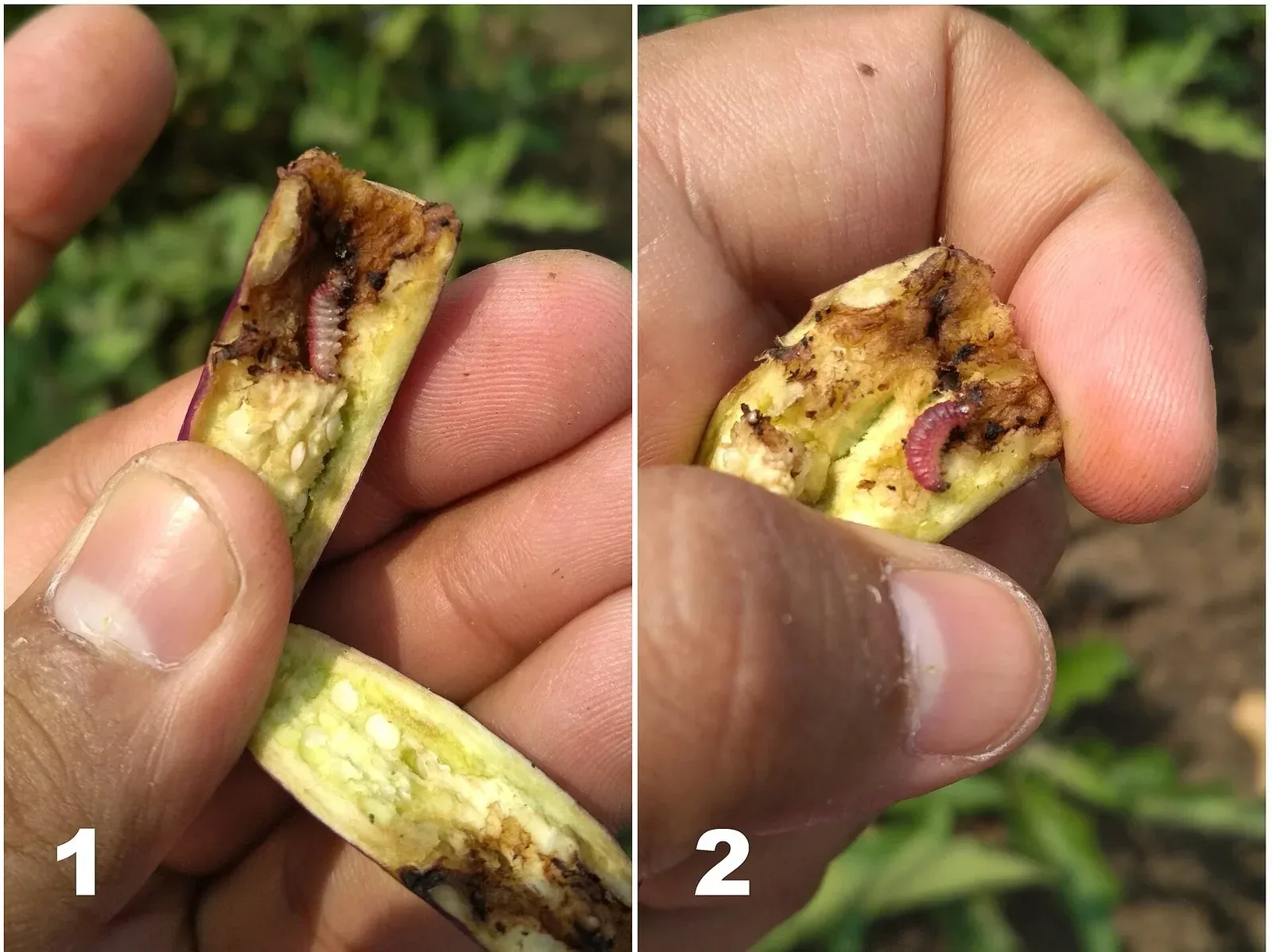
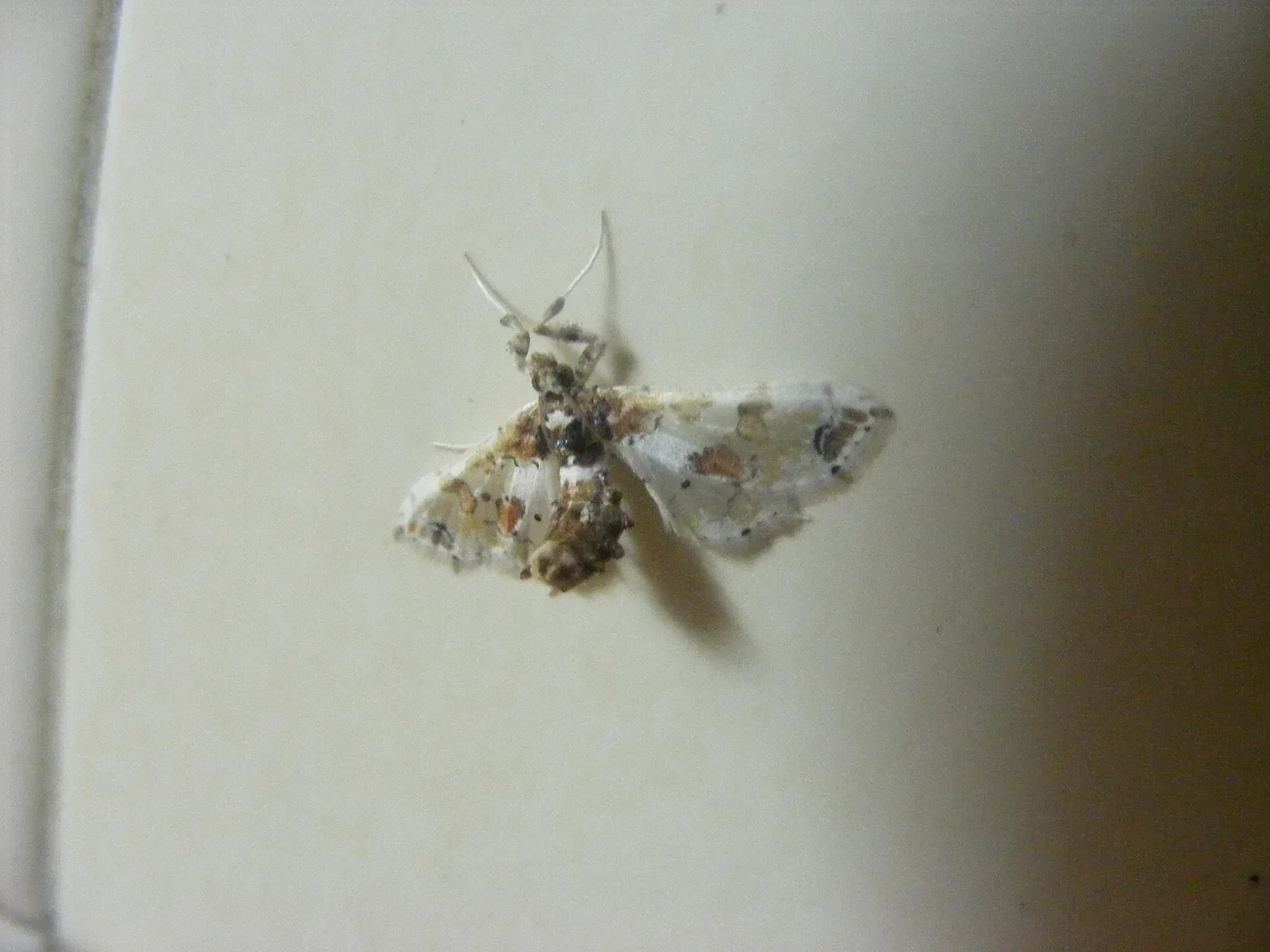
The brinjal (baingan) shoot and fruit borer (Leucinodes orbonalis) shows itself in two ways. Before flowering, the tender shoot tips suddenly wilt and droop because a caterpillar is tunnelling inside. Later, fruits have small round holes, often plugged with brown droppings, and a pinkish caterpillar inside. In a home garden, the best control is to cut off and destroy wilted shoots and damaged fruits every week, use a pheromone trap, and raise seedlings under a net. TNAU notes the pest has developed resistance to all groups of insecticides, so spraying alone rarely works.
Symptoms to look for
On shoots (before and during flowering)
- A young shoot tip suddenly wilts and droops while the rest of the plant is fine.
- Split the drooping shoot lengthwise: you will find a tunnel and often a small, pale caterpillar.
- The growing point dies, so the plant branches below it.
NCIPM describes young larvae boring into tender shoots and tunnelling downwards, so the shoots wither and the growing points die.
On flowers and fruits
- Flower buds may be bored and drop. TNAU notes that in heavy attacks, unopened flower buds swell and hide a caterpillar.
- Fruits have one or more small round holes, often plugged with frass (droppings).
- Inside, the flesh is tunnelled and discoloured, sometimes rotting.
- The caterpillar, when grown, is pinkish with a brown head.
Grown larvae leave the fruit to pupate in tough, silky cocoons on the plant or in fallen debris (TNAU).
Look-alikes
| Problem | How to tell |
|---|---|
| Shoot and fruit borer | Single shoot tips droop; tunnel inside; small plugged holes in fruit |
| Bacterial wilt | The whole plant or whole branches wilt, often quickly, with no tunnel in the shoot. Cut stem placed in water may release milky threads. |
| Stem borer | Older plants; the main stem is bored, and the plant wilts or breaks; larva inside the main stem |
| Other fruit caterpillars (such as Helicoverpa) | Larger, round holes; the caterpillar feeds with only part of its body inside the fruit (as TNAU describes for Helicoverpa on okra) |
| Fruit rot | Soft, sunken, often mouldy patches with no entry hole |
| Heat or water stress | Leaves of the whole plant droop in the afternoon and recover by morning |
If you are unsure, split a few shoots and fruits. Finding a caterpillar or its tunnel is good evidence of borer; clean, intact shoots point to another cause.
Managing it in a home garden
ICAR's NCIPM and IIHR, and TNAU, all recommend a combination of steps rather than relying on sprays.
1. Clip and destroy every week
TNAU's IPM schedule says to cut and destroy wilted shoot tips at weekly intervals during the pre-flowering and flowering period, and to destroy larvae in swollen buds and damaged fruits after each harvest. Put clippings in a sealed bag in the bin or bury them deep; do not leave them on the compost heap, where caterpillars finish growing.
2. Use pheromone traps
A pheromone trap uses a lure specific to this moth to attract males. NCIPM recommends pheromone traps for monitoring and mass trapping of the shoot and fruit borer, and IIHR's biocontrol package uses one trap for every 400 square metres. On a terrace or small bed, one trap is usually enough; replace the lure as the maker directs.
3. Raise seedlings under a net
TNAU recommends a nylon net barrier for the nursery so the pest does not come in with the seedlings. If you buy seedlings, inspect the tips before planting.
4. Use biological controls where available
IIHR's package for this pest combines pheromone traps, weekly releases of the egg parasitoid Trichogramma chilonis, and Bt (Bacillus thuringiensis) sprays at peak flowering. Trichogramma cards are sold by some KVKs and biocontrol labs. Neem products are also listed by TNAU. Follow the product label or KVK advice for rates; we do not give doses here.
5. Keep the garden clean
Remove fallen fruits and old plants after harvest. TNAU also recommends a barrier crop such as maize around larger plots.
What about chemical sprays?
TNAU's IPM schedule states that this pest has developed resistance against all groups of insecticides, and management is very difficult. Sprays also kill the natural enemies that help keep it down. If you do consider a chemical product, ask your KVK which ones are currently approved for brinjal and follow the label and the waiting period before harvest.
When to watch most closely, by region
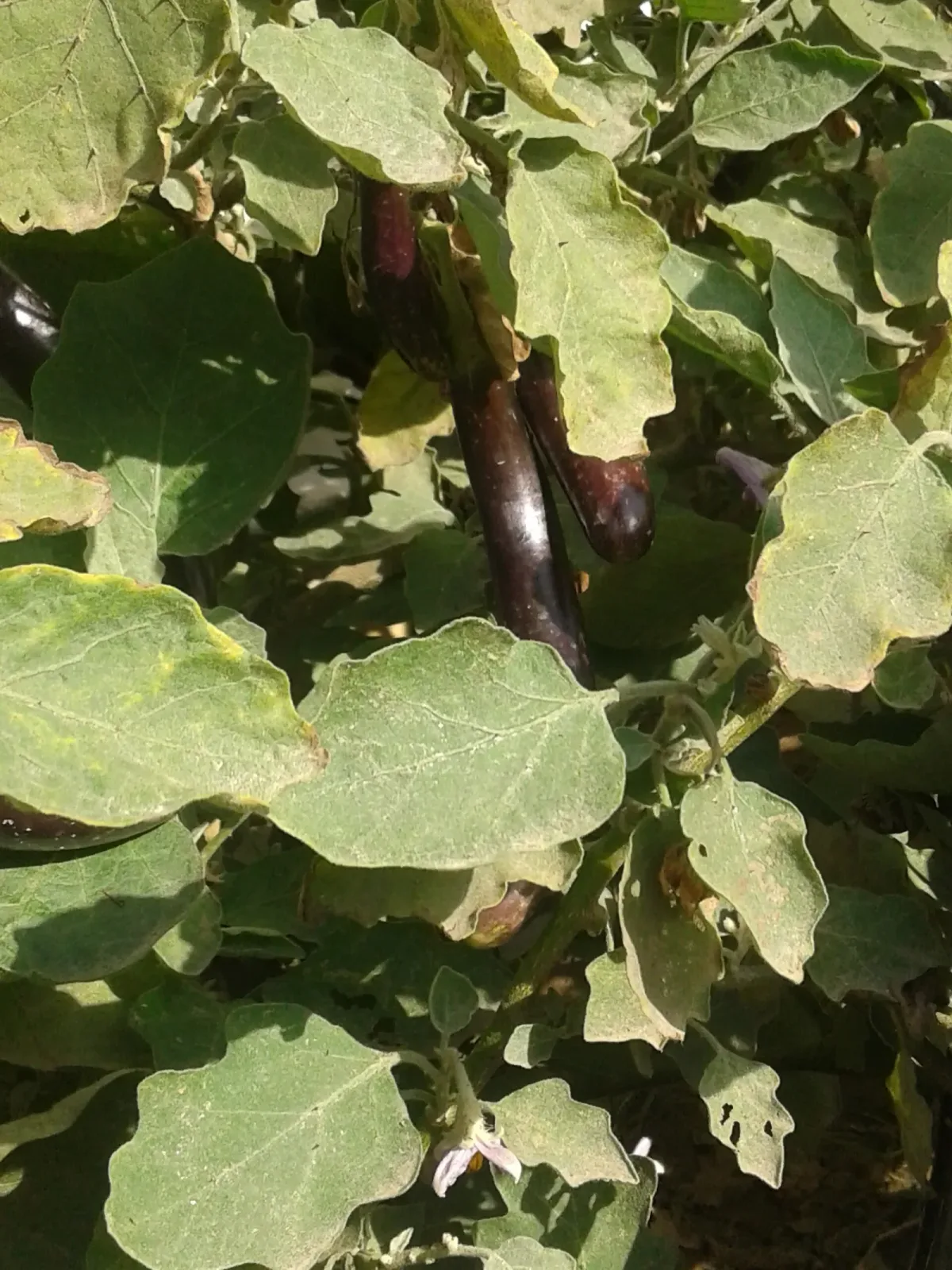
The borer attacks from the nursery until the last harvest, so the danger period follows your planting season. NCIPM also warns that growing brinjal continuously in the same place builds up the borer, so a break between crops helps.
| Region | Main planting time | Source |
|---|---|---|
| Northern plains (Uttarakhand plains example) | Transplant June to July for the rainy-season crop | GB Pant University |
| Hills (Uttarakhand) | April to June | GB Pant University |
| Tamil Nadu | Sow December to January and May to June | TNAU; Tamil Nadu Department of Agriculture |
| Kerala and other coastal areas | Not given as fixed months in the sources we checked; follow your KVK | None found |
Start weekly shoot checks two to three weeks after transplanting and keep going until you pull the plants out.
Is borer-damaged brinjal safe to eat?
You can cut away the tunnelled, discoloured part and use the rest if it is firm and fresh. Discard fruits that are rotting inside.
Watch: pheromone trap for brinjal shoot and fruit borer
A field demonstration of setting up a pheromone trap for this pest.
Related pages
Sources
- TNAU Agritech: Brinjal season of sowing (Tamil Nadu sowing December to January and May to June). Accessed 10 Nov 2026.
- Tamil Nadu Department of Agriculture: Cropping season for major horticulture crops (Tamil Nadu planting seasons for banana, papaya, pomegranate, tomato, brinjal, okra, gourds and drumstick). Accessed 10 Nov 2026.
- GB Pant University of Agriculture and Technology: Kharif season advisory 2020 (brinjal transplanting June to July in plains, April to June in hills). Accessed 10 Nov 2026.
- NCIPM / TNAU: Integrated Pest Management schedule for vegetables (life cycle and symptoms; resistance to all insecticide groups; clipping shoots weekly; net nursery; barrier crops; pheromone traps). Accessed 10 Nov 2026.
- ICAR-NCIPM: Strategies for IPM in okra and brinjal (shoot tunnelling and wilting; fruit boring; pheromone traps for monitoring and mass trapping). Accessed 10 Nov 2026.
- ICAR-IIHR: Biological control of brinjal shoot and fruit borer (pheromone trap per 400 sq m, Trichogramma chilonis releases, Bt sprays). Accessed 10 Nov 2026.
- TNAU Agritech Crop Protection: Bhendi pests and diseases (Helicoverpa larva feeds with only part of its body inside the fruit (look-alike)). Read on 9 Nov 2026; the site returned errors on the 10 Nov 2026 recheck.


Comments
No comments yet — share what worked in your climate.