
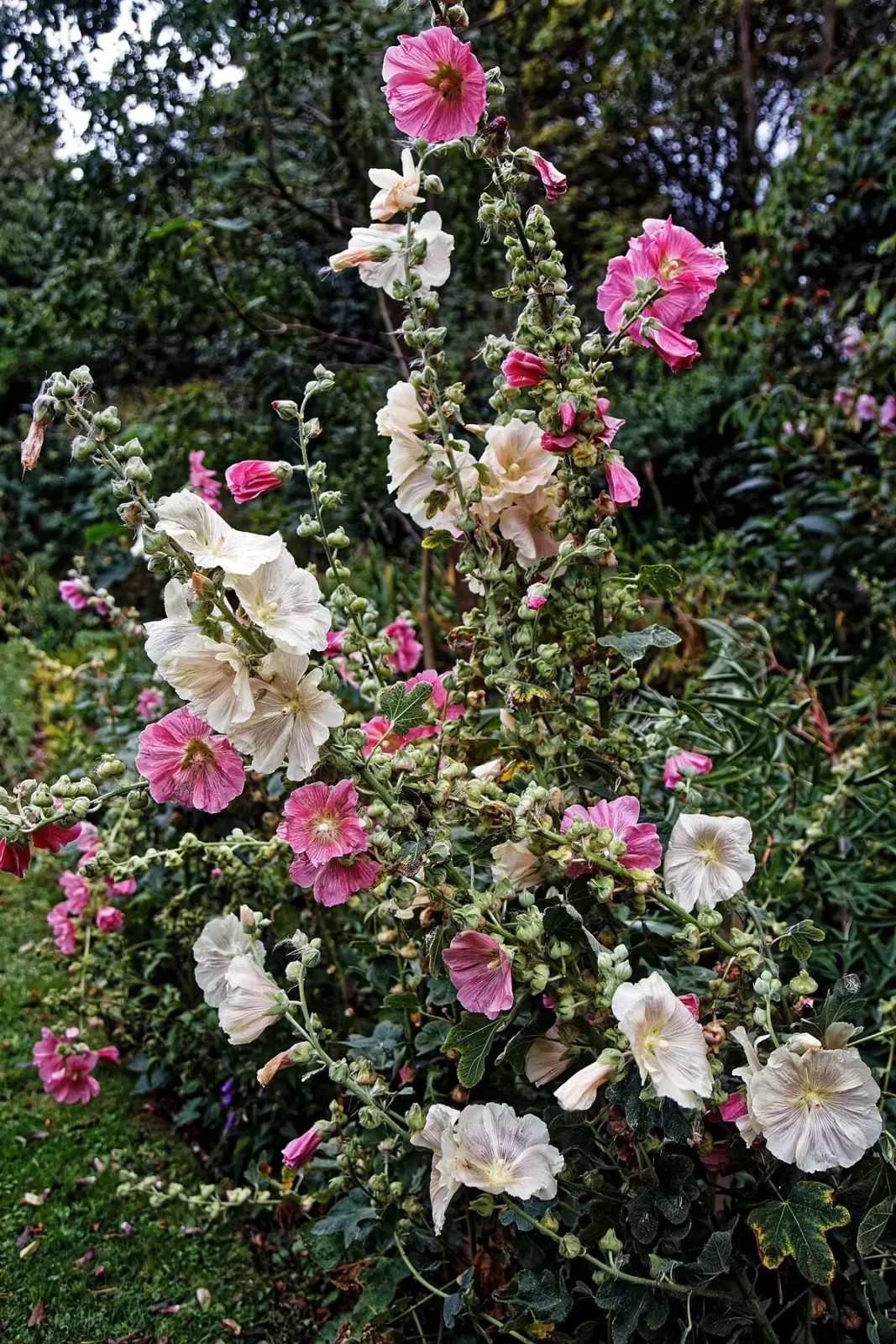
| ☀️ Light | Full sun |
|---|---|
| 💧 Water | Moderate (lightly moist) |
| 🪴 Soil | Fertile, well-drained soil |
| 🌡️ Temp | -30°C – 35°C |
| 🐾 Safety | Cats: non-toxic · Dogs: non-toxic |
| 📏 Mature size | 1.8 m |
Where It Grows & Climate Tolerance
Pet & Companion Animal Toxicity (How to Grow Hollyhock in Canada)
Hollyhocks are a familiar sight along Canadian farmhouses, back lanes and garage walls, from the Prairies to the Maritimes. They are hardy, grow from seed, and reseed from year to year. Plants usually flower in their second summer, from July into August.
Care instructions
Care Guide & Maintenance Routine
Sow seed in spring or late summer where plants are to grow, in full sun and well-drained soil, sheltered from wind. Water seedlings until established. Stake spikes in windy sites, cut them down after flowering, and clear leaves in fall to limit rust.
Light & Sunlight
RHS recommends full sun for the tallest spikes. NC State lists full sun to partial shade. In very hot climates, a little afternoon shade is tolerated.
Watering Schedule
RHS advises keeping the top 15 cm of soil damp but not soggy for young plants in their first few months; after that, plants in the ground need water only in long dry or hot spells. Water at the base to keep leaves dry and limit rust.
Potting Mix & Drainage
Fertile, well-drained soil
Temperature & Humidity
Hardy across most of southern Canada; NC State rates it to zone 5a, and self-sown plants survive colder Prairie winters in sheltered spots. Wet, frozen soil can rot crowns. Late spring frosts rarely harm the rosette.
Hollyhocks in Canadian gardens
The University of Saskatchewan describes hollyhock as an annual, biennial or short-lived perennial, 60 cm to almost 3 m tall, that needs full sun and shelter from wind, and notes that bees and hummingbirds visit it. That hardiness and height make it a Prairie favourite against south walls, fences and outbuildings. NC State gives hardiness to zone 5a, but self-sown plants persist in much colder gardens.
Sowing in Canada
The University of Saskatchewan advises against buying hollyhocks from the perennial section of a garden centre, noting they rarely flower the first year and seldom survive the winter. Its advice is more practical: gather a handful of seed, which can be found on hollyhocks in at least one back alley in most towns, and sow it in fall where the plants are to flower. Seed germinates the following spring. RHS also sows direct in late spring and early summer. Expect a leafy rosette in the first year and flowers the next. Seed started indoors in late winter can sometimes flower the same summer.
Region notes
- Saskatoon, Regina, Winnipeg, Edmonton, Calgary: plant against a south-facing wall for warmth and wind shelter; plants self-seed into lanes and gravel.
- Toronto, Ottawa, Montréal: humid summers bring heavy rust; space plants well and clear debris in fall.
- Vancouver and Victoria: wet springs favour slugs and rust; water at the base.
- Atlantic provinces: salt winds near the coast shred leaves; pick a sheltered spot.
Rust
Wisconsin Horticulture notes hollyhock rust overwinters in plant debris and spreads by wind and splashing water. Clear all leaves and stems after the first hard frost, avoid overhead sprinklers, and pick off spotted leaves early in the season. Choose a new spot for new plants if rust is severe.
Other pests
Slugs eat seedlings in wet springs. Japanese beetles can feed on flowers in southern Ontario. The University of Saskatchewan notes that the red lily beetle sometimes feeds on hollyhock, though it causes only minor damage and does not lay eggs on it.
Back lanes, farmyards and heritage gardens
Hollyhocks are part of the Prairie landscape, seeding themselves along back alleys in Regina, beside granaries and old farmhouses, and against the sunny side of detached garages. Many families grow strains passed down from grandparents' yards. They also suit heritage and pioneer-style gardens. Because they reseed, a patch can last decades with no effort beyond pulling the extras. Plant them where the tall spikes can lean on a fence or wall, out of the path of the strong westerly winds.
A typical season in Saskatoon
Rosettes reappear in May once the snow melts. Spikes shoot up through June and need tying in before the summer thunderstorms. Flowers open in July and continue into August. After flowering, spikes are cut down or left to drop seed, and leaves are cleared after the first hard frost.
Questions from Canadian readers
- Will hollyhocks survive a Prairie winter? Often, yes, especially self-sown plants in sheltered spots, but individual plants are short-lived. Let seedlings replace them.
Seasonal rhythm
Seasonal Calendar
| Month | Care Tasks | Seasonal Focus |
|---|---|---|
| Jan | Protect from frost/heat | Crowns dormant under snow. |
| Feb | Protect from frost/heat | Family Day: order seed of single and double strains. |
| Mar | Sow | March break: start seed indoors for a chance of first-year flowers. |
| Apr | Sow | April: rosettes appear in the south; check for slugs. |
| May | Sow, Plant out | Victoria Day: direct sow or plant out potted plants. |
| Jun | Protect from frost/heat | June: stake rising spikes; pick off rusty leaves. |
| Jul | Harvest | Canada Day: first flowers open. |
| Aug | Harvest | Civic holiday: peak flowering; watch for beetles. |
| Sep | Sow, Prune | Labour Day: cut spent spikes; sow seed in fall. |
| Oct | Prune | Thanksgiving: clear leaves to stop rust overwintering. |
| Nov | Protect from frost/heat | Remembrance Day: light mulch on young rosettes. |
| Dec | Protect from frost/heat | December: snow cover protects crowns. |
Diagnostics
Common Problems & Troubleshooting
Orange rust pustules on leaf undersides; leaf spots; holes chewed by slugs, caterpillars and beetles; spikes blown over in wind; plants dying out after two or three years; no flowers in the first year from seed.
Pests & seasonal watch: Hollyhock rust is the main problem everywhere, especially in humid Ontario and Quebec summers. Slugs in coastal BC and wet springs, Japanese beetles in southern Ontario, and occasional red lily beetle feeding.
- Yellow leaves — Leaves fade from green to yellow, often starting at the bottom.
- Drooping — Stems and leaves hang limp even though the plant was recently fine.
- Root rot — Roots turn brown and mushy in soil that stays wet.
- Spider mites — Fine webbing and pale speckled leaves, worse in dry heated rooms.
- Aphids — Clusters of small soft insects on new tips, often sticky.
- Leaf spot — Brown or tan spots with a yellow halo, sometimes with tiny dots in the centre.
- Brown spots — Scattered brown blotches on the leaf blade, not only the tip.
- No flowers — A flowering houseplant stays leafy and will not bloom.
Similar Botanical Matches
Keep exploring
Related plants
Grower field notes
Reader Field Notes in Canada
Share how this plant performs in your local Canada climate.