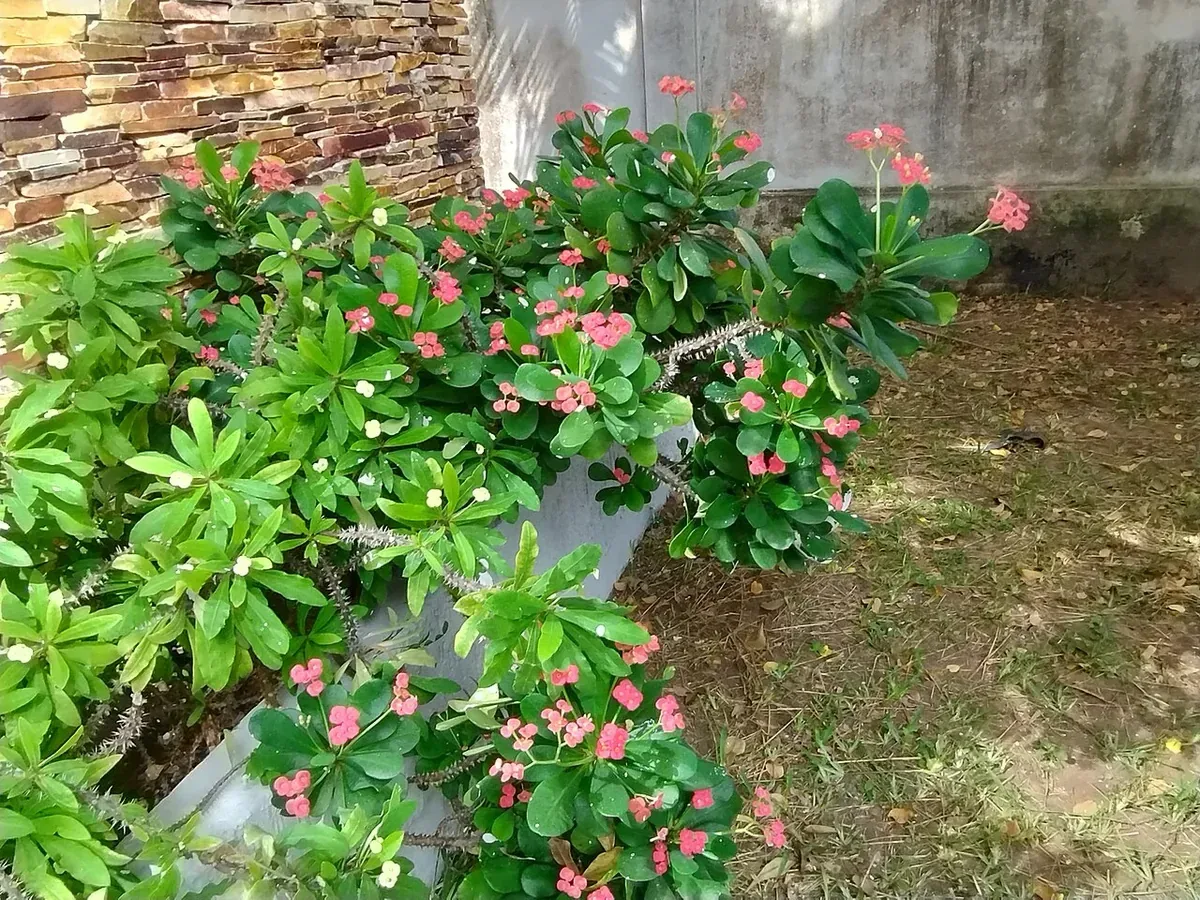
| ☀️ Light | Full sun |
|---|---|
| 💧 Water | Low (allow soil to dry) |
| 🪴 Soil | Gritty, fast-draining cactus or loam-based mix with extra grit or perlite |
| 🌡️ Temp | 5°C – 38°C |
| 🐾 Safety | Cats: toxic · Dogs: toxic |
| 📏 Mature size | 60 cm |
Where It Grows & Climate Tolerance
Pet & Companion Animal Toxicity (Crown of Thorns Care in Canada)
Crown of thorns is one of the few flowering houseplants that copes with dry, furnace-heated Canadian homes. Give it the sunniest window you have and let it dry out between waterings.
Care instructions
Care Guide & Maintenance Routine
Sunniest south or west window from September to May, or an LED grow light in dim homes. Water only when the mix is dry. Optional summer on a sunny deck after nights warm up, back inside by early September on the Prairies. Gloves and glasses when pruning.
Light & Sunlight
NC State Extension and Wisconsin Horticulture both say it does best in full, direct sun. It grows in part shade but flowers less. In very hot summers outdoors, NC State suggests midday shade for better blooming. Acclimatise indoor plants slowly before putting them in full outdoor sun.
Watering Schedule
Wisconsin Horticulture says the species does best when the soil dries between deep waterings. Some large-leaved hybrids prefer more frequent watering. Water sparingly in the cool, resting season.
Potting Mix & Drainage
Gritty, fast-draining cactus or loam-based mix with extra grit or perlite
Temperature & Humidity
NC State and Wisconsin say it survives to about 2°C, but cold, wet soil kills it. It is not hardy anywhere in Canada. Keep it indoors from September to late May or June depending on region, and away from cold glass at night.
Crown of thorns in a Canadian home
Most flowering houseplants struggle with Canadian winters because the air is dry and the days are short. Crown of thorns is a succulent from Madagascar, so dry furnace air does not bother it. Light is what limits flowering here.
Buying and the trip home
Garden centres, grocery chains and IKEA sell small hybrids in 4 inch pots, and specialty plant shops in Vancouver, Toronto and Montréal carry larger Thai hybrids. In winter, wrap it in paper and do not leave it in a cold car; a chill causes sudden leaf drop. Online sellers often hold succulents in deep cold or add a heat pack.
Light in a northern winter
Give it your sunniest south or west window from October to April. In Edmonton, Saskatoon or St. John's, where winter days are short and often grey, a full-spectrum LED grow light on a timer keeps it flowering. If it stops blooming and stretches, it needs more light, not more fertilizer.
Dry air is fine, cold glass is not
Unlike ferns and calatheas, it does not need a humidifier. What hurts it is cold: leaves pressed against frosty glass on a -25°C night blacken, and pots on a cold sill stay wet and rot. Pull it back from the window at night, or put a piece of cardboard between the plant and the glass.
Summer on the deck, by region
- BC coast: last frost averages about 26 March in Vancouver and 14 April in Victoria, but cool nights continue into May. Harden it off from late May.
- Ontario and Quebec: about 4 May in Toronto, 7 May in Ottawa, 29 April in Montréal and 11 May in Québec City. Move it out gradually in late May or June.
- Prairies: about 22 May in Edmonton and Saskatoon, 24 May in Winnipeg, 26 May in Calgary and 28 May in Regina. Wait until June, and bring it in by early September, since first fall frost averages about 10 September in Calgary.
- Atlantic: early to mid-May in Halifax and Fredericton, and about 1 June in St. John's. A sheltered, sunny spot out of the wind works.
Start in shade for a week to avoid sunburn after months indoors.
Zones
NRCan's 1991-2020 map tops out at Zone 9a in Vancouver and Victoria, and Halifax is 6b. None of these winters are survivable for crown of thorns outside.
Pests to identify
- Mealybugs: white fluff between spines; check with a flashlight.
- Spider mites: fine speckling on leaves near hot, sunny windows.
- Aphids and thrips: on plants returning from the deck.
Cats, dogs and toddlers
Winter-bound pets in a Canadian apartment explore every windowsill. Put the pot on a high, sunny shelf instead, and when you trim it in March, wear dish gloves and safety glasses and wipe the latex off with paper towel before rinsing the pruners.
Seasonal rhythm
Seasonal Calendar
| Month | Care Tasks | Seasonal Focus |
|---|---|---|
| Jan | protect | Deep-freeze nights: slide a sheet of cardboard between foliage and the frosty pane. Water sparingly. |
| Feb | protect | Grey Prairie and Newfoundland weeks: a full-spectrum LED on a timer keeps bracts coming. |
| Mar | prune, repot | Daylight saving returns. Repot or shape, with dish gloves and safety glasses. |
| Apr | prune, feed | Begin light feeding. Let tip cuttings callus for 2 to 3 days on a paper towel. |
| May | protect | Vancouver and Victoria: harden off on the patio. Elsewhere, frost is likely until the long weekend in May. |
| Jun | plant | Prairies, Ontario, Quebec, Maritimes: out to the deck once nights are mild; a week in shade first. |
| Jul | feed | Full sun on the deck or balcony; deep soak when dry. Scan for mealybugs. |
| Aug | feed | Final fertilizer. Calgary and Edmonton nights turn chilly late in the month. |
| Sep | protect | Labour Day on the Prairies, mid-month elsewhere: rinse, inspect and bring it indoors. |
| Oct | protect | Thanksgiving: sunniest window, longer gaps between waterings. |
| Nov | protect | Clocks fall back. Water only when the mix is dry right through. |
| Dec | protect | Holiday guests and drafty front doors: keep it bright, dry and out of the entryway. |
Diagnostics
Common Problems & Troubleshooting
Leaf drop in the cool season is normal before rest; yellowing and soft, dark stems from cold, wet soil; few flowers from low light or too much nitrogen; leaf spots after long wet spells.
Pests & seasonal watch: Mealybugs are the most common indoor pest. Spider mites in hot, dry rooms. Plants coming back from the deck can carry aphids or thrips, so inspect and rinse them first.
- Yellow leaves — Leaves fade from green to yellow, often starting at the bottom.
- Root rot — Roots turn brown and mushy in soil that stays wet.
- Mealybugs — White cottony clumps in leaf joints, often with sticky honeydew.
- Spider mites — Fine webbing and pale speckled leaves, worse in dry heated rooms.
- Scale — Hard or soft brown bumps stuck to stems and leaf ribs, often with sticky honeydew.
- Thrips — Silvery streaks and twisted new leaves, sometimes with black specks of frass.
- Leaf spot — Brown or tan spots with a yellow halo, sometimes with tiny dots in the centre.
- Grey mould — Fuzzy grey mould on faded flowers, damaged leaves or soft stems.
- Overwatering — Soil stays wet, leaves yellow or droop, and the pot feels heavy.
- Leaf drop — Many leaves fall in a short time, sometimes still green.
- Cold damage — Dark, water-soaked or blackened patches after a cold night or an AC blast.
- Stem rot — The stem goes soft, dark or black at soil level and the top collapses.
Similar Botanical Matches
Grower field notes
Reader Field Notes in Canada
Share how this plant performs in your local Canada climate.