
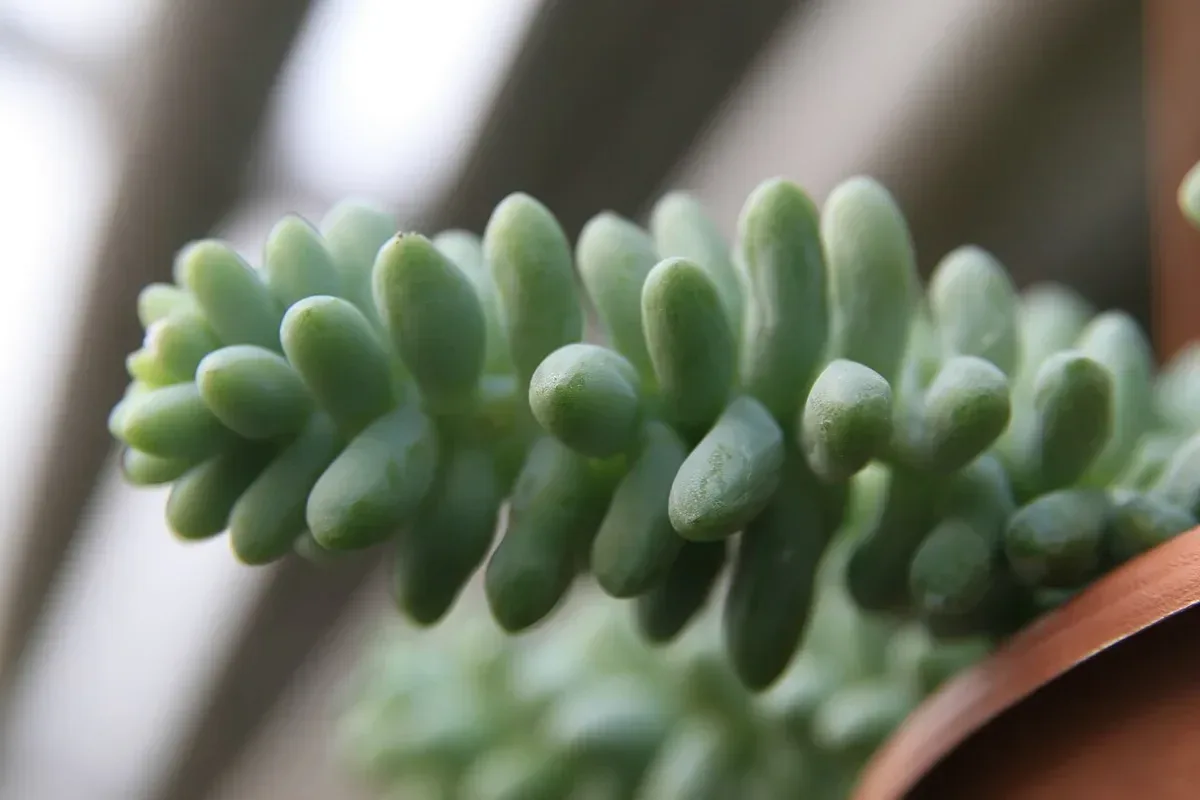
| ☀️ Light | Bright indirect light |
|---|---|
| 💧 Water | Low (allow soil to dry) |
| 🪴 Soil | Cactus and succulent mix with extra perlite, pumice or baked clay granules |
| 🌡️ Temp | 5°C – 35°C |
| 🐾 Safety | Cats: non-toxic · Dogs: non-toxic |
| 📏 Mature size | 60 cm |
Where It Grows & Climate Tolerance
Pet & Companion Animal Toxicity (Burro's Tail Care in Canada)
In Canada, burro's tail is a sunny-window houseplant. It copes well with dry heated air, wants little water in winter and can spend June to September on a bright patio.
Care instructions
Care Guide & Maintenance Routine
Grow in a south- or west-facing window or under a grow light in winter. Water every 3 to 5 weeks from November to February and every 1 to 2 weeks in summer. Move it outside only when nights stay above about 4°C and bring it in before fall frost.
Light & Sunlight
Wisconsin Horticulture says it grows best in bright light to full sun; in poor light the stems stretch and the leaves sit further apart. Very strong sun bleaches leaves yellowish, so in hot climates give morning sun and bright shade after noon.
Watering Schedule
Let the mix nearly dry out between waterings, then water deeply and let it drain. Reduce watering in autumn and give only enough in winter to stop the mix drying out completely (Wisconsin Horticulture). Plump leaves mean enough water; wrinkled leaves mean it needs a drink.
Potting Mix & Drainage
Cactus and succulent mix with extra perlite, pumice or baked clay granules
Temperature & Humidity
Frost-tender; keep above about 5°C. Outdoors only when nights stay above about 4°C, usually late May to September in Ontario and Quebec and mid-June to early September on the Prairies. A cool, bright room in winter suits it.
Burro's tail as a Canadian houseplant
Burro's tail is hardy only where it stays well above freezing, so everywhere in Canada it is a houseplant. That suits it: heated homes are dry, and dry air is what this succulent likes.
Winter light
Short days from November to February are the hard part, especially in Edmonton, Winnipeg and St. John's. Put it in the brightest south- or west-facing window. If stems start stretching, add an LED grow light for 12 to 14 hours a day about 30 cm above the plant.
Winter watering
With low light and cool rooms, the plant almost stops growing. Water only when the mix has dried right through, which may be every 3 to 5 weeks. A cool room of about 10 to 16°C over winter helps it rest and may encourage flowers in summer.
Summer outside
Wisconsin Horticulture advises moving it outdoors once temperatures stay above 40°F (about 4°C) and back in when nights are forecast to drop below that. Use your average last and first frost as a guide (ECCC 1991-2020 normals via GrowersGuide.ca):
- Vancouver: last frost 26 March; first frost about early November. Outside from May to October.
- Toronto, Montréal, Ottawa: last frost 29 April to 7 May. Outside from late May to late September.
- Calgary, Edmonton, Regina, Winnipeg: last frost 22 to 28 May. Outside from mid-June to early September.
- Halifax and Charlottetown: last frost 8 to 18 May. Outside from June to September.
Introduce it to sun gradually over a week or two and hang it under a porch roof, out of strong wind and heavy rain.
Hardiness zones
NRCan zones run from 0a in the far north to 9a in Victoria; burro's tail needs warmer winters than any of them, roughly USDA 10 to 11. Treat it as frost-tender everywhere.
Repotting and moving
Repot only in spring, when the pot is full. Plan the job in one session to limit handling, and avoid moving the plant between rooms in winter.
Pests indoors
Mealybugs are the main pest on indoor plants in winter. Fungus gnats appear if the mix stays wet; let it dry out between waterings.
Dry furnace air
Furnace heat can drop indoor humidity to 20 or 30 per cent during a January cold snap in Saskatoon or Ottawa. Unlike tropical houseplants, burro's tail does not mind. Keep it clear of baseboard heaters, and stop leaves pressing against frosty window glass at night, which can scar them.
Plants bought in winter
A plant picked up at a big-box store in December has often been kept wet in the greenhouse. Slide it out of its pot at home; if the mix is soggy, leave it to dry for several days before you water again.
Cuttings to share
Spring and early summer are the best times to root cuttings, when light is strong and rooms are warm.
Seasonal rhythm
Seasonal Calendar
| Month | Care Tasks | Seasonal Focus |
|---|---|---|
| Jan | Protect from frost/heat | Brightest window or grow light. Water every 3 to 5 weeks. |
| Feb | Protect from frost/heat | Low light: check for stretched stems; add a grow light if needed. |
| Mar | Repot | Days lengthen; slowly increase watering. Repot only if pot-bound. |
| Apr | Fertilize, Repot | Repot and take cuttings. One light feed. |
| May | Protect from frost/heat | Coast: move outside under cover. Elsewhere: wait for warm nights. |
| Jun | Plant out | Ontario, Quebec, Prairies: move outside once nights stay above 4°C; harden off. |
| Jul | Fertilize | Second light feed. Water when nearly dry. |
| Aug | Protect from frost/heat | Check for mealybugs. Shelter from heavy summer storms. |
| Sep | Protect from frost/heat | Prairies: bring in before first frost. Reduce watering. |
| Oct | Protect from frost/heat | Ontario and Quebec: bring pots indoors. Rinse off before bringing in. |
| Nov | Protect from frost/heat | Brightest window; water sparingly. |
| Dec | Protect from frost/heat | Cool, bright rest. Do not move the plant around. |
Diagnostics
Common Problems & Troubleshooting
Soft, translucent or yellow leaves and black stem bases from overwatering; wrinkled leaves from long dry spells; leaves dropping when the plant is moved or brushed; stretched, sparse stems in low light; bleached yellow leaves in harsh sun.
Pests & seasonal watch: Mealybugs on indoor plants in winter; fungus gnats in wet mix. Slugs and snails if summered outside on the ground.
- Root rot — Roots turn brown and mushy in soil that stays wet.
- Mealybugs — White cottony clumps in leaf joints, often with sticky honeydew.
- Leggy — Long weak stems with big gaps between small leaves, leaning to the window.
- Overwatering — Soil stays wet, leaves yellow or droop, and the pot feels heavy.
- Underwatering — Soil is bone dry and leaves are crispy, curled or dull.
- Leaf drop — Many leaves fall in a short time, sometimes still green.
- Sun scorch — Bleached or crispy patches on the side that faces strong sun.
- Stem rot — The stem goes soft, dark or black at soil level and the top collapses.
- Pale leaves — Whole leaves look washed out, not spotted.
Similar Botanical Matches
Keep exploring
Related plants
Grower field notes
Reader Field Notes in Canada
Share how this plant performs in your local Canada climate.