| ☀️ Light | Full sun |
|---|---|
| 💧 Water | Moderate (lightly moist) |
| 🪴 Soil | Fertile, moisture-retentive, well-drained soil |
| 🌡️ Temp | 2°C – 35°C |
| 🐾 Safety | Cats: not verified · Dogs: not verified |
| 📏 Mature size | 45 cm |
Where It Grows & Climate Tolerance
Pet & Companion Animal Toxicity (How to Grow Scarlet Sage (Salvia) in India)
On the Indian plains, salvia is a classic winter bedding flower in parks, school gardens and balcony gamlas, flowering from December into April. SKUAST-Jammu lists it among winter annuals sown in September or October; in the hills it is grown in summer.
Care instructions
Care Guide & Maintenance Routine
Sow seed in a nursery tray after the barsaat, transplant in October or November, and grow in a sunny kyari or gamla with mitti, sand and gobar khad. Water every few days in winter and more often as March warms up. Pinch the tips, deadhead, and give light afternoon shade once the loo approaches.
Light & Sunlight
Full sun gives the most flowers; NC State lists full sun to partial shade. In the hot Indian plains, some afternoon shade keeps flowers fresher in March and April.
Watering Schedule
Keep the soil evenly moist. NC State notes scarlet sage is not drought tolerant; wilting plants drop flowers and the lower leaves yellow. Avoid soggy soil, which causes root and stem rot.
Potting Mix & Drainage
Fertile, moisture-retentive, well-drained soil
Temperature & Humidity
Flowers best in mild sardi, 15 to 28°C. January pala may burn leaf tips in the north; covering beds on frosty nights helps. Hot April and May days with the loo end the season on the plains.
Salvia in Indian gardens
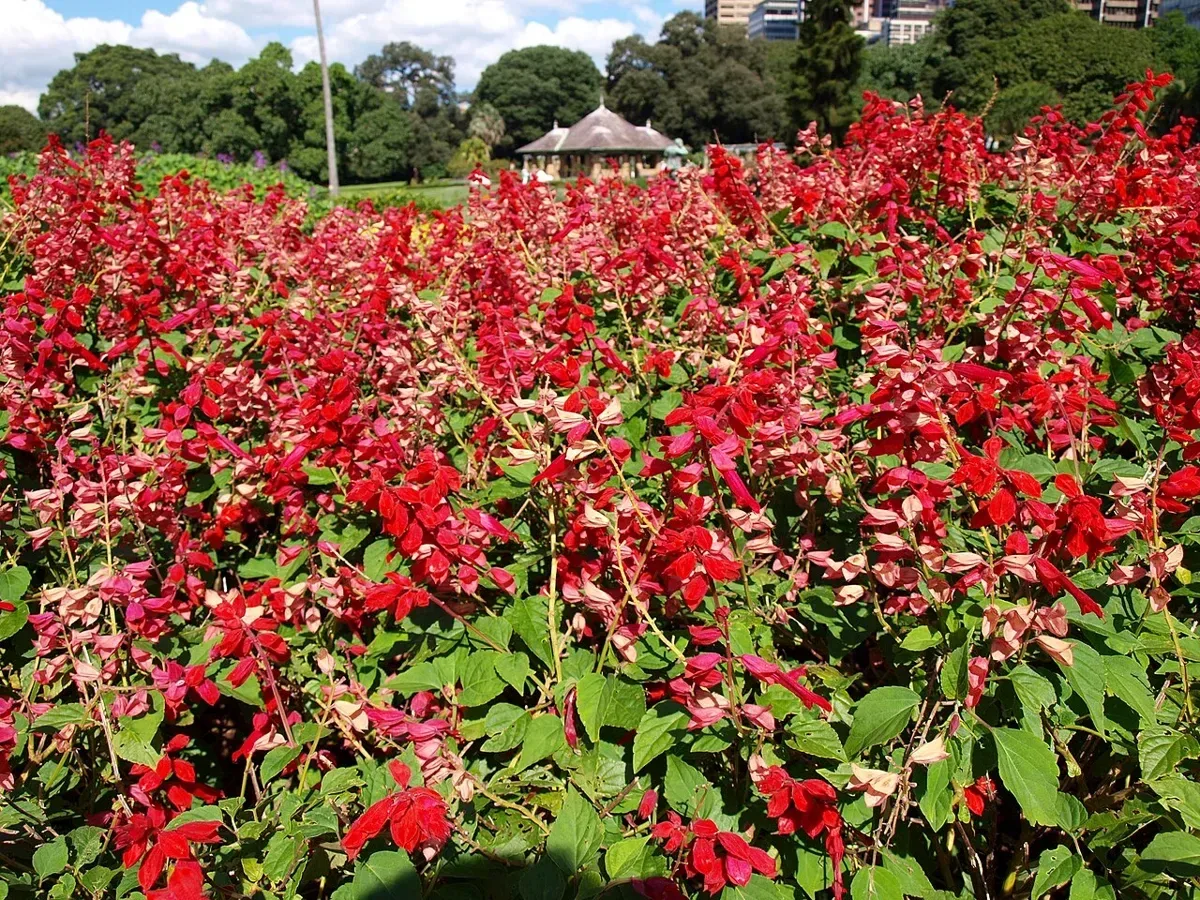
Red salvia is part of the classic Indian winter flower bed alongside marigold, petunia, pansy and calendula. Municipal parks, college lawns and railway gardens use it in bold red blocks, and it is a common sight at winter flower shows in Delhi, Chandigarh and Lucknow.
SKUAST-Jammu timing
SKUAST-Jammu lists salvia among winter-season annuals sown in September and October and transplanted in October and November. It notes seed germinates in five to eight days in winter, seedlings are ready to transplant 28 to 35 days after sowing, and annuals need light watering every seven to ten days in winter. In the hills of Jammu, annuals are grown in summer instead.
Region by region
- Delhi, Punjab, Haryana, UP, Rajasthan: sow after the rains end, plant out by November, flowers from December. Pala can blacken leaf tips in January; plants usually recover.
- Bengaluru, Pune, Hyderabad: milder winters allow sowing from August to December and a long flowering season.
- Mumbai, Chennai, Kolkata, Kochi: grow in the cooler months, October to February; humid heat brings mildew and spent flowers.
- Shimla, Darjeeling, Ooty, Srinagar: sow in spring once frosts end; flowers through summer.
Raising seedlings
Seed is fine. Scatter it on a tray of mitti, sand and leaf mould, press it in without covering, and keep it moist under a chajja. SKUAST-Jammu notes damping-off is the most common seedling disease of annuals, so use clean mix and do not overwater.
Gamla and balcony growing
For a balcony, use 8 to 10 inch gamlas or long troughs with a hole at the base. Fill with two parts mitti, one part sand and one part vermicompost or gobar khad. Plant one seedling per small gamla or three per trough. Place them where they get at least five hours of winter sun. In a flat in Gurugram, Noida or Mumbai, a south- or east-facing railing works well. Water when the top inch is dry, roughly every two or three days in December and daily by March. A pinch of the tip after planting gives two or three spikes instead of one.
Seed saving
PAU notes salvia is often cross-pollinated, with a 5 to 10% chance of crossing, and needs at least 100 m between varieties for pure seed. Seed saved from a mixed park bed will vary.
A typical season in Delhi
Seedlings go into beds after Diwali. The first red spikes appear by Christmas, and the bed is at its best around Basant Panchami and Holi. In April the loo arrives, flowers bleach, and the plants are pulled out to make room for summer zinnia and portulaca.
Questions from Indian growers
- Can I grow salvia in the monsoon? It is not suited to heavy rain on the plains; plants rot and flowers spoil. Raise seedlings in a protected tray as the rains end instead.
Seasonal rhythm
Seasonal Calendar
| Month | Care Tasks | Seasonal Focus |
|---|---|---|
| Jan | protect | Pala nights in the north: cover beds if frost is forecast. |
| Feb | prune | Basant: beds at their best; snip faded spikes. |
| Mar | prune, feed | Holi: last big flush; feed gamlas monthly. |
| Apr | protect | Loo begins: give afternoon shade; plains season ends. |
| May | sow | Hills: sow trays in spring; plains beds cleared. |
| Jun | plant | Hills: transplant into summer beds. |
| Jul | protect | Barsaat: not a monsoon plant on the plains. |
| Aug | sow | Bengaluru, Pune: first sowings under a chajja. |
| Sep | sow | Plains: sow in trays as the rains end; do not cover seed. |
| Oct | plant | Navratri to Diwali: transplant seedlings into kyaris. |
| Nov | prune | Pinch tips once seedlings settle in; water every few days. |
| Dec | feed | First red spikes by Christmas in Delhi and Lucknow. |
Diagnostics
Common Problems & Troubleshooting
Seedlings collapsing from damping-off; few flowers in shade or rich soil; leaf drop and wilting when the soil dries; powdery mildew and grey mould in crowded, damp beds; spider mites in dry heat; aphids and whitefly on young growth.
Pests & seasonal watch: Damping-off in nursery trays, aphids on new shoots in February, whitefly and spider mites in dry March heat, and powdery mildew in humid coastal winters. Ask the nearest KVK before spraying anything.
- Yellow leaves — Leaves fade from green to yellow, often starting at the bottom.
- Leggy — Long weak stems with big gaps between small leaves, leaning to the window.
- Spider mites — Fine webbing and pale speckled leaves, worse in dry heated rooms.
- Aphids — Clusters of small soft insects on new tips, often sticky.
- Whitefly — Tiny white insects fly up in a cloud when you touch the plant.
- White powder — A white powdery film on leaves, usually in still, humid air with dry soil at the roots.
- Grey mould — Fuzzy grey mould on faded flowers, damaged leaves or soft stems.
- Underwatering — Soil is bone dry and leaves are crispy, curled or dull.
Q&A
Frequently Asked Questions
Is scarlet sage annual or perennial?
NC State describes it as a tender perennial grown as an annual. It survives only in frost-free climates, zones 10 and 11.
How do I get more flowers on scarlet sage?
Grow it in full sun, keep the soil moist, pinch young plants, and cut off faded spikes. RHS notes border plants usually need no feeding; feed pots monthly with a potassium-rich fertiliser.
Should I cover scarlet sage seed?
No. NC State notes the seed needs light to germinate, so press it onto the surface of the mix.
Why are my seedlings collapsing?
This is usually damping-off, a fungal disease of seedlings in wet, crowded trays. Use fresh mix, sow thinly and give air.
Is scarlet sage safe for pets?
Toxicity has not been verified for Salvia splendens. The ASPCA scarlet sage page refers to Salvia coccinea, a different plant.
Does scarlet sage attract hummingbirds and bees?
Red tubular flowers are visited by hummingbirds in the Americas, but NC State notes many bedding cultivars produce no nectar.
When should I sow scarlet sage in India?
SKUAST-Jammu lists salvia with winter annuals: sow in September or October and transplant in October or November on the plains; in the hills, annuals are grown in summer.
Can I grow scarlet sage in shade?
It tolerates light shade but flowers less. NC State lists full sun to partial shade.
How is it different from culinary sage?
Culinary sage, Salvia officinalis, is a hardy shrubby herb with grey leaves. Scarlet sage is a tender bedding plant grown for its flowers, not used in cooking.
Similar Botanical Matches
Grower field notes
Reader Field Notes in India
Share how this plant performs in your local India climate.