
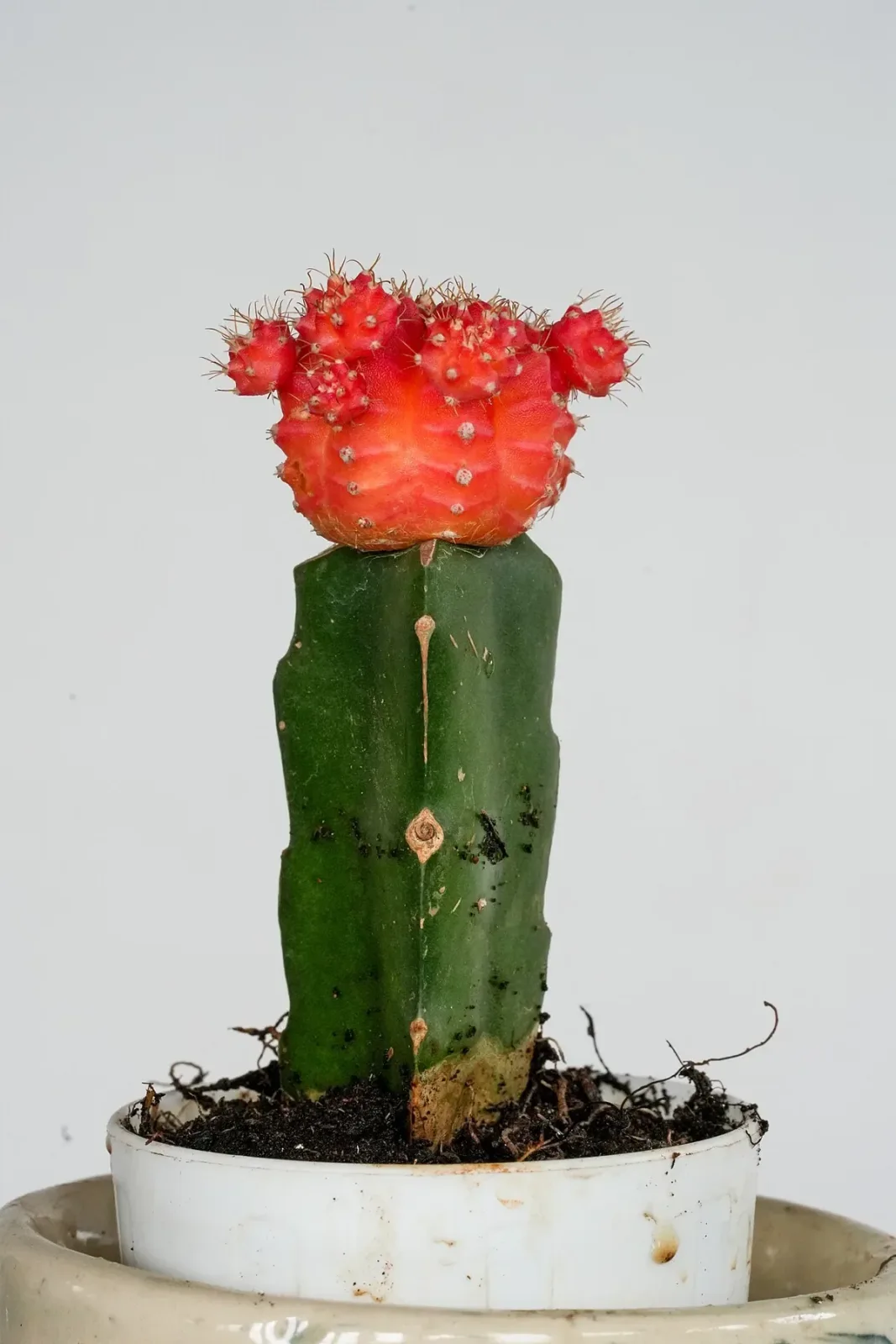
| ☀️ Light | Bright indirect light |
|---|---|
| 💧 Water | Low (allow soil to dry) |
| 🪴 Soil | Gritty, well-drained cactus and succulent mix |
| 🌡️ Temp | 10°C – 32°C |
| 🐾 Safety | Cats: not verified · Dogs: not verified |
| 📏 Mature size | 15 cm |
Where It Grows & Climate Tolerance
Pet & Companion Animal Toxicity (Moon Cactus Care in India)
Not yet verified: Toxicity status for cats, dogs, and horses has not yet been confirmed against veterinary poison-control records. Keep out of reach of pets or consult your veterinarian.
Moon cactus is one of the most common gift plants in Indian nurseries. Indian warmth suits it, but harsh summer sun scorches the coloured top and the monsoon rots the rootstock unless the pot stays dry.
Care instructions
Care Guide & Maintenance Routine
Keep in bright light with shade from midday and afternoon sun. Water only when the mix is fully dry, about every 10 to 14 days in summer, and keep it out of the rain from June to September. Use a gritty mix in a small pot with a hole.
Light & Sunlight
NC State says moon cactus prefers bright, indirect light and notes that too much direct sun can scorch grafted plants. A little gentle morning sun is fine; the coloured top burns in harsh afternoon sun.
Watering Schedule
NC State advises watering sparingly and letting the mix dry out completely between waterings, with even less water in the winter rest. Wet mix and high humidity encourage fungal rot.
Potting Mix & Drainage
Gritty, well-drained cactus and succulent mix
Temperature & Humidity
Frost is rare on the plains, but January nights in Delhi NCR, Punjab and Haryana can drop to around 4 to 5°C; bring the pot indoors on cold nights. Keep indoors all winter in hill towns. Shade from April to June sun, and keep under cover through the monsoon.
Moon cactus in Indian homes
Few plants are sold as widely in India as the moon cactus. It turns up in tiny plastic pots at Ooty and Lonavala stalls, at Bengaluru nurseries, at corporate gift counters and on online succulent sites. Indian heat suits it far better than a cold climate does, but two seasons cause most losses: the harsh pre-monsoon sun and the monsoon itself.
The dragon fruit connection
The green stem under the coloured top is usually Hylocereus undatus, the same climbing cactus now grown as a fruit crop in Gujarat, Maharashtra, Karnataka and the Northeast, where dragon fruit is sometimes marketed as kamalam. That rootstock loves warmth, which is why moon cacti grow strongly in Indian summers, and it hates soggy soil, which is why they rot in the rains.
Light and the Indian sun
From April to June on the northern plains, direct afternoon sun bleaches and scorches the top within days. Give it an east window or a balcony spot that gets morning sun only. In Bengaluru, Pune and Ooty, filtered light on a balcony works year-round.
Monsoon: keep it dry
From June to September in Mumbai, Goa, Kochi, Kolkata and Guwahati, move the pot under a roof or indoors. Stop regular watering; humid air often provides enough. Never let rain fill the pot. Check the base of the rootstock weekly for soft or darkening spots.
Watering through the Indian year
- March to June: water thoroughly when the mix is completely dry, often every 10 to 14 days in Delhi or Nagpur.
- Monsoon: water only if the mix is bone dry for a long stretch.
- October to February: water lightly every three to four weeks in the north; in Chennai and Hyderabad, slightly more often.
Winter in the north
In Delhi NCR, Punjab, Haryana and Lucknow, January nights can fall to 4 or 5°C. Bring the plant indoors on cold nights, since NC State advises keeping it above 10°C. In hill towns such as Shimla and Darjeeling, it stays indoors all winter.
A mix for Indian conditions
Use one part cocopeat or compost, one part coarse river sand and one part perlite, brick pieces or pumice. Avoid heavy mitti and sealed decorative pots. A small terracotta gamla with a hole is ideal.
Choosing a spot in the flat
A sunny kitchen sill facing east, a study table beside a bright balcony door or a covered terrace railing all work. Avoid the top of a fridge or a dark bathroom shelf; tops stay bright but the green stem weakens and leans towards any light it can find.
Gift pots
Moon cacti from gift shops often come in pots without drainage or with stones glued over the surface. Repot into a proper cactus mix within a few weeks so water can drain and you can see the soil.
Seasonal rhythm
Seasonal Calendar
| Month | Care Tasks | Seasonal Focus |
|---|---|---|
| Jan | Protect from frost/heat | North: bring indoors on cold nights; water very little. |
| Feb | Protect from frost/heat | Increase light as days lengthen; still little water. |
| Mar | Fertilize, Repot | Repot crowded plants in fresh gritty mix. Start light feeding. |
| Apr | Fertilize, Protect from frost/heat | Shade from afternoon sun on the plains. |
| May | Protect from frost/heat | Peak heat: morning sun only; water when fully dry. |
| Jun | Protect from frost/heat | Monsoon reaches Kerala and Mumbai: move under cover. |
| Jul | Protect from frost/heat | Keep dry; check the rootstock base weekly. |
| Aug | Protect from frost/heat | Heavy rains: no regular watering; good airflow. |
| Sep | Fertilize, Protect from frost/heat | Last feed as rains withdraw from the north. |
| Oct | Repot | Post-monsoon: repot rotting or waterlogged plants. |
| Nov | Protect from frost/heat | Reduce watering as nights cool in the north. |
| Dec | Protect from frost/heat | North: move indoors before cold nights. South: light watering. |
Diagnostics
Common Problems & Troubleshooting
Rot at the base or at the graft from wet mix; scorched, pale patches on the top from strong sun; a shrivelled top when the rootstock fails; the rootstock outgrowing or swallowing the top over time.
Pests & seasonal watch: Mealybugs at the graft line and in pot crevices, especially in dry months; spider mites in hot, dusty weather; rot of the rootstock in the monsoon when pots get wet.
- Root rot — Roots turn brown and mushy in soil that stays wet.
- Mealybugs — White cottony clumps in leaf joints, often with sticky honeydew.
- Spider mites — Fine webbing and pale speckled leaves, worse in dry heated rooms.
- Aphids — Clusters of small soft insects on new tips, often sticky.
- Overwatering — Soil stays wet, leaves yellow or droop, and the pot feels heavy.
- Sun scorch — Bleached or crispy patches on the side that faces strong sun.
- Cold damage — Dark, water-soaked or blackened patches after a cold night or an AC blast.
- Stem rot — The stem goes soft, dark or black at soil level and the top collapses.
Q&A
Frequently Asked Questions
Why is a moon cactus grafted?
The coloured top is a mutant seedling with no chlorophyll, so it cannot make its own food. NC State explains it is grafted onto a green cactus, usually Hylocereus undatus, which feeds it.
How long does a moon cactus live?
Grafts often last only a few years. The rootstock may fail in cold or wet conditions, or grow faster than the top. A healthy top can be regrafted onto a new rootstock.
How often should I water a moon cactus?
Only when the mix is completely dry, as NC State advises. In warm months that may be every 10 to 14 days in a small pot; in winter, much less.
Can it take full sun?
NC State notes direct sun can scorch grafted plants. Give bright light with shade from the hottest part of the day.
What is the green stem?
The rootstock, typically Hylocereus undatus according to NC State. This is the same climbing cactus that produces dragon fruit.
Can the coloured top grow roots on its own?
No. Without chlorophyll it cannot survive on its own roots. Its offsets must be grafted onto green stock.
Why is the top turning brown or soft?
Possible causes include rot from wet mix, sun scorch or a failing rootstock. Check the base and the graft before deciding; a soft, discoloured rootstock usually means rot.
Should I remove shoots from the green stem?
Yes. Shoots from the rootstock take energy from the coloured top. Twist or cut them off.
Does a moon cactus flower?
It can. NC State notes funnel-shaped flowers in late spring to early summer, pale pink on Hibotan types.
Similar Botanical Matches
Keep exploring
Related plants
Grower field notes
Reader Field Notes in India
Share how this plant performs in your local India climate.