
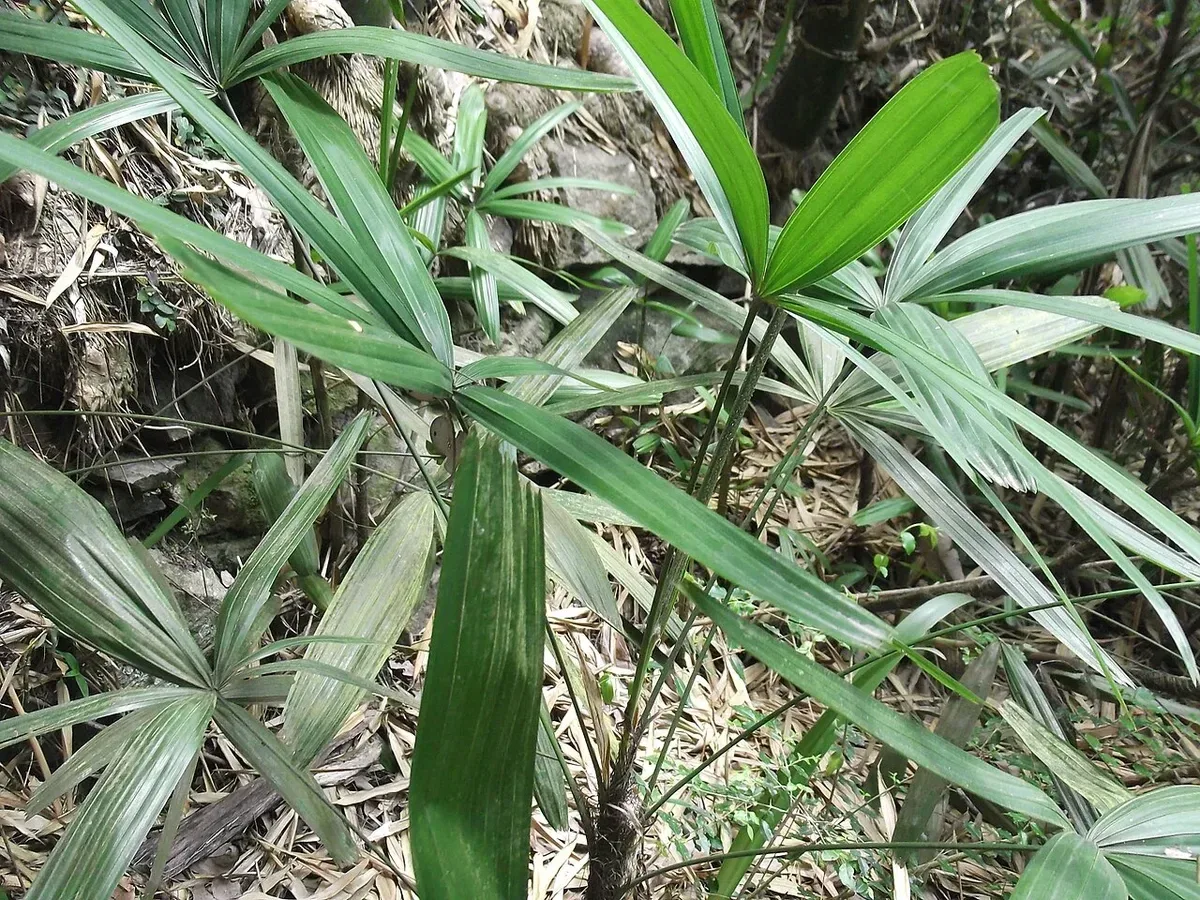
| ☀️ Light | Medium light |
|---|---|
| 💧 Water | Moderate (lightly moist) |
| 🪴 Soil | Well-drained, peat-free potting mix with bark or perlite |
| 🌡️ Temp | 10°C – 35°C |
| 🐾 Safety | Cats: non-toxic · Dogs: non-toxic |
| 📏 Mature size | 1.8 m |
Where It Grows & Climate Tolerance
Pet & Companion Animal Toxicity (Lady Palm Care in India)
Lady palm suits Indian homes well. It handles shade, dry indoor air and air-conditioned offices, and in the south and on the coasts it grows outdoors in shaded gardens. On the northern plains it needs shelter from loo winds in May and from cold December nights.
Care instructions
Care Guide & Maintenance Routine
Keep it on a shaded verandah, in a bright room or under trees, never in afternoon sun. Water when the top of the gamla dries, more often in May, less in the barsaat and the northern winter. Feed lightly in March and July. In Delhi, Punjab and UP, keep it indoors from mid-December to January.
Light & Sunlight
NC State Extension says it needs indirect light and withstands deep shade. Bright, filtered light gives the best colour and growth; direct afternoon sun yellows and scorches the leaves.
Watering Schedule
NC State recommends regular watering except in winter, when watering can be reduced. Let the top few centimetres of mix dry between waterings and never leave the pot standing in water.
Potting Mix & Drainage
Well-drained, peat-free potting mix with bark or perlite
Temperature & Humidity
No frost tolerance. Keep above about 10°C, so protect it on cold December and January nights in Punjab, Haryana, Delhi, UP and the hills. Hot, dry loo winds in May and June scorch leaves on exposed verandahs.
Lady palm in Indian homes
Lady palm has long been a favourite in hotel lobbies and corporate offices in Mumbai, Bengaluru and Delhi, and more homes now keep one in the drawing room. It costs more than an areca palm, but it lives for decades, stays neater and tolerates far less light.
Region by region
- Bengaluru, Pune, Hyderabad, Mysuru: grows outdoors under trees or on a north-facing verandah all year.
- Mumbai, Goa, Kochi, Chennai, Kolkata: humid air suits it. Grow it under a shaded chajja or indoors near a window; heavy rain on an exposed gamla rots roots.
- Delhi, Lucknow, Jaipur, Chandigarh: best indoors or on a covered verandah. Loo winds in May and June brown the leaves; December and January nights get too cold outside.
- Hill towns: keep it indoors; it cannot take frost.
Gamla and mitti
Use a wide clay or plastic gamla with drainage holes. Mix garden mitti, coarse sand and well-rotted compost or leaf mould in equal parts, or use a ready palm mix with added cocopeat and perlite. Do not pack it hard. A layer of broken thikri over the hole keeps mitti from washing out.
Watering by season
From April to June, water when the top few centimetres dry, often every three or four days. In the barsaat, humidity keeps the mix damp, so water far less. In winter on the northern plains, once a week or less may do.
Hard water and brown tips
Borewell water in many Indian cities is hard and salty, and the salts build up in the gamla. Flush the pot with plenty of water once a month in summer, or use collected rainwater or RO reject water mixed with tap water.
Vastu corners and festive decor
Many families place a palm near the main door or in the north-east corner of the drawing room. These spots are often dim, which suits it. During Diwali, keep diyas and candles well away from the dry fibre on the canes, and avoid stringing heavy lights across the leaves.
Air conditioning
The palm handles AC rooms well, as NC State notes it has low humidity needs. Keep it out of the direct blast of a split AC unit.
Monsoon pests
Scale and mealybugs multiply in humid months. Wipe the canes and leaf undersides with a soft cloth every few weeks. By IMD's normal dates, the rains reach Mumbai around 11 June and Delhi around 27 June.
Questions from Indian growers
- Is it safe with pets? Yes. ASPCA lists lady palm as non-toxic to dogs and cats.
- Is it the same as the bamboo palm at my nursery? Often not; nurseries also sell Chamaedorea as bamboo palm. Lady palm has fan-shaped leaves.
Seasonal rhythm
Seasonal Calendar
| Month | Care Tasks | Seasonal Focus |
|---|---|---|
| Jan | Protect from frost/heat | Delhi, Ludhiana, Kanpur: inside after dusk; sparse watering in the foggy weeks. |
| Feb | Protect from frost/heat | Dusty leaves after winter smog: wipe with a damp cotton cloth. |
| Mar | Fertilize, Repot | Holi to Ugadi: shift to a wider gamla or split the clump; first feed. |
| Apr | Protect from frost/heat | Hot spell begins: draw the parda against glare through west windows. |
| May | Protect from frost/heat | Loo winds: water every three to four days; keep off open chhats. |
| Jun | Protect from frost/heat | Pre-monsoon: move gamlas under the chajja; clear blocked holes. |
| Jul | Fertilize | Second feed. Hold back water during continuous barsaat. |
| Aug | Protect from frost/heat | Muggy Shravan weeks: search canes for scale and white fluff. |
| Sep | Protect from frost/heat | Rains withdraw: flush borewell salts with a bucket of water. |
| Oct | Protect from frost/heat | Dussehra weather: return it to the bright verandah. |
| Nov | Protect from frost/heat | Cooler nights after Diwali: lengthen gaps between waterings. |
| Dec | Protect from frost/heat | Northern cold: indoors, away from heat blowers and angithis. |
Diagnostics
Common Problems & Troubleshooting
Brown leaf tips from irregular watering, fertiliser salts or very dry air; yellowing and scorch in direct sun; root rot in waterlogged pots; scale and mealybugs on leaf undersides and canes; spider mites in hot, dry rooms.
Pests & seasonal watch: Scale insects and mealybugs on canes and leaf undersides, worst in the humid monsoon months. Spider mites in dry, dusty air in April and May. Root rot in waterlogged gamlas during heavy rain. Ask a nursery or the local KVK before spraying.
- Yellow leaves — Leaves fade from green to yellow, often starting at the bottom.
- Brown tips — Leaf tips and edges turn dry, brown and papery.
- Root rot — Roots turn brown and mushy in soil that stays wet.
- Mealybugs — White cottony clumps in leaf joints, often with sticky honeydew.
- Spider mites — Fine webbing and pale speckled leaves, worse in dry heated rooms.
- Scale — Hard or soft brown bumps stuck to stems and leaf ribs, often with sticky honeydew.
- Leaf spot — Brown or tan spots with a yellow halo, sometimes with tiny dots in the centre.
- Overwatering — Soil stays wet, leaves yellow or droop, and the pot feels heavy.
- Sun scorch — Bleached or crispy patches on the side that faces strong sun.
Q&A
Frequently Asked Questions
Can lady palm grow in low light?
Yes. NC State notes it needs indirect light and withstands deep shade, making it one of the best palms for dim rooms. Growth is slower in low light.
How often should I water a lady palm?
When the top few centimetres of mix are dry. NC State recommends regular watering, reduced in winter. Never let the pot sit in water.
Why are the leaf tips turning brown?
Common causes include irregular watering, fertiliser salts building up, and very dry air. Check the mix moisture first, and flush the pot with plain water a few times a year.
Is lady palm safe for cats and dogs?
Yes. ASPCA lists lady palm as non-toxic to dogs and cats, and NC State tags it non-toxic for cats, dogs and horses.
How fast does it grow?
Slowly. Expect a few new leaves and occasionally a new cane each year. This is why large plants are expensive.
Can I propagate it?
By division of the rhizome, as NC State notes. Split a crowded clump in spring so each piece has several canes and roots.
Is lady palm the same as bamboo palm?
No. Bamboo palm usually refers to Chamaedorea seifrizii, which has feathery leaves. Lady palm has fan-shaped leaves on fibre-covered canes.
What pests affect it?
NC State lists mites, mealybugs and scale, mainly indoors. Look under the leaves and along the canes for small brown bumps or white fluff.
Can it go outside in summer?
Yes, in shade. NC State notes potted plants can spend summer on a shady patio but must come in before temperatures drop below about 10°C.
Similar Botanical Matches
Keep exploring
Related plants
Grower field notes
Reader Field Notes in India
Share how this plant performs in your local India climate.