
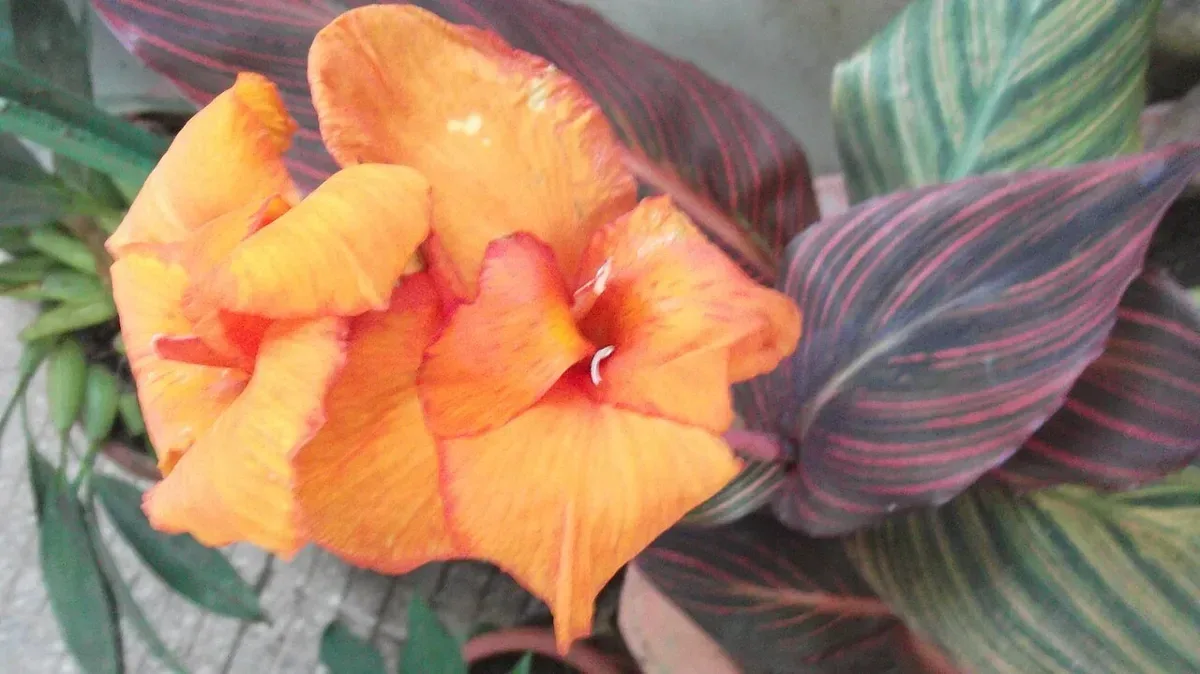
| ☀️ Light | Full sun |
|---|---|
| 💧 Water | High (consistently moist) |
| 🪴 Soil | Rich, moist soil high in organic matter |
| 🌡️ Temp | -4°C – 40°C |
| 🐾 Safety | Cats: non-toxic · Dogs: non-toxic |
| 📏 Mature size | 1.5 m |
Where It Grows & Climate Tolerance
Pet & Companion Animal Toxicity (How to Grow Canna Lily in India)
Canna, known in Hindi as sarvajjaya, is one of the easiest flowering plants in India. It lines railway stations, roadsides, school gardens and temple ponds, and the India Biodiversity Portal records it flowering through the year. It needs sun, water and little else.
Care instructions
Care Guide & Maintenance Routine
Plant rhizome pieces in sunny kyaris or large gamlas before the monsoon, in mitti mixed with gobar khad. Water often in the garmi and let the barsaat do the rest. Snap off spent spikes, cut finished stems to the base, and divide crowded clumps every two or three years in February or March.
Light & Sunlight
NC State notes cannas flower poorly in shade, and UMN Extension recommends full sun and hot weather. A warm site with part-day sun, such as along a house wall, still gives flowers.
Watering Schedule
Cannas need steady moisture and plenty of water in hot weather. RHS notes they can grow at a pond edge with no more than 15 cm of water over the roots. Never let pots dry out in summer.
Potting Mix & Drainage
Rich, moist soil high in organic matter
Temperature & Humidity
Handles 45°C heat if watered, but leaves burn in the loo when the soil dries. In the north, December and January pala scorches leaves while rhizomes survive in the ground. Hill frosts that freeze the soil kill rhizomes.
Canna in Indian gardens
The India Biodiversity Portal records Canna indica as planted in gardens and homesteads, often found along roads as an escape, in wet areas, marshes and lake margins, flowering and fruiting throughout the year. Its seeds are hard, round and black, which gives the name Indian shot, but the genus comes from the tropical Americas. Hybrid cannas with large flowers and bronze or striped leaves are sold by nurseries everywhere. Municipal parks, railway platforms and the Botanical Survey of India garden at Yercaud use them in bold beds, and they are a common sight around village ponds in Bengal and Assam.
Names
Vernacular names recorded on the India Biodiversity Portal include sarvajjaya in Hindi, sarbajaya in Bengali, kolaboti in Assamese, kardal in Marathi, kele phool in Konkani, kalahu in Kannada, kalvazhai in Tamil and laphoorit in Manipuri.
Season by region
- Kerala, coastal Karnataka, Goa, Mumbai, Chennai, Kolkata: grows and flowers almost all year. Cut back tired stems after the monsoon to renew the clump.
- Delhi, Punjab, Haryana, UP, Bihar: strong growth from March to November. December and January pala can scorch the leaves; cut them down after Lohri and fresh shoots follow in February.
- Rajasthan and Gujarat: survives the loo if watered daily; give a thick mulch.
- Hill stations: grows in summer; where the ground freezes, lift rhizomes in November or mulch heavily.
Planting
Plant rhizome pieces in March or in the pre-monsoon weeks, 10 to 15 cm deep, in a sunny kyari enriched with gobar khad. In a gamla use at least a 14 to 16 inch pot for standard types. Water well. Shoots appear within two to three weeks in warm soil.
Water
Cannas need a lot of water in April, May and June. Water daily in pots and every two or three days in beds. During the barsaat, beds look after themselves; tip excess water out of saucers so pots do not sour.
Pests
In warm, humid weather, caterpillars roll and stitch the young leaves together and feed inside, leaving ragged, holed leaves. Pick off rolled leaves by hand. Grasshoppers and snails also feed on leaves in the rains. For heavy attacks or for yellow-streaked leaves that may be a virus, ask the nearest KVK or state horticulture office before spraying anything.
A typical year in Lucknow
Divide clumps around Basant Panchami, when the soil starts to warm. New spikes open by Holi, and the bed is in full flower through the summer and the barsaat. Keep deadheading through Dussehra and Diwali. By late December kohra and pala brown the leaves; leave them as cover until Lohri, then cut the stems to the ground.
Questions from Indian growers
- Is canna safe around cows and dogs? ASPCA's plant list rates canna non-toxic for dogs, cats and horses.
Seasonal rhythm
Seasonal Calendar
| Month | Care Tasks | Seasonal Focus |
|---|---|---|
| Jan | Protect from frost/heat | Pala and kohra brown the leaves in the north; leave as cover. |
| Feb | Plant out, Prune | After Lohri cut old stems; Basant: divide crowded clumps. |
| Mar | Plant out, Fertilize | Holi: plant new rhizome pieces; add gobar khad. |
| Apr | Fertilize | Water daily as garmi builds; mulch the kyari. |
| May | Protect from frost/heat | Loo: deep water every evening; shade new pots. |
| Jun | Plant out | Pre-monsoon: plant out polybag cannas before rains. |
| Jul | Prune | Barsaat: snap spent spikes; pick rolled leaves. |
| Aug | Fertilize | Mid-monsoon: feed with khad; tip water from saucers. |
| Sep | Prune | Late rains: remove stems that finished flowering. |
| Oct | Fertilize | Navratri to Dussehra: second flush; feed lightly. |
| Nov | Prune | Diwali: tidy beds; hill gardens lift or mulch rhizomes. |
| Dec | Protect from frost/heat | North India: let frost cover die back; south keeps blooming. |
Diagnostics
Common Problems & Troubleshooting
No flowers in shade or dry soil; streaked, mottled leaves from virus; ragged leaves from wind or chewing insects; rust spots; rhizome rot in cold, wet storage; frost-blackened leaves.
Pests & seasonal watch: Leaf-rolling caterpillars in the barsaat, grasshoppers and snails in monsoon kyaris, mealybugs at the base of crowded clumps, and rust spots in humid weather. Yellow streaking can be a virus; ask a KVK before treating.
- Yellow leaves — Leaves fade from green to yellow, often starting at the bottom.
- Root rot — Roots turn brown and mushy in soil that stays wet.
- Aphids — Clusters of small soft insects on new tips, often sticky.
- Leaf spot — Brown or tan spots with a yellow halo, sometimes with tiny dots in the centre.
- Underwatering — Soil is bone dry and leaves are crispy, curled or dull.
- Curling — Leaves cup, roll or twist instead of lying flat.
- Cold damage — Dark, water-soaked or blackened patches after a cold night or an AC blast.
- No flowers — A flowering houseplant stays leafy and will not bloom.
Q&A
Frequently Asked Questions
Is canna a true lily?
No. Cannas belong to their own family, Cannaceae, related to bananas and ginger. The name canna lily is a popular label only.
Are cannas safe for pets?
Yes. ASPCA lists canna lily (Canna generalis) as non-toxic to dogs, cats and horses.
Why is my canna not flowering?
The usual reasons are too much shade, dry soil, or overcrowded clumps. NC State notes cannas flower poorly in shade. RHS lists non-flowering among the common complaints.
Do I need to dig up cannas in winter?
Only where the ground freezes. NC State advises lifting in zone 7 and colder and storing rhizomes at 7 to 10°C. In frost-free areas they stay in the ground.
How deep do I plant canna rhizomes?
UMN Extension plants them 8 to 10 cm deep; NC State gives 10 to 15 cm. Space 30 cm to 90 cm apart, depending on the size of the variety.
Why are canna leaves streaked yellow?
Yellow streaks or mottling, often with twisted leaves, can mean a canna virus. RHS advises destroying affected plants, as there is no cure. Confirm before discarding, because nutrient problems can look similar.
Why is it called Indian shot?
The seeds of Canna indica are small, round, black and very hard, like shot pellets. The name does not mean it is native to India; Canna comes from the Americas.
How do I store cannas over winter?
Wisconsin Horticulture advises letting frost kill the tops, digging before a hard freeze, drying the rhizomes for a day or two, then wrapping them in newspaper or peat moss at 7 to 10°C.
Can cannas grow in water?
Yes, to a point. RHS notes cannas can be grown at a pond margin with no more than 15 cm of water over the roots.
Similar Botanical Matches
Keep exploring
Related plants
Grower field notes
Reader Field Notes in India
Share how this plant performs in your local India climate.