
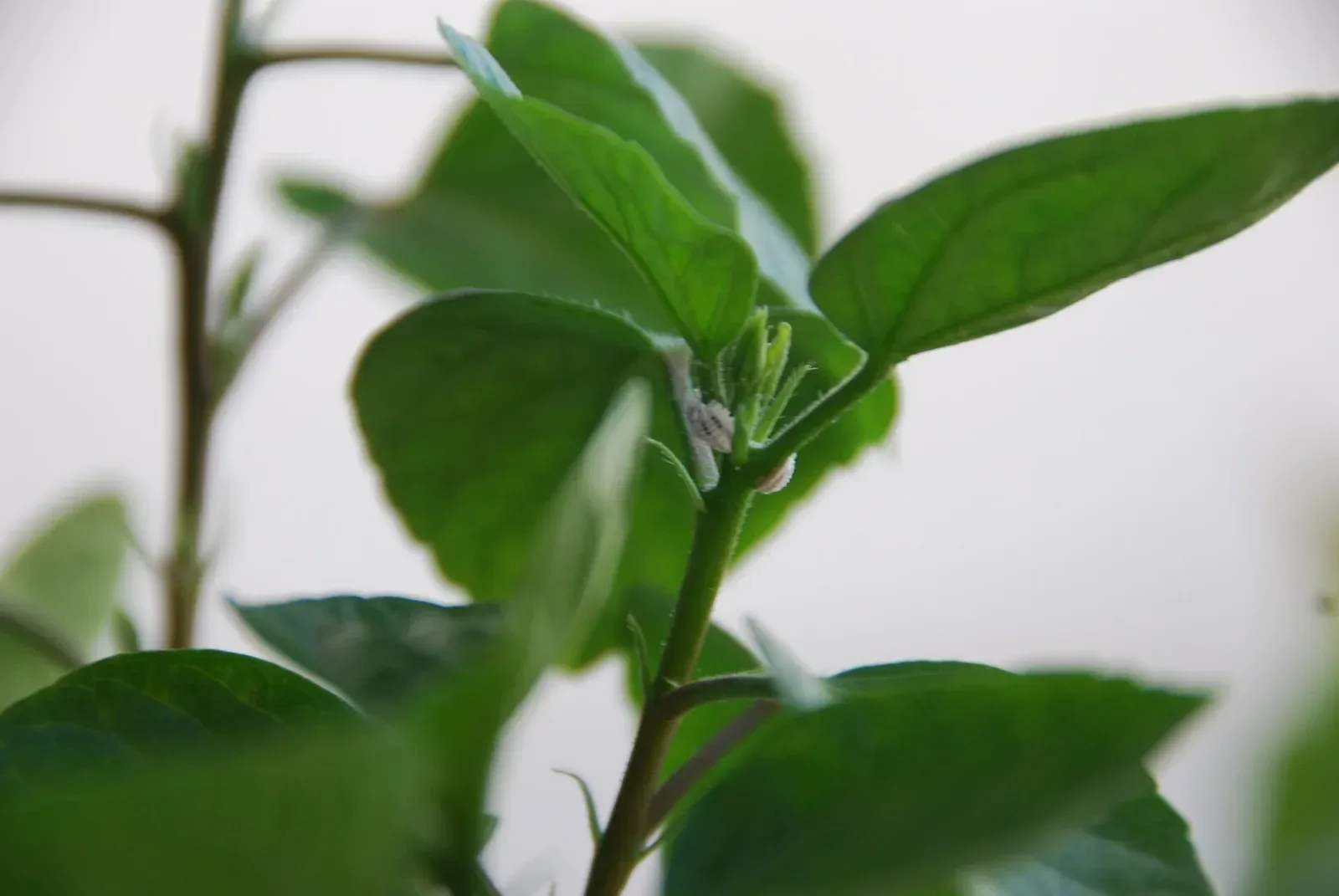
If your gudhal (hibiscus, also called jaswand, sembaruthi or joba in different parts of India) has small white, cottony patches on the shoot tips, buds or the undersides of leaves, the most likely culprit is mealybug. Gardeners often call them safed keede or rui wale keede, cotton insects. They are among the most common pests of hibiscus in India, and a light attack can turn into a crippled, sticky plant within a few weeks if nothing is done.
The good news is that mealybugs on a garden hibiscus can usually be cleared without strong chemicals, as long as you catch them early and keep at it. This guide shows how to confirm what you are looking at, what to do first, which sprays are reasonable for a home garden, and how to stop them coming back. For general hibiscus care, see our hibiscus plant profile. For mealybugs on indoor plants, our short mealybugs page covers the basics.
Is it really mealybug? How to check
Several things on a hibiscus can look white and fluffy, so take two minutes to check before you treat anything. A phone torch and a magnifying glass, or the zoom on your phone camera, help a lot.
- Look in the right places: the soft growing tips, around flower buds, where leaves join the stem, along the veins on the underside of leaves, and in cracks in older stems. Mealybugs like sheltered spots.
- Look closely at one white patch. Mealybugs are soft, oval insects about 3 to 4 mm long, covered in white, mealy wax. You will often see smaller ones and fluffy egg sacs mixed in.
- Touch one with a toothpick. A mealybug is soft and can move slowly. Dust or a fungal coating just smears.
- Check for stickiness. Mealybugs pass a sugary liquid called honeydew, so leaves below them may feel sticky or have a black, sooty coating.
- Watch for ants. Ants walking up and down the stem are often tending a mealybug colony for its honeydew.
Which mealybug is it?
You do not need to name the species to treat a garden plant, but a few are common on hibiscus in India, and knowing them helps you read the damage. The descriptions below are from the National Centre for Integrated Pest Management (ICAR-NCIPM) bulletin on mealybugs.
- Pink hibiscus mealybug (Maconellicoccus hirsutus): no long tails or stripes, and when you squash one, the body fluid is pink to red. NCIPM names Hibiscus rosa-sinensis as a typical host. This is the species that causes the bunched, twisted shoot tips described below.
- Cotton or solenopsis mealybug (Phenacoccus solenopsis): short to medium waxy threads around the edge, short tail threads, and two dark stripes along the back. It has been studied on hibiscus in West Bengal, Gujarat and at ICAR-CRIDA in Hyderabad.
- Striped mealybug (Ferrisia virgata): grey, with very long waxy threads, long tails and two dark stripes on the back.
Look-alikes to rule out
- Whitefly: tiny white winged insects that fly up in a small cloud when you shake the plant. Mealybugs do not fly. See whitefly.
- Scale insects: hard or waxy bumps fixed flat on stems and leaf ribs that do not move. See scale.
- Aphids: small green, black or grey soft insects crowded on new tips, without the white wax. See aphids.
- Mealybug destroyer larvae: these are larger than mealybugs, up to about 1.3 cm long, with longer, curly white wax spikes, and they move around more. They are the young of a ladybird beetle that eats mealybugs, so leave them alone. There is a photo further down.
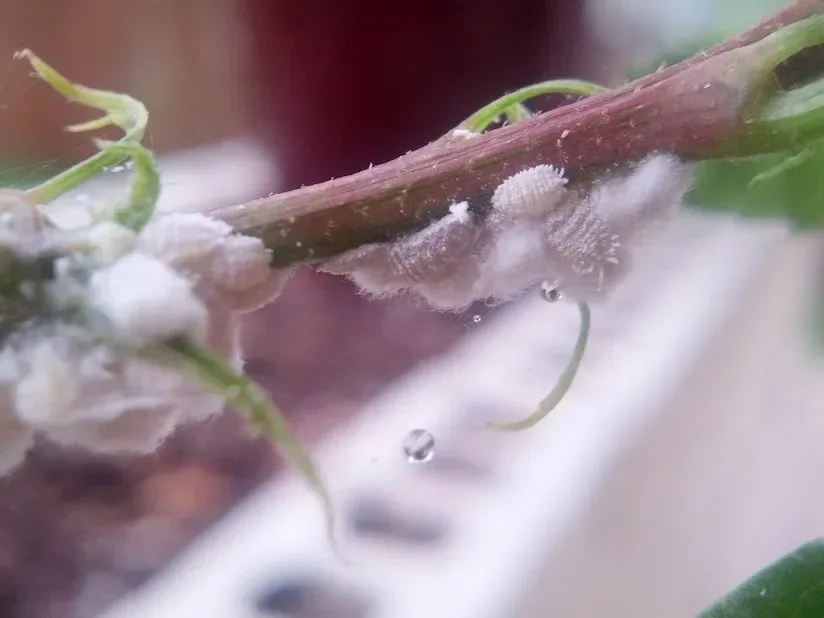
What the damage looks like
Mealybugs suck sap from soft growth. With a few insects you may only see a slight curl in new leaves. As numbers rise, you may see:
- Bunched, twisted shoot tips with short gaps between leaves, sometimes called bunchy top. University of Florida entomologists describe this as the typical sign of pink hibiscus mealybug on hibiscus, because its saliva is toxic to the plant.
- Curled, crinkled or thickened leaves and stems at the tips.
- Buds that stay closed, shrivel and drop.
- Sticky leaves, black sooty mould and lots of ants.
- Yellowing and leaf drop, and in very heavy attacks, dieback of whole branches.
Curled leaves alone do not prove mealybug. Aphids, thrips, mites, heat stress and weedkiller drift can also curl hibiscus leaves, and the University of Florida notes that mealybug damage can look like a virus problem. Always find the insects before deciding. Our curling leaves page lists other causes.
When mealybugs build up in India
Mealybugs like warm, dry weather. NCIPM notes that in warm climates they stay active and breed all year, and can go through many generations a year. Each female can lay hundreds of eggs, which is why a small patch spreads so fast. The timing of the worst attacks depends on your region and on the weather in a given year:
- East and North Indian plains: a two-year survey of cotton mealybug on hibiscus in West Bengal found numbers peaking between late March and early June, with none found after late August. Numbers rose with higher maximum temperatures and fell with rain. In Delhi, Punjab, UP and similar areas, the hot, dry months before the monsoon are the time to check plants weekly. Cold winters slow them down but do not wipe them out, as eggs and other stages can survive on the plant and in the soil.
- West India: a study at Navsari Agricultural University in south Gujarat found the highest numbers on hibiscus in the first half of November, after the rains, again linked to higher temperatures and lower humidity. So do not relax once the summer is over.
- South India and the coasts: with warm weather all year, mealybugs can turn up in any month. Heavy monsoon rain tends to knock numbers down on outdoor plants, and they often build up again in the dry months that follow.
- Hills: outdoor hibiscus is less common, but potted hibiscus kept indoors in a warm room over winter can carry mealybugs right through, because indoor plants are out of reach of the natural enemies that help outdoors.
ICAR-CRIDA's work on cotton mealybug reared on hibiscus found that it developed between 15 and 35°C and is a heat-tolerant species, which fits the summer peaks seen in the field.
How to get rid of mealybugs on hibiscus
Work through these steps in order. Most garden attacks are cleared with the first five.
1. Separate and clean up
- Move a potted plant away from your other plants. Crawlers (newly hatched young) move on wind, ants, clothes and tools.
- Cut off the worst bunched and twisted tips and any heavily covered twigs. Put them straight into a plastic bag, tie it, and put it in the rubbish. Do not shake them over other plants or put them in the compost. NCIPM advises destroying infested prunings quickly.
- A firm prune also helps a badly damaged hibiscus, since it flowers on new growth.
2. Wash them off
Both NCIPM and the University of California IPM programme recommend a strong jet of water to knock mealybugs off sturdy plants. Spray the stems, buds and undersides of leaves with a hose or a pressure sprayer, taking care not to snap soft shoots. Repeat every few days. It removes many insects and much of the wax and honeydew, which makes any later spray work better.
3. Dab small colonies
For a few colonies on a small plant, dab each one with a cotton bud dipped in rubbing alcohol (isopropyl alcohol). The University of California IPM programme recommends a solution of 70 percent or weaker for this, and advises testing it on a small part of the plant a day or two before to check it does not burn the leaves. Keep the plant out of direct sun until it dries. Hand-picking with a damp cloth also works for small numbers.
4. Stop the ants
Ants protect mealybugs from their natural enemies and carry them from plant to plant, so mealybug control often fails until the ants are dealt with. NCIPM recommends sticky bands on the main stem to stop crawlers climbing up, and the same bands stop ants. Wrap a strip of tape around the stem, sticky side out, or use a ready-made sticky band, and replace it when it gets dusty. Keep the plant from touching walls, railings and other plants, which act as ant bridges.
5. Use a soap or oil spray if needed
The University of California IPM programme notes that insecticidal soap, horticultural oil and neem oil can reduce mealybugs, mainly the young ones, but only where the spray actually touches them. The wax on adults and their habit of hiding make any spray less effective, so wash them off first and spray thoroughly. Then:
- Use a product made for plants and mix it at the rate on its label. Do not guess the strength.
- Test it on a few leaves first and wait a day or two for any scorching.
- Spray in the evening or on a cloudy day, never in hot sun.
- Cover the undersides of leaves, the shoot tips, the buds and the stem joints.
- Repeat as the label directs. New crawlers keep hatching from egg sacs you missed.
Avoid household detergents, phenyl, disinfectants and kerosene mixes. Their strength varies from bottle to bottle, and they can burn hibiscus leaves and kill the beneficial insects you want to keep.
6. Keep checking
One round of treatment almost never finishes the job. NCIPM notes that it can take up to about a month for a mealybug to grow from egg to adult, so check the plant every week for at least a month after you stop seeing them, and treat any new patch at once.
Protect the natural enemies
Outdoors, natural enemies are the main reason mealybugs stay at low numbers on most plants. The most important in India is the Australian ladybird beetle, Cryptolaemus montrouzieri, also called the mealybug destroyer. It was brought to India in 1898 and is now used widely against mealybugs on fruit crops and ornamentals. Its larvae look like oversized mealybugs, which is why gardeners sometimes kill them by mistake.
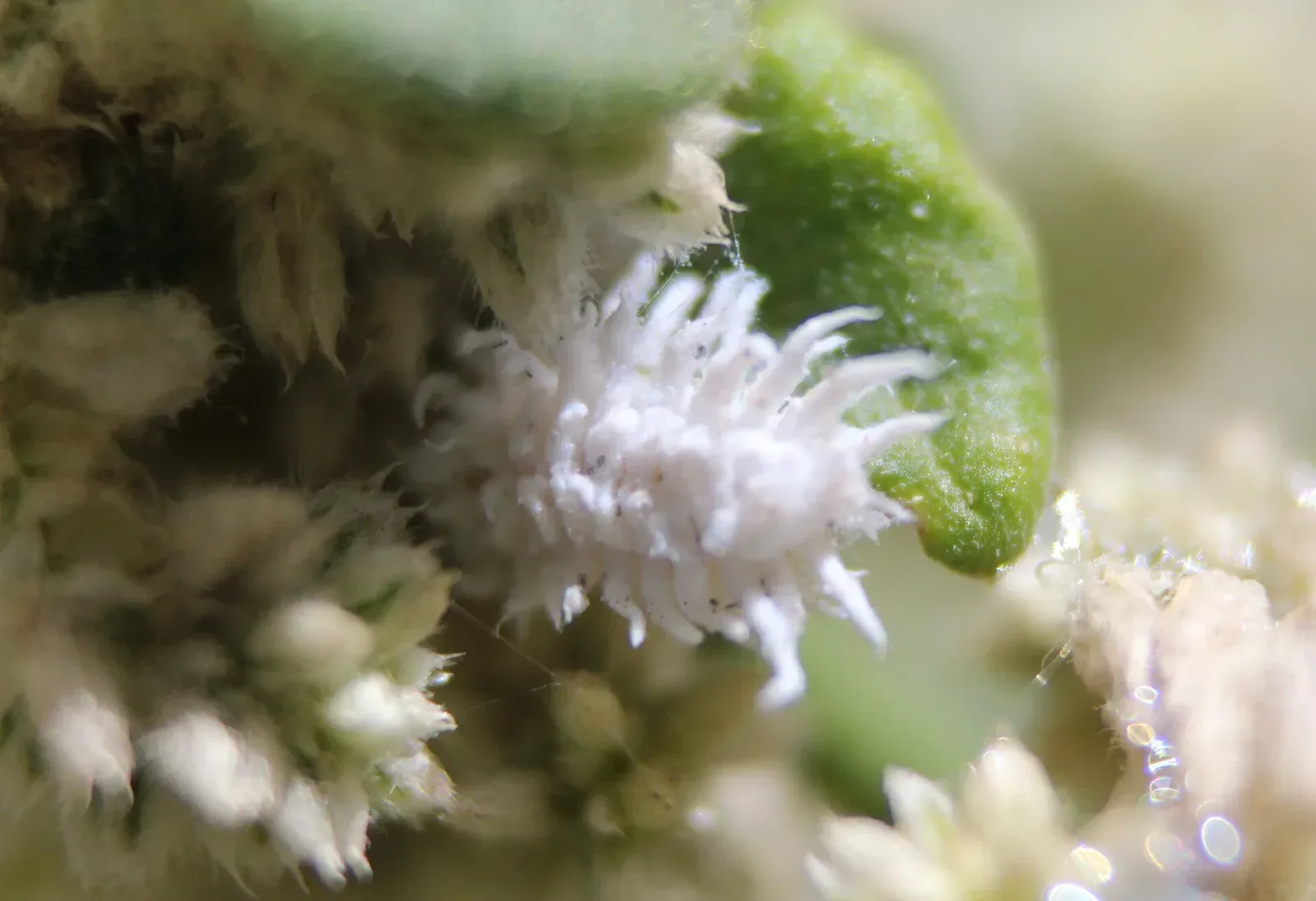
- A larva that is noticeably bigger than the mealybugs around it, with longer, curly wax spikes, and that walks about, is probably a mealybug destroyer. Leave it.
- Other ladybirds, lacewings, small parasitic wasps and spiders also feed on mealybugs. In the Navsari study on hibiscus, two predators were found eating them, including the larva of a small butterfly.
- Broad-spectrum insecticide sprays kill these allies along with the pest. The University of California IPM programme advises avoiding them where natural enemies are working.
- For a large hibiscus hedge with a heavy attack, you can buy mealybug destroyer beetles. The National Institute of Plant Health Management (NIPHM), Hyderabad, lists them with a recommended release of 5 beetles or grubs per infested plant. ICAR-NBAIR, Bengaluru, and some state biocontrol labs and KVKs also supply them. Stop all insecticide sprays two to three weeks before release, as ICAR-NRC Grapes and NCIPM advise, and deal with ants first.
What about chemical insecticides?
Older Indian bulletins on mealybugs, written for farm crops such as grapes and cotton, list strong insecticides at field rates. Several of these are not meant for home gardens, and some are now restricted. The University of California IPM programme notes that home garden insecticides are not very effective against mealybugs, and that systemic products should be avoided on flowering plants where possible because of their effect on bees and natural enemies.
For a garden hibiscus, the steps above are usually enough. If you have a large hedge or a commercial planting with a severe, spreading attack, ask your local KVK or state agriculture department which product is currently approved for that use, and follow the label exactly.
How to stop mealybugs coming back
- Check new plants before they join the rest. Look under leaves, at the tips, and around the base and pot rim. Keep a new plant apart for two to three weeks and check it again.
- Keep nitrogen in check. The University of California IPM programme notes that heavy nitrogen feeding with regular watering produces the soft new growth where mealybugs like to feed and lay eggs. See our rose plant fertilizer guide for how to feed flowering shrubs without overdoing nitrogen.
- Prune to open up crowded bushes so you can see inside and sprays can reach.
- Clean pots, stakes and ties before reusing them. Egg sacs can stick to them.
- Check nearby host plants too. NCIPM lists okra, guava, custard apple, citrus, tomato, brinjal, rose, chrysanthemum and croton among the many hosts of these mealybugs, so a colony on your bhindi, guava, lemon or rose can move back to the hibiscus. Mogra and other shrubs close by are worth checking too.
- Look under the soil if a potted hibiscus keeps declining for no clear reason. Some mealybugs feed on roots and show up as white, waxy patches on the roots and inside the pot wall when you tip the plant out.
When to cut your losses
If a branch is covered in mealybugs and badly twisted, cut it off and bin it rather than trying to save it. If a small potted plant is covered from top to bottom, including the roots, it is often easier to take a few clean cuttings from healthy shoots, check them carefully, and discard the rest. Hibiscus roots readily from cuttings, so you lose less than you might think.
For other pests you may meet on the same plants, see 7 common houseplant pests and thrips.
Watch: the mealybug life cycle
This short English video from Koppert, a biological pest control company, shows each stage of a mealybug in close-up: the egg sacs, the mobile crawlers, the settled nymphs and the winged males. Seeing the crawlers helps explain why one round of treatment is never enough. It is not specific to hibiscus or India.
Sources
- ICAR-National Centre for Integrated Pest Management, New Delhi: Mealybugs and their management, Technical Bulletin 19 (species identification, biology, hosts, ants, cultural and biological control).
- University of Florida IFAS Extension: Pink hibiscus mealybug, Featured Creatures EENY-029 (damage on hibiscus, bunchy top, natural enemies).
- University of California Statewide IPM Program: Mealybugs, Pest Notes for home and landscape (water sprays, alcohol, soaps and oils, nitrogen, natural enemies, insecticides).
- National Institute of Plant Health Management, Hyderabad: biocontrol agents list (Cryptolaemus montrouzieri release rate).
- ICAR-National Research Centre for Grapes, Pune: Australian ladybird beetle, production and use.
- Mandal, Bhowmik and Chatterjee (2014), Journal of Entomological Research 38(3): seasonal abundance of cotton mealybug on china rose in West Bengal.
- Arve, Chavan, Patel and Vidhate, Madras Agricultural Journal 100: biology and population dynamics of Phenacoccus solenopsis on hibiscus in south Gujarat.
- Sreedevi and others, ICAR-CRIDA (2013), PLOS ONE: temperature thresholds of Phenacoccus solenopsis on hibiscus.

Comments
No comments yet — share what worked in your climate.