
Banana leaves turning yellow is normal when only the oldest, lowest one or two leaves yellow and dry while new leaves keep coming out healthy. Banana plants shed old leaves all the time. Look closer if many leaves yellow at once. Orange-yellow old leaves with scorched edges suggest potassium shortage. Yellow streaks in the leaf stalks of lower leaves, with leaves collapsing around the stem, suggest Panama wilt. Spots that merge into dead patches point to Sigatoka leaf spot, and short, narrow, bunched new leaves point to bunchy top virus. Cold below about 12°C and waterlogging also yellow the leaves.
Quick diagnosis by pattern
| What you see | Likely cause |
|---|---|
| Only the oldest one or two leaves yellow and dry; new leaves healthy | Normal leaf ageing |
| Older leaves orange-yellow, scorched along the margins, midribs curving | Potassium shortage |
| Yellow in the middle of the leaf blade and along the midrib, margins still green; purple mottling on leaf stalks | Magnesium shortage |
| All leaves pale green; midribs and stalks pinkish | Nitrogen shortage |
| Young leaves yellow or white | Iron or sulphur shortage |
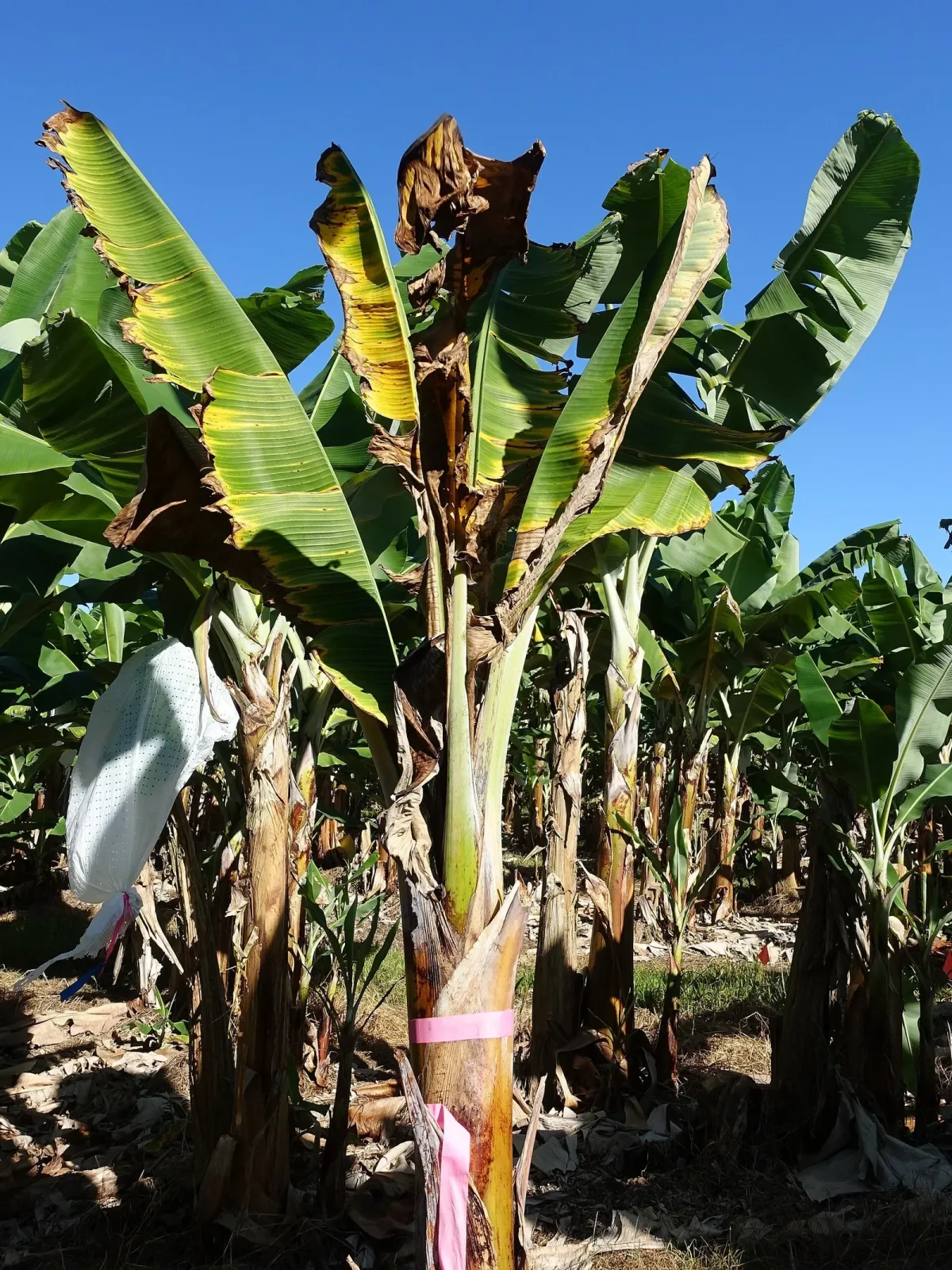
| Faint yellow streaks in leaf stalks of the oldest leaves, then progressive yellowing; leaves collapse at the stalk and hang around the stem; split outer sheath | Panama wilt (Fusarium) |
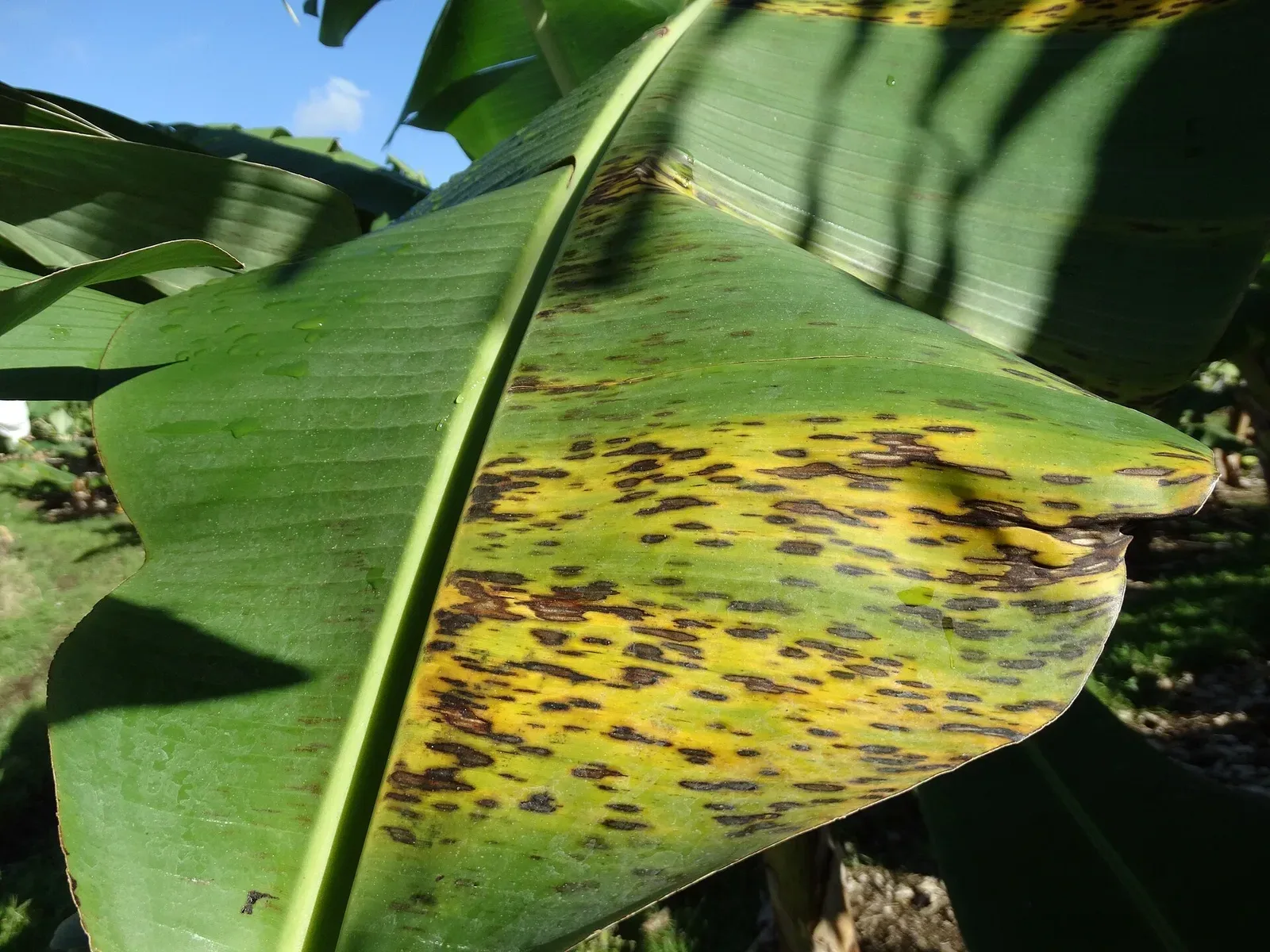
| Small yellowish spots that become oval, brown, then grey-centred; merging into dead areas | Sigatoka leaf spot |
| New leaves short, narrow, upright and bunched; dark green dots or streaks; margins rolled up and yellow | Bunchy top virus |
| General yellowing, stunting, plants topple in light wind | Root nematodes or weevil |
| Yellowing after a cold spell or after long waterlogging | Cold or wet-root stress |
The nutrient symptoms follow the National Horticulture Board's banana disorder sheet; disease symptoms follow NHB and the national IPM package for banana (NCIPM/TNAU).
Nutrient shortages
Banana is a heavy feeder, especially for potassium. NHB notes potassium is needed continuously, particularly at the finger-filling stage. In pots or small beds, nutrient shortage is common.
- Potassium: NHB describes orange-yellow old leaves, scorching along the margins, smaller leaves and curving midribs, with delayed flowering and lower yield.
- Magnesium: yellow in the middle of the leaf and along the midrib while margins stay green, with purple mottling of leaf stalks.
- Nitrogen: all leaves pale green, with pinkish midribs and leaf sheaths.
- Iron: young leaves yellow or white.
Feed with compost or well-rotted manure plus a balanced fertiliser, and get soil tested if yellowing persists. We do not give fertiliser rates here; ask your KVK or follow a soil test recommendation. Banana peel compost adds some potassium; see our banana peel fertiliser guide for what it can and cannot do.
Panama wilt (Fusarium wilt)
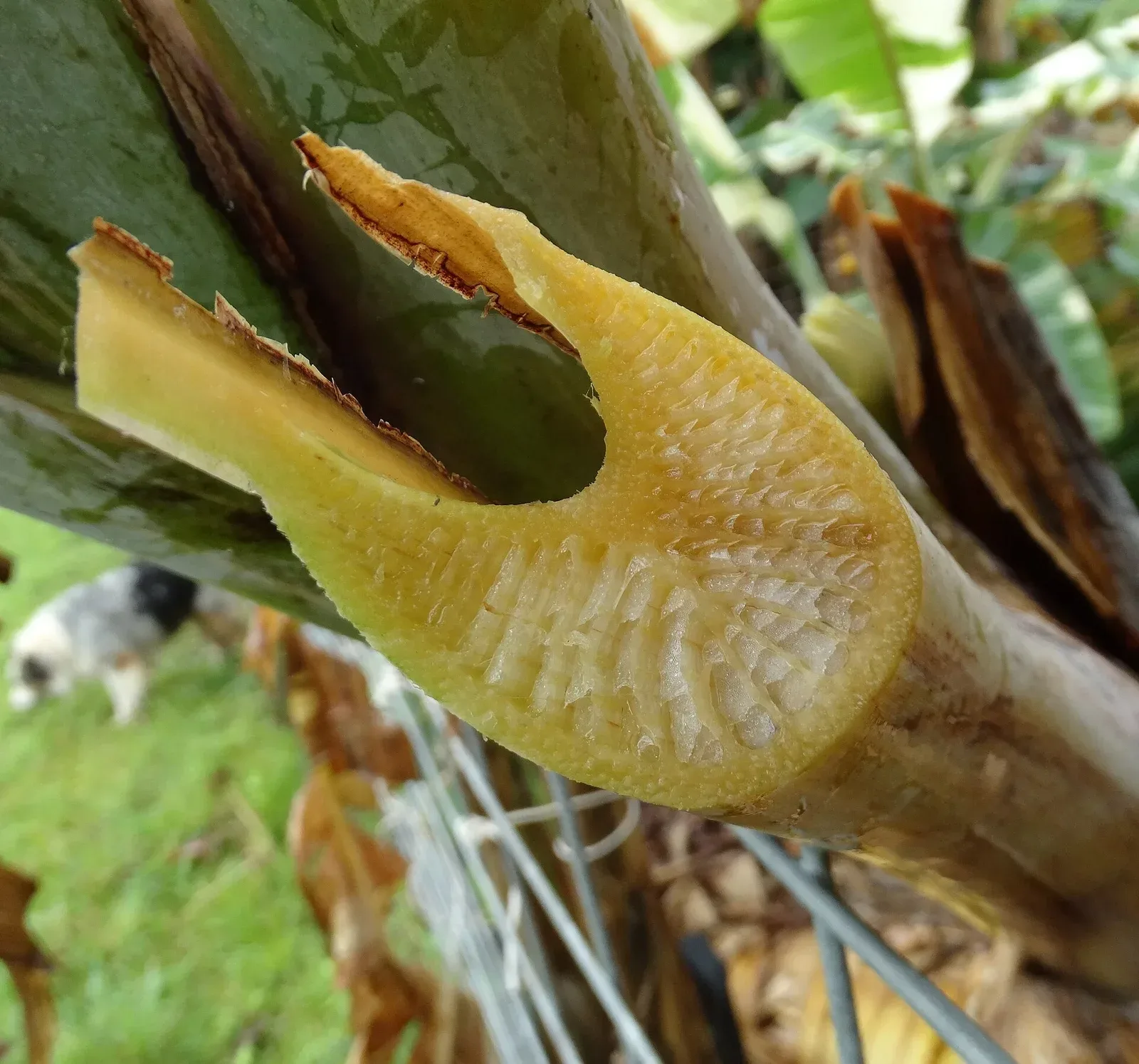
NHB describes Panama wilt as a soil-borne fungal disease that enters through the roots and is most serious in poorly drained soil. TNAU's IPM package says the first sign is faint yellow streaks in the leaf stalks of the oldest leaves. The old leaves then yellow progressively and collapse at the stalk, hanging around the pseudostem, until often only the youngest heart leaf stands upright. Sometimes leaves collapse without yellowing. The outer leaf sheath may split lengthwise. Cut the pseudostem across near the base: yellowish to reddish-brown streaks inside, darker towards the corm, strongly suggest Panama wilt. Ask your KVK or a plant clinic to confirm before you remove a large plant, because only a lab test is conclusive.
There is no cure for an infected plant. NHB advises uprooting and burning severely affected plants and not replanting banana in that soil for at least 3 to 4 years. Use disease-free suckers or tissue-culture plants, and resistant varieties where available. Look-alike: potassium shortage yellows old leaves too, but has scorched margins and no internal streaks.
Bunchy top virus
Spread by the banana aphid and through infected suckers. TNAU's IPM package describes short, narrow, brittle leaves bunched into a rosette, with dark green dots or streaks and upward-rolled margins; plants rarely grow beyond 2 to 3 feet and do not fruit. The only answer is to remove infected plants, roots and all, as soon as you see them, and to plant virus-free material. TNAU advises rogueing infected plants before any aphid control.
Sigatoka leaf spot
NHB describes yellow Sigatoka as starting with light yellowish spots that enlarge, become oval and brown, and then die in the centre, turning grey with a brown ring. Spots merge and kill large parts of the leaf. It spreads in the rainy season above about 21°C. TNAU links severe outbreaks to close spacing, poor drainage, poor sanitation and lack of rotation. Remove badly spotted leaves, improve drainage and air flow, and ask your KVK about approved sprays for heavy infections.
Cold and water stress
NHB gives 15 to 35°C as banana's comfortable range and notes chilling injury below 12°C. In North Indian winters, leaves often yellow and brown in December and January, and the plant recovers in spring if the growing point is healthy. Banana also dislikes waterlogged roots, which yellow the leaves and favour Panama wilt. Plant on a slight mound or in a large, free-draining container.
What to expect in your region
| Region | Usual planting time | Yellowing to watch for |
|---|---|---|
| Northern plains | After the winter cold has passed | Leaves yellow and brown in December and January when nights drop below about 12°C (NHB). New leaves should come out healthy in spring. |
| Maharashtra and the Deccan | June to July (kharif) or October to November (rabi), per NHB | Waterlogged roots after heavy monsoon rain; potassium shortage on fast-growing plants |
| Tamil Nadu | February to April and November to December (NHB); the state agriculture department gives February to April for wetland and January to February or November to December for garden land | Sigatoka in warm, wet spells |
| Kerala and the humid coast | April to May for a rainfed crop; August to September with irrigation (NHB) | Sigatoka leaf spot, which NHB says spreads in the rainy season above about 21°C |
| Hills | Spring, after frost | NHB notes banana grows up to about 2,000 m, but at higher altitudes only a few varieties such as Hill banana do well. Expect cold damage on other types. |
Pets
ASPCA lists banana (Musa acuminata) as non-toxic to dogs, cats and horses.
Watch: nutrient deficiency symptoms in banana
A video showing micronutrient deficiency symptoms on banana leaves.
Related pages
Sources
- Tamil Nadu Department of Agriculture: Cropping season for major horticulture crops (Tamil Nadu planting seasons for banana, papaya, pomegranate, tomato, brinjal, okra, gourds and drumstick). Accessed 10 Nov 2026.
- National Horticulture Board: Banana disorders and nutrient deficiencies (nitrogen, potassium, magnesium, iron and other deficiency symptoms). Accessed 10 Nov 2026.
- National Horticulture Board: Banana diseases (Panama wilt symptoms and control; Sigatoka symptoms and conditions). Accessed 10 Nov 2026.
- National Horticulture Board: Banana model project report (15 to 35°C; chilling injury below 12°C; continuous potassium need). Accessed 10 Nov 2026.
- NCIPM / TNAU: IPM package for banana (revised 2011) (Panama wilt early signs; bunchy top symptoms; Sigatoka risk factors; nematode yellowing; rogueing). Accessed 10 Nov 2026.
- ASPCA: Banana (non-toxic to dogs, cats and horses). Accessed 10 Nov 2026.


Comments
No comments yet — share what worked in your climate.