
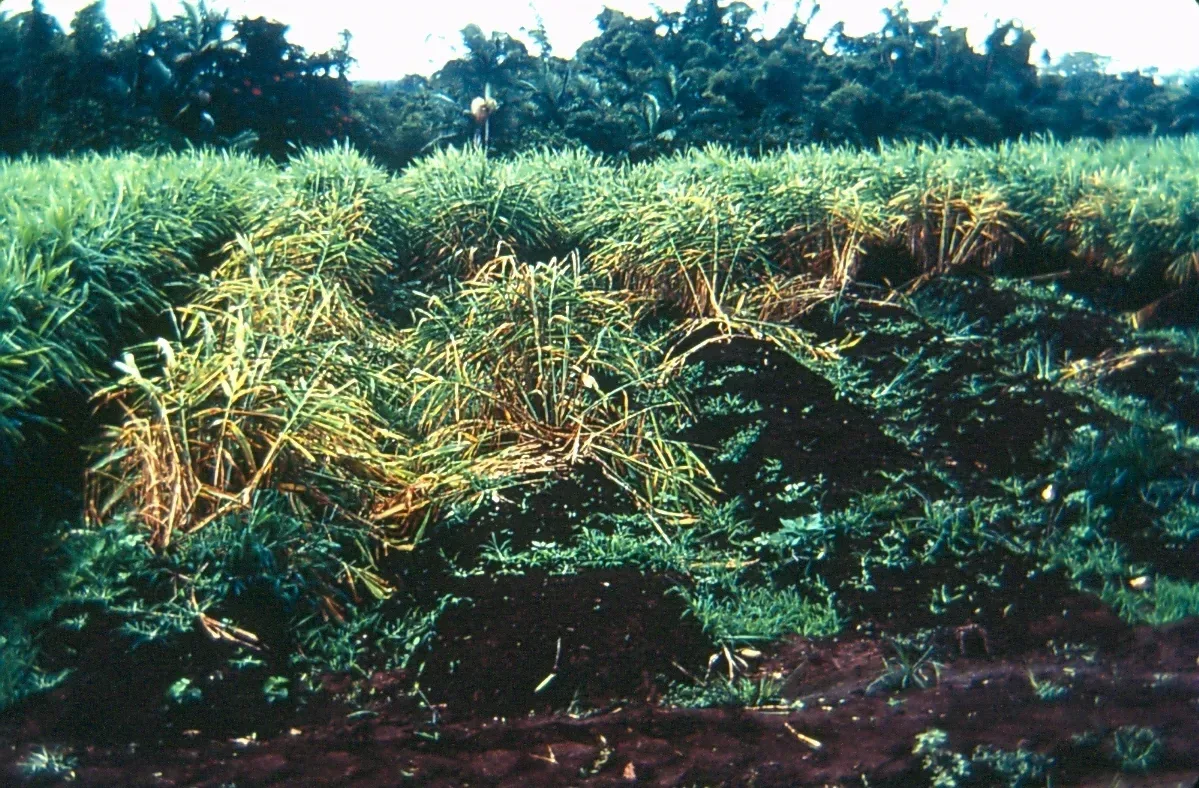
Ginger leaves turning yellow is normal if the plant is about 7 to 8 months old and the whole clump is yellowing and drying evenly; that means the rhizomes are mature and ready to harvest. Yellowing during the monsoon, starting on the lower leaves and spreading upwards, with a soft, water-soaked or foul-smelling base, points to soft rot or bacterial wilt. A single yellow central shoot with a hole and droppings points to shoot borer. Check the collar (where stem meets soil) and the rhizome before deciding.
Step 1: How old is the plant?
ICAR-IISR says ginger reaches full maturity 210 to 240 days after planting, when the leaves turn yellow and start drying. TNAU gives 8 to 9 months. If you planted in April or May and the leaves are yellowing in December or January, that is most likely maturity. Stop watering for a few weeks and harvest.
Step 2: Look at the pattern and the collar
| What you see | Likely cause | Check |
|---|---|---|
| Whole clump yellows and dries evenly after 7 to 8 months | Normal maturity | Rhizomes firm, plump and clean |
| Lower leaf margins yellow first while the middle stays green; spreads upward; stems droop | Soft rot (Pythium) | Collar water-soaked and soft; rhizome rotten and foul-smelling; no milky ooze |
| Lower leaves droop and curl at the edges, then severe yellowing and wilting | Bacterial wilt (Ralstonia) | Dark streaks inside the stem; milky ooze when pressed; ooze test in water |
| Central shoot of one stem yellow and dry | Shoot borer | Bore hole in the stem with droppings coming out |
| White spots with dark brown margins and yellow halo on leaves | Leaf spot (Phyllosticta) | Spots spread in rainy spells; worse in full exposure |
| Plant stunted, pale, few shoots | Nematodes, poor soil or waterlogging | Galls or brown lesions on roots |
These descriptions follow the ICAR-IISR ginger extension pamphlet and TNAU's ginger disease pages.
Soft rot (rhizome rot)
IISR calls soft rot the most destructive disease of ginger. It is caused by soil-borne Pythium species, which multiply as soil moisture builds up with the southwest monsoon. Young sprouts are most at risk. Infection starts at the collar, which becomes water-soaked, and spreads into the rhizome, which rots with a characteristic foul smell. Leaves yellow from the margins of the lower leaves first, then the whole plant yellows, droops and dries.
The disease is also carried in seed rhizomes, so planting store-bought ginger with hidden infection is a common way it starts in home gardens.
Bacterial wilt
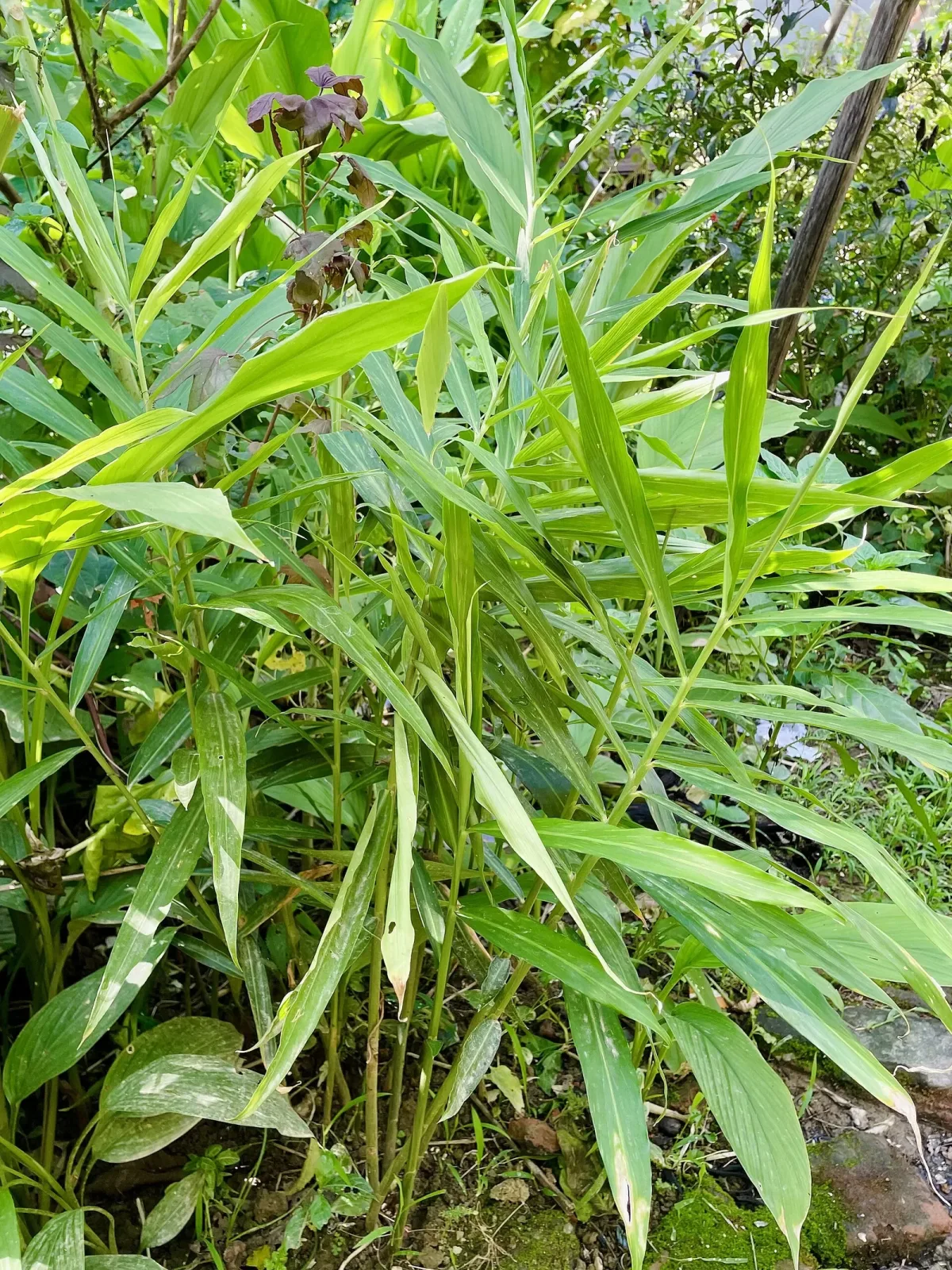
IISR describes bacterial wilt (Ralstonia solanacearum) as a soil- and seed-borne disease of the monsoon months. The first sign is mild drooping and curling of the lower leaf margins, followed by severe yellowing and wilting. The inner tissue of affected stems shows dark streaks, and pressing a stem or rhizome gently squeezes out milky ooze. Rhizomes eventually rot with a foul smell.
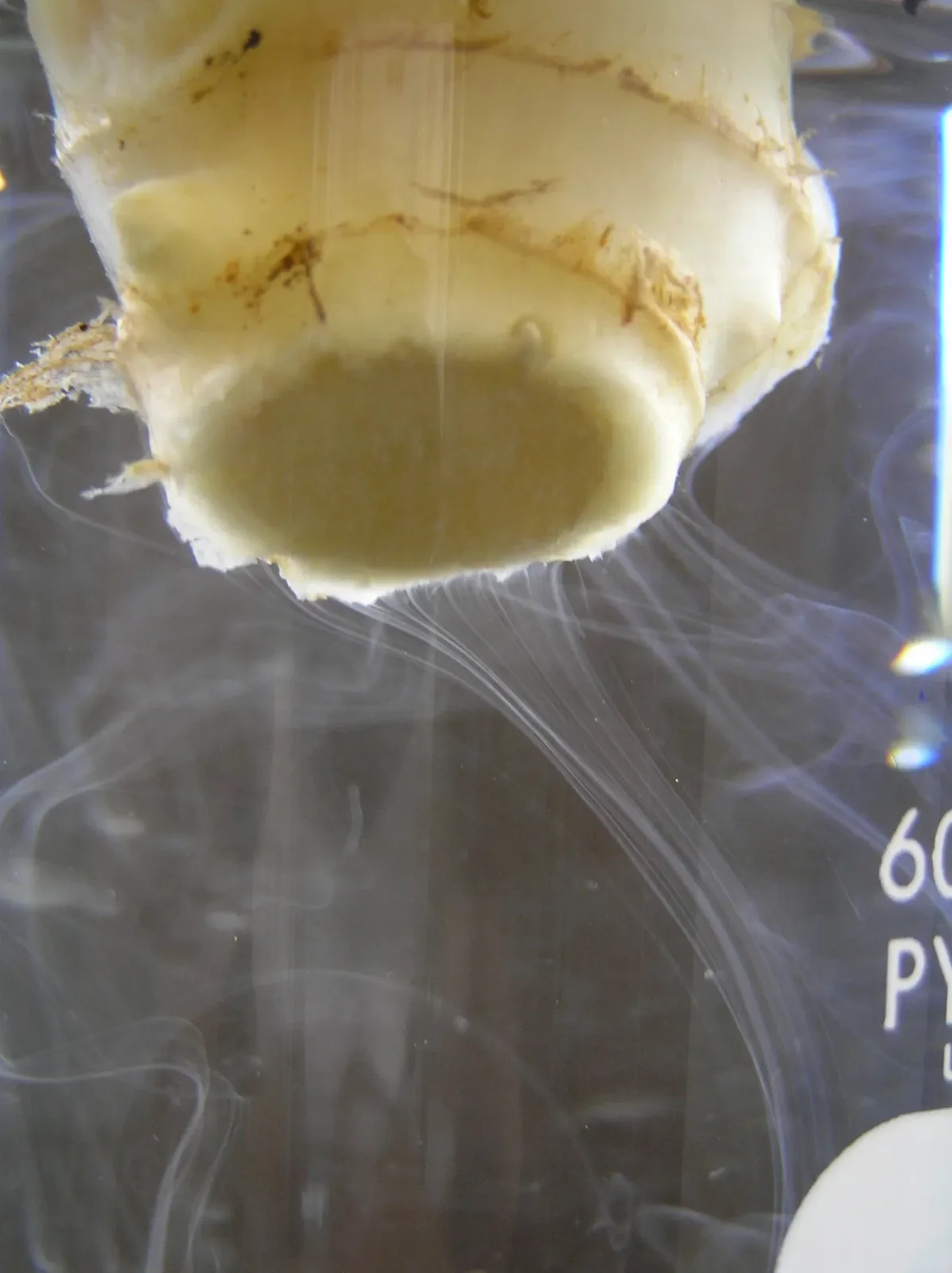
The ooze test: cut a short piece from the base of an affected stem and hang it in a glass of clear water. Milky threads streaming out within minutes suggest bacterial wilt. This is a field indicator, not a lab confirmation.
What to do
If it is soft rot or bacterial wilt
- Remove the affected clump with its surrounding soil, without spilling soil onto healthy plants. Bag it and put it in the bin or burn it; do not compost it.
- In pots, discard the soil from affected pots and do not reuse it for ginger, turmeric, tomato or potato.
- Improve drainage. IISR stresses that standing water predisposes ginger to infection.
- For bigger plots, IISR and TNAU recommend specific fungicide or copper drenches. These need correct current dosing; ask your KVK, and follow the label. We do not give doses.
Prevention next season
- Use seed rhizomes from a disease-free source. IISR says the diseases are seed-borne.
- Plant in raised beds or pots with free-draining mix.
- Do not plant ginger in the same soil year after year, and avoid soil used for potato or other solanaceous crops (IISR advice for bacterial wilt).
- IISR recommends neem cake and Trichoderma harzianum in the soil, and soil solarisation (covering moist soil with clear plastic for several weeks in summer) before planting.
- Mulch with dry leaves or straw, which IISR recommends for ginger.
If it is shoot borer
IISR calls the shoot borer the most serious insect pest of ginger, with numbers highest in September and October. Cut and destroy freshly infested shoots (with the bore hole and yellow central shoot) every couple of weeks from July to August. Ask your KVK about approved sprays if damage is heavy.
Planting time by region
| Region | Planting time | Source |
|---|---|---|
| West Coast (Kerala, Karnataka coast) | First fortnight of May with pre-monsoon showers; February to March with irrigation | ICAR-IISR |
| Uttarakhand | April to May | GB Pant University |
| Northeast (Assam, Meghalaya, Arunachal) and Odisha | Major ginger-growing states (IISR). We did not find planting months for them in the sources we checked; ask your state university or KVK | ICAR-IISR (states only) |
| Other regions | Plant with the first pre-monsoon showers, as IISR describes for the West Coast; check with your state university or KVK | Inferred from IISR |
IISR notes early planting with summer showers in February to March gives higher yield and less disease.
Watch: soft rot of ginger
A podcast from ICAR Research Complex for NEH Region, Umiam, on soft rot in ginger.
Related pages
- Ginger (adrak) and turmeric (haldi)
- Yellow leaves
- Root rot and stem rot
- Turmeric rhizome rot symptoms
Sources
- ICAR-IISR, Kozhikode: Ginger (extension pamphlet) (planting season; soft rot, bacterial wilt, leaf spot, nematode and shoot borer symptoms; prevention; maturity at 210 to 240 days). Accessed 10 Nov 2026.
- TNAU Agritech Crop Protection: Ginger diseases (soft rot leaf symptoms). Accessed 10 Nov 2026.
- TNAU Agritech: Ginger (harvest at 8 to 9 months when leaves yellow and dry). Accessed 10 Nov 2026.
- GB Pant University of Agriculture and Technology: Kharif season advisory 2020 (ginger April to May). Accessed 10 Nov 2026.


Comments
No comments yet — share what worked in your climate.