
| ☀️ Light | Full sun |
|---|---|
| 💧 Water | Moderate (lightly moist) |
| 🪴 Soil | Deep, rich, well-drained soil heavily amended with compost or well-rotted manure; tolerates a wide pH range; avoid low spots where water stands |
| 🌡️ Temp | Min -40°C |
| 🐾 Safety | Cats: toxic · Dogs: toxic (ASPCA Animal Poison Control) |
| 📏 Mature size | 1.3 m |
Where It Grows & Climate Tolerance
Pet & Companion Animal Toxicity (Rhubarb)
Long-lived perennial vegetable hardy to zone 2-3 that needs Canadian winters. Pull stalks from May to early July. The leaves are poisonous.
Care instructions
Care Guide & Maintenance Routine
Full sun, deep rich soil, compost each spring, 3 cm water a week. No harvest year 1, light year 2, full from year 3 (stop by early July). Remove flower stalks. Leaves are poisonous.
Light & Sunlight
Full sun (6+ hours) for thickest stalks; tolerates partial shade
Watering Schedule
Moderate: about 3 cm a week in dry spells, especially in spring
Potting Mix & Drainage
Deep, rich, well-drained soil heavily amended with compost or well-rotted manure; tolerates a wide pH range; avoid low spots where water stands
Temperature & Humidity
Zone 2-3 (Mossfield, Alberta; GrowersGuide.ca citing Natural Resources Canada zones); Kwantlen Polytechnic University: zone 3 (-40 to -34 C)
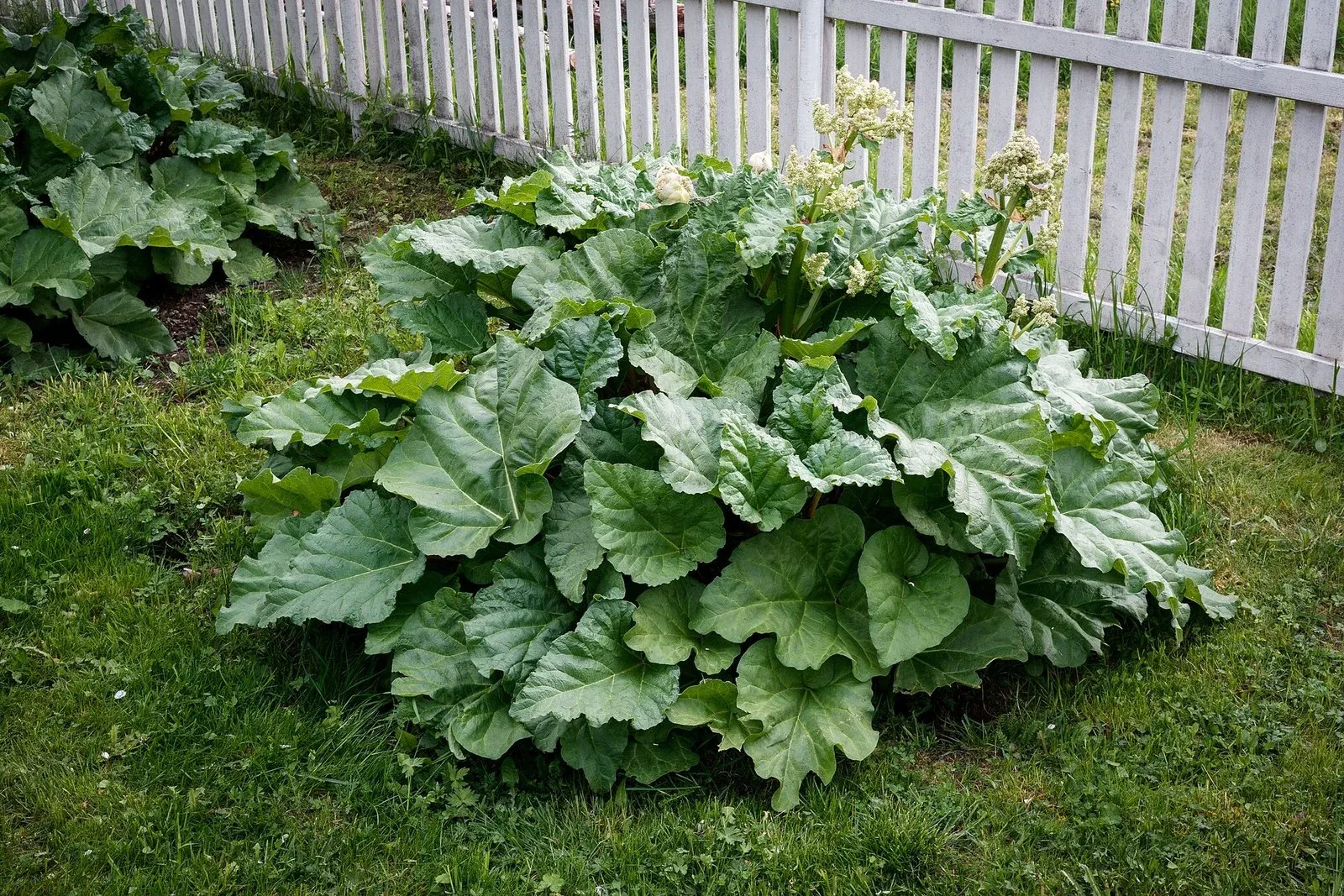
Rhubarb (Rheum rhabarbarum) is the definitive cold-climate perennial vegetable, and the reason is simple: it needs what a Canadian winter offers. The plant needs a long spell below about 4 C to break dormancy and produce a full spring crop, which is why it does so well on the Prairies and struggles where winters are mild. It is hardy to zone 2-3 and forms a crown 1-1.5 m across with enormous heart-shaped leaves on thick fleshy stalks, red, pink or green depending on the variety. A well-sited crown produces for decades with little attention.
Safety first: the leaves are poisonous
Rhubarb leaf blades contain soluble oxalates and are poisonous to people and animals, causing cramps, vomiting and, in serious cases, kidney damage. The ASPCA lists rhubarb as toxic to dogs, cats and horses (kidney failure, tremors, salivation). Only the stalks are eaten. Twist the blades off at harvest and compost them where animals cannot reach them.
Planting
Plant crowns in late April or early May as soon as the soil is workable, or in late September so the roots settle before freeze-up. Plant in full sun (it still produces in partial shade) in deep, rich, well-drained soil heavily amended with compost or well-rotted manure, because the crown stays put for decades. Avoid low spots where water stands, as crown rot is the main killer. Space crowns 90-120 cm apart.
Harvest rules
Take no stalks in the first year, a few in the second and a full harvest from the third year. Pull stalks (grip low and twist slightly) rather than cut them, and never take more than about a third of the stalks at once. Pull from mid to late May through June and stop by early July so the crown can rebuild its reserves.
Care
Water deeply in dry spells, about 3 cm a week, especially through the spring growth surge. Mulch generously with compost each spring. Remove flower stalks the moment you see them, cutting as low as you can, since flowering costs the crown much of the season's growth. Let leaves stand until frosted in autumn, then clear dead foliage after freeze-up. Divide every five years or so, in early spring before growth starts, or sooner when stalks get thin and numerous.
Stalks are very sour raw and are usually stewed, baked or made into jam, jelly or sauce.
Seasonal rhythm
Seasonal Calendar
A month-by-month calendar for Rhubarb in Canada is coming soon. See the light, water and temperature notes above.
Diagnostics
Common Problems & Troubleshooting
- Thin, sparse stalks | Cause: Overcrowding, over-harvesting or lack of winter chill | Fix: Divide about every five years, never take more than a third of the stalks at once - Flower stalk (bolting) | Cause: Natural flowering, which costs the crown much of the season's growth | Fix: Cut the flower stalk out as low as you can reach, as soon as you see it - Crown rot | Cause: Standing water or a cut stub left at harvest | Fix: Avoid low spots, pull stalks rather than cutting, clear dead foliage after freeze-up
Q&A
Frequently Asked Questions
Can I eat rhubarb leaves?
No. The leaf blades contain oxalates and are poisonous to people and animals. Eat only the stalks.
When can I start harvesting rhubarb?
Take nothing in the first year, a few stalks in the second, and a full harvest from the third year. Stop by early July.
What do I do about the flower stalk?
Cut it out as low as you can as soon as you see it, because flowering weakens the crown.
How often should I divide rhubarb?
About every five years, or sooner if the stalks are getting thin and numerous.
Similar Botanical Matches
Keep exploring
Related plants
Grower field notes
Reader Field Notes in Canada
Share how this plant performs in your local Canada climate.