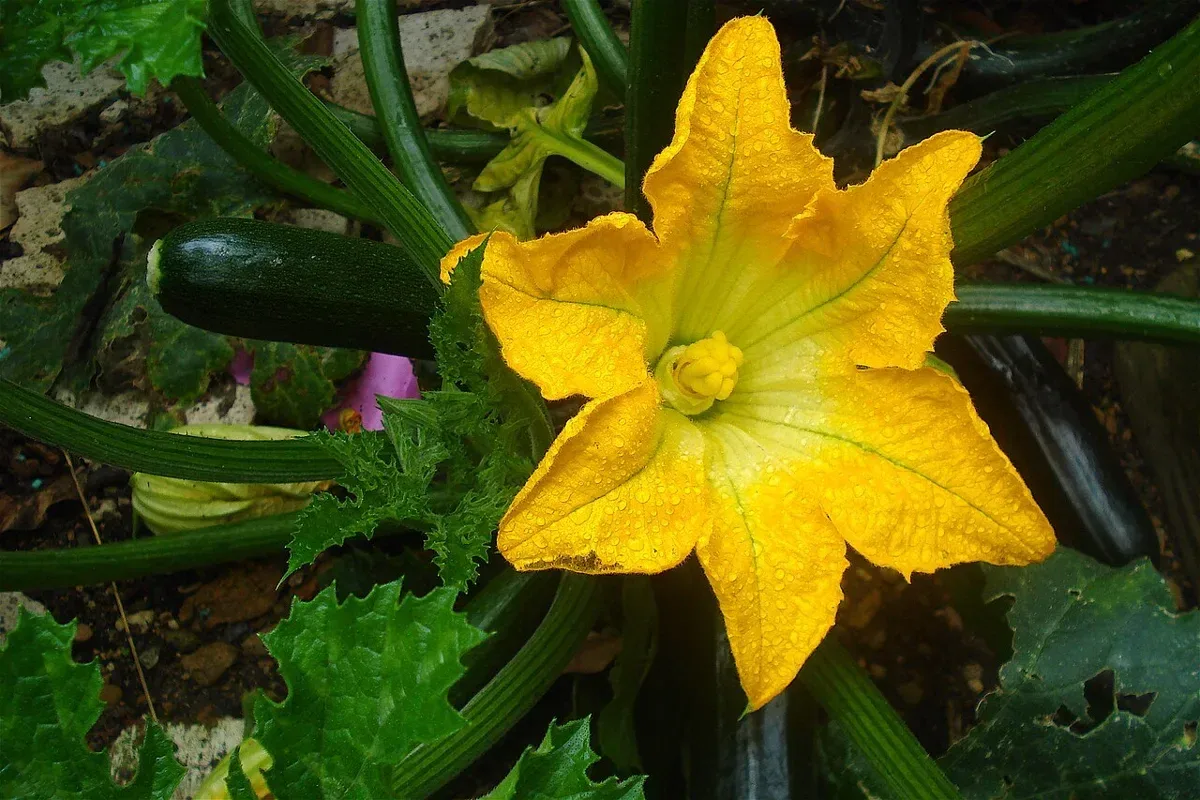
| ☀️ Light | Full sun |
|---|---|
| 💧 Water | High (consistently moist) |
| 🪴 Soil | Rich, moist, well-drained soil with plenty of compost |
| 🌡️ Temp | 10°C – 32°C |
| 🐾 Safety | Cats: toxic · Dogs: toxic (ASPCA Animal Poison Control) |
| 📏 Mature size | 60 cm |
Where It Grows & Climate Tolerance
Pet & Companion Animal Toxicity (How to Grow Zucchini (Chappan Kaddu) in India)
In India zucchini, sold as chappan kaddu, grows best in the mild months on the plains and in summer in the hills. ICAR-IARI and PAU have released varieties for northern India.
Care instructions
Care Guide & Maintenance Routine
Northern plains: sow mid-January to March in the open, or October to November under protection (PAU). Hills: sow after frost in spring. South: sow in the cooler months. Pick every two or three days. Avoid peak summer heat and heavy monsoon rain.
Light & Sunlight
The University of Saskatchewan notes zucchini needs full sun to produce well and does not tolerate shade. The RHS also recommends a warm, sunny position.
Watering Schedule
Large leaves lose a lot of water. Water deeply at the base two or three times a week in warm weather, more in pots. Avoid wetting the leaves, which encourages mildew.
Potting Mix & Drainage
Rich, moist, well-drained soil with plenty of compost
Temperature & Humidity
Frost kills plants, so open sowings in Punjab, Haryana and western UP wait until mid-January or later; low tunnels protect earlier crops. Above about 30°C in April and May flowers drop. Hills: plant after the last frost.
Chappan kaddu in Indian gardens
Zucchini was once found only in hotel kitchens in Indian metros. Today seed shops in Ludhiana, Delhi, Pune and Bengaluru sell it as chappan kaddu, and it grows well in a terrace grow bag through the cooler months. An ICAR Indian Horticulture note from IARI describes summer squash as grown in both hills and plains of India.
Sowing windows by region
- Punjab, Haryana, Delhi: PAU Ludhiana gives mid-January to March for open sowing, and October to November under protection. IARI notes off-season crops in naturally ventilated polyhouses from mid-October to mid-February and under plastic low tunnels from late November to mid-April in the North Indian plains.
- Uttar Pradesh and Bihar: follow the Punjab pattern, sowing in February once the coldest nights end.
- Himachal, Uttarakhand, Kashmir: sow from March to May after frost and pick through summer.
- Bengaluru, Pune, Hyderabad: sow from October to February. Bengaluru's mild winter suits it well.
- Chennai, Mumbai, Kolkata, Kochi: humid heat brings mildew and poor fruit set; November to January sowings give the best chance.
Varieties from Indian institutes
The IARI article notes that Australian Green and Pusa Alankar, both from IARI, have long cylindrical fruits, while consumers in the North Indian plains often prefer flattish round fruits of 70 to 80 g. IARI released Pusa Pasand as an early, heat tolerant round variety for spring-summer sowing in NCR Delhi, ready for first picking 45 to 50 days after sowing. PAU's Punjab Chappan Kadoo-1 is a bush type with disc-shaped green fruits, ready in about 60 days, with field resistance to downy mildew.
Spacing and picking
PAU sows two seeds per hill 45 cm apart on both sides of 1.25 m wide beds. It notes the first picking comes 60 to 80 days after sowing, that fruits are ready about 7 days after setting, and that pickings should be every 2 to 3 days. On a chhat, one plant per 45 to 50 litre grow bag is enough.
Heat, rain and beetles
PAU gives 18 to 30°C as the right range. By late April in Delhi or Jaipur flowers drop and leaves scorch. Monsoon humidity in Mumbai and Kolkata brings mildew and rot. The red pumpkin beetle, which PAU mentions for cucurbits, chews young leaves in spring; check plants daily in the first weeks.
Bees on a terrace
High-rise terraces see fewer bees, so many city growers hand-pollinate every morning with a small brush. Marigold or tulsi nearby can bring in pollinators.
Questions from Indian growers
- Can I grow zucchini in summer in Delhi? Only with Pusa Pasand or similar heat tolerant types sown in February, and the crop ends by May.
- Is the plant safe for our cat? ASPCA lists zucchini as non-toxic to dogs and cats.
Seasonal rhythm
Seasonal Calendar
| Month | Care Tasks | Seasonal Focus |
|---|---|---|
| Jan | sow, protect | Punjab and Haryana: open sowing from mid-month (PAU). Low tunnel crops cropping. |
| Feb | sow | Main sowing in Delhi, UP and Bihar. NCR: sow Pusa Pasand for spring. |
| Mar | harvest, protect | Bengaluru and Pune: pick winter crops. North: guard seedlings from red pumpkin beetle. |
| Apr | harvest, protect | North: peak picking from January sowings. Hills: sow after frost. |
| May | harvest, protect | Plains: crop ends in heat. Himachal and Uttarakhand: plant out and mulch. |
| Jun | harvest | Hills: picking every two or three days. Plains: rest beds. |
| Jul | harvest, protect | Hills: watch for mildew in monsoon. Plains: too wet. |
| Aug | protect | Konkan, Kerala and Bengal: no sowing. Hills: last pickings. |
| Sep | protect | Prepare raised beds with compost for the cool season. |
| Oct | sow | Deccan and Bengaluru: sow. North: polyhouse sowing from mid-month (IARI). |
| Nov | sow, protect | Punjab: sow under protection (PAU). Late month: low tunnel sowings in the North Indian plains. |
| Dec | harvest, protect | South: pick regularly. North: keep tunnels closed on cold nights. |
Diagnostics
Common Problems & Troubleshooting
Young fruits shrivelling from the tip after poor pollination; white powdery coating on leaves; oversized, seedy fruits if picking is missed; wilting at midday in heat; split or scarred fruits after wind or uneven watering.
Pests & seasonal watch: Red pumpkin beetle on seedlings in February and March in the north. Powdery mildew from March. Fruit fly and viruses in warm spells. Ask the local KVK before spraying.
- Yellow leaves — Leaves fade from green to yellow, often starting at the bottom.
- Drooping — Stems and leaves hang limp even though the plant was recently fine.
- Aphids — Clusters of small soft insects on new tips, often sticky.
- Whitefly — Tiny white insects fly up in a cloud when you touch the plant.
- White powder — A white powdery film on leaves, usually in still, humid air with dry soil at the roots.
- Underwatering — Soil is bone dry and leaves are crispy, curled or dull.
Q&A
Frequently Asked Questions
What is the difference between zucchini and courgette?
None. Zucchini is the Italian-derived name used in North America and India; courgette is the French-derived name used in Britain. Both mean young fruits of bush summer squash, Cucurbita pepo.
Why do my zucchini fruits rot or shrivel when small?
Usually poor pollination. The female flower was not visited by bees, so the young fruit stops growing and shrivels from the tip. Hand-pollinate with a small brush in the morning.
How big should zucchini be when picked?
Most cooks prefer them at 15 to 20 cm long. PAU notes fruits are ready about 7 days after they set and recommends picking every 2 to 3 days.
How long does zucchini take to crop?
The University of Saskatchewan says most zucchini need 48 to 60 days to maturity. PAU gives 60 to 80 days to first picking, depending on variety and season.
Can I grow zucchini in a pot?
Yes, in a big one. Use at least 45 to 60 litres of rich mix per plant, water often and feed once fruits start.
What is the white powder on the leaves?
Powdery mildew is the most common cause, especially late in the season. Remove the worst leaves, keep plants well spaced and water the soil rather than the foliage.
Can I eat zucchini flowers?
Yes. Male flowers are usually picked for stuffing or frying, leaving a few for pollination. Pick in the morning when they are open.
Is zucchini safe for pets?
ASPCA lists zucchini as non-toxic to dogs, cats and horses.
Why are there flowers but no fruit?
Plants often make only male flowers for the first week or two. Female flowers follow. If they still do not set, hand-pollinate.
Similar Botanical Matches
Grower field notes
Reader Field Notes in India
Share how this plant performs in your local India climate.