
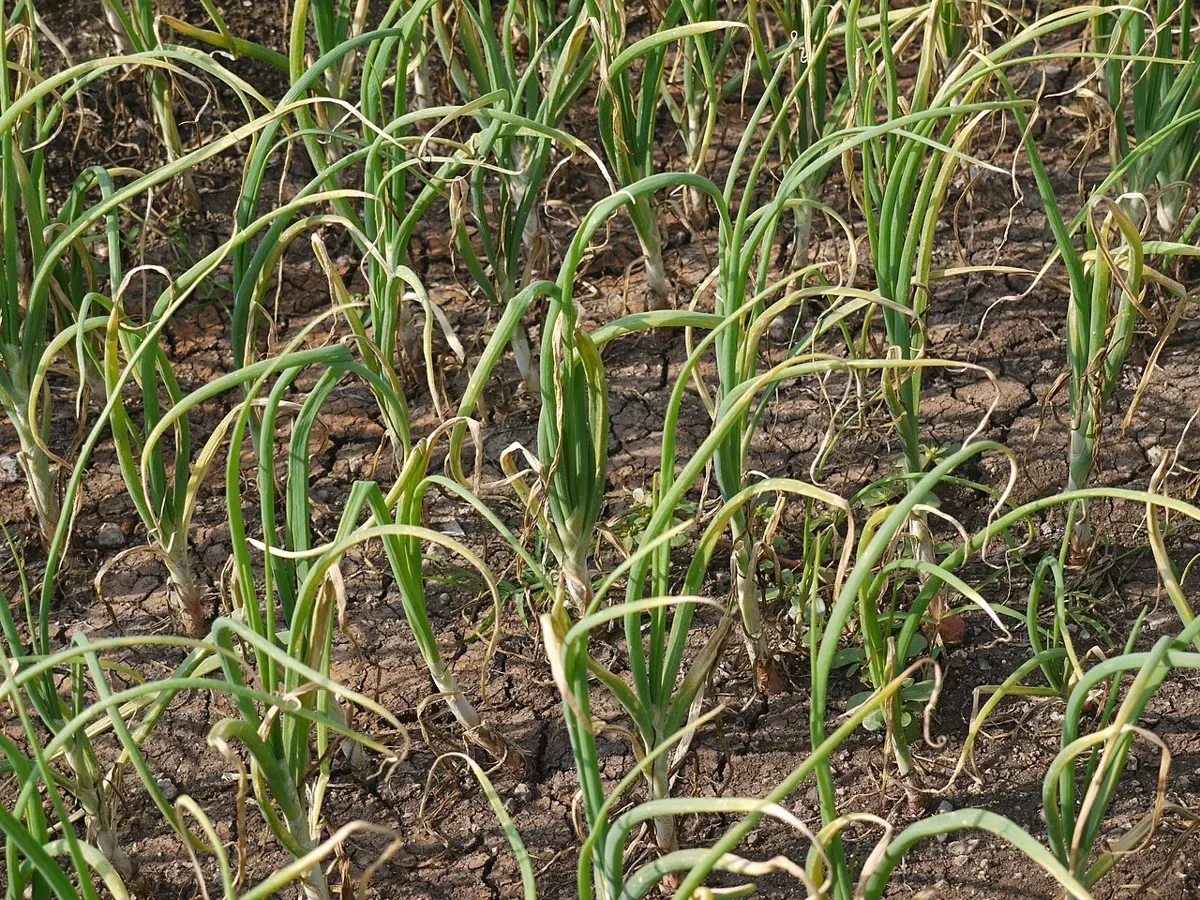
| ☀️ Light | Full sun |
|---|---|
| 💧 Water | Moderate (lightly moist) |
| 🪴 Soil | Fertile, loose, well-drained loam rich in organic matter |
| 🌡️ Temp | -5°C – 35°C |
| 🐾 Safety | Cats: toxic · Dogs: toxic |
| 📏 Mature size | 45 cm |
Where It Grows & Climate Tolerance
Pet & Companion Animal Toxicity (How to Grow Onion and Hara Pyaz in India)
Pyaz is grown in India in Rabi and Kharif seasons, with Rabi giving the main stored crop. Hara pyaz grows in pots through the cool months and with some care in summer too.
Care instructions
Care Guide & Maintenance Routine
Rabi: sow the nursery mid-October to mid-November and transplant mid-December to mid-January (PAU). Kharif: raise seedlings in June or plant bulb sets in late August. Water at 7 to 10 day intervals and stop two weeks before harvest. Sow hara pyaz in pots every three weeks.
Light & Sunlight
The RHS recommends a warm, sunny site. Bulb onions need full sun to size up. Spring onions accept a few hours of shade but grow thin in deep shade.
Watering Schedule
Onions have short roots and need steady moisture while leaves are growing. PAU advises stopping irrigation at least a fortnight before harvest so bulbs store longer. Waterlogged soil leads to bulb rot.
Potting Mix & Drainage
Fertile, loose, well-drained loam rich in organic matter
Temperature & Humidity
Cold spells in December and January on the northern plains can make young transplants bolt. Hot winds from late March speed maturity and give smaller bulbs. Hills: plant after frosts. Heavy monsoon rain rots Kharif bulbs in poorly drained beds.
Pyaz and hara pyaz in Indian gardens
India grows pyaz in two main seasons. The Rabi crop, raised through winter and lifted in April and May, gives the bulbs that are stored for months. A Kharif crop, grown through the rains and harvested from November, fills the gap in prices before the Rabi crop arrives. Maharashtra, around Nashik and Lasalgaon, is the best-known onion belt, and many gardeners in Karnataka, Madhya Pradesh, Gujarat and Rajasthan grow it at home too.
Rabi onion, region by region
- Punjab, Haryana, Delhi, western UP: PAU Ludhiana recommends sowing the nursery from mid-October to mid-November and transplanting from mid-December to mid-January, choosing large, healthy seedlings 10 to 15 cm tall.
- Rajasthan and Gujarat: nursery in October and November, transplanting in December. Dry heat in March finishes the bulbs early.
- Maharashtra, Karnataka, Telangana: Rabi nurseries go in after the rains end in October. IMD's normal withdrawal for Mumbai is 8 October.
- Bihar and Bengal: sow in November after the soil dries.
- Himachal, Uttarakhand, Kashmir: onions are grown as a spring and summer crop once frosts ease.
Kharif onion and bulb sets
PAU describes a bulb set method for Kharif. Seed is sown thickly in mid-March, and the small bulbs are lifted in the last week of June and stored in baskets in a dry, airy room. Sets of 1.5 to 2.5 cm are planted in the second half of August, and the crop is ready by the end of November. For a Kharif nursery, PAU recommends mid-June sowing under a straw shade 1.5 m high for the first month. It names Agrifound Dark Red as the Kharif variety.
Varieties
For Rabi in Punjab, PAU lists PRO-6 and PRO-7 (red), Punjab Naroya, Punjab White (suited to dehydration), PYO-102 (yellow), PWO-35 (white) and the hybrid POH-1. All Indian bulb varieties are short-day types. Imported long-day seed meant for Europe or Canada will not bulb well here.
Small onion in the South
In Tamil Nadu and parts of Karnataka, the small multiplier onion used in sambar, chinna vengayam, is planted from bulbs rather than seed and gives a cluster of small bulbs.
Hara pyaz on the balcony
Any pot 15 cm deep works. In Bengaluru and Pune it grows almost all year; in Delhi, Lucknow and Jaipur sow from September to February. In May and June shift the pot to morning sun only. In Mumbai, Chennai and Kochi during the monsoon, keep pots under a ledge and let the mix dry slightly between waterings.
Water and storage
PAU advises irrigation every 7 to 10 days and stopping at least a fortnight before harvest. After lifting, cure bulbs in shade and cut the leaves 1 to 2 cm above the bulb. Turn stored onions once a fortnight and remove injured ones, as PAU suggests.
Questions from Indian growers
- Can I use kitchen onions that have sprouted? Plant them for hara pyaz. They rarely give a good bulb.
- Our dog eats anything from the kyari. ASPCA lists onion as toxic to dogs and cats, so fence the bed.
Seasonal rhythm
Seasonal Calendar
| Month | Care Tasks | Seasonal Focus |
|---|---|---|
| Jan | Plant out | Punjab, Haryana, Delhi: finish transplanting Rabi seedlings by mid-month (PAU). |
| Feb | Fertilize, Protect from frost/heat | Second nitrogen dose four to six weeks after transplanting. Weed by hand. |
| Mar | Protect from frost/heat | Check for thrips on the plains. Mid-month: sow seed thickly for Kharif bulb sets (PAU). |
| Apr | Harvest, Protect from frost/heat | Rajasthan and Gujarat: bulbs mature. Stop irrigating two weeks before lifting. |
| May | Harvest | Main Rabi harvest in the north. Cure in shade and trim leaves 1 to 2 cm above the bulb. |
| Jun | Sow, Harvest | Mid-month: Kharif nursery under a straw shade. Last week: lift bulb sets and store. |
| Jul | Protect from frost/heat | Transplant Kharif seedlings into raised beds in Maharashtra and Karnataka. Turn stored onions. |
| Aug | Plant out | Punjab: plant Kharif bulb sets in the second fortnight. Hara pyaz pots under cover. |
| Sep | Protect from frost/heat | Drain Kharif beds after heavy rain. Sow hara pyaz in pots again as rains ease. |
| Oct | Sow | Mid-month onward: sow Rabi nursery beds in Punjab, Haryana and UP. |
| Nov | Sow, Harvest | Rabi nursery sowing ends mid-month. Kharif bulbs from August sets ready; sell or use as green onion. |
| Dec | Plant out, Harvest | Kharif crop lifted. Mid-month: start transplanting Rabi seedlings. |
Diagnostics
Common Problems & Troubleshooting
Bolting from cold stress or old sets; thick necks that rot in storage; small bulbs from crowding, weeds or the wrong day-length type; silvery streaked leaves from thrips; soft bulbs after late watering.
Pests & seasonal watch: Onion thrips peak in February and March on the plains and in dry spells of the Kharif crop. Purple blotch in humid weather. Bulb rot in waterlogged soil during the rains. Ask the local KVK before spraying.
- Yellow leaves — Leaves fade from green to yellow, often starting at the bottom.
- Brown tips — Leaf tips and edges turn dry, brown and papery.
- Root rot — Roots turn brown and mushy in soil that stays wet.
- Thrips — Silvery streaks and twisted new leaves, sometimes with black specks of frass.
- Leaf spot — Brown or tan spots with a yellow halo, sometimes with tiny dots in the centre.
- Overwatering — Soil stays wet, leaves yellow or droop, and the pot feels heavy.
- Nutrient shortage — Overall pale growth, or yellowing between veins, on a plant that is otherwise watered well.
Q&A
Frequently Asked Questions
Are spring onions and onions the same plant?
Often, yes. The RHS notes salad onions are varieties of Allium cepa or Allium fistulosum. Many spring onions are ordinary onions picked young; bunching types such as Welsh onion (A. fistulosum) never form a large bulb.
Should I grow onions from seed or sets?
The RHS says sets are the easiest and fastest route but are more prone to bolting, and heat-treated sets reduce that risk. Seed is cheaper and gives more choice of varieties but takes longer.
Why are my onions flowering?
That is bolting. PAU says very low temperatures at an early stage cause it. Snap off the flower stalk and use those bulbs first, since they will not store well.
When are onions ready to harvest?
NC State advises lifting when about two-thirds of the tops have fallen over. PAU says harvest when the tops dry and fall, after stopping irrigation about two weeks earlier.
How do I cure and store onions?
Dry bulbs in shade with good airflow for two to three weeks, as NC State suggests, then trim the leaves 1 to 2 cm above the bulb. Store in mesh bags or slatted crates in a dry, airy place and check them every couple of weeks.
What does day length have to do with onions?
Onions start forming bulbs when days reach a certain length. Short-day varieties suit tropical and subtropical latitudes; long-day varieties need the long summer days found further north. The wrong type gives small bulbs or none.
Can I regrow spring onions from the roots?
Yes, for a short time. Stand the white base with roots in a pot of mix and it sends up new leaves. The second crop is thinner, so sowing fresh seed gives better plants.
Are onions toxic to pets?
Yes. ASPCA lists onion as toxic to dogs, cats and horses. The compounds damage red blood cells, and cooked or dried onion is also harmful.
How far apart should onions be?
NC State gives about 15 cm for bulb onions in garden rows. PAU uses 15 cm between rows and 7.5 cm between plants in the field. Spring onions can be sown much closer, about 1 to 2 cm apart.
Similar Botanical Matches
Keep exploring
Related plants
Grower field notes
Reader Field Notes in India
Share how this plant performs in your local India climate.