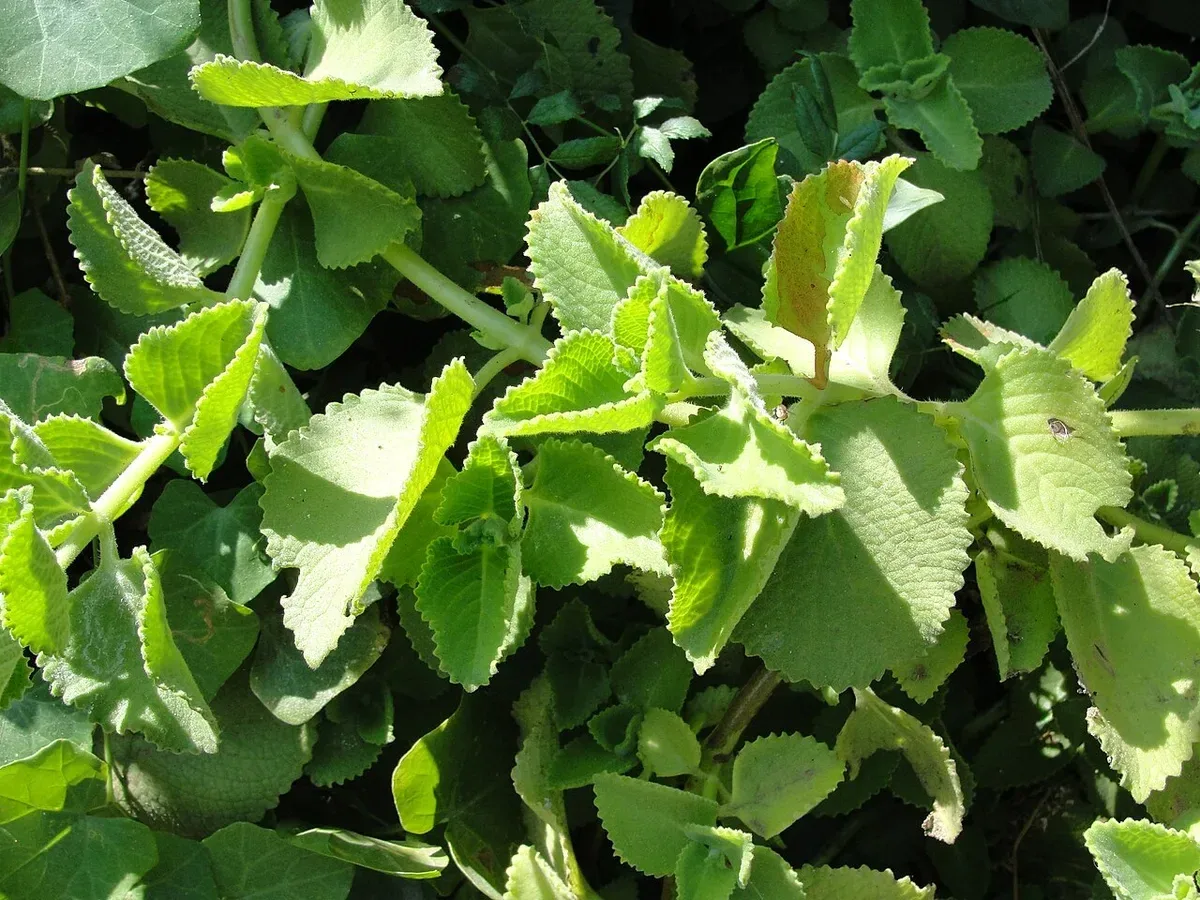
| ☀️ Light | Bright indirect light |
|---|---|
| 💧 Water | Low (allow soil to dry) |
| 🪴 Soil | Free-draining loam or potting mix with compost; near neutral pH |
| 🌡️ Temp | 10°C – 40°C |
| 🐾 Safety | Cats: toxic · Dogs: toxic |
| 📏 Mature size | 60 cm |
Where It Grows & Climate Tolerance
Pet & Companion Animal Toxicity (How to Grow Indian Borage (Ajwain Patta) in India)
Ajwain patta, also called karpooravalli and panikoorka, is a doorstep herb in homes across India. It grows almost all year in the south and on the coasts. On the northern plains it slows in winter and dies if nights drop near freezing, and anywhere it rots if the gamla stays wet in the monsoon.
Care instructions
Care Guide & Maintenance Routine
Grow in a gamla with sandy, well-drained mitti and morning sun. Water only when the top is dry, raise pots in the rains and trim rotting stems. In Delhi, Punjab and UP, move pots indoors or against a warm wall in December and January. Root spare cuttings every few months.
Light & Sunlight
NC State notes it likes hot, dry sites but needs protection from strong summer sun, which can burn the leaves. A review of the species in PubMed Central (PMC6274163) reports it tolerates both scorching sun and strong shade but grows best in partial shade. Morning sun with afternoon shade, or a bright window, suits it.
Watering Schedule
The PMC6274163 review advises watering sparingly: the fleshy stems and leaves store water, the plant copes with drought, and excess water in the soil makes the roots rot. Let the top few centimetres dry before watering.
Potting Mix & Drainage
Free-draining loam or potting mix with compost; near neutral pH
Temperature & Humidity
No frost tolerance. Below 10°C growth stops and leaves darken; near 0°C the plant dies. Frost-prone nights in Punjab, Haryana, Delhi, UP and the hills in December and January are the main cold risk. In May, loo winds and 45°C terraces scorch leaves.
Ajwain patta at home
The leaf smells like ajwain seed, hence the Hindi name, and a pot sits outside many kitchens. In Tamil Nadu and Kerala, karpooravalli and panikoorka leaves go into bajji, rasam and chutney. The plant is easy, but Indian weather tests it at two points: long, wet monsoon weeks and, in the north, cold winter nights.
Region by region
- Chennai, Kochi, Thiruvananthapuram, Mangaluru: grows all year. The danger is July rain; keep plants in pots under a chajja rather than in open beds.
- Bengaluru, Hyderabad, Pune: mild weather suits it. Give afternoon shade from March to May.
- Mumbai, Goa, Konkan: fast growth, but four months of heavy rain. Root spare cuttings in May before the monsoon.
- Kolkata, Bhubaneswar, Guwahati: similar to the coast. Watch for rot during long humid spells.
- Delhi, Lucknow, Jaipur, Chandigarh: grows strongly from March to November. Shade it from loo winds in May, then protect it in December and January, when nights fall below 10°C and frost is possible.
- Hill towns: keep it indoors near a sunny window or in a glassed verandah for winter.
Mitti and gamla
Mix two parts garden mitti, one part coarse sand and one part vermicompost. A clay gamla dries faster than plastic. Put pot shards over the hole and stand the pot on bricks. Reused mitti from an old pot packs down and stays soggy, so refresh it each year.
Getting through the monsoon
Stop watering when it rains, empty saucers and cut out any stem that turns black and soft at the base. IMD's normal onset dates (Mumbai 11 June, Delhi 27 June) are a cue to move pots under cover and to root a few backup cuttings.
Summer on terraces
On a west-facing terrace in April and May, leaves scorch at the edges. A shade net or a spot beside a wall that blocks afternoon sun keeps the plant leafy.
Winter in the north
Move pots indoors or to a covered verandah from mid-December. Water every week or two only. Nights near freezing can kill the plant overnight.
In the ground
In Kerala and coastal Karnataka, panikoorka is often planted at the edge of a raised bed or near the well, where it spreads into a low mat. Choose a slightly raised spot that does not flood, and pull out any runaway stems before they smother smaller herbs.
Kitchen use
Dip whole leaves in besan batter for bhaji, add a few to rasam, or grind them with coconut for chutney. The taste is strong, so start small.
Questions from Indian growers
- Is it safe if my cat chews it? No. ASPCA lists it as toxic to cats and dogs; keep pots out of reach.
- Is this the same as doddapatre? Yes, doddapatre is the Kannada name.
Seasonal rhythm
Seasonal Calendar
| Month | Care Tasks | Seasonal Focus |
|---|---|---|
| Jan | protect | North: keep pots indoors or against a sunny wall. South: steady picking. |
| Feb | plant, prune | Root cuttings. Cut back cold-damaged stems once nights warm. |
| Mar | plant, feed | Pot up new plants. Top-dress with vermicompost. |
| Apr | harvest, protect | Pick freely. North: shade from afternoon sun. |
| May | plant, protect | Loo winds: water in the morning. Root backup cuttings before the rains. |
| Jun | protect | Move pots under cover as the monsoon arrives. Raise them on bricks. |
| Jul | prune, protect | Rains: no watering, cut out any blackened stems. |
| Aug | protect | Empty saucers after rain. Watch for soft, collapsing stems. |
| Sep | prune, harvest | Rains ease: trim leggy growth and use the cuttings. |
| Oct | plant, feed | Good month for new plants. Feed lightly. |
| Nov | harvest | Steady picking. North: prepare an indoor spot for winter. |
| Dec | protect | North and hills: bring pots indoors before cold nights; water sparingly. |
Diagnostics
Common Problems & Troubleshooting
Stem rot and collapse in waterlogged soil; leaf burn in hot afternoon sun; leggy, sprawling stems in low light or without pinching; limp, darkened leaves after cold below 10°C; mealybugs in leaf joints.
Pests & seasonal watch: Stem and root rot during the monsoon, especially in plastic pots and open beds. Mealybugs in leaf joints in dry months. Spider mites on hot terraces before the rains. Ask the local KVK or a nursery before spraying anything.
- Root rot — Roots turn brown and mushy in soil that stays wet.
- Mealybugs — White cottony clumps in leaf joints, often with sticky honeydew.
- Leggy — Long weak stems with big gaps between small leaves, leaning to the window.
- Spider mites — Fine webbing and pale speckled leaves, worse in dry heated rooms.
- Overwatering — Soil stays wet, leaves yellow or droop, and the pot feels heavy.
- Sun scorch — Bleached or crispy patches on the side that faces strong sun.
- Cold damage — Dark, water-soaked or blackened patches after a cold night or an AC blast.
- Stem rot — The stem goes soft, dark or black at soil level and the top collapses.
Q&A
Frequently Asked Questions
Is Cuban oregano the same as Indian borage?
Yes. Cuban oregano, Indian borage, ajwain patta, Mexican mint and Spanish thyme are all common names for Coleus amboinicus, also known by the older name Plectranthus amboinicus.
Is it related to real oregano or borage?
It is in the mint family, like oregano, but it is a different genus. It is not related to borage (Borago officinalis). NC State notes the name Cuban oregano comes from its strong oregano scent.
How often should I water it?
Only when the top few centimetres of soil are dry. The fleshy stems store water, and the PMC6274163 review warns that excess water makes the roots rot.
Can it take full sun?
Some, but strong afternoon sun can burn the leaves, as NC State notes. Morning sun with light afternoon shade is the safest position in hot climates.
How do I propagate it?
From stem cuttings, which root very easily in water or soil. It rarely sets seed, so seed is not a practical option.
Why is my plant leggy and floppy?
Low light and no pinching. Move it to a brighter spot, pinch the tips every few weeks and restart old plants from cuttings.
What is the lowest temperature it tolerates?
The PMC6274163 review reports it cannot survive below 0°C and is stressed below 10°C. Keep it frost-free and preferably above 10°C.
Is it safe for cats and dogs?
No. ASPCA lists Coleus amboinicus, with Indian borage as an alternate name, as toxic to dogs, cats and horses because of its essential oils.
Is this the ornamental coleus?
No. Ornamental coleus is a related plant grown for its colourful leaves. Indian borage has plain green, sometimes cream-edged, fuzzy aromatic leaves and is grown as a herb.
Similar Botanical Matches
Grower field notes
Reader Field Notes in India
Share how this plant performs in your local India climate.