
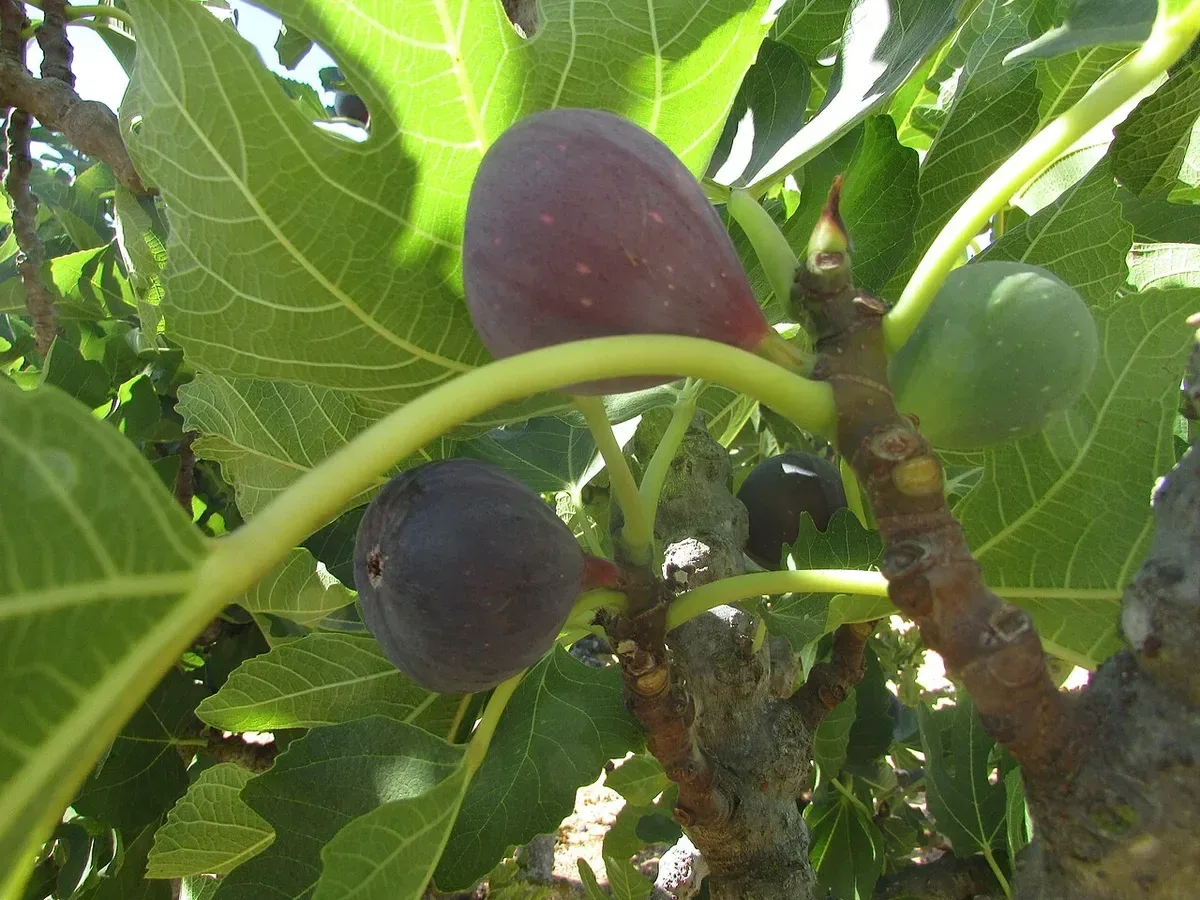
| ☀️ Light | Full sun |
|---|---|
| 💧 Water | Moderate (lightly moist) |
| 🪴 Soil | Well-drained loam rich in organic matter; avoid waterlogged ground |
| 🌡️ Temp | -12°C – 42°C |
| 🐾 Safety | Cats: toxic · Dogs: toxic |
| 📏 Mature size | 4.5 m |
Where It Grows & Climate Tolerance
Pet & Companion Animal Toxicity (How to Grow Fig (Anjeer) in India)
Anjeer grows best in the dry, mild Deccan, where Purandar near Pune is the best-known fig area with a GI tag since 2016. It also does well in large pots on sunny terraces across peninsular and western India.
Care instructions
Care Guide & Maintenance Routine
Choose the sunniest spot and a well-drained soil or a 45 to 50 cm pot. Water evenly in the dry months and stop extra water in the monsoon. Prune to set the cropping season: IIHR pruned previous season's shoots back to six basal buds in September. Net ripening fruit against birds and bats.
Light & Sunlight
NC State lists full sun to partial shade, but fruit ripens best in full sun. The RHS advises a warm, sunny, sheltered spot, ideally against a south- or south-west-facing wall in cooler climates.
Watering Schedule
Keep soil evenly moist while fruit is developing; NC State advises mulching to hold moisture. Irregular watering, followed by heavy watering, can split ripening fruit. Pots dry out quickly in summer.
Potting Mix & Drainage
Well-drained loam rich in organic matter; avoid waterlogged ground
Temperature & Humidity
Grows well with hot days up to about 40 to 42°C if watered. In the North Indian plains, young trees can be damaged by frost in late December and January; cover them on cold nights. Long, humid monsoon weeks cause more trouble than heat.
Anjeer in India
Most Indians know anjeer as the dried fruit in sweet shops, but fresh figs are grown commercially in parts of Maharashtra and Karnataka. Purandar taluka near Pune is the best-known area. According to Village Square, commercial cultivation started there in 1904 at Jadhavwadi in Dive village, and around 600 hectares are now grown. Purandar Fig received a geographical indication (GI) tag in 2016, recorded in the IP India GI registry.
Which regions suit it
- Western and Southern Plateau (Pune, Satara, Ahmednagar, Bengaluru, Bellary): mild, dry weather suits figs best and allows two crops a year.
- Gujarat and Rajasthan: heat is no problem if roots are well watered and mulched; dry air keeps fruit sound.
- North Indian plains: trees drop their leaves in the cold months and fruit once in summer. Shelter young plants from December and January frost.
- Heavy-rain coasts (Konkan, Kerala, Bengal, North-East): long monsoons bring rust and fruit rot. Grow in a raised bed or pot under some cover.
Pruning sets the season
In the semi-arid tropics, figs keep growing all year, so growers prune to decide when fruit comes. An ICAR-IIHR trial at Bengaluru with the varieties Poona and Deanna trained trees to an open-centre frame and pruned the previous season's shoots back to the basal six nodes each September. High-density planting under that system raised early yields. Farmers in Purandar get two harvests; Village Square reports that the rainy-season fruit is less sweet, while the spring-summer harvest is the best quality.
Terrace and balcony figs
A fig in a 45 to 50 cm drum or grow bag does well on a sunny terrace in Pune, Hyderabad, Bengaluru, Ahmedabad or Delhi. Use garden soil mixed with compost and coarse sand. Stand the pot on bricks during the rains so it drains freely.
Water by season
From February to May, water deeply every two or three days in pots, weekly for trees in the ground. During the monsoon, give no extra water unless there is a long break. A sudden soaking after a dry spell often splits ripe fruit.
Birds, bats and wasps
Ripe figs attract bulbuls, parakeets, crows and fruit bats. Bag individual fruits in cloth or mesh bags, or net the whole tree.
Common problems in India
Fig rust shows as orange-brown spots under leaves during humid months. Stem borer and scale may attack older trees; ask your local KVK for an approved control before spraying anything.
Drying a few at home
Ripe figs from a home tree can be halved and sun-dried on a clean cloth under a mesh cover for a few days in the dry, hot weeks of March to May, like the dried anjeer sold in markets. Store them in an airtight jar once fully dry.
Handling the sap
Wear gloves and full sleeves while pruning, especially in strong sun, because the sap irritates skin.
Seasonal rhythm
Seasonal Calendar
| Month | Care Tasks | Seasonal Focus |
|---|---|---|
| Jan | Protect from frost/heat | North: dormant; cover young trees on frosty nights. Deccan: fruit developing; water evenly. |
| Feb | Plant out, Harvest | Plant new trees in the North. Deccan: summer crop starts to ripen. |
| Mar | Harvest | Deccan: picking season; bag fruit against birds. Water pots every two or three days. |
| Apr | Harvest | Peak heat: water deeply and mulch. North: fruit swelling. |
| May | Prune, Harvest | North: ripe figs. Some Deccan growers prune now for a rainy-season crop. |
| Jun | Protect from frost/heat | Raise pots on bricks before monsoon onset (IMD: Mumbai 11 June, Pune 10 June). |
| Jul | Protect from frost/heat | Monsoon: no extra water; watch for rust spots under leaves. |
| Aug | Harvest, Protect from frost/heat | Rainy-season fruit is less sweet; pick before it rots. |
| Sep | Prune | Deccan: prune previous season's shoots to six basal buds (IIHR) for the main crop. |
| Oct | Fertilize | Mulch with compost after pruning. Take hardwood cuttings in the North after leaf drop begins. |
| Nov | Protect from frost/heat | New shoots and fruitlets forming in the Deccan. Check for scale. |
| Dec | Plant out, Prune | North: light pruning on dormant trees; take cuttings. |
Diagnostics
Common Problems & Troubleshooting
Fruit dropping while small from dry soil or poor light; lots of leaves and little fruit from rich soil or unrestricted roots; split fruit after heavy rain; rust spots on leaves in humid weather; frost-killed shoot tips.
Pests & seasonal watch: Fig rust in the monsoon; scale insects and mealybugs on stems; stem borer on older trees; birds, fruit bats and wasps on ripe fruit. Get any chemical control from your local KVK or state agricultural university.
- Yellow leaves — Leaves fade from green to yellow, often starting at the bottom.
- Root rot — Roots turn brown and mushy in soil that stays wet.
- Mealybugs — White cottony clumps in leaf joints, often with sticky honeydew.
- Spider mites — Fine webbing and pale speckled leaves, worse in dry heated rooms.
- Scale — Hard or soft brown bumps stuck to stems and leaf ribs, often with sticky honeydew.
- Aphids — Clusters of small soft insects on new tips, often sticky.
- Leaf spot — Brown or tan spots with a yellow halo, sometimes with tiny dots in the centre.
- Underwatering — Soil is bone dry and leaves are crispy, curled or dull.
- Leaf drop — Many leaves fall in a short time, sometimes still green.
- Cold damage — Dark, water-soaked or blackened patches after a cold night or an AC blast.
Q&A
Frequently Asked Questions
Does a fig tree need a pollinator?
Common figs, which include most garden varieties, set fruit without pollination. NC State notes that in North America the fruit forms without any pollination, and the RHS calls the fruit parthenocarpic.
How do I know when a fig is ripe?
It softens, droops on its stalk, changes to its full colour and may split slightly at the base. Unripe figs do not ripen well once picked.
Why is my fig dropping small fruit?
Often dry soil, sudden heavy watering, poor light or a very young tree. In cool climates, the RHS says small second-crop figs left at the end of summer will not ripen.
Is fig sap harmful?
Yes, it can irritate skin, and NC State notes the reaction can worsen in sunlight. Wear gloves and long sleeves when pruning or picking.
Can I grow a fig in a pot?
Yes. The RHS says figs crop well in containers, and the pot restricts roots, which helps fruiting. Pots can also be moved under cover in winter.
When should I prune a fig?
Do the main pruning when the tree is dormant, then pinch new shoots in early summer. Light pruning keeps it compact and fruiting.
Is a fig tree safe for pets?
Treat it as unsafe. NC State flags common fig as a problem for pets and notes the sap is irritating.
Is the common fig related to the fiddle-leaf fig?
They are in the same genus, Ficus, but are different species. Fiddle-leaf and weeping figs are grown as houseplants and do not produce edible fruit indoors.
Why does my fig have lots of leaves but no fruit?
Usually rich soil, too much nitrogen or roots with unlimited space. The RHS recommends restricting roots to curb leafy growth.
Similar Botanical Matches
Keep exploring
Related plants
Grower field notes
Reader Field Notes in India
Share how this plant performs in your local India climate.