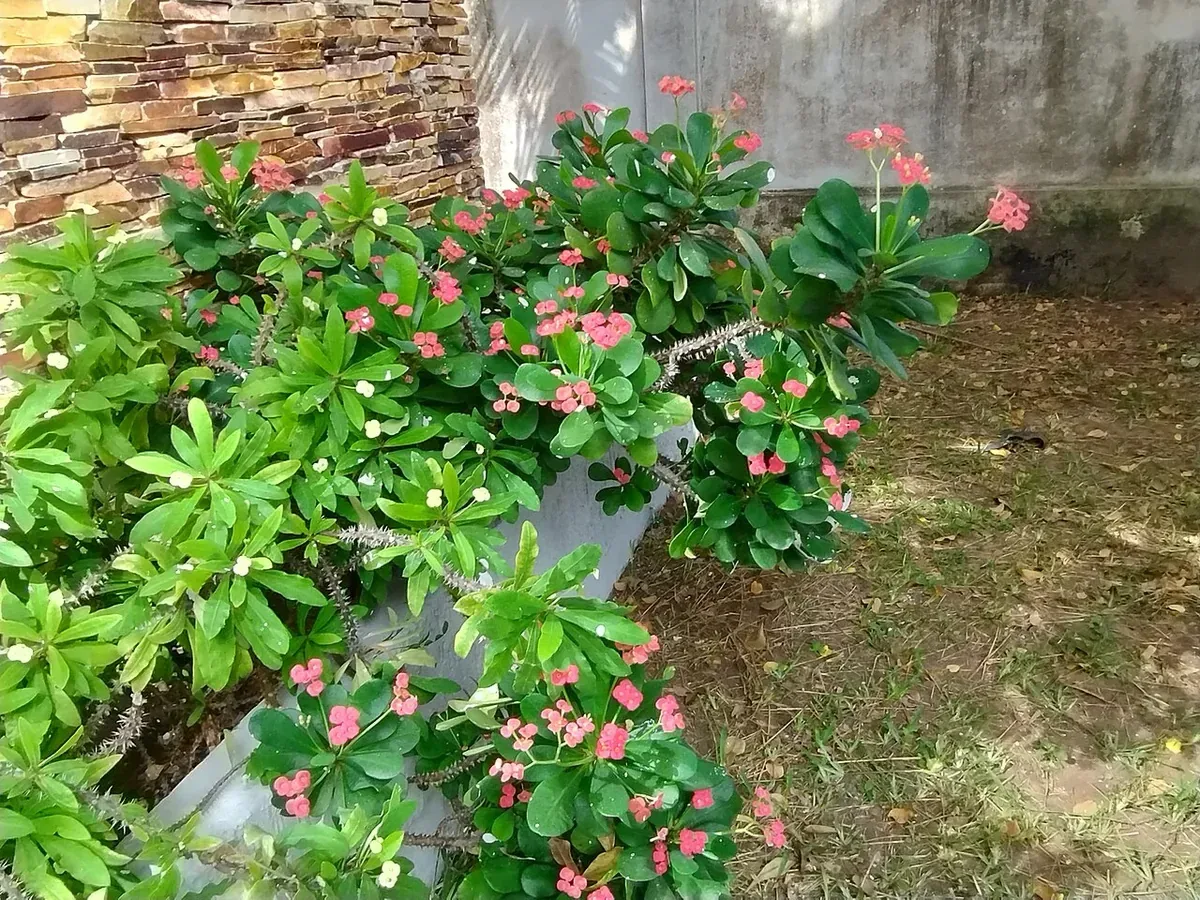
| ☀️ Light | Full sun |
|---|---|
| 💧 Water | Low (allow soil to dry) |
| 🪴 Soil | Gritty, fast-draining cactus or loam-based mix with extra grit or perlite |
| 🌡️ Temp | 5°C – 38°C |
| 🐾 Safety | Cats: toxic · Dogs: toxic |
| 📏 Mature size | 60 cm |
Where It Grows & Climate Tolerance
Pet & Companion Animal Toxicity (Crown of Thorns Care in India)
Crown of thorns is one of the toughest flowering pots for a sunny Indian terrace or balcony, blooming through most of the year from Ahmedabad to Chennai. It hates two things: soggy monsoon soil and cold, wet pots on a Punjab winter night. Wear gloves; the sap burns.
Care instructions
Care Guide & Maintenance Routine
Full sun on a terrace or south- or west-facing balcony. Water deeply only when the mix is dry. Monsoon: under a roof, raised on bricks, no feeding in long wet spells. North India: dry and sheltered in December and January. Hills: a sunny indoor sill in winter.
Light & Sunlight
NC State Extension and Wisconsin Horticulture both say it does best in full, direct sun. It grows in part shade but flowers less. In very hot summers outdoors, NC State suggests midday shade for better blooming. Acclimatise indoor plants slowly before putting them in full outdoor sun.
Watering Schedule
Wisconsin Horticulture says the species does best when the soil dries between deep waterings. Some large-leaved hybrids prefer more frequent watering. Water sparingly in the cool, resting season.
Potting Mix & Drainage
Gritty, fast-draining cactus or loam-based mix with extra grit or perlite
Temperature & Humidity
NC State and Wisconsin say it survives to about 2°C but dislikes cold, wet soil. Clear December and January nights in Punjab, Haryana and Rajasthan can come close, so keep pots dry and sheltered. Heat is not the problem; NC State suggests midday shade in very hot climates for better flowering.
Crown of thorns on Indian terraces
Walk past a row of terrace pots in Jaipur, Indore or Hyderabad and you will usually spot crown of thorns, flowering in red, pink, cream or yellow with hardly any attention. It suits Indian homes because it likes heat and strong sun and does not mind a missed watering. Indian nurseries sell it as crown of thorns, Christ plant or just "Euphorbia", and the large-flowered kinds are labelled Thai hybrids.
Buying
City nurseries, roadside stalls on Delhi's ring roads and online plant stores all sell it, usually in black plastic pots. Thai hybrids carry chunkier stems and fist-sized bract clusters; they cost more and appreciate slightly more frequent watering. Pick a plant with firm stems, no black or soft patches at the base, and buds at the tips. Carry it home wrapped in newspaper, because the spines catch on everything.
Region by region
- Rajasthan, Gujarat, MP, Vidarbha: ideal. Full sun most of the year; in May, when afternoons pass 40°C, a little midday shade helps flowering, as NC State suggests for hot climates.
- Delhi NCR, Punjab, Haryana, UP: flowers from February to June and again after the rains. In December and January, keep pots dry and against a warm wall; cold and wet together cause rot and leaf drop.
- Bengaluru, Hyderabad, Chennai: flowers almost all year in full sun.
- Kerala, Goa, Konkan, coastal Bengal: the monsoon is the problem. Grow it under a roof or a polycarbonate shade from June to September.
- Shimla, Mussoorie, Darjeeling: outdoors from April to October, then a sunny indoor sill.
Monsoon care
IMD's normal monsoon onset is about 1 June in Kochi, 11 June in Mumbai and 27 June in Delhi, with withdrawal from Delhi around 25 September and from Mumbai around 8 October. During those weeks, move pots under a chhajja or covered balcony, raise them on bricks and water only when the mix is dry. Skip feeding in long wet spells. Check stem bases every week for dark, soft patches.
Summer: loo and coastal heat
It handles the dry North Indian summer better than almost any other flowering pot. On the coast, humid heat brings fungal leaf spots if pots are crowded; space them out.
Terrace, grill ledge or drawing room?
Treat it as an open-air pot. Inside a typical 2BHK, even beside a sliding window, bracts fade within weeks. South- or west-facing balconies, a rooftop chhat, or the ledge outside a kitchen grill all work. Keep thorny pots away from the stairwell door and drying-line, where someone brushes past daily.
Spotting pests and rot
- Mealybugs: white cotton between spines and under leaves; use a torch and an old toothbrush to check.
- Stem rot: stems turn soft, dark and shrunken from the soil line in July and August.
- Leaf spot: brown or black spots after long wet spells.
- Thrips: silvery streaks on leaves and deformed flowers.
Kids, pets and the terrace
Indian terraces double as play areas, drying spaces for papad and achaar, and kite-flying decks on Makar Sankranti and Independence Day. Park the pots in a corner, not along the parapet where a kite string or a child's hand can snag. The white latex stings skin and eyes, so prune in kitchen gloves and wash the knife at the outdoor tap rather than in the sink.
Reader questions
- Bare stems in a Delhi or Amritsar January? Seasonal rest; fresh foliage returns by Basant Panchami if pots stayed dry.
- Some vastu advice discourages thorny plants indoors; should I avoid it? That is a cultural choice. Horticulturally, it belongs outdoors in sun anyway.
- Can it share a pot with adenium or portulaca? It can sit beside them on a sunny ledge, since all three like drying out, but give each its own pot.
Seasonal rhythm
Seasonal Calendar
| Month | Care Tasks | Seasonal Focus |
|---|---|---|
| Jan | protect | Ludhiana, Jaipur, Lucknow: pots dry and hugging a warm wall on foggy nights; some leaf drop is normal. Chennai, Kochi: in bloom. Shimla: sunny indoor sill. |
| Feb | prune | After Basant Panchami: new shoots in the North; shape with gloves on. Bengaluru and Hyderabad: steady flowers. |
| Mar | feed, repot | Before Holi: repot root-bound pots, start light feeding. Delhi terraces burst into bloom. |
| Apr | prune | Cuttings root fast everywhere. Rajasthan: water more as heat climbs. Mussoorie: back onto the balcony. |
| May | protect | Loo over Barmer, Nagpur and Banda: a little midday shade, deep soak when dry. Coimb |
| Jun | protect | Kerala and Konkan rains begin: shift pots under the chhajja. Delhi: still scorching. |
| Jul | protect | Monsoon everywhere: water only when bone dry, pots up on bricks, no feeding. |
| Aug | protect | Wettest weeks in Mumbai and Guwahati: press stem bases; cut out soft, dark rot. |
| Sep | prune | Rains withdraw from Delhi around 25 September: tidy shape. Kolkata: still muggy. |
| Oct | prune | Dussehra to Diwali: cuttings and a second flush of bracts. |
| Nov | protect | North: nights cool, water less, no fertilizer. Tamil Nadu's northeast monsoon: pots under cover. |
| Dec | protect | Punjab and UP fog, Kashmir and Himachal frost: dry and sheltered, indoors in the hills. Kerala: flowering in sun. |
Diagnostics
Common Problems & Troubleshooting
Leaf drop in the cool season is normal before rest; yellowing and soft, dark stems from cold, wet soil; few flowers from low light or too much nitrogen; leaf spots after long wet spells.
Pests & seasonal watch: Mealybugs in the dry months, often hidden between spines. Root and stem rot and leaf spot in the monsoon. Scale and thrips now and then. Wear gloves when cutting out rotten parts.
- Yellow leaves — Leaves fade from green to yellow, often starting at the bottom.
- Root rot — Roots turn brown and mushy in soil that stays wet.
- Mealybugs — White cottony clumps in leaf joints, often with sticky honeydew.
- Spider mites — Fine webbing and pale speckled leaves, worse in dry heated rooms.
- Scale — Hard or soft brown bumps stuck to stems and leaf ribs, often with sticky honeydew.
- Thrips — Silvery streaks and twisted new leaves, sometimes with black specks of frass.
- Leaf spot — Brown or tan spots with a yellow halo, sometimes with tiny dots in the centre.
- Grey mould — Fuzzy grey mould on faded flowers, damaged leaves or soft stems.
- Overwatering — Soil stays wet, leaves yellow or droop, and the pot feels heavy.
- Leaf drop — Many leaves fall in a short time, sometimes still green.
- Cold damage — Dark, water-soaked or blackened patches after a cold night or an AC blast.
- Stem rot — The stem goes soft, dark or black at soil level and the top collapses.
Q&A
Frequently Asked Questions
Is crown of thorns poisonous?
Yes. NC State says the milky sap in all parts can cause skin irritation, can damage the eyes and causes blistering in the mouth if eaten. Keep it away from children and pets.
Why is my crown of thorns dropping leaves?
Some leaf drop before the cool, resting season is normal, according to NC State. Sudden drop with soft stems points to cold, wet soil.
How often should I water crown of thorns?
Water deeply, then wait until the mix is dry before watering again. In cool weather water much less.
Why is my crown of thorns not flowering?
Usually not enough direct sun or too much nitrogen fertiliser. Move it to the sunniest spot and feed lightly.
Can crown of thorns grow indoors?
Yes, in a sunny window. Wisconsin Horticulture notes it handles low humidity and heated homes well.
How cold can crown of thorns tolerate?
NC State and Wisconsin say it survives to about 2°C, but cold, wet soil causes rot. Keep it warmer and dry in winter.
What do I do if sap gets on my skin or in my eyes?
Wash skin with plenty of water. If sap gets in the eyes, rinse well and get medical advice, since NC State warns it can damage the cornea.
How do I prune crown of thorns?
Wear gloves and eye protection, use a knife, cut back to side buds or remove weak branches at the base, in spring or summer.
Similar Botanical Matches
Grower field notes
Reader Field Notes in India
Share how this plant performs in your local India climate.