
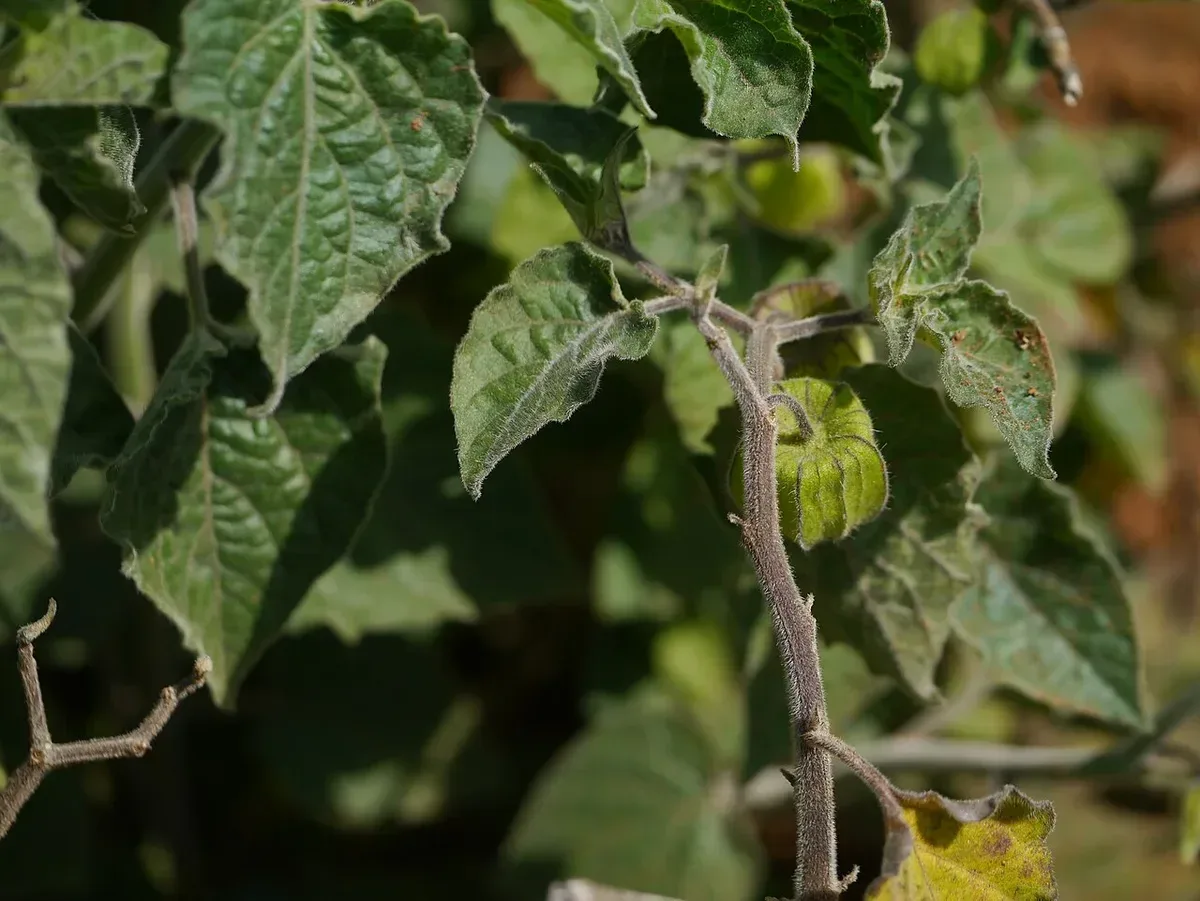
| ☀️ Light | Full sun |
|---|---|
| 💧 Water | Moderate (lightly moist) |
| 🪴 Soil | Well-drained loam or sandy soil of medium to low fertility |
| 🌡️ Temp | 1°C – 32°C |
| 🐾 Safety | Cats: toxic · Dogs: toxic |
| 📏 Mature size | 1.0 m |
Where It Grows & Climate Tolerance
Pet & Companion Animal Toxicity (How to Grow Cape Gooseberry (Rasbhari) in India)
Rasbhari is a winter fruit in North India. In Punjab's kitchen-garden calendar, published in ICAR's Indian Horticulture, it fruits in March, and the recommended varieties are Punjab Rasbhari 1 and 2. In the southern hills it grows almost wild and fruits for much of the year.
Care instructions
Care Guide & Maintenance Routine
On the northern plains, sow in trays in August or September and transplant in September or October, about 75 by 60 cm apart. Use well-drained mitti without heavy khad. Stake plants, cover them on frosty nights in December and January, and pick fruit from February to April as husks turn papery.
Light & Sunlight
The RHS and NC State both call for a sunny position. Fruit set and sweetness drop in shade.
Watering Schedule
Water regularly while plants establish. The University of Arkansas Extension warns that too much water, like heavy feeding, encourages leafy growth and delays flowering. Once plants are fruiting, water when the top few centimetres are dry.
Potting Mix & Drainage
Well-drained loam or sandy soil of medium to low fertility
Temperature & Humidity
Not frost hardy. Frost on the Punjab, Haryana and western UP plains in late December and January damages leaves and young plants unless covered. Heat above about 35°C in May ends fruiting.
Rasbhari in Indian gardens
Rasbhari has long been sold in husks at winter fruit carts in Punjab, Delhi and Uttar Pradesh, and in Kerala and Karnataka the plant grows wild along hill paths. An ICAR article from ICAR-DWR Jabalpur describes it as a profitable crop for small farmers.
PAU recommendations
Writing in ICAR's Indian Horticulture (Sept-Oct 2025), PAU authors list Punjab Rasbhari 1 and Punjab Rasbhari 2 as the recommended varieties, planted 0.75 by 0.60 m apart, and show cape gooseberry fruiting in March in a home fruit garden. They suggest growing it between the rows of young fruit trees and note it suits terrace gardens.
Timing on the northern plains
- August to September: sow in trays under shelter from heavy rain.
- September to October: transplant once the rains ease. IMD's normal monsoon withdrawal from Delhi is around 25 September.
- November to January: plants flower and set fruit. Cover with a sheet or straw on nights with frost warnings.
- February to April: main picking. Fruiting ends as May heat builds.
Other regions
- Bengaluru, Pune, Hyderabad: sow after the rains; fruits from winter into spring.
- Nilgiris, Kodaikanal, Coorg, Munnar: often perennial, fruiting much of the year.
- Kolkata and Bihar: a winter crop like on the northern plains, with less frost risk.
- Mumbai, Chennai, Kochi lowlands: grows, but fruits poorly in humid heat; try a winter crop.
- Himachal and Uttarakhand mid-hills: plant in spring after frost; fruit in summer and autumn.
Seed and saving your own
Squeeze the pulp of a few fully ripe berries into water, leave it for a day, then rinse and dry the seeds on a plate in the shade. Store them in a paper envelope until August. Seedlings from local market fruit are often well suited to your climate.
Using the harvest
Eat rasbhari fresh with a pinch of kala namak, cook it into a tangy chutney with jaggery, or mix it into fruit chaat. Husked fruit keeps for weeks in a cool corner of the kitchen.
Mitti and khad
Do not over-enrich. Ordinary garden mitti with a little compost is enough. Heavy gobar khad gives a giant bush with few berries.
In a gamla on the terrace
Use a 14 to 16 inch gamla or a grow bag, one plant each, with a stake. Terrace pots dry fast in March; water in the morning.
Frost on the plains
Late December and January frosts in Punjab and Haryana burn leaves and can kill young plants. A temporary cover of old sheets or a straw thatch on cold nights is enough.
Questions from Indian growers
- Is it safe for children? Only the ripe, golden berry is edible. NC State notes the rest of the plant and green fruit contain solanine.
Seasonal rhythm
Seasonal Calendar
| Month | Care Tasks | Seasonal Focus |
|---|---|---|
| Jan | Harvest, Protect from frost/heat | North: cover on frosty nights; first ripe husks. Hills: steady picking. |
| Feb | Harvest | Pick fruit as husks turn papery and straw-coloured. |
| Mar | Harvest | Main harvest in Punjab, as ICAR's calendar shows. |
| Apr | Harvest | Last pickings; save seed from the best berries. |
| May | Protect from frost/heat | Plains: heat ends fruiting. Remove old plants. |
| Jun | Protect from frost/heat | Mid-hills: water and stake summer plants. |
| Jul | Protect from frost/heat | Prepare seedling trays under shelter. |
| Aug | Sow | Sow seed in trays, sheltered from heavy rain. |
| Sep | Sow, Plant out | Prick out seedlings. Transplant as rains end. |
| Oct | Plant out | Main transplanting on the plains; stake at once. |
| Nov | Protect from frost/heat | Flowering begins. Water sparingly; no heavy khad. |
| Dec | Protect from frost/heat | Fruit setting. Keep sheets ready for frost. |
Diagnostics
Common Problems & Troubleshooting
Lots of leaves but little fruit in rich soil or with heavy watering; floppy stems without support; fruit splitting after heavy rain; frost kill; seedlings collapsing in wet, cold mix.
Pests & seasonal watch: Whitefly and aphids on winter crops. Fruit borer caterpillars in some seasons. Damping off of seedlings in wet August and September. Ask the local KVK before spraying a fruit crop.
- Drooping — Stems and leaves hang limp even though the plant was recently fine.
- Spider mites — Fine webbing and pale speckled leaves, worse in dry heated rooms.
- Aphids — Clusters of small soft insects on new tips, often sticky.
- Whitefly — Tiny white insects fly up in a cloud when you touch the plant.
- Leaf spot — Brown or tan spots with a yellow halo, sometimes with tiny dots in the centre.
- Overwatering — Soil stays wet, leaves yellow or droop, and the pot feels heavy.
- Cold damage — Dark, water-soaked or blackened patches after a cold night or an AC blast.
Q&A
Frequently Asked Questions
How do I know when cape gooseberries are ripe?
The husk turns from green to dry, papery and straw-coloured, and the berry inside is golden orange. Ripe fruit often drops to the ground in its husk.
Is it safe to eat unripe fruit?
No. NC State warns that in Physalis all parts except the ripe fruit are toxic because of solanine. Eat only fully ripe, golden berries.
Why is my plant all leaves and no fruit?
Rich soil or too much water. The University of Arkansas Extension notes heavy fertilisation and too much water encourage leafy growth and delay flowering.
How long until it fruits?
The University of Arkansas Extension says plants set out as transplants begin fruiting in about 70 to 80 days and keep producing while they grow.
Does it need support?
Yes. The RHS advises supporting the lax branches. A cage or a few stakes and string keep stems and fruit off the ground.
Can I grow it in a pot?
Yes, in a container at least 30 cm wide and deep. ICAR notes cape gooseberry is one of the fruit crops suitable for terrace gardens.
Is it the same as a ground cherry?
They are related Physalis species. Ground cherries are smaller, lower plants with smaller fruit; cape gooseberry is taller with larger, tangier berries.
How long do the berries keep?
Left in their husks, they store well. The University of Arkansas Extension notes husked fruit can keep for several months, which is why it travelled well on sea voyages.
Is it safe for pets?
No ASPCA entry exists, but NC State lists Physalis plants as toxic except for the ripe fruit and as a problem for horses. Keep pets away.
Similar Botanical Matches
Keep exploring
Related plants
Grower field notes
Reader Field Notes in India
Share how this plant performs in your local India climate.