
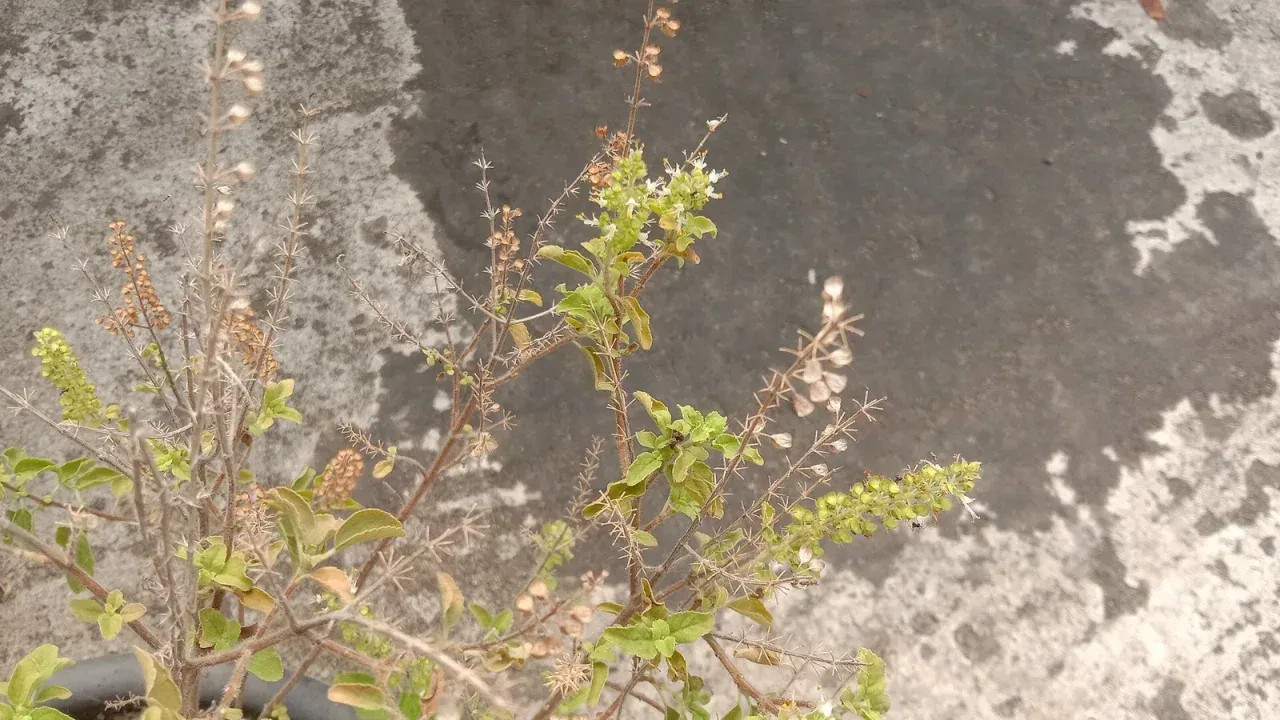
A tulsi plant that was thick and green in October can look dry, thin and brown by late December. In most of North India this is the cold at work. Tulsi is a tropical plant, and it handles cold worse than heat, drought or heavy rain. The good news is that a drying tulsi is often still alive at the base and can be brought back if you change a few things now.
This guide explains why tulsi dries in winter, how to check whether your plant can recover, and what to do in each region.

Why tulsi dries up in winter
1. Cold nights and frost
Cold is the main cause in North India and the hills. Scientists at CSIR-CIMAP, Lucknow tested holy basil (Ocimum tenuiflorum) under cold, drought, flooding and salt stress, and found it was most sensitive to cold; in their trial, plants died if the cold treatment ran longer than 72 hours. The Royal Horticultural Society gives tulsi its H1C hardiness rating, which means it needs a minimum of about 5 to 10°C. Nights in Delhi, Punjab, Haryana, UP, Bihar and Rajasthan often drop below that from mid December to mid January, and ground frost (pala) can blacken the leaves overnight.
2. Cold, wet soil
In winter, tulsi drinks much less. If you keep watering on the summer routine, the soil stays cold and wet, roots start to rot, and the plant dries from the top even though the pot is damp. This is common with pots that sit on a cold floor or in a tulsi chaura that does not drain.
3. Too many flowers and seeds (manjari)
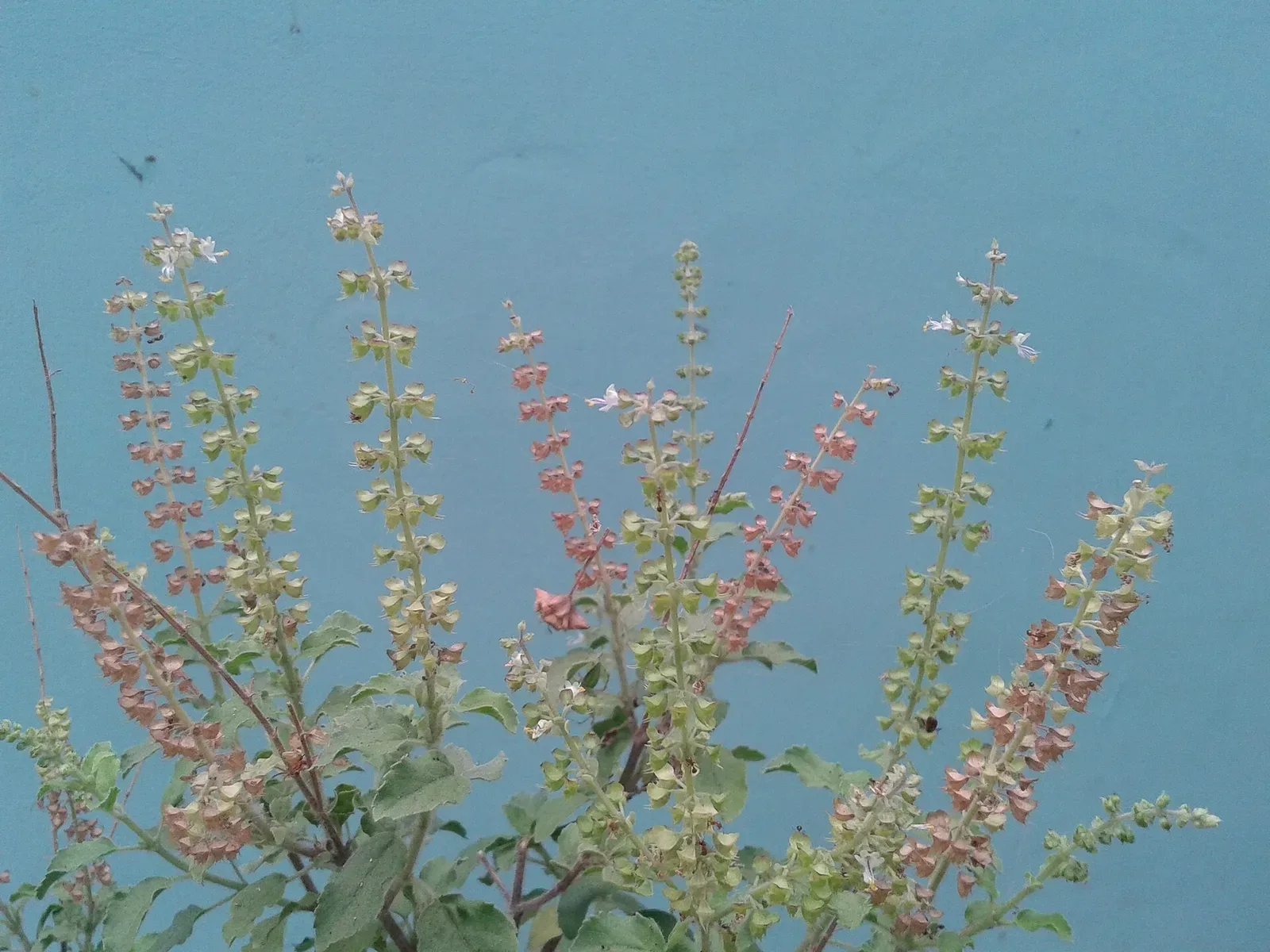
Tulsi flowers heavily in the cool months. Each spike of manjari turns into seeds, and a plant covered in seed spikes puts its energy there instead of into new leaves. The stems turn woody and the plant looks thin. The RHS advises pinching out flower heads to keep leaf growth going.

4. Age
Tulsi is a short-lived plant. The RHS describes it as an annual or biennial that matures in one to two years. An old plant with thick, woody stems and few leaves may simply be at the end of its life. Seedlings that come up around it, or a fresh plant from seed, are the natural replacement.
5. Less sun
Winter sun is low, and a spot that got full sun in May may now be in shade all day. Tulsi needs full sun, especially in winter, to keep its leaves.
6. Pests
Aphids and mealybugs can still build up on soft shoots. Check the undersides of leaves and the stem tips. Our tulsi leggy growth and aphids guide covers this.
Is my tulsi dead or alive? A quick check
Do not judge by the leaves alone. Dry leaves can come from cold, root rot or simple old age, and they look much the same. Check these three things:
- Scratch test: gently scratch the bark of a main stem near the base with a fingernail. Green and moist underneath means that part is alive. Brown and dry means it is dead. Test a few stems, working down from the top.
- Bend test: living twigs bend. Dead twigs snap.
- Root check: if the soil smells sour or stays wet for days, ease the plant out of the pot. Healthy roots are pale and firm. Rotten roots are dark and mushy and come apart when touched.
If the base is green, the plant can usually recover by March. If the whole stem is brown and dry down to the soil and the roots have rotted, start again with a new plant or seeds.
How to save a drying tulsi in winter
Move it to the warmest, sunniest spot
- Put the pot where it gets the most direct sun, usually against a south-facing wall. The wall also gives back heat at night.
- Lift the pot off a cold floor with a brick or a stand.
- Keep it out of cold wind, such as an open terrace corner or a gap between buildings.
- On very cold nights in the north, a potted tulsi can come inside near a bright window, then go back out in the morning sun.
Cover it on cold nights
The India Meteorological Department's cold wave advice for farmers recommends covering young plants with straw, polythene sheets or gunny bags. For a tulsi pot, drape an old cotton cloth, a jute bag or a sheet over a few sticks in the evening so it does not press on the leaves. Remove it in the morning so the plant gets sun and air.
Water less, and at the right time
- Water only when the top 2 to 3 cm of soil is dry. In peak winter this may be once every several days, not daily.
- Water in the late morning, never in the evening, so the soil is not wet and cold overnight.
- Use water at room temperature, not straight from a cold overhead tank.
- Make sure the pot drains. Empty any saucer that collects water.
Pinch the manjari
Pinch off most flower spikes as they appear. Leave a few on a healthy plant if you want seeds for next season. Dry them, rub out the tiny black seeds and store them in a paper packet.
Do not feed, repot or prune hard now
- Feeding: IMD advises against applying nutrients during cold weather, because roots take up very little. Wait until February.
- Repotting: moving roots in the cold adds stress. Repot only if roots are rotting and the pot is waterlogged.
- Pruning: remove only clearly dead tips now. IMD suggests cutting back cold-damaged parts at the end of February or in early March, when new growth is about to start. That is the time to trim tulsi back to green wood.
Mulch the surface
A thin layer of dry leaves or straw over the soil keeps the roots a little warmer. Keep it a finger's width away from the stem so the stem does not stay damp.
Region-wise winter care for tulsi
- North Indian plains (Punjab to Bihar, Rajasthan, MP): the highest risk, from about mid December to the end of January. Follow every step above, especially covering on cold nights and cutting back watering.
- Hills: tulsi does not survive outdoor winters in most hill towns. Grow it in a pot and keep it indoors in the brightest window from November to March, or treat it as a seasonal plant and sow fresh in spring.
- South India and the coasts (Chennai, Bengaluru, Hyderabad, Mumbai, Kerala): winter cold is rarely the cause. If tulsi dries here, look at overwatering, poor drainage during the northeast monsoon, heavy flowering, pests or the plant's age.
- East and Northeast plains: nights can be cold in January. Move pots to sunny, sheltered spots and water less.
Starting new tulsi plants
Tulsi seed needs warmth to sprout. In the north, sow seeds from about March onwards, when nights warm up. Tulsi also roots from soft stem cuttings in warm, humid weather. If you collected seeds this winter, keep them dry until spring. See our tulsi sun, water and harvest guide and the tulsi plant profile for year-round care.
Watch: reviving tulsi after a harsh winter

Related pages
- Plant care in winter in India
- Root rot
- Overwatering
- Cold draft damage
- Winter flowering plants for North India
Sources
- Rastogi S. et al. (CSIR-CIMAP), Ocimum metabolomics in response to abiotic stresses: cold, flood, drought and salinity, PLOS ONE, 2019
- Royal Horticultural Society, Ocimum tenuiflorum (holy basil) plant profile
- India Meteorological Department (Agromet), Dos and Don'ts for Cold Wave
Comments
No comments yet — share what worked in your climate.